“CREATING A SYSTEM OF MUTUAL SUPPORT FOR CHAPTERS!”
A Report of the January 8, 2024 Special Virtual Council Meeting!
A special meeting of the Pennsylvania Audubon Council took place on the evening of Monday, January 8, 2024. The program was an open forum for our chapter leaders to hear directly from several of the former Northeast Pennsylvania Audubon Society Board members in the wake of their decision to cease their operation as an Audubon chapter and an organization. They shared their unvarnished and straightforward assessment of their nearly two-year effort to keep the chapter afloat. The program provided an opportunity for the Pennsylvania Audubon Council to help follow up with ideas that came from the discussion that evening. Phil Witmer, Valley Forge Audubon, Tess Wilson, Audubon MidAtlantic, and Leigh Altadonna, Wyncote Audubon will follow-up with the ideas raised that evening. We welcome any others who would like to participate in this follow up effort. Contact Leigh Altadonna @ paauduboncouncil@gmail.com by Saturday, February 25, 2024 to be added to the follow-up group.
Another discussion topic centered on the communications by Audubon MidAtlantic to withdraw staff support for the Audubon Bird Habitat Recognition Program. A number of comments and ideas were shared during the discussion. Audubon MidAtlantic also promoted a forum that is scheduled for the near future to explore the future of the Bird Habitat Recognition Program. The January 8th program concluded with brief chapter updates on the “Audubon” name and some comments about the decision of AOS to address the common names of birds.
The January 8th Council Forum was recorded and is available on the Pennsylvania Audubon Council’s YouTube.
|
|
WHY A MUNICIPALITY SHOULD CONSIDER A UTILITY SCALE SOLAR ORDINANCE!
Report on the January 22nd Webinar Cohosted by WeConservePA and the Pennsylvania Audubon Council
Special thanks to Carolyn Grayshaw, WeConservePA and the Pennsylvania Audubon Council’s Renewable Energy Committee for an important and informative program on the need for municipalities to address “utility scale solar” in their ordinances and zoning codes. The webinar promoted the importance of these steps to ensure that utility scale solar projects are encouraged and enhanced with responsible guidelines for siting of these facilities. Properly sited utility scale solar projects are needed as part of the transition from carbon based energy generation for the benefit of birds, wildlife, and people!
Steve Nelson, AICP, provided a brief “civics 101” lesson on the limits of authority of state government and the importance of the authority vested at the municipal level. He noted that the majority of municipalities in Pennsylvania have no municipal planning codes in place whatsoever! Among those that do, utility scale solar is not yet included. He encouraged webinar participants to work with their municipalities to add utility scale solar to there zoning codes.
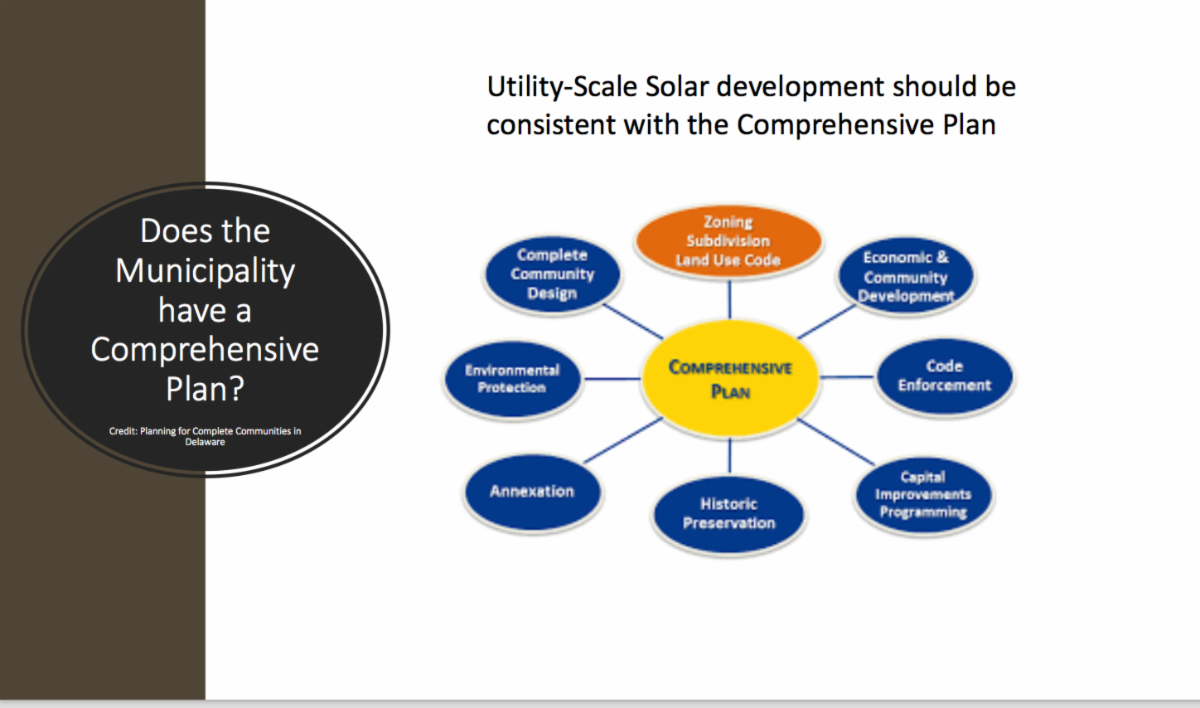
Tom Kuehl, Allegheny Plateau Audubon Society and Judy Stepenaskie, Wyncote Audubon Society presented a PowerPoint that noted the elements that should be addressed in a zoning ordinance. Laura Jackson, Juniata Valley Audubon Society, provided a brief walkthrough of the Commonwealth Court decision on the Brookview Solar Project in Adams County. This court opinion was strongly based on upholding the local ordinances. It demonstrated the critical importance of municipalities having local ordinances in place.
Thank you to those who were able to join us for the webinar, Why Municipalities Should Consider a Utility-Scale Solar Ordinance. WeConservePA is grateful to project partners the Pennsylvania Audubon Council and Bird Town Pennsylvania for their work in organizing this presentation. We are appreciative to our speakers, Tom Kuehl, Judy Stepenaskie, Laura Jackson, and Steve Nelson, for sharing their time and expertise, and to the members of the Pennsylvania Audubon Council’s renewable Energy Committee in researching and developing the recommendations and resources highlighted in the webinar.
|
|
CONSERVATION ALERTS
Brief Updates on Issues of Concern
|
|
SOLAR 4 SCHOOLS! (HB 1032)
The Pennsylvania Audubon Council continues to encourage chapters to actively support the Solar for Schools (HB 1032) legislation. It has been the focus of two of Conservation Alerts! We noted that the bill passed in the State House with broad bipartisan support. Last spring’s successful House Bill has moved to the State Senate where action is needed! The next steps are for the bill to be considered by the State Senate’s CERD Committee (Community, Economic and Recreational Development) and then move to the floor of the full Senate for consideration. It is important for our chapters to contact the State Senators who represent districts that are part of respective chapter territories. Reach out through the senatorial district offices with a phone call, email or other form of outreach to urge their support for Solar for Schools (HB 1032).
State Representative Fiedler’s office has created a webpage with information about the legislation: https://www.pahouse.com/Fiedler/Solar4Schools Included is a button for the Gen180 sign on where you can send a message of support directly to the State Senator who represents you! There is also a new “button” for school officials to indicate their interest and/or support for the bill. Contact your local school district leaders to use this link to demonstrate demand and interest for this program. School officials who fill out the form will be offered resources and a meeting and an opportunity to answer questions and learn more. We encourage those of you with connections to schools to make them aware of the link, the new federal funding for solar school projects, and the possibility of additional state funding through this bill.
Thanks for your continued support!
|
|
LIGHT POLLUTION AND RESPONSIBLE LIGHTING: (HB1803)
Our colleagues with the Pennsylvania Dark Skies Association alerted us to HB 1803 introduced on October 31, 2023 that addresses the issue of “light.” The bill has been referred to the House Committee on Environmental Resources and Energy. While this legislation was not specifically introduced in relation to the many “Lights Out” initiatives to protect night migrants, it will benefit these efforts as well as provide benefits for insects and other wildlife. In general, the proposed legislation seeks to minimize upward-directed light, glare and light trespass. It directs that building façade lighting be turned off or dimmed between 11 p.m. and 6 a.m. Provisions for street lighting, highway lighting and other exterior lighting is in the proposed legislation.
A copy of the legislation can be found here:
This legislation was introduced by Representative Chris Pielli and has a number of cosponsors. The Department of Government Services (DGS) intervened to review the legislation and has delayed a vote by the Committee on Environmental Resources and Energy. It is expected that a vote will take place in the near future and, if passed, it will move to a vote in the full house.
We continue to encourage our chapter leaders and members to reach out to the state representatives who represent any portion of their chapter territories. Reach out through their district offices with a phone call, email or other form of outreach to urge their support for (HB 1803).
Our friends from “Dark Skies” appreciate whatever support or encouragement you can provide!
|
|
COMMUNITY SOLAR ENERGY LEGISLATION
HB 1842
It is widely recognized that provisions for the expansion of community solar is sorely needed in Pennsylvania. House Bill 1842 makes provisions for the installation of solar arrays on small parcels of property. Small-scale community solar, properly sited and designed, is an important step for Pennsylvania. Similar programs, as supported in HB 1842, exist in twenty-two other states with small projects that can be developed by private owners, municipalities and institutions.
On February 14, 2024, the House Consumer Protection, Technology & Utilities Committee hosted an informational hearing about HB 1842, community solar legislation. The hearing focused on the bill jointly sponsored by Committee Chair Rob Matzie (D-Beaver) and Representative Pete Schweyer (D-Lehigh), and included expert testimony from clean energy developers, advocates, and organized labor representatives. The legislation would enable community solar projects that are accessible to all Pennsylvanians, regardless of their ability to install solar panels on their own roofs. Current Pennsylvania law prohibits shared residences, apartment buildings or shaded roofs from utilizing solar energy – one of the fastest growing and cheapest forms of energy nationally. The bill now requires a vote by the Committee, anticipated for March upon the House’s return to regular session and then considered for a full House vote.
Once an offsite project is operational, participants can subscribe to a portion of the energy generated and receive credit on their electricity bill for the power produced – the same process as if the panels were installed on their own home. As it now stands, low to moderate income families are unable to enjoy the benefits of solar energy because of the large upfront investments of the projects and because they may not own their home. Community Solar energy is valuable as the state modernizes its energy portfolio to include more renewable sources. It also provides pathways for solar on multi generational farmland, brownfields, and reclaimed mining lands. As is the case with utility scale solar projects, it is important that community solar projects are addressed in local zoning ordinances to ensure compliance with best practices.
Farmers could more aggressively benefit from the cost savings and extra income stream of solar without having to take farmland out of production. Some ground mounted solar arrays are now being developed as preserves for native plants and pollinators. Solar panels may be placed above crops to allow the land to have a dual-use: agriculture and solar.
Take time to contact the state representative(s) whose district is in all, or part of your chapter territory to support community solar.
|
|
BREEDING BIRD SURVEY ROUTES
The Breeding Bird Survey (BBS) Program Needs Volunteers!
Dan Brauning, PA State BBS Coordinator, is seeking a few skilled birders are needed to complete a survey one morning in June per year! Each year about 80 birders complete rigorous roadside surveys in Pennsylvania, which collected with the thousands completed across the continent, make up the most important long-term monitoring program for North American Birds. And each year, a few surveys become available for adoption. Several are available this year, mostly in the eastern half of the state.
A BBS route is comprised of 50 pre-established stops, at which all birds seen or heard in 3 minutes are documented. Routes are completed once annually in June. Ideally, a volunteer completes a route each year, starting at about 5:00am, and then conduct the survey for as many years as possible. More information about the methodology is available here: https://www.pwrc.usgs.gov/bbs/about/. This is a demanding survey, so we are looking for birders who can identify likely species by sight and sound!
As of this writing, survey routes are available in the following counties:
*2024 VACANT ROUTES*
Location/County of starting point
72038 Hop Bottom/S. Susquehanna, south
72084 Collegeville/Montgomery
72079 Carsonville/Dauphin
72059 Martinsburg/S. Blair
72177 Mt Gretna 2/Lebanon
72178 Brunnerville 2/N Lancaster
72166 Doylesburg/N Franklin – W Perry
Please contact Dan Brauning to see if a BBS route will be part of your birding activities.
PA State Coordinator
|
|
MANAGE YOUR EMAIL IN BOX
Be Sure to Receive Messages from the Council:
The Pennsylvania Audubon Council uses a Gmail address for many routine communications. Because Gmail uses a “.com” in its address, many recipients will find messages routed to a “junk” or “spam” folder. This can be avoided by a simple step as you manage your email at home or work. Simply add paauduboncouncil@gmail.com to your email mailbox and future messages will appear in your regular “inbox” of incoming emails.
|
|
|
|
|
|
|