|
How long have you worked for MWMC/City of Eugene, and how did you get your start?
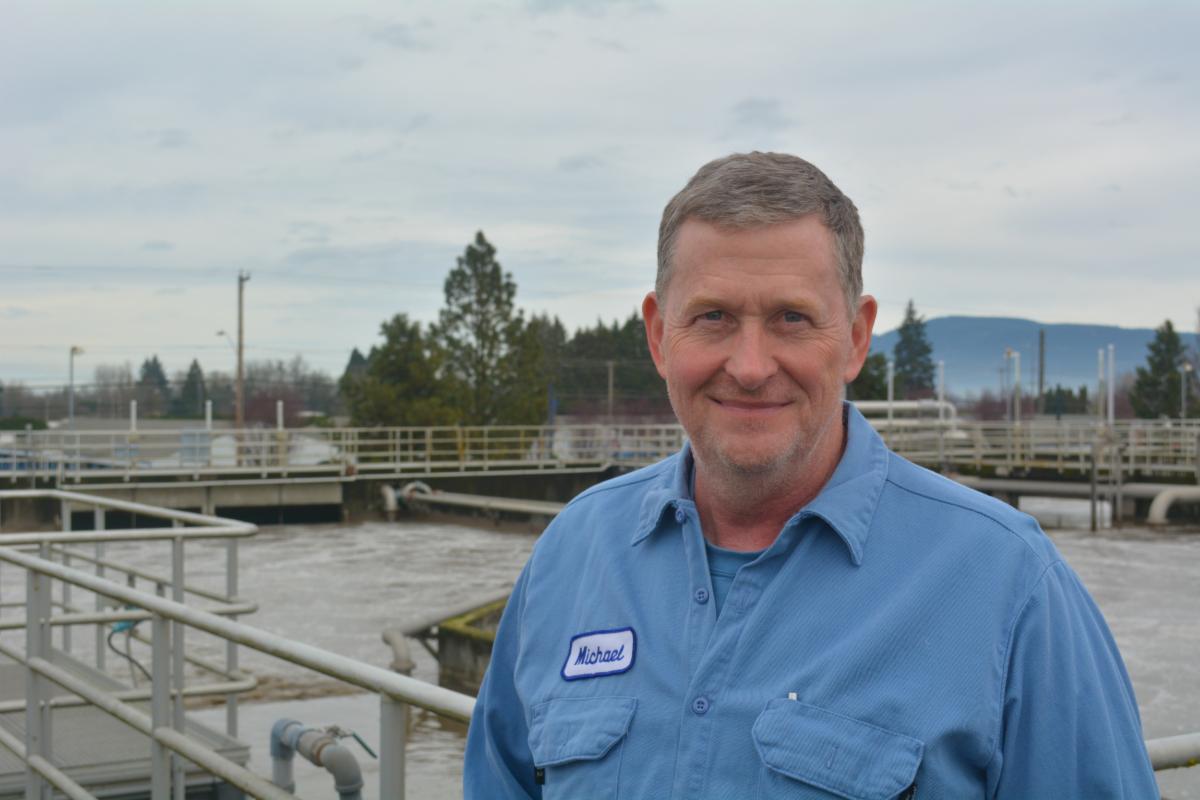
13 years. I started out at the Biosolids Management Facility (BMF) as an operator out there. I was out there 11 years and was just looking for more technical experience and a change, so I came into the plant job-shadowing. Also, during COVID they were short staffed, so I came in and backfilled, and then I transitioned in here when there was an open position.
How did you get into the wastewater industry?
I had small kids, and [my previous job] was very demanding, and I wasn’t getting to see my kids enough. I knew about biosolids from classes that I took at OSU. I have two degrees, Bachelor of Science in Crop and Soil Science, and a Master’s in soils. So I had a lot of experience in the agronomic parts of [the job]. I was able to transfer over really easy, and it didn’t take long once I had some wastewater experience to be certified as a treatment operator.
What’s a typical day at the treatment plant like for you?
Meeting up in the morning, discussing with my crew members and teammates how we’re gonna split up the duties of the day. I typically go down to final [treatment] and do a chlorination and dechlorination check, then come up and monitor the process in the aeration basins and the biology there, look at numbers, make sure everything’s within the way we want them, and check equipment.
The days now tend to be a little bit more crazy, because we have quite a bit of new staff, and I’m still learning quite a bit. You get pulled in different directions quite often. Day shift is not very routine most of the time.
What’s your favorite thing about working here?
I just like the openness of the work group. I like the environment here. It’s enjoyable. Right now, we have a really good work group. Everybody’s very pleasant to work with. I like the variety of the work. You do multiple things outside. There’s problem-solving, there’s technical aspects. From the 10,000-foot view, it can look kind of mundane, but when you get down to the nitty gritty, there’s all kinds of variables and a variety of things to do every day.
You mentioned you took a job in wastewater to spend more time with your kids. What kinds of things do you enjoy doing with them?
When I started at the City [of Eugene], my daughter was about four weeks old. My son was three at the time. By having a less demanding work life, I went through and was in Boy Scouts and Cub Scouts with my son, and he just earned his Eagle Scout. I get to go to my daughter’s volleyball games; I get to go to her horsing events that she does. We go camping.
What’s your favorite thing to do recreationally?
SCUBA diving. I’ve been diving for two-and-a-half decades? 24, 25 years, I don’t remember exactly when I got certified. I’ll go any place on the Oregon Coast that’s safe. It’s just fun to be under the water. You see things. You’re in kind of a weightless environment. I enjoy fishing, and I enjoy chasing crab down for dinner. I typically like the saltwater because there’s more marine life.
What kinds of things have you found while diving?
You never know what you’re gonna find. People drop things off of the pier; people throw things out. Our artifacts don’t last long in the marine environment. They just rust away. You’ll see fishing line, you’ll see crab pods, and they’re rusting away, barnacle-covered, so nature’s taking it all back. I haven’t found anything really crazy. You’ll find golf balls, knives, and random things you don’t even know, because it’s barnacle covered or buried in sand.
We find weird things at the plant too. Anything stand out from your memory here at the plant or at BMF?
Probably the strangest thing that comes to mind is that after we applied liquid biosolids to the poplar trees, which usually happened in mid-July, all of a sudden, we’d have a bunch of tomato plants growing out in the trees. So the tomato seeds will make it through the entire process, through the digestion process, out into the lagoons, and sit in the lagoons for years potentially, and still be viable. Then you’ll put them out in the soil, and you’ll have tomato plants. At that point, they’re small, they’re growing in August. They don’t produce anything. It’s just vegetation.
You can learn more about the work Michael and our wastewater operators do on our website!
|