|
Welcome!
Whether or not you believe that Punxsutawney Phil is a credible source for weather information, this past week’s weather seems to indicate that spring is certainly not right around the corner.
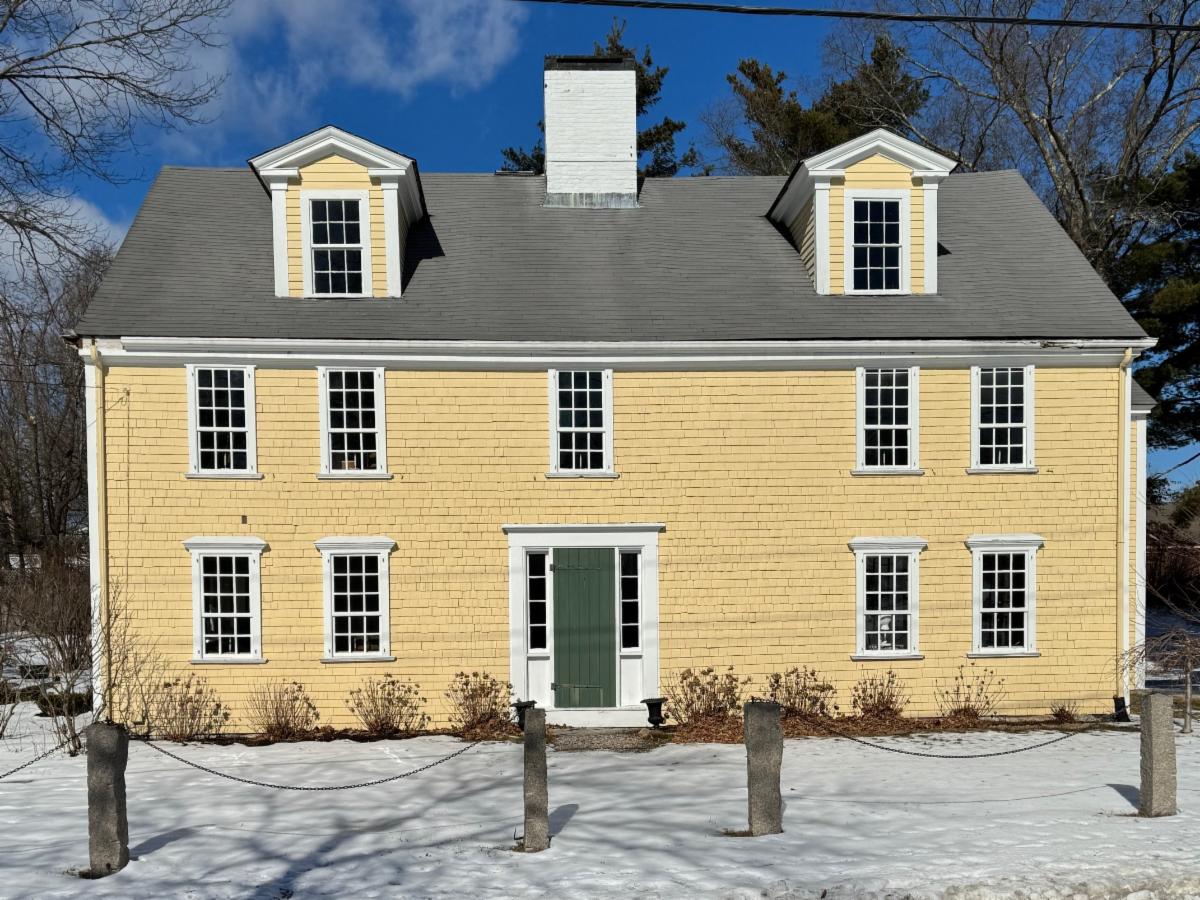
Understandably, we find that February is a month when few visitors want to stop by and tour the Dwight-Derby House. Fortunately, we are always open by appointment, and recently we had a rare visitor who is the subject of one of our articles for this edition.
Additionally, we want to share with you an additional piece of Dwight family history that was brought to attention by our editor and webmaster and former board member, Jo Ellen Heck, and a relevant connection with our families to Black History Month.
Thank you for your continued interest and support.
| President, Friends of the Dwight-Derby House |
|
|
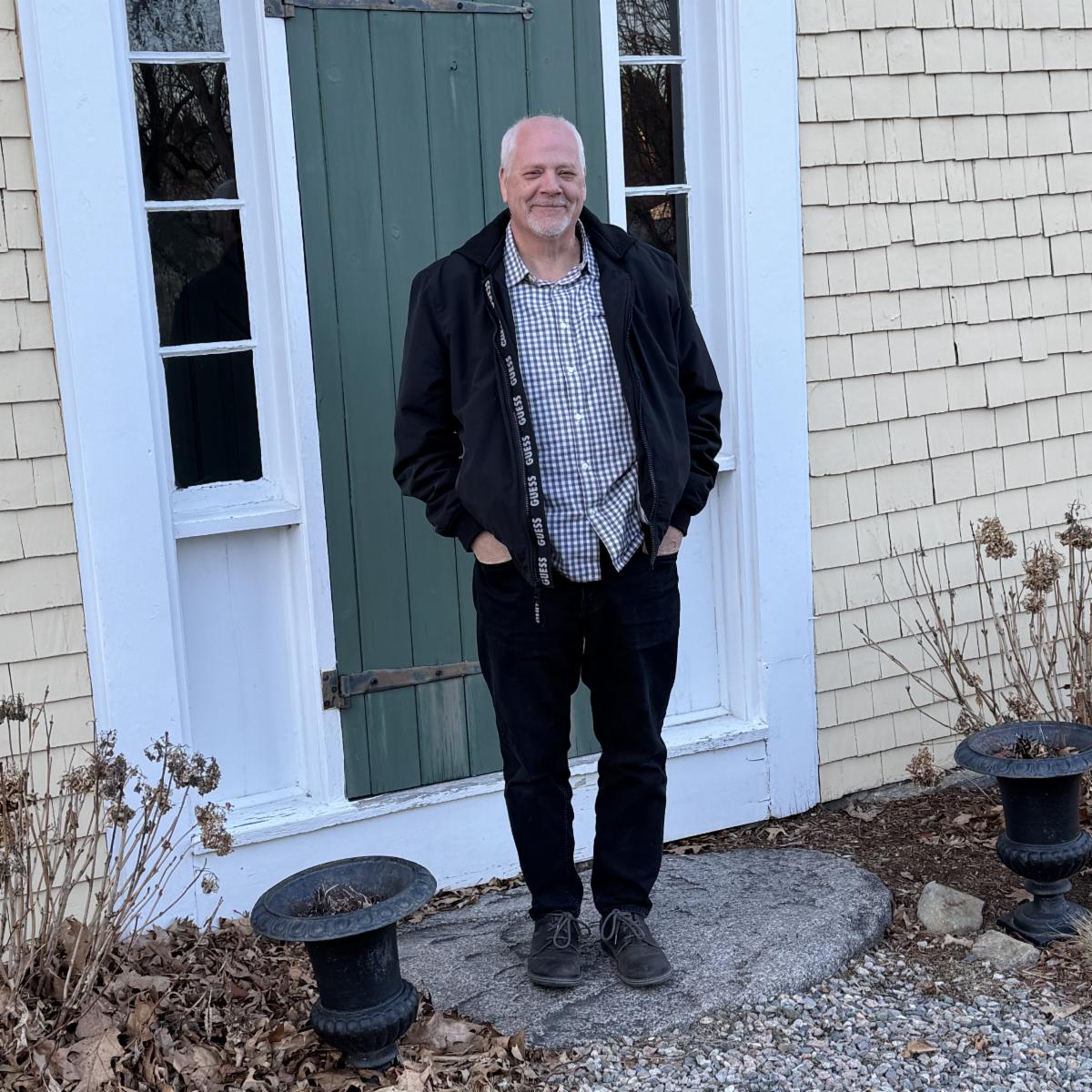
A few weeks ago, I received a call from William “Bill” Shea from Long Island. Bill was in the Boston area on business and requested a tour as he is a direct descendant of John Dwight, 1598-1660, the older brother of Timothy Dwight. In addition, Bill is a direct descendant of John Dwight 1819-1903 of Hadley, MA, and later Manhattan, NY, who founded the Arm & Hammer company with his brother-in-law, Austin Church.
Bill shared his family documentation with me. At first, I was a little skeptical, so as an amateur genealogist I went about verifying his information as best as possible using my favorite sources. After identifying an error that led to a discrepancy between the 1855 New York state census and the FamilySearch Dwight family tree, I proved that Bill was just who he claimed. In my almost two years as a docent, this was my first encounter with a member of the Dwight family.
Not surprisingly, Bill drove away with a copy of Electa Kane Tritsch’s book, “The Dwight-Derby House, a Story of Love and Persistence.”
| |
Bill Shea in front of the Dwight-Derby House. | |
Honoring Black History Month | |
Slaves at the Dwight-Derby House
In as much as February is Black History Month, I thought that it would be appropriate to investigate any involvement that the Dwights or Derbys had with slavery. While the subject of slavery in Medfield has been well researched and reported by a number of individuals, including William S. Tilden, David Temple, and Robb Gregg, I recently discovered an article by noted author and genealogist Laurie L. Kearney with some interesting facts.
Quoting Ms. Kearney directly, “from 1764, in the Boston Evening-Post, where Seth Dwight of Medfield was looking for the return of his “Indian Man Servant,” Ebenezer Ephraim, on October 22, 1764. Dwight gave a physical description of Ephraims, and included his age and what he was wearing. Dwight offers a reward of One Dollar plus expenses for Ebenezer Ephraim's return. This ad ran several times in October and November 1764. It appears Ephraim never came back to Medfield.
Ebenezer Ephraim was baptized 26 Jul 1747 in Natick, the son of Peter Ephraim and Hannah Weebucks (this couple appears to be free). Peter died in 1753 and Hannah in 1759, orphaning three children under ten and two teenagers. Peter’s estate was valued at £394 and was divided up amongst his heirs. It is possible Ebenezer came to Medfield soon after the deaths of his parents, perhaps as an indentured servant, under the custody of Seth Dwight.
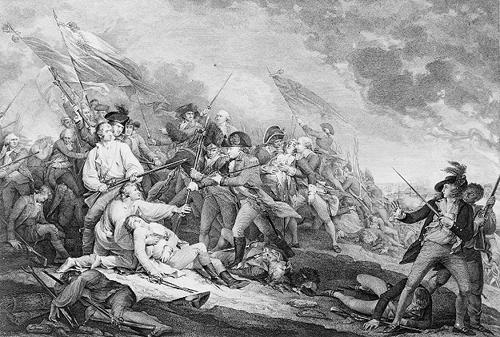
After Dwight’s 1764 advertisement, Ebenezer next appears in records in August of 1767 in Medford, Massachusetts (warning out) where he secured a room in the home of Gideon Gardner. In 1775, Ebenezer Ephraim was living in the Worcester area, where he enlisted to serve an eight-month term in the Militia, where he was one of fifteen Indigenous Men who fought at Bunker Hill. He died just before he was to start his military service in January 1777.”
| Image courtesy Snark/Art Resource, NY | |
|
Clearly, the life of black indentured servant was not much better than being a slave given that Seth was willing to pay a reward for Ephraim’s return. In the absence of records, we are left to our own imaginations to ponder the living conditions of an indentured servant in 1764 on the Dwight farm, and why Ephraim ran away.
Moving on to the Dwights, we find another interesting piece of information. Mary Townsend Derby 1797-1880 is the granddaughter of Medfield’s 3rd minister, the Rev. Johnathan Townsend. While the Reverend Townsend did not appear to have owned slaves himself, his father, who was a minister in Needham, did. In other words, Mary Derby is the great granddaughter of a slave owner.
Finally, we know that the Underground Railroad ran from Attleboro to Ellis Allen’s house on North Street, making it highly likely that Black fugitives seeking freedom passed near the Dwight-Derby House.
To read Ms. Kearney's entire article, click here.
| |
George Horatio Derby Keeps Us Laughing | |
|
From p. 71-72 of "John Phoenix, Esq.: The Veritable Squibob" (New York: Henry Holt and Company, 1932), written by George R. Stewart, on the subject of the climate of Ft. Yuma.
The first joke was attributed to Derby by no less a practitioner in wit than Mark Twain himself:
There is a tradition (attributed to John Phoenix) that a very, very wicked soldier died there once, and of course went straight to the hottest corner of perdition—and the very next day he telegraphed back for his blankets.
The other wisecrack merely states the fact that at Fort Yuma it is so hot that the hens lay hard-boiled eggs.
One more reference to Fort Yuma will serve as a valedictory to Derby’s career as a locator of and searcher after army posts. In his mock lectures upon astronomy he discussed the planet Mercury:
It receives six and a half times as much heat from the Sun as we do; from which we conclude that the climate must be very similar to that of Fort Yuma, on the Colorado River. The difficulty of communication with Mercury will probably prevent its ever being selected as a military post; though it possesses many advantages for that purpose, being extremely inaccessible, inconvenient, and doubtless, singularly uncomfortable.
| |
|
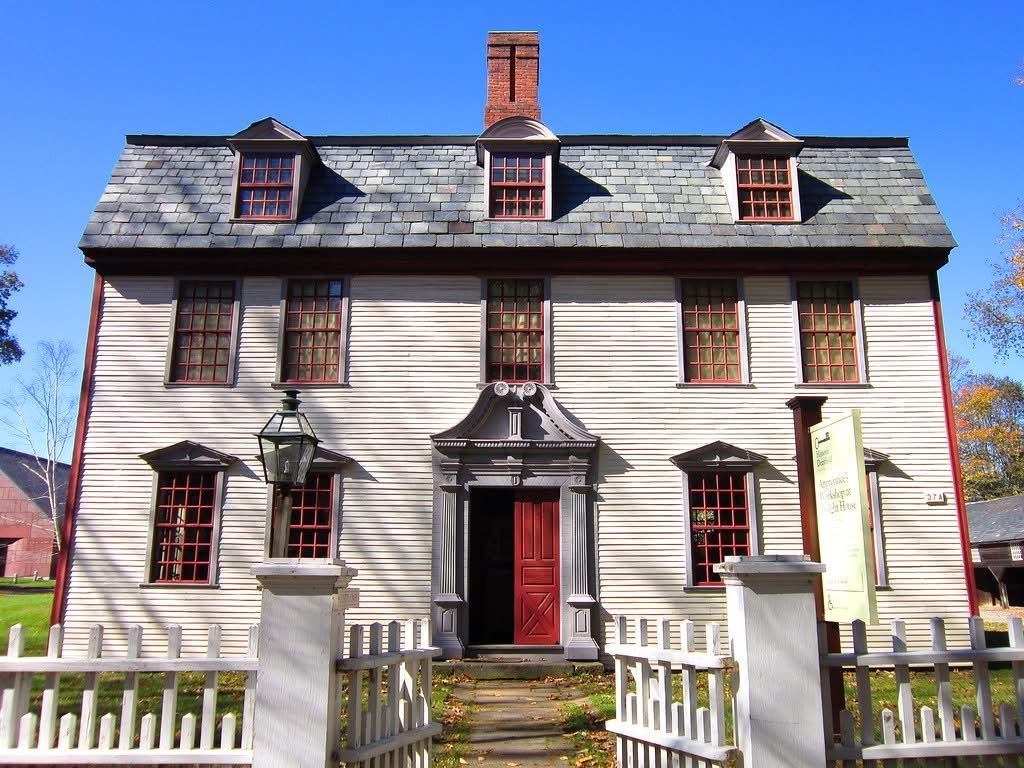
The story was prompted by a picture of the Dwight House at Historic Deerfield Village, sent to me by our editor, Jo Ellen. Although my late aunt Rose was a master tour guide at Historic Deerfield Village and qualified to lead tours in every building, I can’t recall visiting this particular house.
The story behind this house is a complicated saga involving relocation, missing pieces, and preservation gone wrong. Here’s what we uncovered:
The original Dwight House was built on Main Street in Springfield, Massachusetts, sometime between 1722 and 1733. It was purchased by Josiah Dwight 1715-1768 who was born in Hatfield, MA, which ironically is only 13 miles from Deerfield. Josiah was the great-grandson of John Dwight of Dedham.
Fast forward to 1950, the Dwight House was slated for demolition to make way for urban renewal. Henry and Helen Flynt, who were instrumental in creating what we now know as Historic Deerfield Village, purchased the house with the intention of relocating it to Deerfield.
| |
|
Unfortunately, only the very front of the house was moved to Deerfield, and the front door was missing. Apparently, Henry Francis Dupont 1880-1969 had previously purchased the door and removed it to be installed in his new summer home in Southampton, New York. In yet another interesting twist, the door was later relocated to his famous Winterthur estate in Delaware.
The Flynts used a contractor by the name of William E. Glass to renovate all of their houses in the village. Unfortunately, the house that Mr. Glass constructed to connect to the relocated front of the house was not historically accurate for a variety of reasons. Further, Peter Strang noted that the relocated Dwight house was, “the least authentic home on the street.” If you are interested, you can read the entire story in “Historic Deerfield - A Portrait of Early America” by Elizabeth Stillinger.
So if any of our readers are heading to Western Massachusetts or perhaps Winterthur, Delaware, you can check the remaining pieces of the Dwight House.
|
|
|
Join Our Community
Get the latest news and updates by joining our online community. Click the Facebook icon below, then hit the "Like" button on our page. Your support helps us grow and keep you connected—thank you!
| |
|
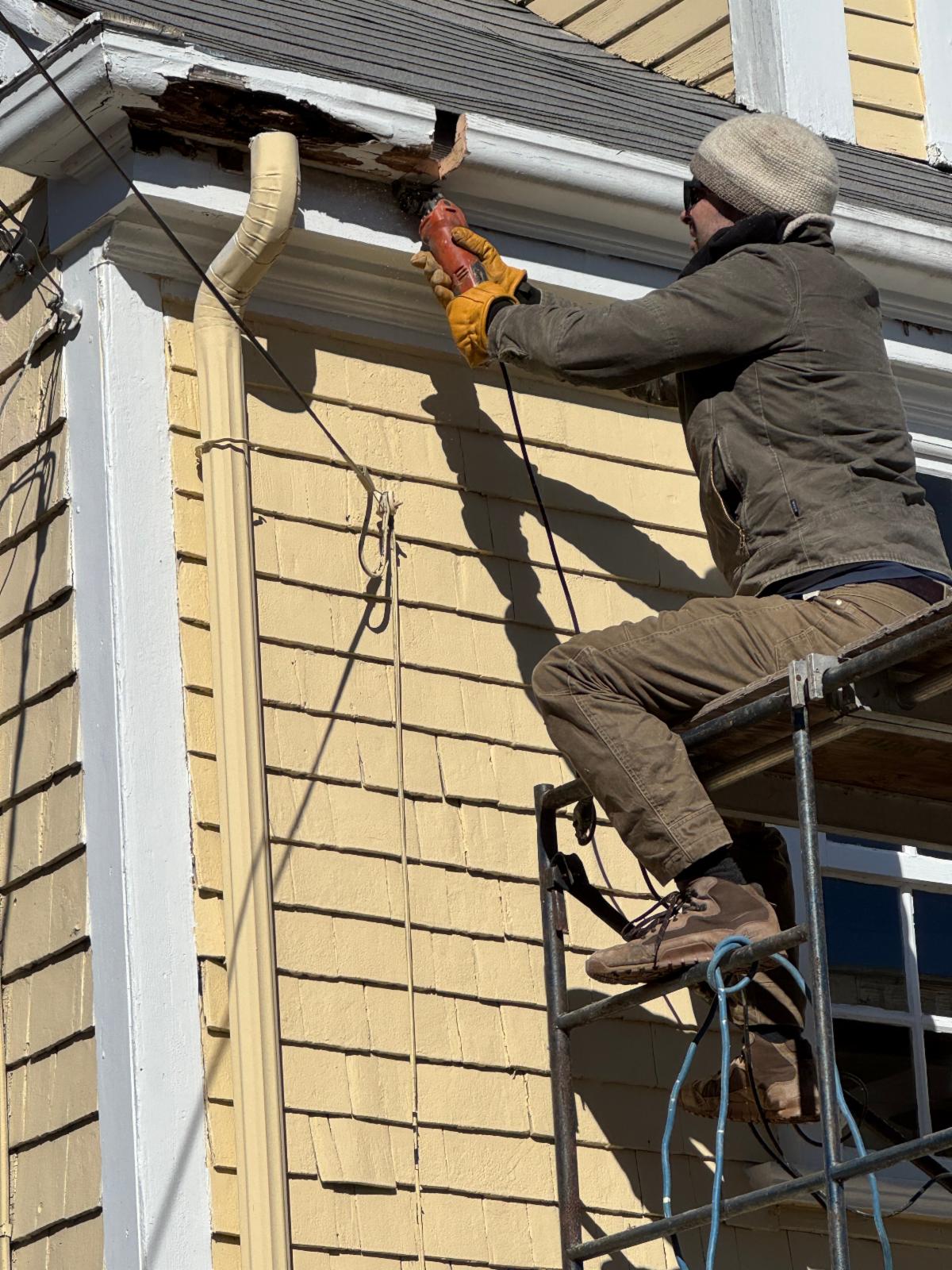
We hope that the recently contracted preservation work on the gutters, dormers, skylight, etc. will be in full swing in a few weeks. We will still be open for tours and include an explanation of the preservation process as it is underway.
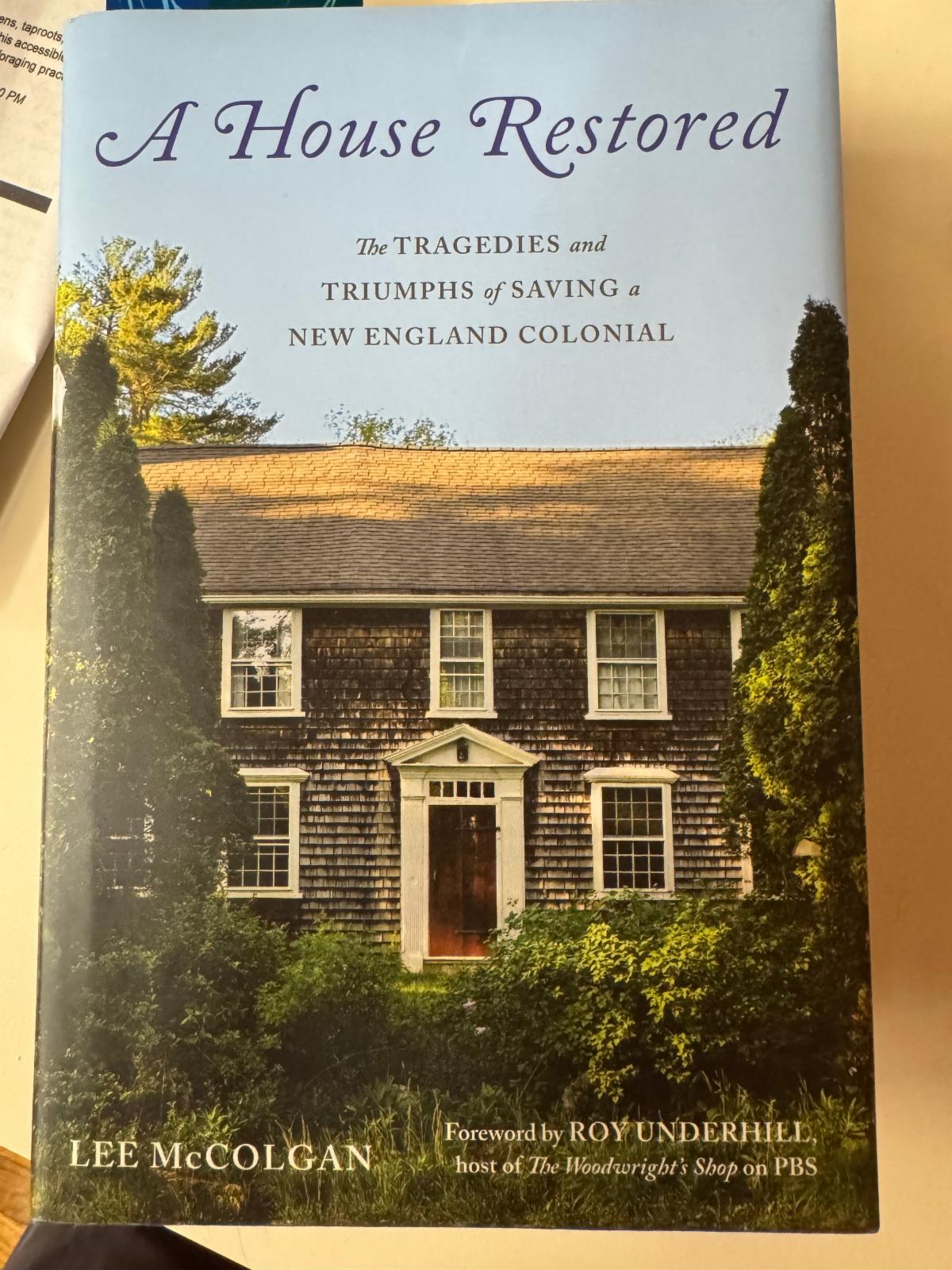
Attached are pictures of our contractor, Lee McColgan, who recently wrote a book about preserving his residence in Pembroke and was interviewed on National Public Radio.
Finally, this edition of the Squibob Herald marks the completion of an entire year of newsletters for the first time in the history of The Friends of the Dwight-Derby House. We hope you have all enjoyed the opportunity to stay in touch as much as we have enjoyed creating it. And special thanks to our editor, Jo Ellen Heck, and contributors Vicki Costello and Kyran Wilson.
| |
Lee Colgan's book on restoring his home. | |
|
Lee works on repairing the gutters. | | | | |