February 2026 || Newsletter Edition 185 | |
In this issue:
CSU Food Systems Spotlight
Mark Your Calendar
Funding Opportunities
News, Resources, and Reading
From Our Communities
About Us
Stay Connected
| | CSU Food Systems Spotlight | | |
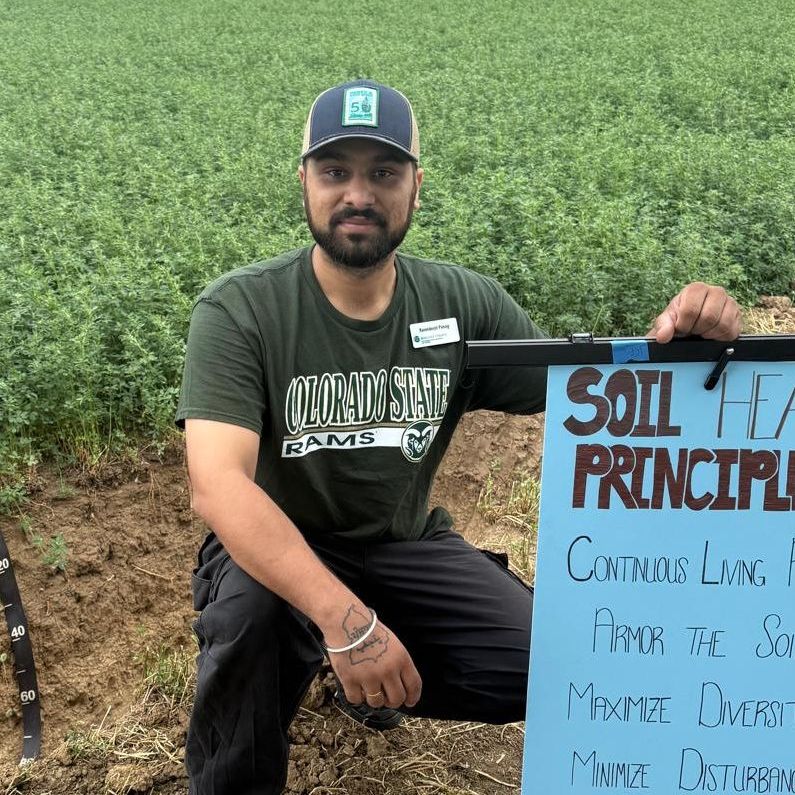
Ravinderjit Singh Panag
Agriculture Extension Specialist, Boulder County
Ravi is an Agriculture Extension Specialist with Colorado State University Extension, serving Boulder County. He holds a Bachelor of Science in Agriculture from Punjab Agricultural University, India, a master’s degree in food technology, and a Post-Graduate Diploma in Agricultural Business Management from Fanshawe College, Ontario, Canada. His professional experience spans agricultural extension and the food industry, with expertise in soil health, agronomy, crop production, and effective agricultural communication.
Since joining CSU Extension in January 2024, Mr. Panag has played a key role in advancing production agriculture programming in Boulder County. Guided by the principles of educating, creating, and connecting, he leads the development of impactful educational initiatives, builds strategic partnerships with farmers and partner agencies, and organizes workshops, field days, and outreach events that strengthen agricultural resilience and promote long-term natural resource stewardship. His major projects include a drone demonstration for agricultural applications, mental health awareness programming for producers, hands-on training on soil moisture probe use and data interpretation, webinars on noxious weed management, and ongoing technical assistance to local farmers.
| | |
Winter Farm Planning Course at Fort Lewis College
Registration is open for the Old Fort's 10-week Winter Farm Planning Course. The course will be held virtually with live Spanish interpretation from 1-3pm on Tuesdays from January 27th-April 7th, 2026 (except for February 24). This course is geared toward beginning farmers planning to start a specialty crop farm (vegetables, fruits, and/or flowers). It will cover crop and business planning, growing techniques, marketing, financials, soil health and more. Scholarships are available, folks can email ebell1@fortlewis.edu for more details.
Register here: https://secure.touchnet.net/C20732_ustores
Ya está abierta la inscripción para nuestro Curso de Planificación Agrícola de 10 semanas, que se impartirá virtualmente con interpretación simultánea al español los martes de 1 a 3 pm MST (hora de Colorado y Nuevo México), del 27 de enero al 7 de abril. Este curso está diseñado para agricultores principiantes que planean iniciar una explotación de cultivos especializados (hortalizas, frutas y/o flores) y abarca planificación de cultivos y negocios, técnicas de cultivo, comercialización, finanzas, salud del suelo y mucho más. Hay becas disponibles; contáctenos ebell1@fortlewis.edu para obtener más información.
Preinscribirse aquí: https://secure.touchnet.net/C20732_ustores
| |
UCCS Grain School Online 2026
UCCS's Grain School is a flexible, year-long learning experience which explores farming and processing grains, covering nutrition, health, and community. The course is designed for farmers, bakers, makers, educators, and grain-curious community members. The online course includes a live kickoff orientation on February 3rd and self-paced content through April with self-paced access until the end of the year. Scholarships are available for producers and makers.
Click here to enroll.
| |
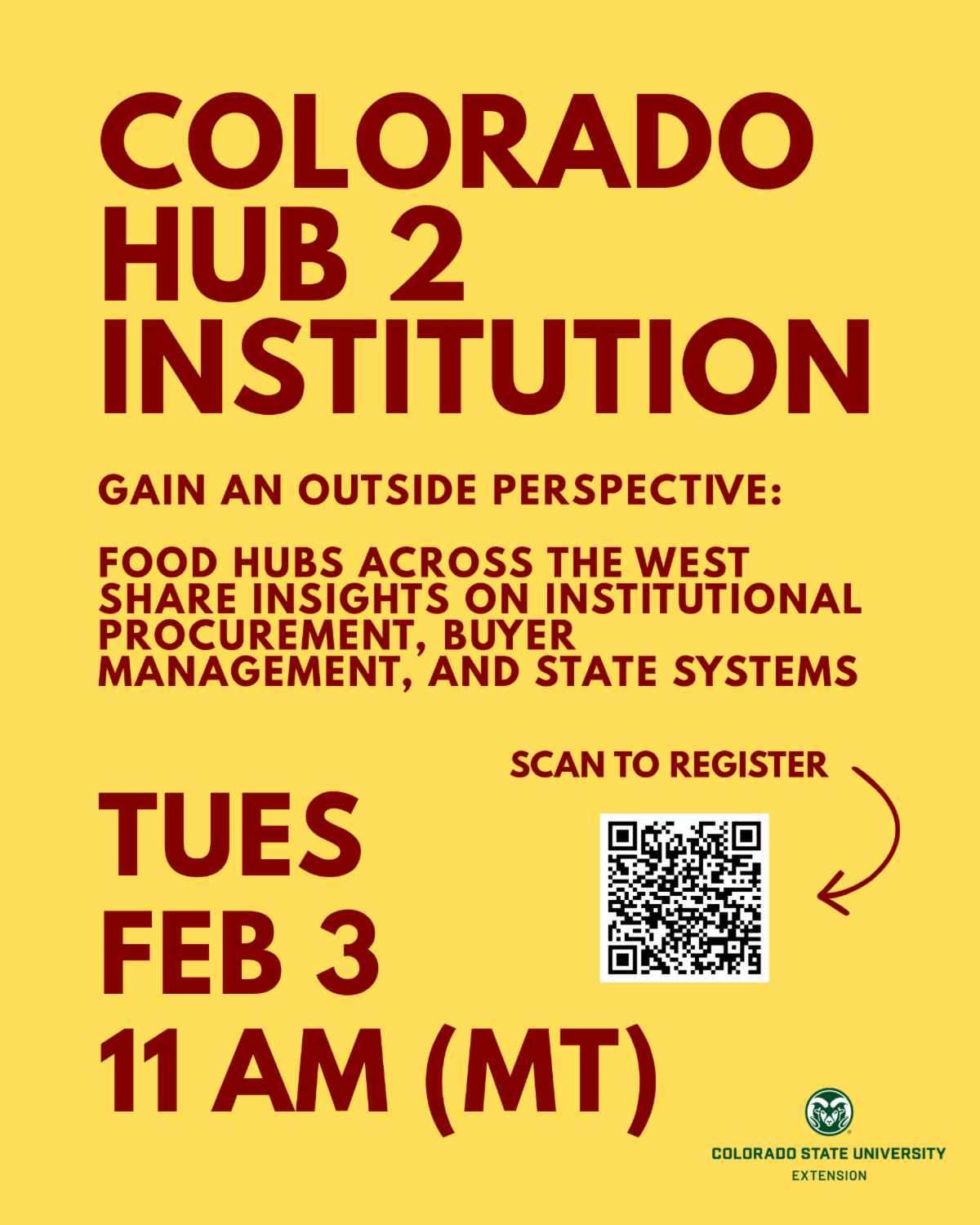
Colorado Hub 2 Institution Webinar
The goal of this webinar conversation is to support learning among state leaders, Extension staff, and food hubs by drawing on lessons from food hubs and producers in states with more established hub networks and farm-to-school or local food purchasing initiatives. By learning from these experiences, the discussion aims to provide clearer direction on how Extension, agencies, and nonprofit partners can address existing gaps, support the anticipated growth in institutional local food purchasing, and identify opportunities for coordinated technical assistance to help producers and hubs meet rising demand.
February 3rd from 11:00am to 12:30pm
Register here
| |
Climate Resilience Course
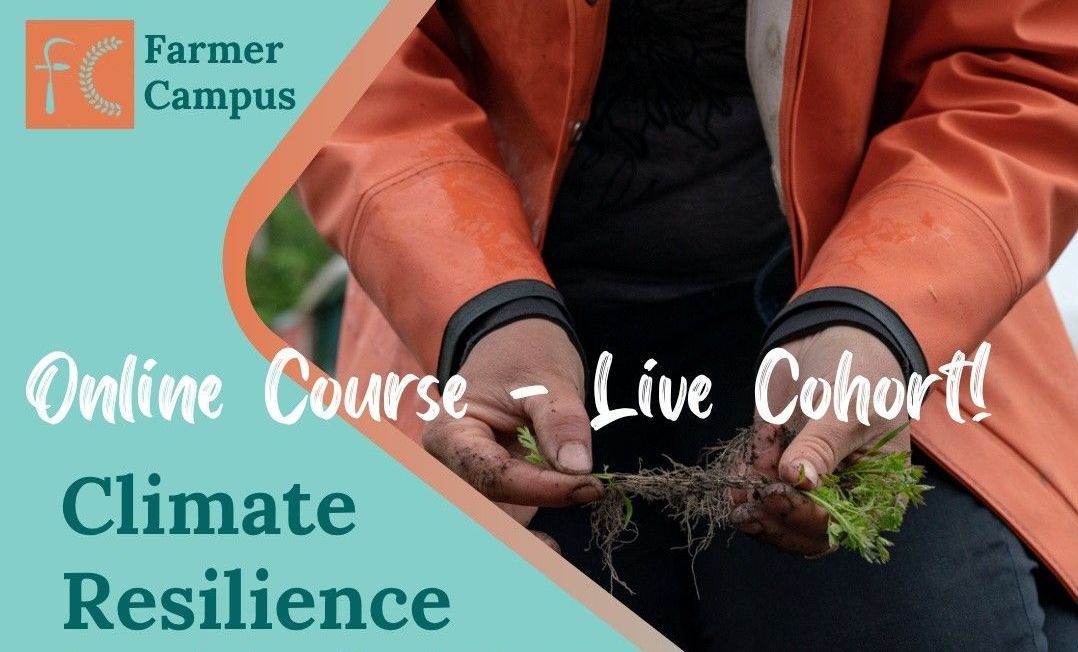
Farmers and ranchers in the West: strengthen your climate resilience strategies this winter with Farmer Campus’s live Climate Resilience Course. Six online workshops with expert speakers run Tuesdays, February 3rd – March 10th, 2026, paired with a flexible five-module online course. Learn practical tools, build a Climate Resilience Action Plan, and connect with peers across the West.
Enroll here: https://farmercampus.com/courses/climate/
| | |
Farm 2 Local Biz Networking Event
Are you curious about purchasing local food for your business?
You and your business are invited to the Farm2LocalBiz Networking Event, hosted by the Larimer County Extension Office at Block One Events in Fort Collins on February 5th from 4:30 - 7:30pm.
You'll have the opportunity to connect with over 20 Northern Colorado agricultural producers, sampling an array of premium local products. Locally crafted wine, beer, and appetizers will be served, with each dish featuring ingredients from the very producers showcased at the event. Don't miss this unique chance to network and discover the flavors of our region!
Event Agenda:
- 4:30pm: Doors open
- 5:00pm: Purchasing Local Panel
- 6:00pm: Networking & Sampling Delicious Local Fare
As an added bonus, businesses that attend the event will receive a $100 coupon for their first purchase from any of the farms or ranches at the event.
Register here!
The registration deadline for this event is January 31st. Space is limited, sign up early to claim your spot!
| | |
2026 Researcher & Extension Meetup and Organic Conference
The Organic Farming Research Foundation (OFRF) invites you to register for a special Researcher & Extension Meetup on Monday, February 9, in Cheyenne, Wyoming.
This event will bring together organic-focused researchers, Extension professionals, and educators to connect, share knowledge, and lay the groundwork for future collaboration across the region. This event is free to attend. Register here.
Following the meet-up, the High Plains Organic Conference will take place on February 10th and 11th. Conference registration is $45 with meals included. If you’re interested in presenting research or helping shape a research-focused track, email communications@ofrf.org.
| | |
New Online Course for Aspiring Farmers, Ranchers, and Food System Workers: Exploring Your Farm Dream
Exploring Your Farm Dream is a new online course offered by the CSU and the Colorado Building Farmers and Ranchers Program for people looking to equip themselves with the knowledge, skills, and business strategies for a future in agricultural production. This self-paced course is designed for learners who have limited experience in agriculture. Visit the course website here for more information.
Participants can expect to:
- Learn from CSU Extension faculty instructors with expertise in agricultural business management
- Get access to strategic personal and business planning insights, tools, and resources
- Assess preparedness for starting a farm-based business aligned with your resources, skills, and goals
- Explore a variety of different pathways and business models in ranching, agriculture, and food systems
The course consists of 10 modules, which learners will have access to for a full year. Registration costs $150. Register for the course here.
| | |
2026 Southern Rocky Mountain Agriculture Conference Education Program
Join for 3 days of education to connect, learn, and navigate the challenges and opportunities shaping modern agriculture.
February 3-February 5, 2026 at the Ski Hi Complex in Monte Vista, CO
Register here.
| |
Food Safety and Business Training for Colorado Cottage Foods Producers
Two trainings are being offered to support cottage food businesses.
Food safety - Learn how to safely produce food from home as a cottage food business. This course covers a variety of topics, including: basic food safety, foods that are permissible under the updated Colorado Cottage Foods Act, ingredient labeling, special considerations for food preparation at high altitudes, and safe food sampling best practices. Registration is $55. For additional dates and to learn more, check the website here.
The next CSU Extension Cottage Food Safety Trainings will take place on:
- February 17, 8:30am-12:00pm, online register
- February 27, 9am-12:3opm, online register
- February 28, 9am-12:30pm, online register
- March 9, 8:30am-12:oopm, online register
- March 20, 9am-12:30pm, online register
- April 6, 12:30-4pm, online register
- April 14, 8:30am-12pm, online register
- May 14, 12:30-4pm, online register
- September 8, 8:30am-12pm, online register
- October 9, 12:30-4pm, online register
Business Training - You’ve perfected your product, now it’s time to cash in!! Whether you’re targeting local farmer’s markets, family and friends, or retail store shelves, this short-course will give you tools to consider your costs of production and your product-market fit. The training provides easy-to-use tools as you launch and grow.
- Virtual - February 3, 5:3opm, online register
| |
Produce Safety Alliance Grower Training Course
Feb 19-Feb 20
Colorado State University Extension, Fort Lewis College, and the Colorado Fruit and Vegetable Growers Association will be hosting an online only Produce Safety Alliance Grower Training Course in two parts, from 8am-1:00pm on both February 19 and February 20, 20263. Since it is online only, it has a very specific structure. Please read all the registration information to make sure this course and its format will work for you.
This course will provide a foundation on the FSMA Produce Safety Rule requirements, Good Agricultural Practices (GAPs) and co-management information, and details on how to develop a farm food safety plan. Individuals are expected to gain a basic understanding of:
- Requirements in the FSMA Produce Safety Rule and how to meet them;
- Microorganisms relevant to produce safety and where they may be found on the farm;
- How to identify microbial risks, practices that reduce risks, and how to begin implementing produce safety practices on the farm; and
- Parts of a farm food safety plan and how to begin writing one.
The registration fee is $75 which includes PSA materials and a certificate of completion as required under FSMA. Registration for this course closes on February 11 in order to have time to mail out required course materials.
Register here
Note that additional trainings will be offered in March (March 19 & 20) and April (April 22 & 23).
| |
Colorado Fruit and Vegetable Growers Association 2026 Annual Conference Feb 24-Feb 25
Join for networking and learning at the 12th annual conference in Westminster, CO.
CFVGA, in partnership with the Colorado Agriculture Forum and FFA Hall of Fame Banquet, brings three days of cutting edge agricultural programming and networking for the farm and ranch sector in Colorado.
Register here.
| |
Save the Date: Colorado Farmers Market Association Annual Conference
The Colorado Farmers Market Association is holding its annual conference from February 27-March 1, in Fort Collins, co-hosted by the Larimer County Farmers' Market and the Winter Farmers Market.
Register here.
| |
Women in Agriculture 2026
Join us for an exciting event celebrating the vital role of women in the agriculture industry. Connect with like-minded individuals, learn from inspiring speakers, and network with professionals in the field. This in-person event offers a great opportunity to gain valuable insights, share experiences, and empower one another. Don't miss out on this unique gathering of women shaping the future of agriculture!
La Plata County Fairgrounds from March 5 at 10am to March 6 at 3pm.
Register here.
| |
Guidestone's 11th Annual AgriSummit
March 5-6, 2026
AgriSummit is a rural agricultural conference in Salida. This year's theme is "Restoring Relations: Rooting Down and Reaching Out" with plans to highlight the many relationships that make up local food systems. This event offers educational sessions, networking opportunities, and discussions focused on local food production, food access, food Rx, land management, and agritourism. All Friday sessions will include simultaneous Spanish interpretation.
Click here to register and learn more.
| |
Save the Date:
Colorado Grain Summit
March 7, 2026
Join us on March 7 at the SteamPlant in Salida, Colorado, for the 2nd annual Colorado Grain Summit! The Colorado Grain Summit aims to inspire businesses using local grains to envision pathways for sustainable growth and increased market impact. This single-day conference will feature curated networking sessions, expert panels, and keynotes highlighting innovative success stories across the grain supply chain. Our goal is to create an environment that fosters partnerships, provides pathways to market expansion, and connects grain producers with businesses across Colorado.
Click here to register and learn more.
Interested in sponsoring this event? Click here.
Receive 10% off the Colorado Grain Summit and the AgriSummit by attending both events.
| | |
2026 Sun Soil Water Summit
Join Pueblo Food Project, CSU Pueblo County Extension, and partners to gather, learn, and share delicious food at the Sun Soil Water Summit. This weekend-long gathering at Pueblo Community College is focused on bringing the community closer to the food system. With several events celebrating local leaders, educating our peers, and uplifting local entrepreneurs, there is something for everyone at the summit.
-
Pueblo Food Systems Awards and Gala - March 20th, 6:00pm-8:30pm: An evening of celebration as we honor leaders in the Pueblo Food System. We will enjoy local food, drinks, music, and an inaugural silent auction.
-
Community Led Summit - March 21st, 8:00am-4:30pm: A gathering to learn, share, inspire, and catalyze community food systems change. This day-long conference will include keynote presentations, panel discussions, hands-on breakout sessions, and delicious food. This summit will help community members, organizations, and producers gain knowledge to better engage with our food system.
-
Makers' Market and Happy Hour - March 21st, 4:30pm-7:00pm: Conference participants can explore ideas, try products, and support local food businesses while enjoying local beer and wine at the Makers' Market and Happy Hour. Makers and community organizations interested in a table are welcome to share their products and ideas.
Register here. If you are interested in volunteering, complete this form.
| | |
Farm Resilience Online Course
Learn practical strategies and tools to boost your farm’s resilience amidst the challenges of climate change. This self-paced, online course is designed specifically for farmers and ranchers in the West, focusing on real-world solutions and hands-on techniques.
Join a community of like-minded individuals and gain the knowledge you need to secure your farm's future. CSU was fortunate to partner with this program to develop some of the content and decision tools.
Enroll today and deepen your journey towards climate resilience and sustainability.
| | |
The FruitGuys Community Fund -
Small Farm Grants 2026
The FruitGuys Community Fund (FGCF) has opened the 2026 grant cycle for small U.S. farms (250 acres or less) and agricultural nonprofits. Grant awards are up to $5,000. Farms or farmers that have previously received a FGCF grant are ineligible. Applications are due January 30, 2026.
Click here to learn more and apply.
| | |
Farmer Veteran Fellowship Fund
The Farmer Veteran Fellowship Fund is a small grant program that provides direct assistance to veterans who are in their beginning years of farming or ranching. The Fellowship Fund gives money to third-party vendors for items the veteran has identified will make a crucial difference in the launch of their farm business. Awards range from $1,000 to $5,000, and nearly $4 million has been awarded to more than 930 veterans since 2011.
Applications are due on February 17, 2026. Click here to learn more and apply.
| | |
2026 Organic Grains Microgrant
The Colorado Grain Chain (CGC) has opened applications for the 2026 round of the Organic Grains Microgrant program. For the past three years, CGC has been running an annual microgrant program to help get locally grown, organic grains to market. Click here to learn more about past and current grants.
The microgrant is open to Colorado-based grain growers working on projects that help get certified organic grain products to market. Applications are due March 23, 2026. Click here to apply.
Email any questions to microgrant@coloradograinchain.com.
| | |
Graduate Research and Education Grant
This Western SARE grant program involves full-time graduate students enrolled in an accredited university of Western U.S., their academic advisor and at least one producer implementing projects to address identified needs in sustainable agriculture. Projects must integrate rigorous research and education aiming to advance the three components of sustainable agriculture- environmental, economic, and social. Applications are due March 5, 2026.
Visit the website to learn more and apply.
| | |
Value Added Producer Grants
The USDA Value-Added Producer Grant (VAPG) program helps U.S. agricultural producers that generate new products from raw agricultural commodities, create and expand marketing opportunities, and increase producer income through enhanced product value and market reach. Agricultural producers, producer groups, farmer- or rancher-cooperatives, and majority-controlled producer-based business ventures are invited to apply. Click here to learn more.
These grants support either:
-
Planning activities (e.g. feasibility studies, business or marketing plans) - up to $50,000
-
Working capital needs (e.g. processing, packaging, advertising, inventory, and salaries) - up to $200,000
Applications are due April 15, 2026. Click here to apply.
| | News, Resources & Reading | | |
Farmers Market Toolkits
The Farmers Market Coalition (FMC), in partnership with AMS developed two toolkits to help expand access to fresh, healthy foods and strengthen local food systems. These resources help markets and institutions implement effective farmers market programming that supports nutrition education, community engagement, and local producer sales. The Fruit & Vegetable Education Toolkit offers markets step-by-step guidance to design and deliver produce-based nutrition education. The Starting a Farmers Market at a University Toolkit provides a framework for planning and launching on-campus markets. Click here to learn more.
| | |
2025 National Food Hub Survey Report
Michigan State University Center for Regional Food Systems (CRFS) has released the Findings of the 2025 National Food Hub Survey which shows results from the 6th iteration of the national survey.
The report captures data and experiences from food hubs for the 2024 calendar year, notably looking at data following the COVID-19 pandemic. Results from the survey indicate that between 2021 and 2025, food hubs reported that the average amount of total gross sales to schools more than tripled. Grant funding to help procure and distribute local foods was a key incentive to increasing local food access in schools and food banks. The survey project examines challenges and opportunities for growth in national and regional distribution, especially following times of disruption in the global food supply.
To explore other findings and recommendations, read the full report: https://www.canr.msu.edu/resources/findings-of-the-2025-national-food-hub-survey
| | |
Food Hub Operator's Toolkit
USDA AMS, in partnership with the University of Vermont and Michigan State University, investigated the main roles of food hub operators and the progression of their work from start up, to expansion, to innovation.
Many Hats – A Food Hub Operator’s Toolkit is a central depot of resources that will support food hub operators in the roles they may play at each phase of a Food Hub’s lifespan. It provides peer-generated knowledge, industry context, and direct links to existing and relevant resources across organizational, value chain, operations, and partnership development. This project is accompanied by a four episode podcast series available through The Food Hub Podcast.
| | |
Characteristics of Regional Food Policy Councils
Interest in regional approaches to food system planning, development, and governance has grown dramatically in the last decade, including that of food policy councils (FPCs). Due to limited information on regional FPCs, AMS and researchers and practitioners from Ohio State University, Colorado State University, and Johns Hopkins Center for a Livable Future partnered with 11 regional FPCs through an 18-month community of practice. They explored the unique opportunities, challenges, and needs of regional FPCs and developed resources to inform and support regional work.
These resources offer insight from the community of practice to support FPCs and other groups taking a regional approach. Visit the project website to view the resources and to learn more about the project background and takeaways.
| | |
The Wallace Center at Winrock International's Agriculture and Food Systems Strategy
The Wallace Center at Winrock International is proud to announce its new Agriculture and Food Systems Strategy, a bold vision and plan for the years to come.
As a national program of Winrock International, the Center's work is grounded in Winrock's mission "to empower the disadvantaged, increase economic opportunity, and sustain natural resources." Building on decades of leadership and trusted relationships, the Wallace Center is strengthening its role in this time of rapid change. With strong regional roots and national reach, they are deepening their impact by scaling innovation, channeling resources, and supporting lasting change through collaboration. This strategy ensures they remain grounded in their vision and values moving forward.
Through this strategy, the Wallace Center will support:
- Just economic opportunities by strengthening value chains, unlocking resources, and supporting fair markets
- Healthy agricultural ecosystems through regenerative practices that improve soil, water, and farm profitability
- Effective cross-sectoral collaboration to align investment, policy, and innovation for greater impact
- Resilient communities by uplifting local leadership, creating good jobs, and building long-term wealth
| | |
Cultivation Station: A Colorado Proud Podcast
Cultivation Station is a business development podcast from the CO Department of Agriculture's Colorado Proud program. The podcast dives into the rich and diverse world of food and agricultural businesses. Whether you are just beginning to think about starting a food or ag business in Colorado, or your operation is up and running, there are many expert insights and insider tips to help you be successful.
Find the full list of podcast episodes here.
| | |
Introducing the Poudre Valley Community Farms Land Access Bulletin
Poudre Valley Community Farms has launched a bulletin designed to connect producers with land and water access opportunities across the Front Range. Each issue will feature current listings and announcements that support long-term access and stewardship, intended for producers seeking land and landowners looking to connect with growers.
Sign up for the bulletin here.
| | |
Read the Report on Farmers Market Organizations
The USDA Agricultural Marketing Service (AMS) partnered with Emory University and Arizona State University to research the varied structures of farmers market organizations to identify benefits, challenges, and services associated with externally managed farmers markets. The goal of the “Analyzing the Impacts of Farmers Markets Managed by Organizations” cooperative research agreement was to increase the general public’s understanding of the diverse forms that farmers markets in the United States take and the breadth of their activities.
The project was conducted over two years (October 2022 to September 2024) and used mixed methods (an online environmental scan, listening sessions, focus groups, and semi-structured interviews) to explore the structures, activities, impacts and trends shaping farmers market organizations.
Read the report here.
| |
List Your Business in USDA AMS Local Foods Directories
The USDA Local Foods Directories allow you to market your local food business to a wider nationwide audience. In particular, make sure your agritourism venture is featured in the USDA Local Food Directories! To create a new listing, answer quick and easy questions about the status of your business so consumers can learn more about you.
Click here to sign up for the directory.
| | |
USDA Local Food Survey
USDA’s National Agricultural Statistics Service (NASS) is conducting the Local Food Marketing Practices Survey to gather data on the production and local marketing of foods. Information includes the value of food sales by marketing channel, value of crop and livestock sales, marketing practices, expenses, federal farm program participation, and more. As consumer interest has grown and programs and policies for local foods have developed, the Local Food Marketing Practices Survey is critical to show where the sector is today and help identify future needs.
The survey was mailed out January 6, 2026 to almost 64,500 producers nation wide. Producers who receive the survey are strongly encouraged to respond online at agcounts.usda.gov. Learn more about the local food survey by visiting nass.usda.gov/go/local-food.
| |
|
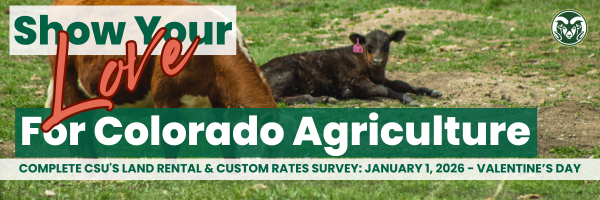
Land Rental and Custom Rates Survey
Colorado producers and agribusiness owners are encouraged to complete CSU's Land Rental and Custom Rates Survey. Take just 10 minutes to fill out the survey before February 14th, 2026.
Complete the survey here: https://colostate.az1.qualtrics.com/jfe/form
What is the survey?
CSU Extension conducts an annual survey of land rental and custom rates charged for various crop and livestock operations and lease arrangements in Colorado in the preceding year. Data are collected from agricultural producers, landowners and managers, lenders, agricultural consultants, machine operators, and Extension agents. Results of the survey are used by producers, ag lenders, county assessors, the CO Department of Agriculture, land appraisers, and more.
Why should I complete the survey?
- The Land Rental and Custom Rates Report allows you to advertise custom services or locate/hire custom service operators in your area.
- More responses ensure more accurate data and a more complete list of rates for today’s practices. These determined rates influence land appraisal values, your property taxes, and more.
- Information about Custom Rates is used by elected officials to inform federal, state, and local policy, including crop insurance.
- Your responses are safe and anonymous.
Your CSU Extension Agriculture and Business Management Team is here to answer questions. Learn more: https://abm.extension.colostate.edu/meet-the-team/
| | |
U.S.-Based Urban Agriculture Organization Survey
Anyone in a decision-making, management, or coordinating role in an organization that operates an urban agriculture initiative in the United States is invited to participate in a research study about how urban agriculture organizations operate, adapt, and sustain impact over time. The results of this study are expected to help identify how urban agriculture leaders can develop more sustainable and impactful organizations. The survey has 3 sections and takes approximately 10 minutes. Responses will be reported in aggregate and de-identified so that individual people and organizations are not identifiable.
Take the survey here.
| | |
Call for Historical Farmers Market Data
Farmers markets are one of the most enduring and dynamic civic and food movements. To help capture and preserve this history, market leaders and partners are encouraged to contribute stories and background from farmers markets across the U.S.
If you have been involved in launching, shaping, or sustaining a farmers market, you are encouraged to contribute your market's story. These submissions will be compiled to build a public record of how markets emerged and evolved. To learn more about the project, visit this article referring to the work.
Add your market's history here: https://docs.google.com/forms/d/e
| | |
Introducing the National Farmers Market Management Survey
Michigan State University Extension (MSUE) and farmers market sector partners are excited to share that the next National Farmers Market Management Survey (NFMS) will be conducted in early 2026. The survey will gather comprehensive data on how farmers markets operate across the U.S., covering topics like market structure, staffing, funding, and vendors. The insights collected will provide markets with data for market comparison and inform resources, policies, and best practices to strengthen farmers markets and support local food systems. National and regional results will be shared to help market leaders, researchers, and policymakers understand characteristics of markets today.
Farmers market managers and coordinators are invited to complete the survey. You can learn more about the project here: canr.msu.edu/NFMS
| |
ABOUT FOOD SYSTEMS
at Colorado State University
| | Food systems are the connections between natural resources, the agricultural and food industries, and the buyers, consumers, and communities to which they contribute. Research, extension and education identify and inform opportunities to bridge how production, supply chains, and eaters respond to changing markets, policy, and the environment. At CSU, we focus on these key areas to train, influence, and communicate ways to connect food-related roles and foster healthy communities, economies, and individuals. | | | Find us on social media, get farm or food systems related questions answered via email, forward to a friend, or submit your contributions to our newsletter! | | | | |