Your Monthly News & Updates | |
| |
Dear Members and Friends of the Medfield Historical Society,
As we step into February, I’m grateful for the energy, teamwork, and community spirit that continue to define our Society. Winter may be in full swing, but there’s no hibernation happening here—we’re maintaining momentum and making steady progress.
One of our major focus areas this season has been reorganizing the basement, a project that is already making a meaningful difference. With improved storage, clearer cataloging, and more efficient use of space, we’re laying the groundwork for easier access to our collections and smoother operations throughout the year. Thank you to everyone who has rolled up their sleeves to help make this happen.
I’m also thrilled to share a recent accomplishment: our participation in the Second Annual Medfield Volunteer Fair. It was a wonderful opportunity to connect with the community, and we were delighted to welcome several new volunteers to our efforts. Please join me in extending them a warm and enthusiastic greeting. Their willingness to contribute is a powerful reminder of how many people care deeply about Medfield’s rich history.
Looking ahead, we’re excited for our February speaker event, which promises to be a highlight of the month. I hope you’ll join us—and bring a friend!
We’re also turning our attention to two inspiring new projects:
- Transforming our museum exhibits to bring fresh life, clarity, and engagement to our displays
- Preparing for a future Vine Lake Cemetery tour, where we’ll share the lives and legacies of some of Medfield’s most fascinating past residents
Both efforts will offer opportunities for volunteers to participate, collaborate, and learn. Volunteers gather every Monday at 4:30 p.m. to work on projects—let me know if you’d like to join the fun.
Thank you, as always, for your donations, your involvement, your passion, and your pride in preserving Medfield’s history. Together, we’re not just caretakers of the past—we’re building a strong foundation for generations to come.
Warmly,
Yumi Jones
President
| | Join or Renew Your Membership Now | |
If you've already joined or renewed, thank you!
If you haven't, it's not too late. Whether you’re a longtime member or considering joining for the first time, your support provides the steady, reliable funding the Medfield Historical Society depends on.
Membership helps us:
- Protect and care for our collections
- Expand access through digitization and archival software
- Offer free public programs and community events
- Plan confidently for 2026 and beyond
One-time grants help—but memberships sustain us. Join or renew today to keep Medfield’s history alive, accessible, and meaningful. And if your circumstances allow, please consider making an additional donation.
| | |
This spring, the Medfield Historical Society presents three programs connected by a shared focus on the American Revolutionary era. In recognition of the 250th anniversary of 1776, our spring events have been intentionally designed to explore this transformative moment in our nation’s history.
Together, these programs highlight how the Revolution shaped local communities, families, and everyday life, inviting reflection on the enduring legacy of the Revolutionary generation. We hope this curated series deepens understanding of the Revolutionary generation and its lasting legacy as we begin this important commemorative milestone.
| | "The Road to Liberty and Union" with Jonathan Lane | | |
Wednesday, February 11
5:30 pm
Council on Aging
1 Icehouse Road, Medfield
This talk looks at the American Revolutionary period in Massachusetts during the transformative years between 1765 and 1790 when ordinary people experienced profound political, social, and economic upheaval. Towns mobilized in protest, new ideas of sovereignty were spread, and thousands offered support to the struggle for independence. Drawing on the stories of farmers, merchants, women, free and enslaved African Americans, Indigenous communities, and soldiers, the talk considers how Massachusetts embodied revolutionary change.
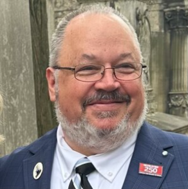
Jonathan Lane is Executive Director of Revolution 250, a consortium of Massachusetts organizations working to commemorate the 250th Anniversary of the American Revolution. He has more than 30 years’ experience in public history, tourism and cultural programming. Mr. Lane has been awarded the “Massachusetts Office of Travel & Tourism Revolutionary Achievement Award” from Massachusetts Governor Maura Healy in March of 2024.
This event, co-sponsored with the Medfield Public Library and the Council on Aging, is free and open to the public but registration is requested.
| | "One for the Revolutionary Road: Taverns and the American Revolution" with Malcolm Purinton | |
Tuesday, March 6
6 pm
Dailey Room, Medfield Public Library
468 Main Street, Medfield
Few places were more important in Colonial and Revolutionary America than local taverns. Although relationships with alcohol in the colonial and early American periods were often conflicted—as they remain today—these spaces serving beer, wine, and spirits were where people gathered to share news and debate the politics of the day. Taverns were essential meeting grounds for both rural and urban communities, hosting town meetings and elections, providing a place to gather after church, and helping to shape revolutionary identities in the 18th century.
As centers of local life, taverns bore witness to events that were local, regional, and national in scope. Decisions made in these cozy environments had far-reaching consequences, from organizing protests to planning dramatic actions such as the Boston Tea Party.
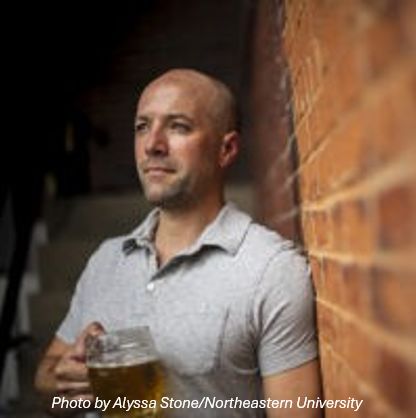
Malcolm F. Purinton is a professor in the History Department at Northeastern University, where he teaches courses on world history, the British Empire, and the history of Boston and colonial America. He also presents public lectures on American alcohol and beer history. His recent book, Globalization in a Glass: The Rise of Pilsner Beer through Technology, Taste, and Empire, explores the global spread and dominance of light golden lager in the late nineteenth century.
This event is free and open to the public and is co-sponsored by the Medfield Public Library.
| | Glimpses of 19th Century Medfield: Presenting the Tilden-Tucker Album | | |
These days, “the cloud” holds our photographs, possibly forever. And for those of us still blessed or burdened with physical photos cluttering our physical spaces, there are apps that can scan and send them there. I sometimes imagine the amazement of our Medfield forbears if they could see this innovation, but they only stare back at me from their photos.
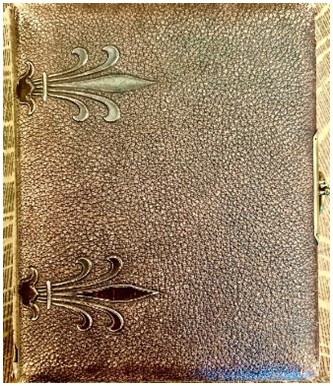
One of our treasures is a massive photo album, bound in leather, with large brass hinges and a clasp on the side, which was once owned by William Smith Tilden (1830-1912) and his wife. Tilden was the first president of Medfield History Society and author of our “Bible,” The History of Medfield from 1650-1886.
| | Figure 1 The Tildens’ Cabinet Photo Album | | |
The album was designed to hold Cabinet Cards, which “were America’s main format for photographic portraiture throughout the last quarter of the nineteenth century... Inexpensive and sold by the dozen, they transformed getting one’s portrait made from a formal event taken up once or twice in a lifetime to a commonplace practice shared with friends (Pauwels).”
These popular photographs, introduced in the 1870s, were albumen prints glued to cards standardized to 6 ½ by 4 ½ inches. This size was large enough to reveal extensive detail. People often incorporated elaborate or fancy backdrops, poses and props (Pauwels). The phenomenon spawned the manufacturing of special albums, which were often quite elaborate (see Figure 1).
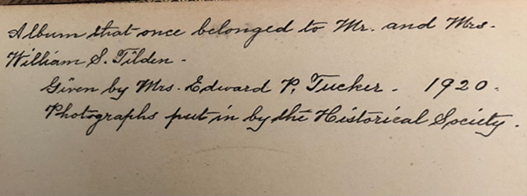
We cannot be certain that the photos in the album belonged to the Tildens, for the album itself was donated to MHS around 1920 by Mrs. Edward P Tucker, and the photos were inserted by MHS volunteers (see Figure 2, Inscription).
| Figure 2 Inscription in Album from 1920 | | |
The donor appears to have been Katie Phillips Fischer Tucker, wife of Edward Payson Tucker. The Tuckers are buried in Vine Lake Cemetery, but the relationship between the Tuckers and the Tildens is not entirely clear… yet; however, we can reasonably assume that the Tildens knew most or all the people pictured. In fact, most or all these Medfielders probably knew each other.
Read more >>
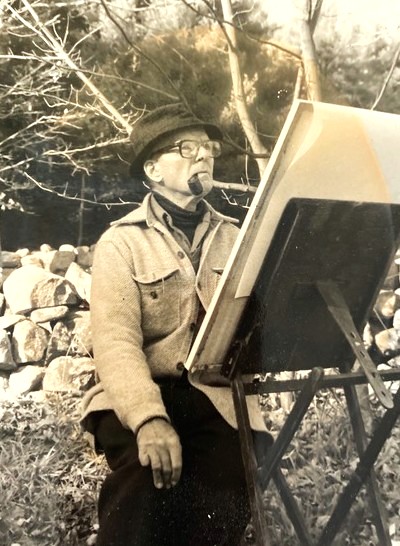
| | People and Places of the Past | | The Legacy of a Roadside Artist | | | | |