|
Market Navigator for the Month Ending February 28, 2026
Presented by Austin Fearon
February was a challenging month for stocks, as concerns surrounding the disruptive nature of AI and shifting geopolitical risks weighed on investor sentiment. Domestic equities ended the month in the red; however, bonds and foreign stocks fared better.
1. Beyond the Headlines: Challenging February for Markets
2. Geopolitical Update: Shifting Risks Impact Markets
3. Economic Report Updates: Slowing Growth
4. Looking Ahead: Shifting Risks
Beyond the Headlines: Challenging February for Markets
Markets were mixed in February, driven by rising investor concern surrounding the potentially disruptive nature of AI and shifting geopolitical risks. The S&P 500 fell 0.76 percent in February while the Dow Jones Industrial Average was up 0.31 percent. The technology-heavy Nasdaq Composite Index was down the most, as the index lost 3.33 percent for the month.
These disappointing returns came despite improving fundamentals. Fourth-quarter earnings season is wrapping up, and the results have been impressive. As of February 26, with 95 percent of companies having reported actual earnings, the average earnings growth rate for the S&P 500 was 13.5 percent. This is well above analyst estimates for an 8.4 percent growth rate at the start of earnings season. The better-than-expected results were widespread, as 10 of the 11 sectors saw earnings growth beat expectations. Over the long run, fundamental factors drive market performance, so the continued earnings growth was a positive sign for investors.
While fundamental factors were supportive in February, technical factors were not. All three major U.S. indices ended the month below their respective 200-day moving averages. This marks the first time that all three indices have finished a month below trend since April of last year. The 200-day moving average is a widely monitored technical signal, as prolonged shifts above or below this level can signal shifting investor sentiment for an index.
International stocks continued to outperform domestic stocks in February. Developed and emerging markets both rose during the month, following strong returns throughout 2025 and the start of 2026. The MSCI EAFE Index gained 4.63 percent for the month while the MSCI Emerging Markets Index did even better, up 5.51 percent.
Fixed Income Update: Falling Rates Support Bonds
Bonds were also up in February, as falling long-term interest rates helped support bond prices. The 10-year Treasury yield fell from 4.26 percent at the end of January to 3.93 percent by the end of February. The Bloomberg Aggregate Bond Index gained 1.64 percent in February while the Bloomberg U.S. Corporate High Yield Index gained 0.19 percent.
Bonds were supported by the broader risk-off sentiment, which drove down long-term yields and served as a tailwind for fixed income investors. Rising tensions in the Middle East contributed to the drop in long-term rates, with short-term interest rates largely unchanged. The U.S.-Israel strikes on Iran signaled a further escalation, which could lead to further support for bonds
The Takeaway
· Bond returns were positive in February due to falling long-term interest rates.
· Shifting geopolitical risks could lead to further support for bonds.
Geopolitical Update: Shifting Risks Impact Markets
February served as a good reminder that markets face a variety of risks and that investors should keep that in mind when constructing portfolios. The major news story in February was the joint U.S.-Israeli strikes on Iran at month-end. This was a largely unexpected development for investors that captured global attention and brought further uncertainty to the region. While the initial market reaction to the news was largely muted, the heightened uncertainty could cause further volatility ahead.
Energy prices rose following the strikes, with oil prices rising sharply. If higher energy prices persist, they could serve as a headwind for future economic growth and contribute to rising inflationary pressure. With that being said, a potential de-escalation in the region could cause prices to fall swiftly. For now, we’ll have to wait and see what the ultimate impact of the escalating conflict will have on energy markets.
The Takeaway
· Geopolitical risks shifted in February; however, the initial market reaction was muted.
· Escalating conflicts in the Middle East could contribute to further uncertainty and market volatility.
Economic Report Updates: Slowing Growth
While geopolitical risks garnered headlines and gathered attention at month-end, the economic updates released in February largely showed signs of slower economic growth. The fourth-quarter GDP report showed that the annualized pace of economic growth slowed from 4.4 percent in the third quarter to 1.4 percent in the fourth quarter. The slowdown was partially driven by a slump in federal spending, which in turn was due in part to the shutdown in October. Looking forward, economists largely expect to see growth pick up in 2026; however, if we continue to see slower growth, it would likely serve as a headwind for markets.
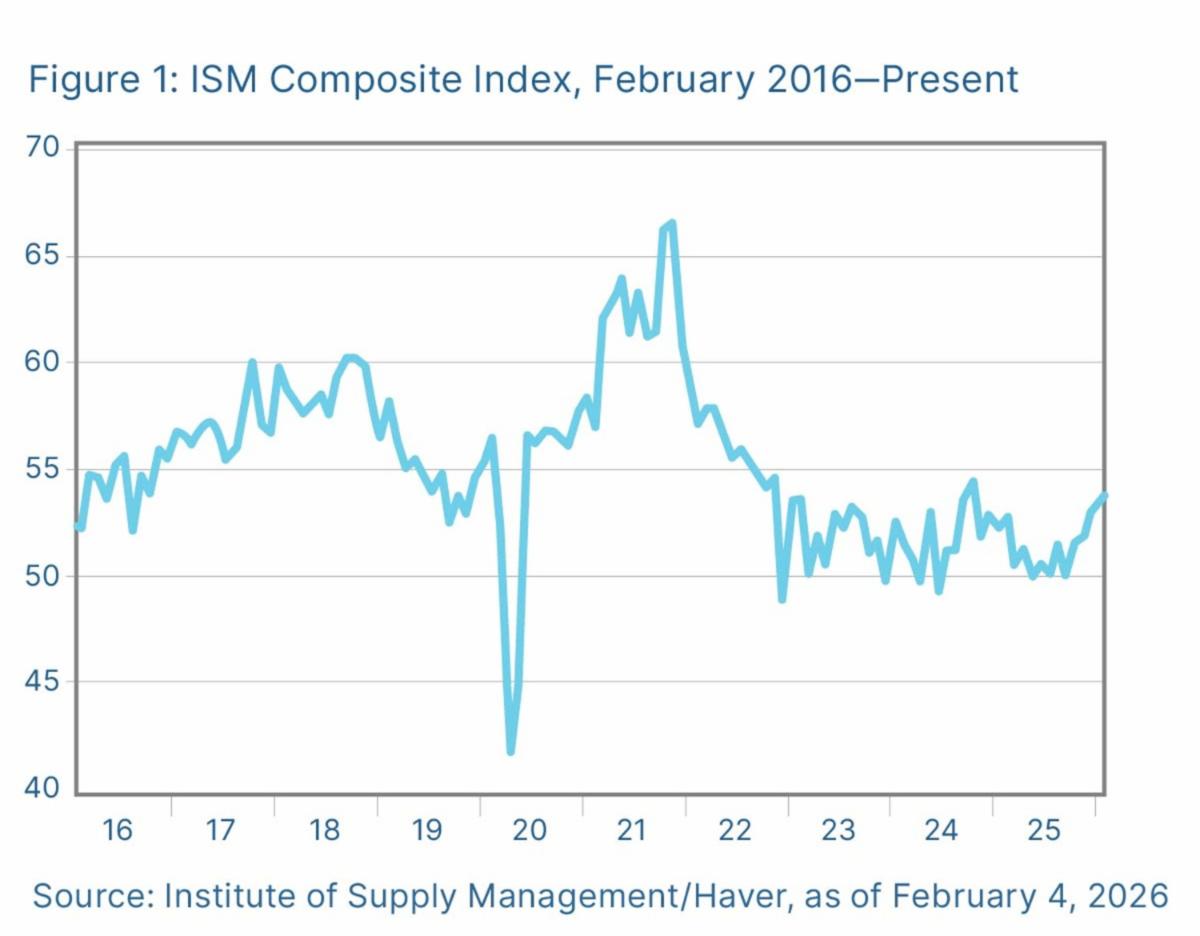
On a more positive note, business and consumer confidence showed signs of improvement during the month. As seen in Figure 1, business confidence, as measured by the ISM Composite Index, hit its highest level in more than a year in January. Manufacturer sentiment, which was a headwind throughout much of 2025, improved notably in January and helped drive the overall improvement for the index. Historically, higher levels of confidence have supported spending growth, so this is a good sign for business investment.
|