Students first. Advocacy second. Support always.

February 27, 2026

A Note from our New Executive Director, Selena Torres-Fossett

Hello CSAN community,


CSAN Policy & Advocacy Update

As we move deeper into 2026, advocacy is active at the federal, state, and local levels. Below is a snapshot of key conversations and how CSAN is positioning the sector.


Federal Advocacy – Washington, D.C.

In February, Dr. Ercan Aydogdu. and I attended the Diverse Charter Schools Coalition Advocacy Day in Washington, D.C. We met with the offices of Senators Rosen and Cortez-Masto to advocate for the modernization of the federal Charter Schools Program (CSP).


Two important federal bills were introduced in January:

FLEX Act – Modernizes the CSP by increasing flexibility, streamlining outdated requirements, and ensuring funds reach classrooms more efficiently.

Equitable Access to School Facilities Act – Addresses one of the most significant barriers to charter growth: access to facilities financing.

Both proposals maximize existing CSP funds without increasing federal spending.


Moving forward, CSAN will partner with Education Advocates to discuss the impact of these bills with federal representatives in Nevada.


Charter School Reserves – Commission on School Funding

On February 20, the Nevada Commission on School Funding discussed charter school reserve balances under the Pupil-Centered Funding Plan (PCFP). No action was taken, but the issue will return in April.


Commissioners acknowledged that charter schools do not receive property tax revenue or dedicated facilities funding. Because of this, reserves are essential for facilities planning, managing enrollment volatility, and maintaining operational stability.


A potential policy under discussion would cap annual PCFP dollars flowing into reserves at 20% (excluding non-PCFP funds). Any reserve cap would disproportionately impact charter schools’ long-term sustainability and facilities stability.


CSAN will continue to engage directly with Commissioners to explain how a cap on PCFP reserves will impact Charter schools in the State.


Regional & Local Engagement

TMRPA approved an MOU with SPCSA to formalize information sharing on new and expanding charter schools. Draft amendments to the school siting policy could affect future charter expansion, and we are monitoring closely.


We also met with the City of Henderson, a new Charter School Authorizer in Nevada, to build a working relationship. The City is on its way to authorizing its first school, Kesher Academy. Since this process is new, we are monitoring closely to determine whether legislative action is needed to improve the timeline for the local government authorizing process.


Call to Action

As conversations around federal CSP modernization, charter school reserves, facilities access, and preparation for the 2027 legislative session move forward, this is an important moment for our sector. The decisions being discussed will directly impact the long-term stability and growth of public charter schools in Nevada.


Your engagement matters!


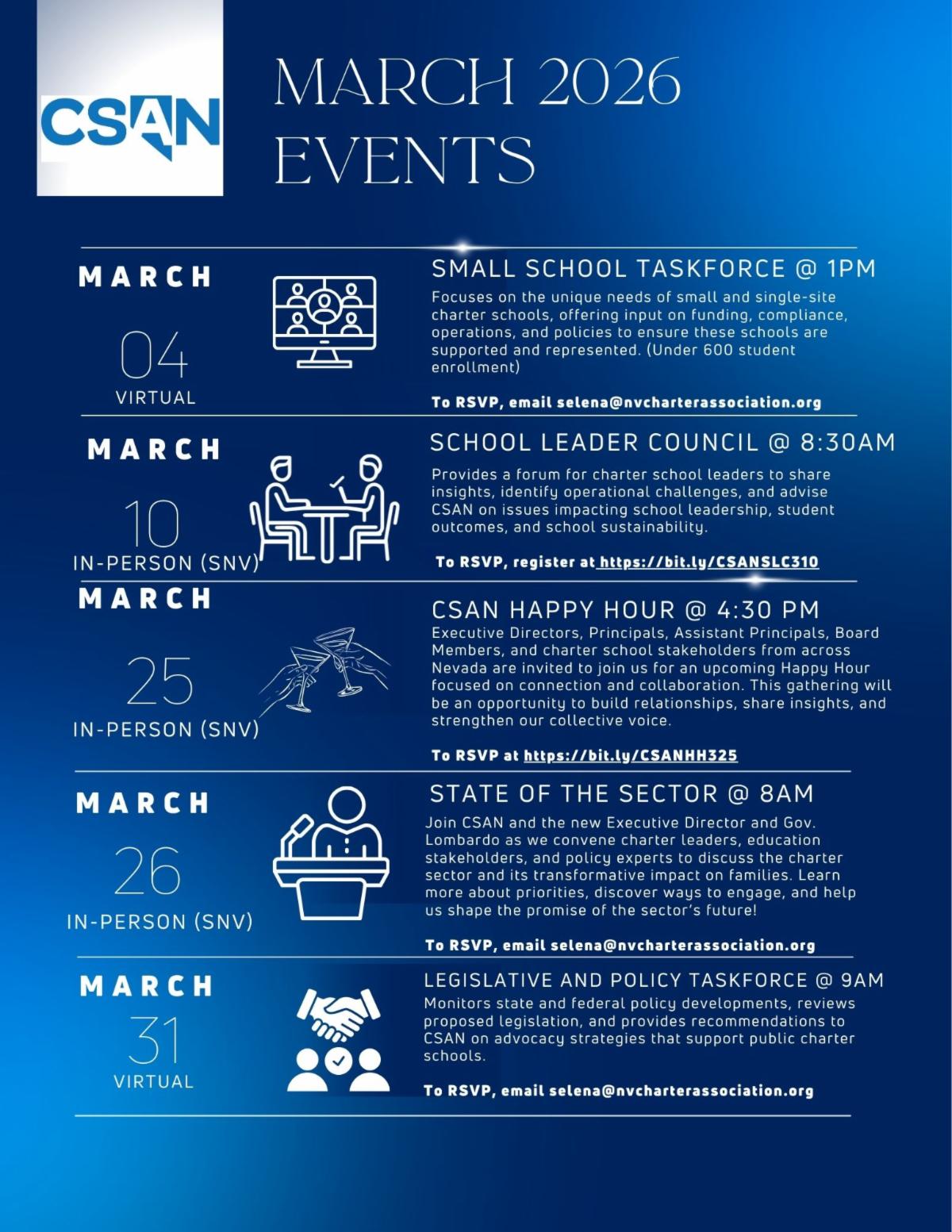
I encourage you to attend our March convenings, including the Small School Taskforce, the School Leader Council, the Happy Hour, the State of the Sector, and the Legislative & Policy Taskforce. These spaces are designed to keep you informed, elevate your voice, and ensure policymakers understand the real impact of their decisions on our schools and students.


In the coming weeks, we may also ask leaders to host school tours and connect directly with elected officials. When we show up together, our collective voice is stronger.


Selena Torres-Fossett

Executive Director, CSAN


Charter Schools in the News

What are charter schools, and how do they compare to traditional school districts?- The Nevada Independent

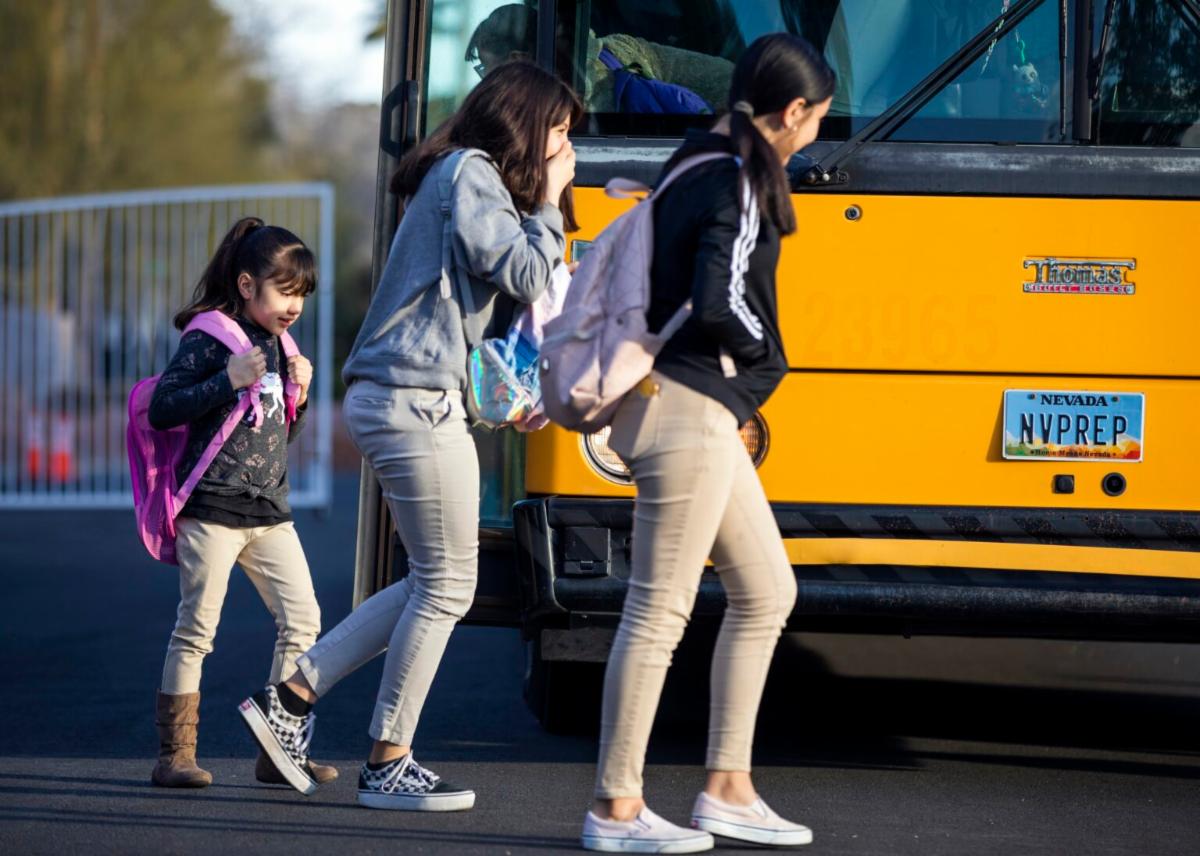
Charter schools are a growing public school option in Nevada, offering tuition-free alternatives to traditional districts with greater flexibility in class size, programming, and instructional models to better meet student needs. Serving more than 70,000 students statewide, charter schools are primarily authorized by the State Public Charter School Authority and operate under appointed boards, while receiving per-student state funding without access to local property tax revenues for facilities. Open enrollment allows students to apply regardless of where they live, with lotteries used when demand exceeds capacity. Recent legislative investments have expanded transportation access, though availability varies by school. Charter schools serve a wide range of grade levels and offer diverse academic, athletic, and extracurricular opportunities, giving families the ability to choose and change schools if a program is not the right fit.

Coral Academy of Science Las Vegas’ Cadence Middle School Receives 5-star Designation

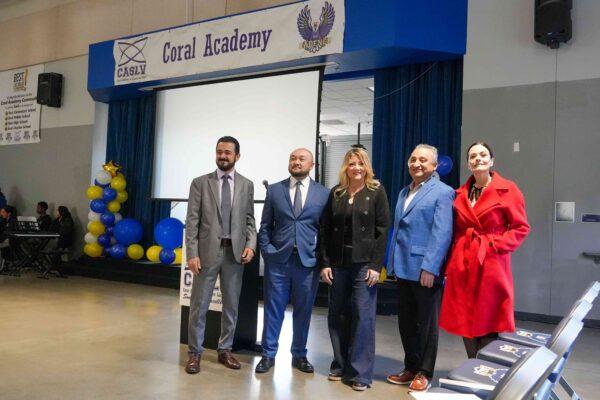
Coral Academy of Science Las Vegas Cadence Campus earned a top distinction after its middle school received a 5 star designation under the Nevada School Performance Framework, marking a major academic milestone for the school community. The achievement was celebrated alongside local and state leaders, including Michelle Romero and Carrie Buck, and reflects the school’s commitment to rigorous, college preparatory, and culturally responsive STEM education. Coral Academy of Science Las Vegas is now accepting applications for all campuses for the 2026–2027 school year.

What does K-12 education in Nevada need? |

Opinion (Pat Hickey)

school_supplies_2.jpg

The Op-ed concerns that American schools are falling behind international competitors, particularly in math and science. While acknowledging frustration with outdated systems and stagnant outcomes, the author argues that completely dismantling and rebuilding the education system would be too radical and impractical. Instead, the piece suggests that reforms should focus on improving and modernizing the existing system rather than tearing it down entirely.

Nevada opts into federal tax credit scholarship program

Nevada Governor Joe Lombardo announced that the state will opt into the new Federal Tax Credit Scholarship Program created under the One Big Beautiful Bill Act, expanding school-choice options for families beginning on January 1, 2027. The program allows individuals to receive a dollar-for-dollar federal tax credit of up to $1,700 annually for donations to approved nonprofit scholarship organizations, with funds supporting K through 12 students for private school tuition and other qualified education expenses. Scholarships will be available to students from households earning up to 300 percent of the area median income, with Nevada responsible for approving eligible nonprofit organizations and coordinating oversight in partnership with the U.S. Treasury.

Ice and ed Reform

Immigration enforcement activity near schools is causing widespread fear among students, families, and educators, leading to sharp drops in attendance, staffing challenges, and a return to remote learning in some communities. At the same time, turning immigration into a broad political litmus test risks dividing education reform efforts and weakening support for policies that improve student outcomes. A focused, shared response is needed that keeps schools safe and accessible, protects in-person learning, and ensures all children can attend school without fear, regardless of differing political views on immigration.

Facebook  X  Instagram