|
Sr. Vice President for Research & Economic Development
Proposal Services & Faculty Support
February Funding Focus Newsletter #2
| | Our editorial team is keeping abreast of the current status of federally funded opportunities. Such opportunities advertised here, to our knowledge at time of publication, are active. However, please continue to check solicitation websites for updates to U.S. Government opportunities of interest. | | |
What is a Limited Submission?
A limited submission solicitation places a cap on the number of proposals Auburn may submit to a sponsor. Auburn coordinates limited submissions with notifications via this newsletter and competitions created in the Auburn University Competition Space (InfoReady). To apply to any limited submission posted in this newsletter, click on the link within the announcement. Please refer to the Limited Submission Procedures page for a general list of requirements.
Found a Limited Submission opportunity that interests you?
If so, please contact the PSFS office sooner than later so that an internal competition can be created for a timely, university-wide, fair and equitable selection process that allows for ample time for review, feedback and revisions.
| | Limited Submission Announcements | | |
DOE: Building EPSCoR-State/National Laboratory Partnerships
DOE’s Established Program to Stimulate Competitive Research (EPSCoR) program announces its interest in receiving applications for Building EPSCoR-State/DOE-National Laboratory Partnerships. These partnerships advance understanding of the physical world by supporting fundamental, early-stage energy research collaborations with the DOE National Laboratories.
Participation by undergraduate students, graduate students, or postdoctoral fellows is required. Early career faculty from EPSCoR jurisdictions are encouraged to apply. Utilization of DOE user facilities is encouraged.
Institutions are allowed two pre-applications in each of the program areas listed below as the lead organization:
a. Advanced Scientific Computing Research
b. Basic Energy Sciences
c. Biological and Environmental Research
d. Fusion Energy Sciences
e. High Energy Physics
f. Isotope R&D and Production
g. Nuclear Physics
h. Office of Critical Minerals & Energy Innovation
i. Office of Cybersecurity, Energy Security, and Emergency Response
j. Office of Electricity
k. Office of Environmental Management
l. Hydrocarbons & Geothermal Energy Office
m.Office of Nuclear Energy
**Please Note that Application Requirements for this competition differ from Standard Limited Submission Requirements.
Institutional Limit: 2 Pre-proposals per program area
Internal Deadline: Tuesday, March 3, 2026, 4:45pm
Funder Pre-proposal Deadline: March 18, 2026, 5:00pm ET
| | |
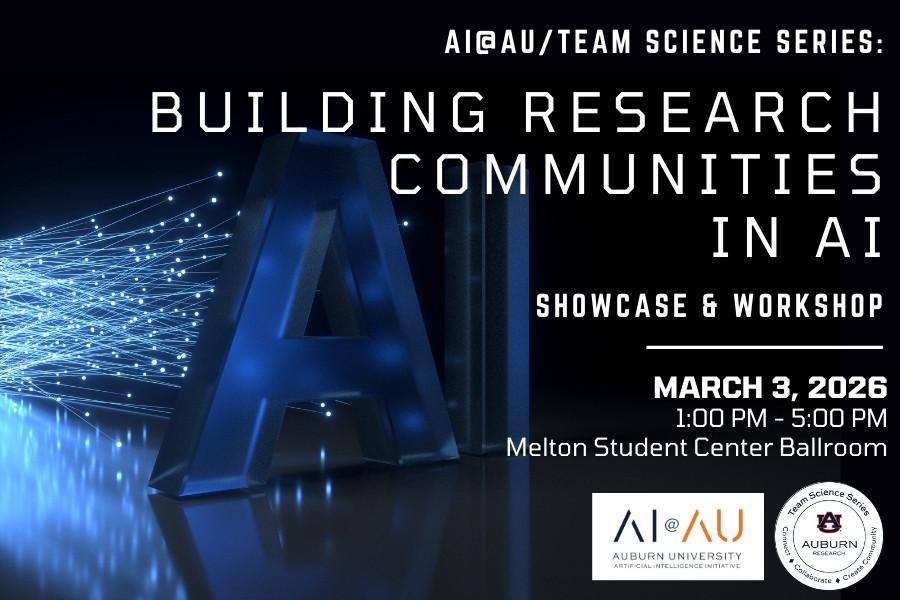
Open to faculty, staff, post-docs and students, this AI@AU/Team Science Series Showcase and Workshop features current applications and investigations of AI in AU research.
- Increase your awareness of how AU researchers are applying and investigating AI
- Explore connection opportunities
- Garner resources and information
- Engage in timely discussions among participants
Posters Sessions
Digital Slide Presentations
Lightning Talks
Round-table Group Discussions
Keynote Speaker
Introducing Aubria: Our AI-generated Keynote Speaker
| **Faculty who submitted an abstract and plan to attend should also register here** | | |
Auburn Author Awards: Nominations Now Open
The Auburn Author Awards - co-sponsored by Office of the Senior Vice President for Research and Economic Development, Auburn University Libraries and the Graduate School - recognize faculty and staff who published a book-length scholarly work during the previous calendar year. Recipients are recognized in an annual spring semester ceremony (April 23).
The Auburn Author Awards program is now accepting nominations through March 1, 2026.
| |
|
American Psychological Foundation (APF): Visionary Grants
The APF Visionary Grants seek to seed innovation through supporting research, education and intervention projects and programs that use psychology to solve social problems in the following priority areas:
- applying psychology to at-risk, vulnerable populations (e.g., serious mental illness, returning military, those who are incarcerated or economically disadvantaged);
- preventing violence;
- understanding the connection between behavior and health (e.g. wellness, diabetes, obesity);
- understanding and eliminating stigma and prejudice (e.g., race, gender, sexual orientation, religion, age, disability, and socioeconomic status);
- furthering racial equity: APA has requested funds from their fund at the Tides Foundation to fund a Visionary Grant that is focused on furthering racial equity.
Eligibility is confined to graduate students or early career researchers (no more than 10 years postdoctoral). Pilot projects will take preference.
Applications Due: April 3, 2026
| |
|
Google.org Impact Challenge: AI for Government Innovation
This is a global initiative to help governments use AI to transform how public services function for social good — from everyday essential services to complex societal challenges.
Proposals should address a critical public service challenge through data-driven solutions that drive significant, measurable outcomes for communities, leverage strong government partnerships, and demonstrate a deep understanding of how end beneficiaries will be reached and supported. Proposals should leverage generative or agentic AI applications that go beyond incremental change, accelerating high-potential solutions or enabling new ideas that address the core problem in line with Google’s AI Principles.
This program is not an opportunity to support research proposals. Google is looking for projects with clear visions and action plans to develop technology that will be applied to impact a specific set of end beneficiaries. Beyond funding, selected organizations will receive dedicated pro bono technical support from Google AI experts through a multi-month Google.org Accelerator to help bring these projects to life.
Applications Due: April 3, 2026 at 11:59PM PT
| | |
David, Helen and Marian Woodward Fund: Capital Projects and Education Improvement Fund
This foundation supports capital improvement and project initiatives across diverse fields, including education, arts, health, environment, human services, international affairs, religion, and public benefit, aimed at fostering a better world for future generations.
Applications Due: April 1, 2026
**If interested in this opportunity, please contact Evan Havard with AU Foundations and Corporate Relations Office.
| | |
NSF: Fire Science Innovations through Research and Education
This program supports convergent research, education and networking activities to improve understanding, prediction and resilience to wildland fire and its interactions with communities, infrastructure and the natural environment. It includes a focus on new modeling and computational approaches to understand wildland fire (including artificial intelligence and machine learning approaches). The prrogram invites innovative multidisciplinary and multisector investigations focused on convergent research and education activities in wildland fire.
Applications Due: April 7, 2026, 5:00pm CT
| | |
PCORI: Broad Pragmatic Studies
On April 1, 2026, PCORI will announce an RFP to fund patient-centered comparative clinical effectiveness research projects. PCORI will seek proposals that compare clinical interventions (e.g., pharmacological and nonpharmacological treatments, screening and diagnostic approaches) and healthcare delivery system interventions (e.g., workforce, technologies, healthcare service delivery designs) to evaluate potential benefits and harms of different treatment and care delivery options, thus generating evidence that empowers patients, caregivers and the broader healthcare community with information to make informed choices that reflect their needs and preferences.
**Applicant Town Hall
April 9, 2026; 11:30 am (ET)
Initial Applications Due: April 28, 2026, 5:00pm ET
| | |
Explaining the NIH Public Access Policy
Researchers who publish NIH-supported work are subject to the NIH Public Access Policy, which requires manuscripts to be submitted to PubMed Central and be publicly available from the date of publication. While previously this policy allowed for a 12-month embargo, as of now public access in PubMed must be immediate upon publication.
While some scholarly publishers encourage authors to pay a fee to publish open access in their journals, paying open access fees is never required to comply with NIH policy. Instead, it is critical researchers save their author accepted manuscript (AAM), the version of the article that was accepted after peer review but does not yet have any publisher copyediting or formatting. This version may be double-spaced, have a ragged right margin, or have tables and figures at the end of the text, but content should otherwise be the same as the final published article.
The AAM should be deposited into PubMed Central without delay upon acceptance, and the date it becomes available should coincide with the article’s date of publication.
Auburn researchers supported by federal funding should routinely save and retain the AAM version of all articles on which they have authorship. Compliance with NIH and other federal public access policy is the responsibility of the grant PI, not the corresponding author, for any given work.
For researchers with questions about providing public access to their AAMs, subject librarians at Auburn University Libraries are available to help.
| | |
USDA NIFA Programs Transitioning to eRA Commons
USDA NIFA is transitioning new Funding Opportunity Announcements within the following programs to the eRA grants management system in early 2026 (there have been some delays due to the fall government shutdown):
- Agricultural Genome to Phenome Initiative
- Equipment Grants Program
- Farm Business and Benchmarking Program
- Food and Agriculture Service-Learning Program
- Food Safety Outreach Competitive Grants Program
- Organic Agriculture Research & Extension Initiative
- Renewable Resource Extension Act National Focus Fund Program
- Secondary Education, Two-Year Postsecondary Education, and Agriculture in the K-12 Classroom Challenge Grants Program
- Smith-Lever Special Needs Competitive Grants Program
What Does This Mean for You?
If you are planning on applying for one of the above opportunities, you should register for eRA Commons as soon as possible. Please see their announcement for more information on how to create an account with eRA Commons.
Important Note: Only new applications to the above programs are moving to eRA at this time. Prior awards will continue to operate using previous systems and processes. In addition, while other programs are not yet transitioning, if you propose to any USDA NIFA programs, you may want to consider registering as all will be transitioned in the next two years.
Looking Ahead
NIFA is working to include additional programs throughout FY 26 and beyond. Keep an eye out for more updates as they continue to modernize their grants management system. For updates and announcements on NIFA’s Grants Modernization Initiative (GMI) and eRA migration, visit the GMI webpage.
| | |
In Order to Set-up an eRA Commons Account at Auburn
Send the following information to the appropriate College-level designee or OSP Sponsored Programs Officer:
First Name:
Middle Name (optional):
Last Name:
AU Email:
Preferred Username (please provide 3 options):The User ID length should be between 6 and 30 characters and should NOT contain special characters except the @ sign, the hyphen, the period, and the underscore.
**Note that proposal submission to NIFA will continue to be handled through Endeavor/System-to-System transmission. The eRA Commons access will be primarily for post-award actions. However, the eRA Commons user ID will be a required field at proposal submission.
| | |
NASA Grants Webforms/Research Security Update
Effective January 28, 2026, NSSC Grants Activities Branch (GAB) has discontinued all external webform pages due to security concerns.
Impacted webforms:
- Grant/Cooperative Agreement Administrative Supplement Request (includes No-Cost Extensions)
- Grant/Cooperative Agreement Research Performance Progress Report Submission
- NSSC Grant PI Transfer Request
Updated submission process for NASA grantees:
These updates are effective immediately and replace the discontinued webforms. Following these instructions will ensure timely processing of reports and requests.
NASA Research Security Update
The Office of Procurement (OP) has published Grant Information Circular (GIC) 26-02, Research Security Training Requirements. GIC 26-02 implements research securit y training requirements for covered individuals listed on NASA grant and cooperative agreements proposals in accordance with section 10634 of t he CHIPS and Science Act of 2022.
Starting August 2026, covered individuals will be required to attest that they have met the training requirements outlined in the GIC, and entities' Authorized Organizational Representatives will have to attest that covered individuals employed by their entity have satisfied the requirement. The GIC provides further details on who is considered a covered individual and training modules that may be taken to satisfy the requirements.
| |
|
Hanover Research Webinars
Revamping Your Grantseeking Strategy in a Changing Landscape
Thursday, February 26, 2026
11:00am CT
This webinar offers practical strategies for building successful partnerships with industry, emphasizing the importance of understanding cultural differences and aligning goals for mutual benefit. Attendees will learn how to communicate effectively, initiate collaborations, and leverage a wide range of engagement opportunities.
Register Here.
| | |
Hanover Research Queue Proposal Review Availability
Slots available March 13 - April 20 and after May 18
Auburn University has partnered with Hanover Research for a number of grant development solutions including Pre-proposal Support; Proposal Development; and Capacity Building. Hanover's full-service grant development solutions are available to set goals, build strategies to achieve key grant-seeking objectives, and develop grant proposals that are well-planned, researched, and written.
For information regarding Hanover’s core capabilities and project timelines, click here. If you are interested in a slot in the queue, please e-mail Tony Ventimiglia.
| | |
Hanover GLC Modules for NIH, NSF-CAREER & Grant Development
The Hanover Research Grants Learning Center (GLC) on-demand grant development training portal offers faculty enrollees the unique opportunity to receive targeted training through self-paced, interactive modules with step-by-step guidance and templates for prospective applicants to develop compelling proposals. In addition to NIH and NSF-CAREER modules, AU faculty now have access to a variety of new modules on grant seeking, development and revisions.
Auburn faculty interested in signing up for this training should contact Christine Cline for registration information.
| | |
Free CITI Training Modules
Auburn subscribes to several training modules via the CITI Program website that may be of interest to researchers and research administrators. Each module is self-paced and can be finished in one or multiple sessions. Click on the link above to read descriptions.
- Essentials of Grant Proposal Development
- Essentials of Research Administration
| | Limited Submission Reminder | | |
DOE: Energy Frontier Research Centers (EFRCs)
The DOE SC program in Basic Energy Sciences (BES) announces a re-competition of the Energy Frontier Research Center (EFRC) program and encourages both new and renewal applications. Applications from multi-disciplinary teams will be required to propose discovery science and use-inspired basic research that address scientific challenges in one or more of the topic areas listed below. The focus of the EFRC program is on fundamental scientific research, therefore applications to this NOFO must not propose applied research and technology development activities.
BES is soliciting applications in two general categories: BES Report Topics and Special
Topics. Applications may respond to topics in both categories.
In the BES Reports Topics, applicants must address priority research directions (PRD) and opportunities (PRO) identified in one or more of the following reports (see full description for PRO/PRD restrictions):
- Foundational Science to Accelerate Nuclear Energy Innovation
- Controlling Subsurface Fractures and Fluid Flow: A Basic Research Agenda
- Basic Research Needs for Next Generation Electrical Energy Storage
- Basic Research Needs for Transformative Manufacturing
- Basic Research Needs for Microelectronics
- BES Roundtable on Opportunities for Quantum Computing in Chemical and Materials Sciences
- BES Roundtable on Opportunities for Basic Research for Next-Generation Quantum Systems
In the Special Topics, applicants must address one or more of the following topics (see full description for details):
- Controlling Quantum Phenomena to Enable Unconventional Computing Paradigms
- Development and Workflow Integration of AI/ML Models for Materials and Chemistry Discovery Science
- Emergent Phenomena of Complex Chemical Systems
- Fundamental Science for Critical Minerals and Materials (CMM)
**Please Note that Application Requirements for this competition differ from Standard Limited Submission Requirements.
Institutional Limit: Three (3) Pre-Applications
Internal Deadline: Friday, February 27, 2026, 4:45pm
Funder Deadline: April 1, 2026, 5:00pm ET (*Note Corrected Funder Due Date)
| | The federal funding landscape is changing daily, necessitating extra due diligence on the part of funding seekers. When perusing a solicitation, 1) make sure you are viewing the latest version, 2) read all notes in the headers and margins, and 3) follow provided links to ensure a solicitation is still active and accepting applications. | |
Proposal Services & Faculty Support
| | | | |