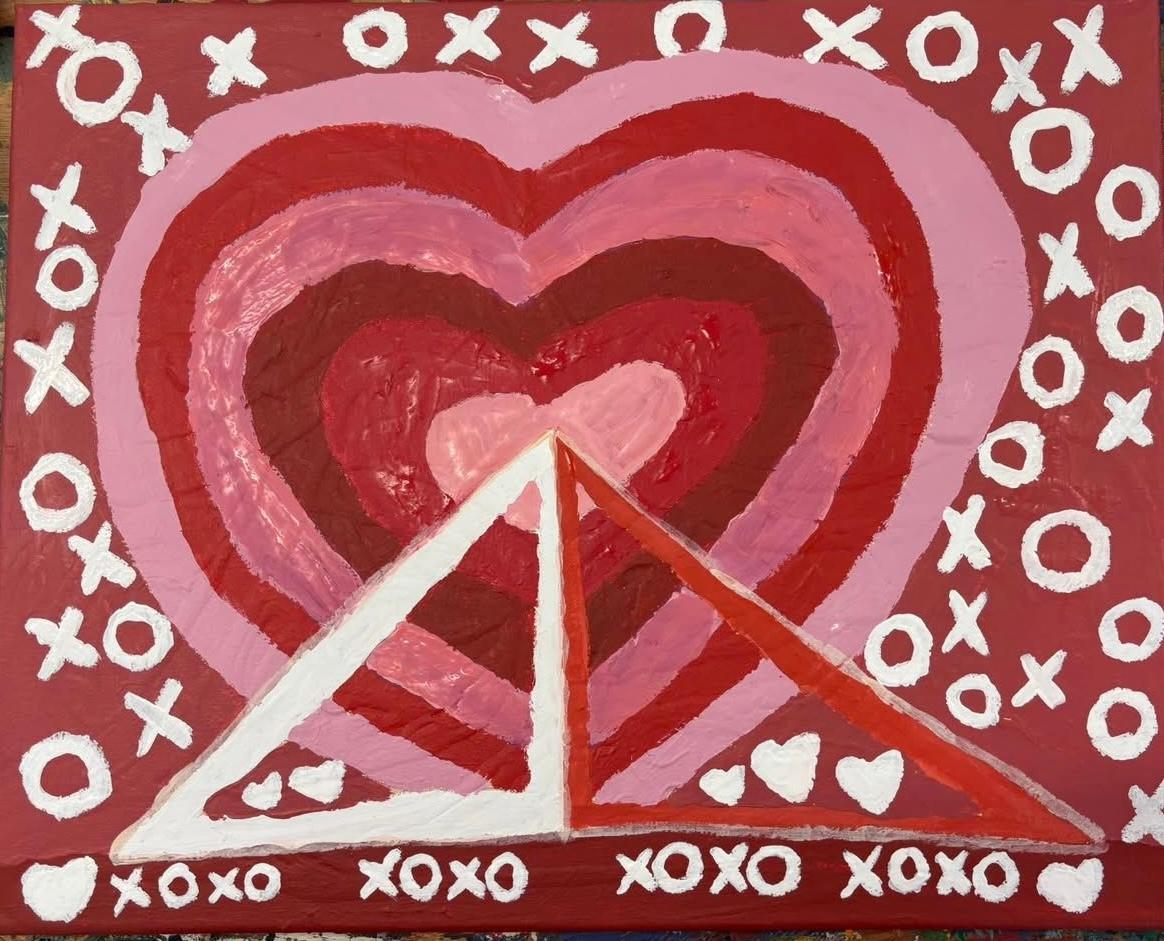
Valentine painting — “Love Pyramid” by Kieran. I’m not sure what a love pyramid is, but I am sharing with good wishes for a wonderful Valentine’s Day. | | |
When my son, Kieran, was first diagnosed, we were told that Applied Behavior Therapy was the only treatment, but it “wasn't available” where we lived. As we began reading everything we could find on Autism therapies, we found that there was not yet much research on the alternatives. We adopted a “throw it at the wall and see what sticks” approach to Autism therapy. If a therapy seemed to have negligible adverse effects, appeared not to be “snake oil” and we could afford it, it went onto the list of possibilities. Over the years, we have taken some flack from certain professionals for our choices, but we have never regretted any of them.
Our first foray into alternative treatments was DMG – a dietary supplement recommended by Dr. Bernard Rimland – one of the founders of Autism Society of America. I telephoned his office out in California to ask about it and was impressed when he personally answered the phone and discussed the treatment with me.
Thirty years later, there are still mixed opinions, and some research on dimethylglycine, indicating that while it may or may not be helpful to certain individuals, it is not harmful. Kieran's experience with it was limited by how quickly he figured out which gum drop I had hidden the chewable in – he ate the others with relish and declined to ingest the important one. This was truly a “no harm, no foul” Autism intervention. It was unsuccessful, but inexpensive.
Next, we tried Auditory Integration Therapy – the Berard method. For us, this was a huge success – I'm sure scientists would call it “anecdotal” evidence, rather than scientific proof. However, almost immediately after the first treatment series, he was able to take a shower – something he had never been able to tolerate before. When the shower went on, he covered his ears and shrieked. I have been roundly criticized by some professionals for approving of AIT on the basis of a lack of controlled research proving its efficacy. It is currently considered experimental treatment. I'm fine with that. We can't prove that Kieran's desensitization to the sound of a shower was caused by or merely a correlation to the AIT, but we are grateful for the past 27 years of happy showers!
Another unproven, but effective in Kieran's case, treatment we tried was treatment for yeast overgrowth. After attending a presentation at a conference, I talked to our pediatrician about it. She, in turn, consulted an Autism specialist who told her there was no evidence that such treatment had any effect on Autism. Our doctor, however, felt that there would be no adverse effect in prescribing anti-yeast medication, adopting our “throw it at the wall” approach. Kieran loved the lemon-flavored discs and, lo and behold, after a few weeks, his feet stopped stinking, his abnormal flatulence disappeared and his diet expanded from yogurt, chocolate milk, pizza with the cheese removed and anything sweet to pretty much everything. This experimental treatment had a huge effect on this one individual.
These experiences were clearly reflected at the time in the Autism Society's options policy. In 2011, this policy stated:
"The Autism Society promotes the active and informed involvement of family members and the individual with Autism in the planning of individualized, appropriate services and supports. The Board of the Autism Society believes that each person with Autism is a unique individual. Each family and individual with autism should have the right to learn about and then select the options that they feel are most appropriate for the individual with autism. To the maximum extent possible, we believe that the decisions should be made by the individual with autism in collaboration with family, guardians and caregivers."
The wording has changed somewhat over the years, but the basic premise is the same – therapies and supports should be an informed decision by the individual and family and tailored to individual needs. This empowers us to continue to pursue what safely works for our person, no matter what might work for the majority.
| Kathi J. Machle, President | | |
Salt Dough Activity idea:
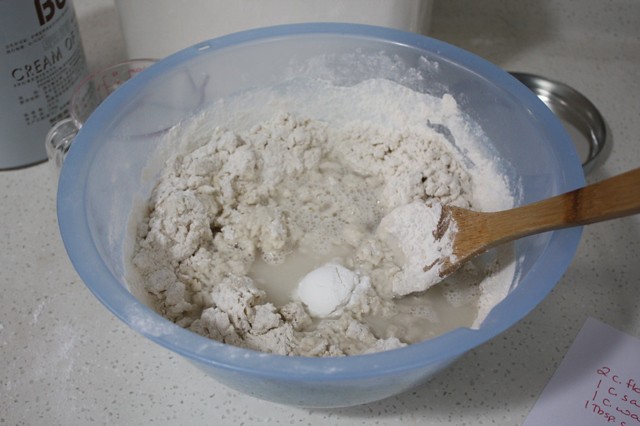
As I write this, we are snowed in. It reminded me of the months we stayed at home for COVID. During that time, I created several activity boxes which we mailed to central Ohio families to help them keep occupied. As winter lengthens, I thought I'd share our Salt Dough Recipe. We recommended using it to create “fossils” with a plastic dinosaur. However, it could also be used to create hearts for Valentine's Day or shamrocks for St. Patrick's Day. It provides some math skills (measuring), motor skills, and sensory input any time!
| | |
MATERIALS:
- 1 cup salt
- 2 cups flour
- ¾ cup water
- Toothpick
- Oven
| | |
ACTIVITY:
1. Combine salt, flour, and water in a bowl. Mix well until a soft dough forms. Stirring is a great task to get your kiddo involved in baking!
2. When the dough forms, scoop out small fistfuls to shape into flattened rounds, similar to the shape and size of a cookie. Press your animal toy into the dough for a fossil, or roll out with a rolling pin and cut with cookie cutters.
3. Using a toothpick, sign your name or initials at the bottom of each ornament and make a hole at the top.
4. Bake at 200 degrees until your fossils/shapes are hard and dry. Timing depends on size – if fossils are small and flat, it may only take 45 minutes. Larger, thicker fossils can take 2-3 hours. We recommend doing this activity first and then the rest while your fossils are baking!
5. Remove fossils from oven. Once cool, you can paint them or color with markers. Cut a few 5-6” pieces from your ribbon to hang them.
| | |
Registration is now open for the Disability Policy Seminar, taking place March 23–24 in Washington, DC. The Autism Society is proud to partner on this important event alongside The Arc of the United States, the American Association on Intellectual and Developmental Disabilities, the Association of University Centers on Disabilities, Caring Across Generations, Disability Belongs, the National Alliance for Direct Support Professionals, the National Down Syndrome Congress, United Cerebral Palsy, Self Advocates Becoming Empowered, and TASH.
This year’s seminar features a streamlined format: one day of in-depth policy training followed by a dedicated day on Capitol Hill, where participants will advocate directly with their Members of Congress on critical disability policy priorities.
Learn more and register at disabilitypolicyseminar.org/.
| |
ASO is preparing for its 2026 grant cycle. If you have a project for which you seek funding in any of the counties not served by a local affiliate (Adams, Allen, Ashland, Athens, Auglaize, Belmont, Brown, Carroll, Clark, Clinton, Coshocton, Crawford, Erie, Fayette, Gallia, Guernsey, Hardin, Harrison, Highland, Hocking, Holmes, Huron, Jackson, Jefferson, Lawrence, Mercer, Meigs, Monroe, Morgan, Muskingum, Noble, Perry, Pike, Richland, Ross, Scioto, Tuscarawas, Van Wert, Vinton, Washington, or Wyandot) you can find information at autismohio.org/grants.
ASO also provides funding to your local affiliate to ensure that Autism programming and awareness is spread throughout Ohio's 88 counties.
| | |
The Autism Society relies upon the tremendous work of our local organizations to help individuals and families throughout Ohio. If you don’t see your county listed below, please contact the Autism Society of Ohio so we can connect you with support and services in your area. For more information, call 614-495-7551 or via email at info@autismohio.org
For information about events and support groups sponsored by other local Autism Society Affiliates, click HERE. The page identifies counties covered by a local affiliate and provides contact information.
| | |
Band Together Central Ohio is going on the road! In addition to its regularly scheduled open mic (Gatsby's in Gahanna on the second Sunday of every month), Band Together artists will be performing at Franklin Park Conservatory's Autism and Art event on March 1 from 11 AM to 2 PM. This is in conjunction with FPC's Community Day (free admission for Franklin County Residents). On March 21, BTCO artists will be performing at the Songs for Sarah fundraiser on March 21 at Eldorado's Food and Spirits.
Autism Society Central Ohio has more information about this and other events.
| | NOW is a great time to order ASO merch for yourself or give as a gift. Find your new favorite hat, T-shirt, and more on our website! | | |
Looking for a fun and impactful way to support those with Autism in your community or throughout the state? Consider hosting a third-party fundraising event! Whether you're an individual, business, or organization, there's something for everyone to get involved in. These events raise vital funds, spread awareness, promote inclusivity, and can significantly impact families living with Autism.
Let's make a difference together!
| | |
Examples of third-party events:
- Sip and paint
- Car washes, craft shows, or bake sales
- Casual Fridays and holiday parties
- Grand openings and store promotions
- Art shows/art auctions
- Bike-a-thon, walk-a-thon, bowl-a-thon
- Golf tournaments
- Black-tie events
- 5k races and marathons
| | STATE AND NATIONAL ADVOCACY | | |
Autism Society of America continues to monitor what is happening in Washington. For updates on national legislation, you can subscribe to The Capitol Connection.
ASO has continued its advocacy statewide. Please reach out to us with comments or concerns. Your voice is important.
|
| | | |