|
Across the nation, children and families are suffering at the hands of executive directives and illegal actions that continue to devastate communities, especially individuals and families who have long been pushed to the margins.
ICE operations have proven deadly, traumatic, destabilizing for families, and are profoundly and negatively impacting students. And even for those not directly targeted, these actions eviscerate fundamental rights, fracture community trust, and diminish security for all of us. Our children and their families need safe, welcoming communities and schools to thrive.
At times of uncertainty, fear, and instability across our nation, ELC-PA remains deeply committed to a cornerstone of our democracy: public education. Thanks to each of you for your partnership and advocacy during these difficult times.
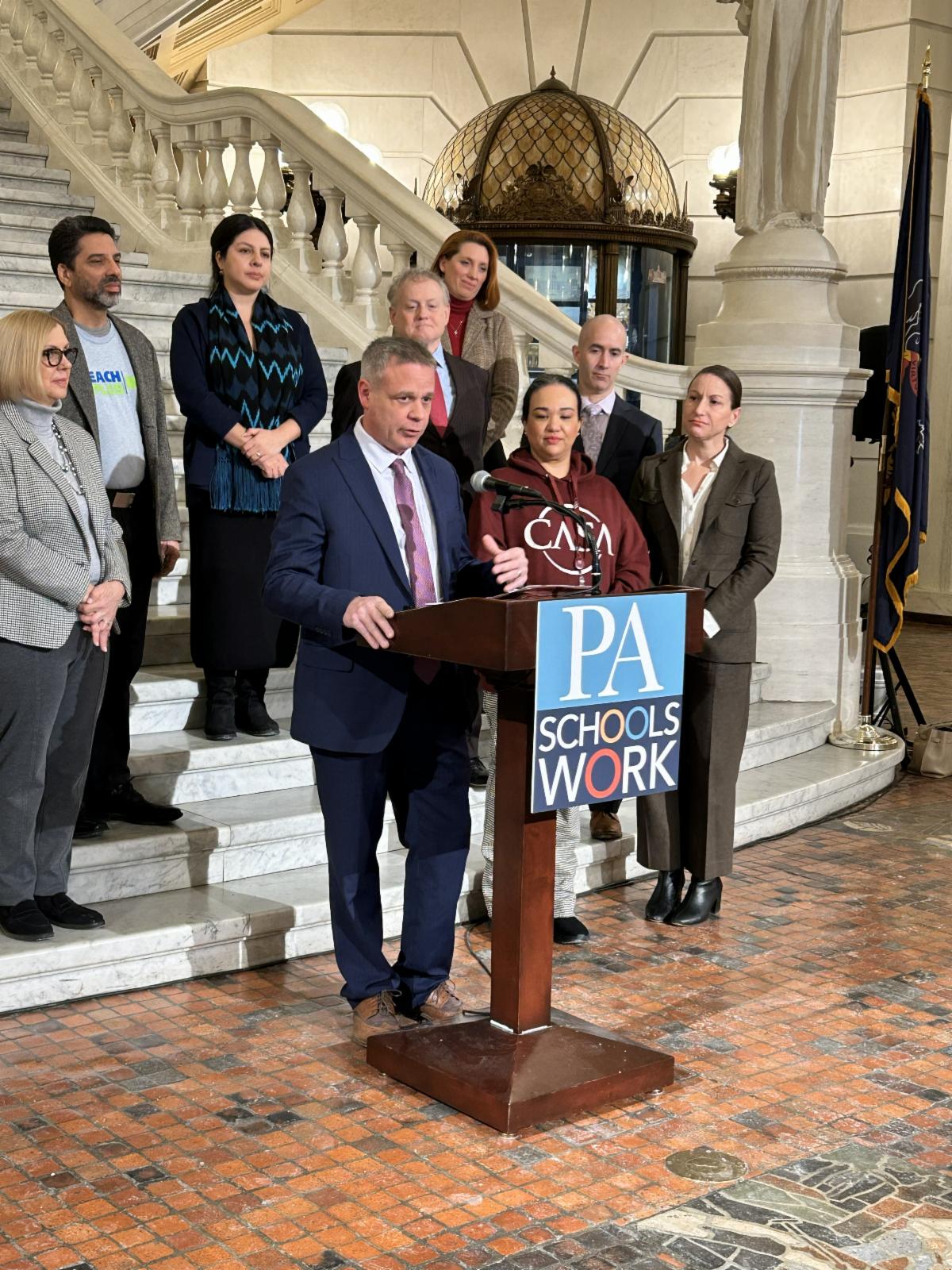
| School Funding Is on the Line | | Jason Moser, Superintendent of Lehighton Area School District, described the tangible impact adequacy funding has had in his community and urged Pennsylvania lawmakers to close the adequacy gap. Photo credit: John Neurohr | |
Tomorrow, Governor Shapiro will unveil his FY27 budget proposal. Following the Commonwealth Court's 2023 decision declaring Pennsylvania's school funding system unconstitutional, the state has made progress with two years of increased adequacy funding. Entrenched underfunding has disproportionately impacted Black and Brown students, as well as immigrant and low-income students, who have borne the greatest harm from decades of state disinvestment. We call on Governor Shapiro and the General Assembly to include a third installment of adequacy funding in the upcoming budget to continue closing the remaining $3.8 billion adequacy gap with greater urgency and ensure every Pennsylvania student has access to a quality education.
Investments made through the adequacy formula are already delivering real benefits for students, including hiring more kindergarten teachers, developing mental health programming and hiring staff, expanding afterschool tutoring, supporting STEM education, reopening school libraries, reducing class sizes in early grades, and more.
Last week, PA Schools Work released a set of fact sheets for the 360 school districts across the Commonwealth with an adequacy gap. These fact sheets detail how much adequacy funding the districts have received during the past two budget cycles and how much funding is needed to fill their remaining adequacy gaps.
What’s needed now is bold action: a third installment of increased funding based on a more expeditious plan for fully funding our schools, reflecting the urgency underscored by the Commonwealth Court’s February 2023 ruling. Please join us in this critical advocacy throughout this winter and spring. The first action you can take is to join our partners at Education Voters of PA for a deep dive into Governor Shapiro's proposed 2026-2027 budget for education on February 10 at 7 p.m. Register here. And then consider joining Families for Equitable School Funding and special guest, Molly Sweeney of 482Forward for an interactive training on power mapping — a critical organizing tool for advocates — on February 17 at 6 p.m. Register here.
| | New Resource: Implementing Pennsylvania's CROWN Act | | |
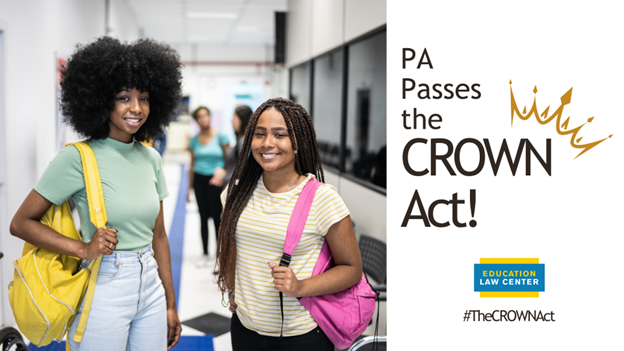
Students have the right to be free from illegal racial hair discrimination, including discrimination against students for the texture of their hair or for wearing a protective hairstyle such as locs, twists, braids, afros, and Bantu knots. Pennsylvania’s CROWN Act is now in effect and schools must ensure their compliance. This law is an important component of continuing efforts to end racial discrimination in schools and something that Black girls in Pennsylvania have been demanding for many years. Schools cannot adopt or enforce rules that discriminate against students for their hair texture or for wearing a protective hairstyle, and districts and charter schools must review and revise existing rules to comply with this new and important law.
ELC-PA has just published a new resource to help school boards, administrators, and educators as well as families, students, and advocates understand this new law and what it means in practice. This guide explains why eliminating illegal racial hair discrimination is important and what schools must do to ensure their compliance. Visit CROWN Act Prohibits Racial Hair Discrimination to learn more.
Students who are experiencing racial hair discrimination in public schools — or their caregivers and advocates — can reach out to ELC-PA's Helpline (215-238-6970, Eastern and Central PA or 412-258-2120, Western PA) by phone or online for free and confidential legal advice. Students and caregivers can also file a complaint with the Pennsylvania Human Relations Commission.
| | Celebrating 100 Years of Black History Month | | |
In February, we join educators, students, and families across the country to celebrate Black History Month, a time to honor the brilliance, resistance, and power of Black people. Its founding purpose remains deeply relevant today as the federal administration continues efforts to roll back essential rights and protections against racial discrimination.
This year marks a significant milestone: the 100th anniversary of Black History Month. First established in 1926 by scholar Carter G. Woodson, Black History Month began as “Negro History Week,” and was rooted in a belief that history has the greatest impact when it tells the full story of Black people’s lives and leadership. We see this clearly through the life and legacy of Claudette Colvin, who died recently at the age of 86. In March 1955, Colvin was a 15-year-old student when she refused to give up her seat on a segregated Montgomery bus, months before Rosa Parks’ more widely known act of resistance. Colvin later shared that her courage came directly from what she had learned during Black History Month at school. She described feeling the presence of Sojourner Truth and Harriet Tubman beside her, giving her the strength to stay in her seat.
Colvin’s story is a powerful reminder of what happens when young people have access to honest history. This Black History Month, we celebrate Black students – their brilliance, their leadership, and their advocacy – and the educators who make space for Black history and joy in the classroom. While February offers a moment of reflection, we know that Black history does not belong to a single month, and that the stories, voices, and histories of Black people should be centered every day.
We encourage readers to learn more about Claudette Colvin and learn about Black students, educators, parents, and advocates who have worked toward creating affirming, anti-racist schools in our report, We Need Supportive Spaces That Celebrate Us: Black Girls Speak Out About Public Schools.
| | Immigrant Students Have the Right to Access School Safely | | |
Schools must be safe and welcoming places where every student can learn and thrive. But increases in violent immigration enforcement activity and disinformation have created fear and confusion, causing immigrant students and their families across Pennsylvania and the country heightened fear and anxiety and increased absences at school, prompting many educators to ask what they can do to support students.
To support students, educators, parents, and community partners, we’ve compiled and curated key resources that explain students’ rights, schools’ responsibilities, and offer practical tools for navigating these issues.
We’ve developed school-focused resources that include an overview of the basic rights of immigrant students and their families in school settings. This overview explains what schools are legally obligated to do and what families should know to ensure that students’ learning isn’t disrupted. This resource is available in English and en Español. ELC-PA is working with partners to provide rights-based information as community and parent groups develop Safe Passage and rapid response groups around their school communities. Call our Helpline for more information.
We also highlight trusted partner resources on immigrants’ rights and legal advocacy. Access all of these resources in one place on our new Resource Page: Immigrant Students’ Rights.
| |
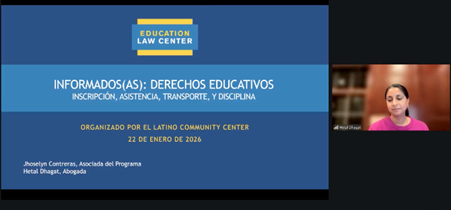
Latino Community Center Webinar | | On January 22nd, ELC-PA shared information with parents and other caregivers on school enrollment, attendance, transportation, and discipline during a Facebook Live session hosted by the Latino Community Center. A recording of the session, which is available in English with Spanish interpretation, is accessible here. | | Know-Your-Rights: Special Education Rights and Addressing Bullying & Harassment | | |
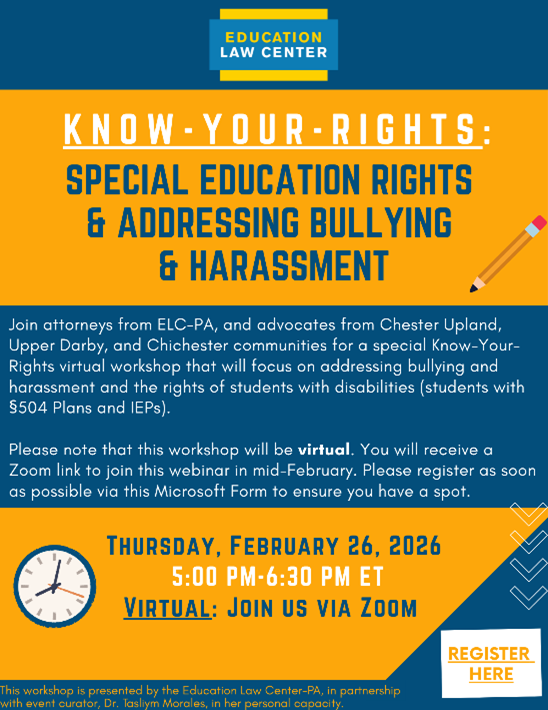
Join attorneys from ELC-PA’s Black Girls Education Justice Initiative and advocates from Chester Upland, Upper Darby, and Chichester communities on February 26, 2026, from 5:00pm - 6:30pm for a virtual Know-Your-Rights workshop that will focus on addressing bullying and harassment and the rights of students with disabilities (students with §504 Plans and IEPs).
To join, please register here. This workshop is presented by the Education Law Center-PA, in partnership with event curator, Dr. Tasliym Morales, in her personal capacity.
| | ELC-PA Upholds the Rights of Students Experiencing Homelessness | | |
Children experiencing homelessness have important legal rights, including the right to remain in their school of origin or be immediately enrolled in a new school, as well as access to additional supports under Act 1. Yet despite these protections, schools continue to deny many children access to education, leaving them with nowhere to attend school. Learn more about the Rights of Students Experiencing Homelessness and Act 1.
In December, ELC-PA represented “Ms. Sanderson,” the proud mother of “Lana,” an eighth grader eager to begin high school, and “Mia,” a kindergartener excited to start school for the first time. Although the school district knew the family had lost their housing and was temporarily living with others, it illegally insisted that Ms. Sanderson submit a lease as a precondition of enrollment, which the family did not have because they were experiencing homelessness. One of the children’s schools even threatened to pursue a truancy action against Ms. Sanderson, after turning her child away.
With ELC-PA’s advice and guidance, Ms. Sanderson filed successful state complaints on behalf of both children, which ensured their immediate enrollment and that both children were identified as “Act 1 eligible,” meaning that the children were assigned a Point of Contact at school who supported their school placement and equal access to educational opportunities. Both children are enjoying school and making good progress — and no longer fear having their education disrupted by unlawful school practices.
| | |
Maggie Emmendorfer (she/her) is a second-year student at Villanova University Charles Widger School of Law. Maggie earned a bachelor's degree in education policy with a minor in gender and sexuality studies from Rhodes College in Memphis, Tennessee. Throughout her time in Memphis, Maggie worked at a local nonprofit children's theatre where she served as an instructor in theatre, dance, and music. Her academic interests focus on the impacts of discriminatory discipline practices on students of color and on the inclusion of all body types and abilities in the classroom.
Jacob Taylor (he/him) is a second-year law student at Villanova University Charles Widger School of Law. Jacob earned his bachelor's degree in criminal justice and philosophy at Alvernia University. He also earned his MBA from Alvernia and worked there as an adjunct professor before law school. Jacob is very passionate about public interest law and hopes to study how the written law affects living persons.
Asbel Fede (she/her) is a second-year law student at Temple University Beasley School of Law with a background in early childhood education and child advocacy from the University at Buffalo. Her academic and professional interests are rooted in advancing the rights and well-being of children and families.
Lee Gautier (he/him) is a second-year student at Villanova University Charles Widger School of Law. Lee received his bachelor's degree in international affairs and economics before beginning a nearly 10-year career as a public and private school teacher. Before and during law school, Lee has focused his work on education law and public interest advocacy, with experience supporting students and families through school-based legal and policy issues.
Ann Pham (she/her) is a third-year student at Temple University Beasley School of Law. Ann received two bachelor's degrees — one in sociology with a concentration in education and the other in criminal justice — from Penn State University. During her time in college and law school, Ann has worked in the public interest sector as a victim's advocate, a legal intern with the New Jersey Office of the Public Defender, and a legal intern with the Child Advocacy Unit in Philadelphia.
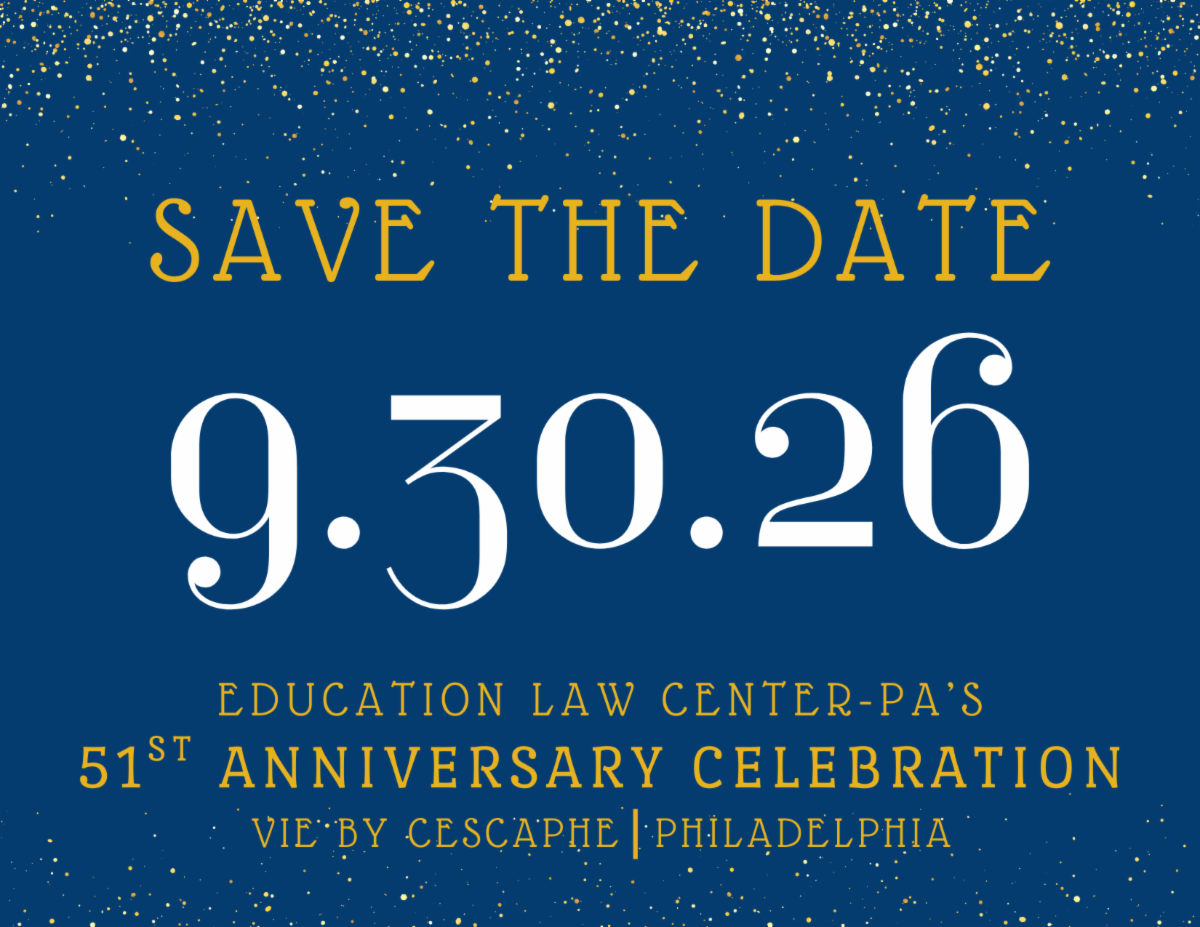
| | Celebrate With Us September 30, 2026! | | |
Mark your calendars today! We invite you to join us on Sept. 30, 2026, for the Education Law Center’s 51st anniversary celebration at Vie by Cescaphe in Philadelphia.
ELC-PA’s premier fundraiser serves as a unique opportunity to connect with key stakeholders in education advocacy and reform. Please contact Ariella Gregson to learn more about partnership benefits.
We hope you will celebrate with us this fall!
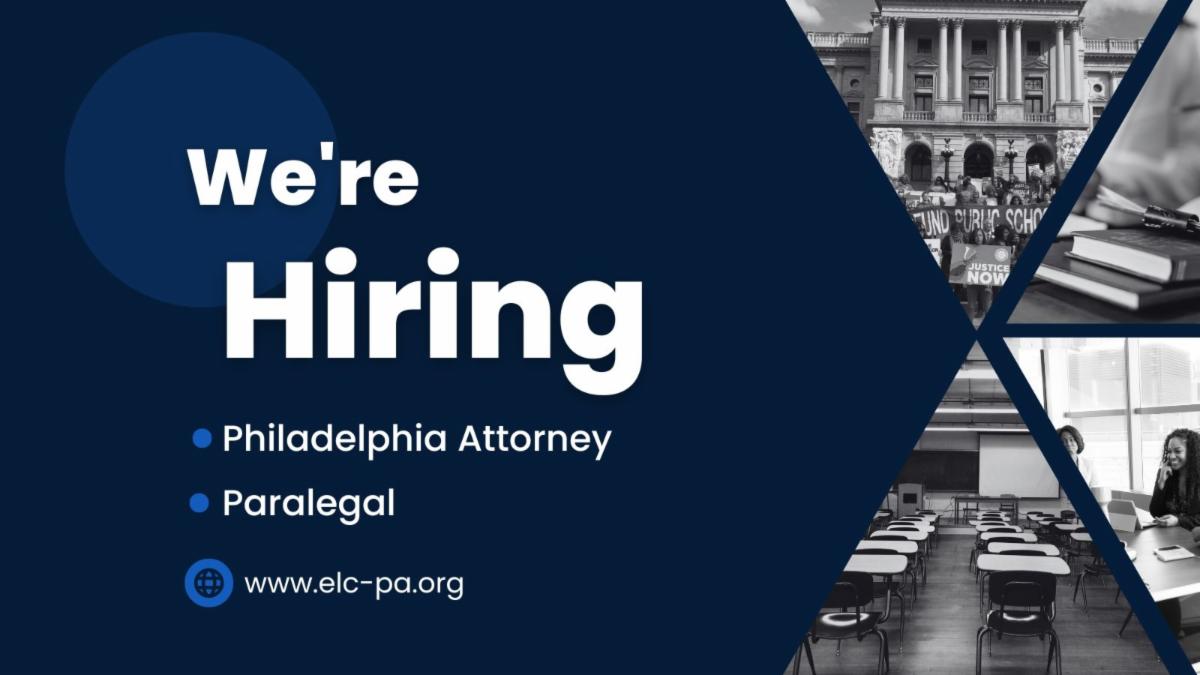
| | Check Out our Job Postings! | | Education Law Center-PA | 215-238-6970 (Philadelphia) | 412-258-2120 (Pittsburgh) | | A copy of the official registration and financial information of the Education Law Center-PA may be obtained from the Department of State by calling toll-free, within Pennsylvania, 1-880-732-0999. Registration does not imply endorsement. | | | | |