|
Hello USA-NPN,
Here is your monthly update on the Time to Restore project, a newsletter for those participating in the project in New Mexico, Oklahoma, Texas, and Louisiana. If you know others who may be interested in this newsletter, please send it their way! If you were forwarded this message, you can sign up to get on our list here.
| |
|
|
Need some help getting started?
We are hosting a special "Setting Up Your Nature’s Notebook Site" training webinar on Thursday, February 27th at 6:30pm CT. This training will walk you through (i.e. step by step) how to get your sites set up in Nature's Notebook. If you want to attend but can't make the training webinar, please register anyway as we'll share the recording with all who sign up. Don't miss out!
| |
|
We'll have second run of this popularly requested virtual training during Phenology Week on March 17th. See below for more details.
You can also find training materials and other resources on our Time to Restore page. Or, reach out to your State Coordinator with the contact information listed at the bottom of this email.
| |
Plant of the Month: Upright prairie coneflower, Ratibida columnifera | |
|
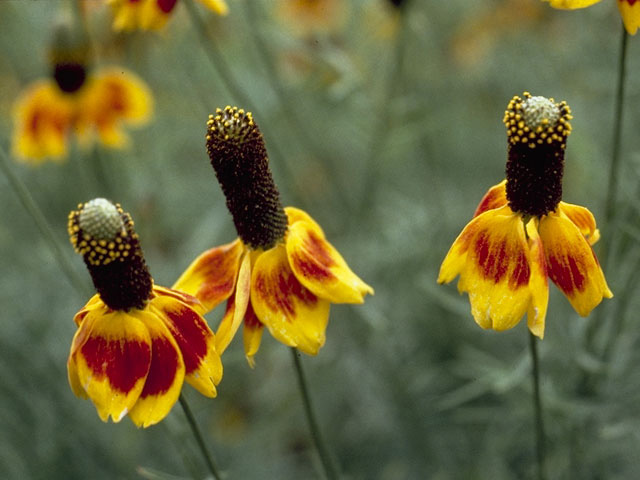
Photo: Kimberly Kline via Ladybird Johnson Wildflower Center
Each month, we feature one of the plants on the Time to Restore list. Upright prairie coneflower (Ratibida columnifera) has been identified as a priority species in Texas and Louisiana. The range of this species spans much of the central United States from Texas to Montana.
You can expect to see this tough, drought-tolerant plant bloom over a long season in the summer and fall.
You can observe this species as a single plant in Nature's Notebook, or, if you have multiple plants growing together that are difficult to differentiate, register the plant as a patch and make your observation considering the patch as a whole. If you have more than one plant or patch, consider monitoring 2-3 individuals at the same site to capture the variation between plants.
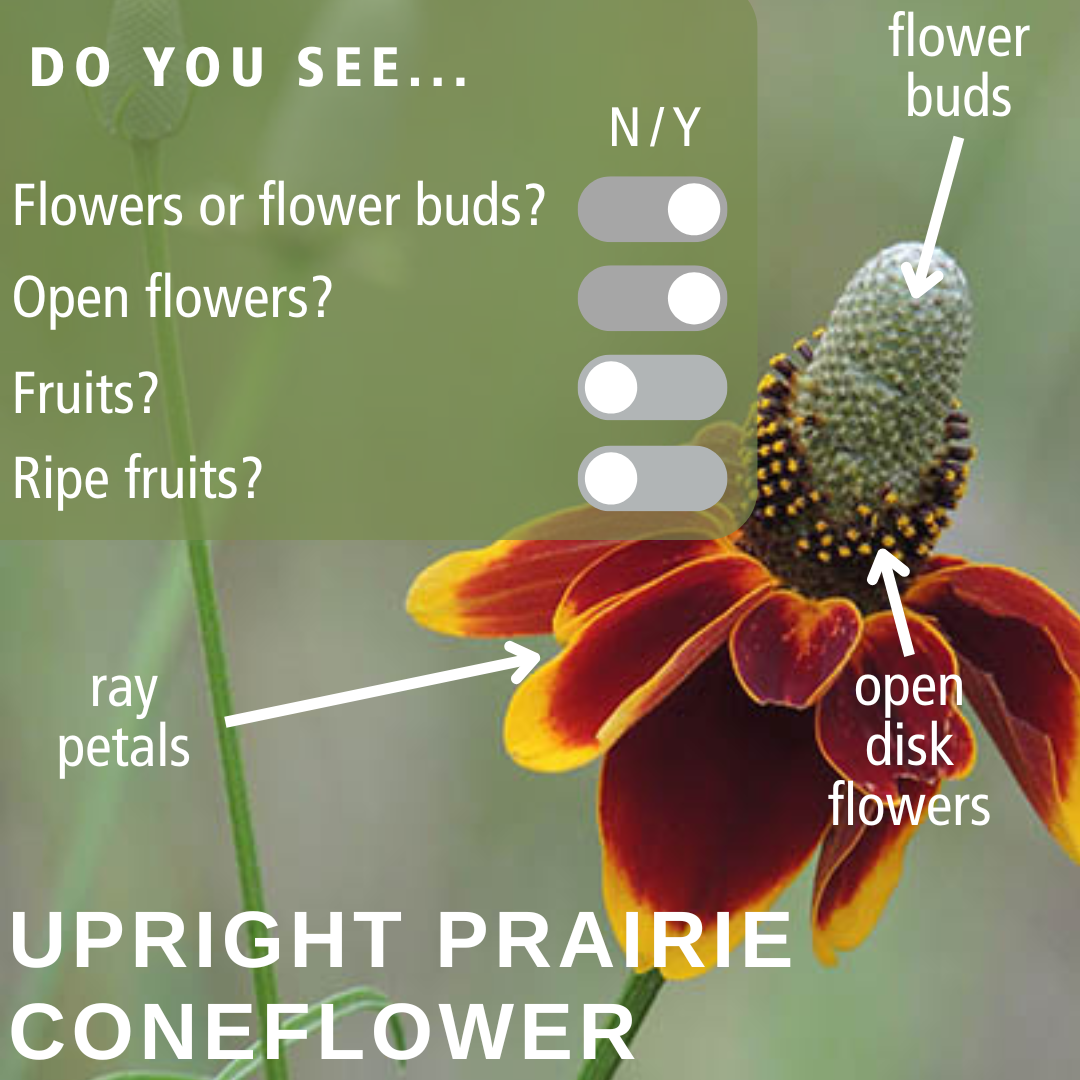
For the plant pictured below, you would report:
Flowers or flower buds - yes
Open flowers - yes
Fruits - no
Ripe fruits - no
| |
|
Photo: Charmaine Richardson via Ladybird Johnson Wildflower Center
As for the optional intensity questions, remember to count the flowers as inflorescences.
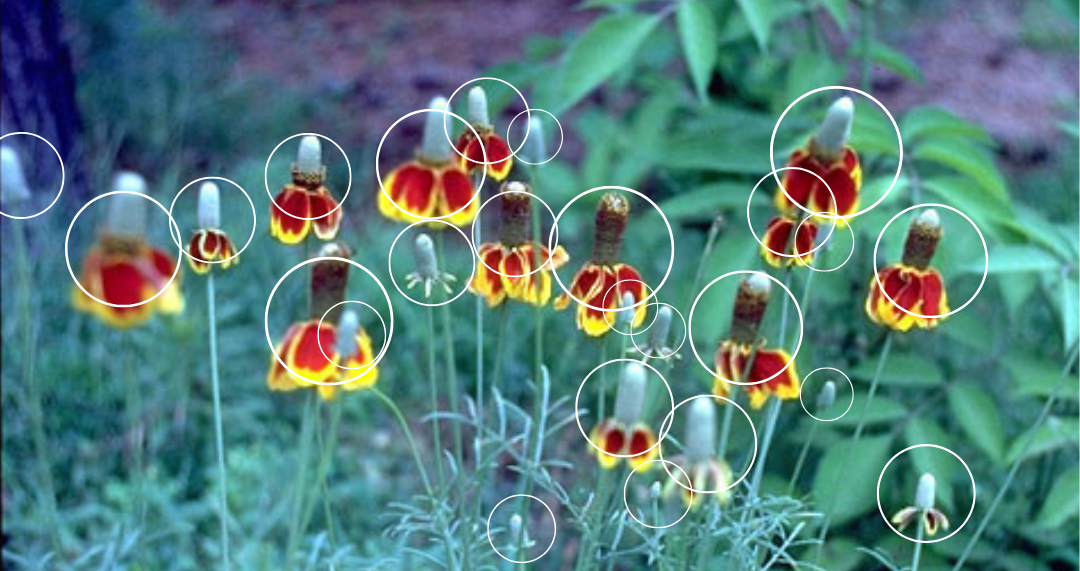
For the photo below, for the question "How many flowers or flower buds?", you would select the bin 11-100 flowers, as there are 25 inflorescences in the photo.
For the question "What percent of flowers are open?", this is a little tricky! There are 10 inflorescences that look like they may have open flowers on them, 40% of the total. Of those, it looks like, on average, a little less than 50% of the disk flowers on the flower head are open. For this reason, we would recommend putting the estimate in the bin of 5-25% of flowers open (40% of inflorescences open x 50% of each inflorescence, on average = 20%).
| |
|
Photo: Campbell and Lynn Loughmiller via Ladybird Johnson Wildflower Center
Questions? Reach out to Erin@usanpn.org.
| |
|
Join us for Phenology Week!
March 17-21, 2025 is Phenology Week - a virtual celebration of the seasonal cycles of plants and animals. The purpose of Phenology Week is to celebrate YOU, our Nature's Notebook observers, Local Phenology Programs, and partners! We'll have webinars, awards, daily challenges, observer stories, and more. Our Monday webinar, "Let's get you started with Nature's Notebook," offers another chance for an orientation for getting your sites and plants set up.
See the webinar schedule »
Sign up for Phenology Week emails »
| |
|
Training options in your state | |
|
Louisiana
Interested in organizing a training for your group in Louisiana? Reach out to Gina Lloyd to schedule.
New Mexico
Interested in organizing a training for your group in New Mexico? Reach out to Kim Eichhorst to schedule.
Texas
We have several upcoming virtual trainings in Texas in coming weeks that anyone is welcome to join:
-
Project Presentation for the Blackland Prairie Chapter of Texas Master Naturalists (North Texas), February 25, 2025 @ 6:00 p.m. - Virtual via Zoom
-
Project for the Brush y Canyons Chapter of Texas Master Naturalists (Southwest Texas), March 6, 2025 @ 6:30 p.m. - Virtual via Zoom
-
Project Presentation and Training Workshop for the Gideon Lincencum Chapter of Texas Master Naturalists (Central Texas), March 15, 2025 @ 10:00 a.m. to 1:00 p.m. - In-Person Extended Workshop in Brenham, Texas
Please email David Gwin, Texas TTR Coordinator, at dgwin@ymail.com (yes, that's a y!) for the meeting’s Zoom registration link you are interested in joining. Thanks!
Interested in organizing a training for your group in Texas? Reach out to David Gwin to schedule.
As you can see in the table below, we recently added a few new Texas counties in North, Central, and Southwest Texas that are represented by Master Naturalist and NPSOT chapters that have already approved the project. Let us know if you are already planning on participating in the project but your county is not represented below!
| |
| North Texas Counties | Dallas, Denton, Collin, Cooke, Hunt, Kaufman, Montague, Parker, Rockwall, Tarrant, Parker, Wise | | Central Texas Counties | Bell, Hays, Milam | | East Texas Counties | Polk, San Jacinto, Trinity, Tyler | | Southeast Texas Counties | Austin, Brazoria, Brazos, Burleson, Colorado, Fayette, Fort Bend, Galveston, Grimes, Harris, Lee, Leon, Madison, Montgomery, Robertson, Walker, Waller, Washington, Wharton | | Southwest Texas Counties | Uvalde, Medina, Kinney | | | |
|
|
Contact
Erin Posthumus
Partnerships and Projects Manager
USA National Phenology Network
erin@usanpn.org
| | |
|
|
Gina Lloyd
Time to Restore Louisiana Coordinator
ginalloyd113@gmail.com
| | |
|
|
Kim Eichhorst
Co-Director of the Bosque Ecosystem Monitoring Program (BEMP)
New Mexico contact for Time to Restore
kimde@unm.edu
| | | | |