|
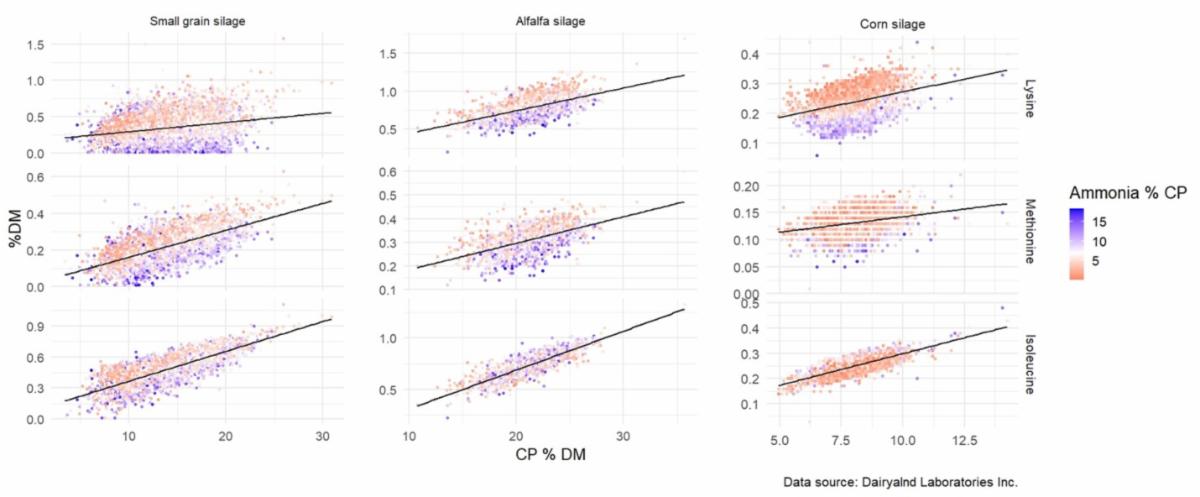
What might be causing these trends?
It looks like amino acids are being deaminated due to poor or extended fermentation during ensiling. As bacteria and fungi break down proteins, deamination results in ammonia production (raising ammonia while lowering amino acids). Clostridium species are especially known for their proteolytic and deaminating activities.
But why are some amino acids being degraded more than others? Lysine has a unique structure with a side chain amino group, which could make it more susceptible to deamination. Methionine and cysteine are unique in that they contain a sulfur atom, which can cause them to be targeted preferentially by bacteria and fungi. In contrast, isoleucine, leucine, and valine are branch chain amino acids with more hydrophobic side chains, which could make them less susceptible to microbial attack.
How much does this matter?
In this example diet, moving the silages’ amino acids and ammonia from a standard deviation on one side of average to the other changed CNCPS predictions of MP allowable milk 2 lbs, MP supply 44 grams, lysine supply 5 grams, and methionine supply 1 gram.
|