|
If you think Burnhammania (the curious phenomenon where when popularity runs ahead of definition), has reached its acme, yer wrong!
You can buy a Burnham mug.
Brace yerself there’s more...
... A T-shirt.
How long before Andy’s Eye Lash Extender?
He’s got his bags packed and on the way to Downing Street, but…
… not wishing to be a kvetcher, may I suggest there are …
…five things Andy Burnham should think about before Mrs Burnham starts measuring the curtains in Number 10.
Actually, there are hundreds, but…
… these five would make the NHS work better without another penny of taxation.
Better still, they could all begin in the first hundred days. They also happen to fit rather neatly with Burnham's own instincts about public service.
First. Pause the NHS Bill.
The legislation currently struggling through Parliament pulls power back towards Whitehall just as the NHS has become too big, too complex and too diverse to be run from Whitehall.
Pause it. Amend it in line with what we know about Burnham’s political instincts about devolution.
Create ten, genuinely powerful regional authorities responsible for performance, workforce, capital and improvement. Link them to the Mayors and the local authorities.
The centre should set the standards, allocate the money and hold the regions to account.
The Regions should run the service.
It is a lot easier to get ten regional leaders around a table than to imagine Whitehall can successfully direct more than 10,000 NHS organisations and services from a desk.
Second. Stop funding organisations. Start funding patient journeys.
The Better Care Fund should become the vehicle.
Allow councils and the NHS to contribute whatever they judge necessary to joint-schemes, that keep people out of hospital or get them home sooner, safer and with confidence.
Big reforms of social care will come. They have to. But, they will take years and billions.
This can start tomorrow.
After every unplanned admission, routinely, ask one question:
‘What would we have had to do,
to prevent this?’
Then redesign the service around the answers.
Third. Devolve capital.
Regional leaders know where the bottlenecks are.
- Another scanner.
- A refurbished operating theatre.
- Community diagnostics.
- Primary care premises.
- Mental health facilities.
Capital should improve patient flow, not reward the best bid, written in Whitehall's management-speak.
If regional leaders are accountable for performance, they should control the investment.
Fourth. Declare a Digital First NHS – and mean it.
Not by talking endlessly about artificial intelligence.
By eliminating work.
By the next election, half of all administrative activity that does not require human judgement should no longer require a human being.
The NHS is probably close to the limits of what can be achieved through largely manual systems.
The next leap in productivity will come from removing bureaucracy, simplifying the patient journey and allowing clinicians to spend more time with patients than paperwork.
Finally. Protect the front line.
Make the NHS the best place in Britain to work.
- Less bureaucracy.
- Better training for managers.
- Modern equipment.
- Proper digital support.
- Real autonomy.
- Visible career development.
- Recognition.
Get serious about getting better...
... not through another reorganisation, but by making it easier for good people to do good work, and …
… there is one final change.
Forget another forest of targets.
Forget another inspection regime.
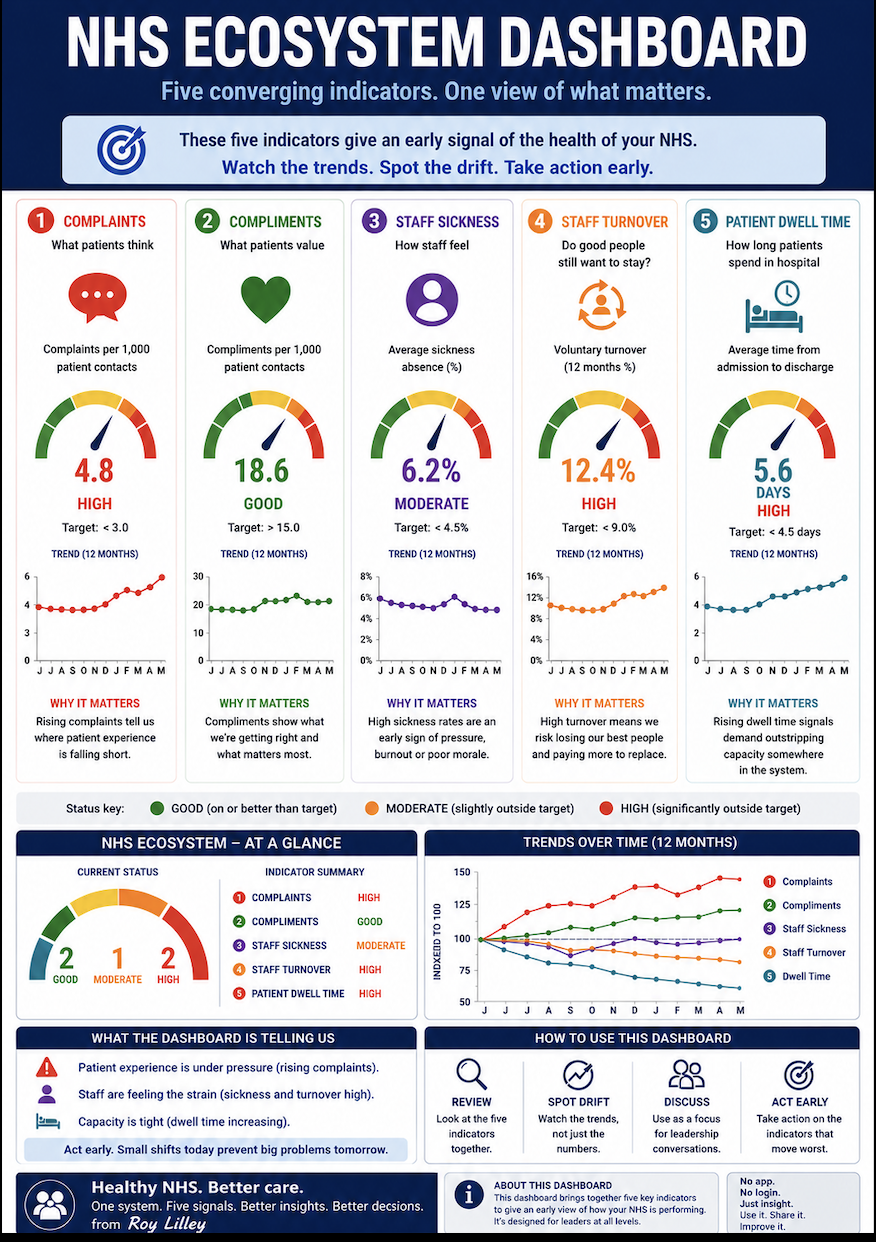
Build an NHS barometer.
Engineers don't rely on one gauge. Pilots don't fly using one instrument.
They use what they call converging indicators… independent signals that, taken together, reveal trouble long before catastrophe strikes.
The NHS should do the same, with five converging indicators.
-
Complaints; what patients think.
-
Compliments; what patients value.
-
Staff sickness; how staff feel.
-
Staff turnover; whether good people still want to stay, and…
… Patient dwell time; the average time patients spend in hospital from admission to discharge.
If it starts drifting upwards, somewhere demand is beginning to outstrip capacity. If it falls, somewhere the system is getting better.
Publish every month, staff, public... any and everywhere.
One indicator may be a faulty sensor. Five moving together tell us something important is changing.
Don't send inspectors. Send help. That's the difference between inspection and management.
Inspection tells us what went wrong. A barometer tells us the pressure is changing.
The NHS has become very good at investigating yesterday.
Burnham could build a service that sees tomorrow coming.
That won't solve every problem, but… it might stop the next one.
And, we will all 'Feel-the-Burn'.
|