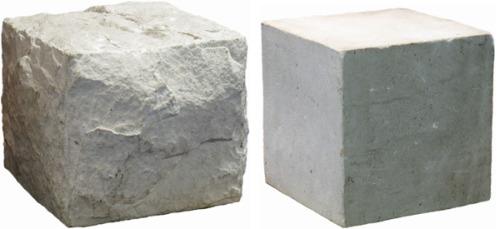
Rough & Perfect Ashlars
This exploration into the symbolic and philosophical aspects of Masonic Ashlars.
The Rough and the Perfect Ashlars of the Lodge, always there for the brethren to moralize upon. Masters may come and masters may go, but always in full view of everyone in the Lodge are the two emblems we are about to consider.
In masonry, the symbolism relating the Ashlar has been used as a teaching device since at least William Preston’s time in the 1760s, and if not even longer, almost all sources view the symbolism of the Rough Ashlar in the same manner. The new entered apprentice is the Rough material straight from the quarry. “Rough undressed stone - ignorant, uncultivated man, ready to be squared and prepared for purposeful employment by skilled craftsmen”. The Rough Ashlar is a symbol of initiation, the entered apprentice degree.
In Masonic jargon, the term “Rough Ashlar” seems to universally be applied to individuals, candidates or the newly initiated, as the raw elements of building material; their state of finish, however, seems to be a matter of interpretation.
Perfect Ashlar represents the dressed stone (after it has been made uniform and smoothed) by use of the working tools.Only after the stone has been dressed by an experienced stonemason, can it be suitable to be placed into the architectural structure or building.
Speculatively, a Perfect Ashlar is an allegory to a Freemason who, through Masonic education, works to achieve an upstanding life and diligently strives to obtain enlightenment.
The one representing man in his early stages of culture, and the latter illustrating what he may become under the refining influences of education, assisted by the secrets of our Masonic Art, transformed into a Perfect Ashler.
How does this individual transformation occur?
William Preston states in a lecture on the Entered Apprentice Degree ,his opinion about the Rough and Perfect Ashlars and perhaps how they apply to us.
“The Rough Ashlar is a stone taken from the quarry in its rude and natural state. The Perfect Ashlar is a stone made ready by the hands of the workmen to be adjusted by the tools of the Fellow Craft. By the Rough Ashlar we are reminded of our rude and imperfect state by nature; by the Perfect Ashlar, that state of Perfection and which we hope to arrive by a virtuous education, by our own endeavors and the blessing of Deity.”
Again, the emphasis is on the individual Mason improving himself rather than on a comparison to others. The Mason figuratively chips away at the Rough edges of his moral character thRough the practices and principles of Masonry."
A stone thus prepared is often referred to as a “Perfect Ashlar”; a term which can also apply to a well prepared Mason. The symbolism of the Perfect Ashlar may be misunderstood. Please note that the use of the word “Perfect,” and all the Masonic variations in its use when referring to Ashlars, does not denote “flawlessness.” This assumption that “flawlessness” means “Perfection” is a dangerous one that will lead the best of intended Masons down a road of never being of any great use to the Builder. Masons believing that they are Working toward flawlessness are misguided.
Joseph Fort Newton clarifies in the Builders, that the reference is not to a man without flaw, but rather to “...a finished Mason, a man who’s thought and conduct is upright, virtuous, and honest.” This requires perseverance, effort, and daily application of the principles of Masonry throughout a man’s life.
Let’s stress these last points once again: Perfection in working Ashlar refers to the “maturing” and bringing it to the state in which it has use for the Builder. In other words, the Perfect Ashlar shows no flaw that would prevent it from being used before it is Perfected and is called “Perfect” only when it has reached a point when it has use to the Builder.
Yet, it is also premature to believe that all Masonic Work is completed at this stage. It is not. While one might conclude that the Masonic Work on one’s Stone ends after Perfecting the Ashlar, this conclusion is misleading. There is further Work to be done and this Work requires other Perfect Ashlars to commence. More specifically, Perfect Ashlars that have been Raise and Cemented into one unified Structure must be involved. These are the Stones called “Master Masons.” Master Masons are those Perfect Ashlars whose Stone Work continues with the unified efforts of other Perfect Ashlars.
“Perfect” is not an easy state to achieve, some will even argue that the terms “Perfect” and “impossible” are ideal stable mates.
Let's take a look at a 3rd state of a Ashlar, the Perpend Ashlar.
In Ancient Masonic Ritual, there is mention of a special Stone called the “Perpend Ashlar” or “Bond Stone.”
It was change during the Eighteenth Century from Perpend to Perfect as one of the Jewels of the lodge. Perpend is defined as: To consider carefully; to ponder; to reflect; to be attentive long after being Raised
. Stone walls are usually built with two layers of Perfect Ashlar, an inner and an outer, and may or may not have rubble sandwiched between them. Either way, these two walls require connector Stones to stabilize the Structure thus built with Perfect Ashlars used to connect the Inner and Outer layers of walls.
Perpend Ashlars are those Stones whose lengths allow them to extend from the outside of the outer wall to the inside of the inner wall thus showing their smooth faces on the construct’s inner and outer surfaces. All the Stones used in the construct are Raised into position, properly aligned and placed. Once placed, these Stones are then joined together as one unified interlocking mass. Unification is done using Cement (a.k.a. “Brotherly Love”), spread with yet another working tool, to allow these unified structures to be created. The amount of Cement required is directly proportional to the Roughness of the finish. Rougher finishes require the most amount of Cement; smoother finishes require far less Cement to unify a Structure. The former does not allow for the closeness that the latter does by default. This Perpend Ashlar effectively wove the other stones in the wall together, causing them to act in unison and harmony with one another.
In this manner, we should all strive to make our Ashlars Perfect for two reasons. First, that the Perfect Ashlar of an individual Mason will enhance and make strong his personal moral and Masonic edifice; and secondly, that the Perfect Ashlar of a Speculative Mason, will act as the Perpend Ashlar of the Operative Mason, helping to bind our Institution as a whole.
Whether used as a Perpend or Perfect Ashlar in any construct, both Stone types use all the tools of the Craft to assure that what is Built has Integrity. A single Stone lacking Integrity jeopardizes anything that is Built. The main reason any prospective Mason must have integrity and character to begin with; flawed men and stones will only frustrate and waste the builder’s time as they try to form them into a useful state, and will always yield disappointment.
In the Fellowcraft Degree, we see the use of the Rough and Perfect Ashlars. The lesson to be learned is that by means of education through the seven liberal arts and sciences which are mechanisms of both individual endeavor and virtuous education, a man improves the state of his spiritual and moral being.
Like man, each Rough Ashlar begins as an imperfect stone. With education, cultivation and brotherly love, man is shaped into a being which has been tried by the square of virtue and encircled by the compasses of his boundaries, given to us by our Creator.
The Fellow Craft degree Encouraged to learn and practice the concepts of Truth, Relief and Brotherly Love together with a strong recommendation to continue personal self-education.
"How a man finds knowledge is a matter of comparative indifference; he may learn from books or he may never read a page; he may attend school or not; he may gain information by himself or from a master. That is for the man’s own choosing, and Masonry offers no recipe for an education. But enlightenment is a thing every Mason stands pledged to seek, and seek it he must if he is to be a Mason in fact as well as in name."
- H. L. Haywood
References:
Preston -Webb Monitor
Illustrations of Masonry - William Preston
Lifting the Veil - Esoteric Masonic Though
Pocket Lexicon of Freemasonry
Mackey's Encyclopedia of Freemasonry
Builders - Joseph Fort Newton
Symbolical Masonry - H.L. Heywood
Manly P Hall
Dr. John S Nagy