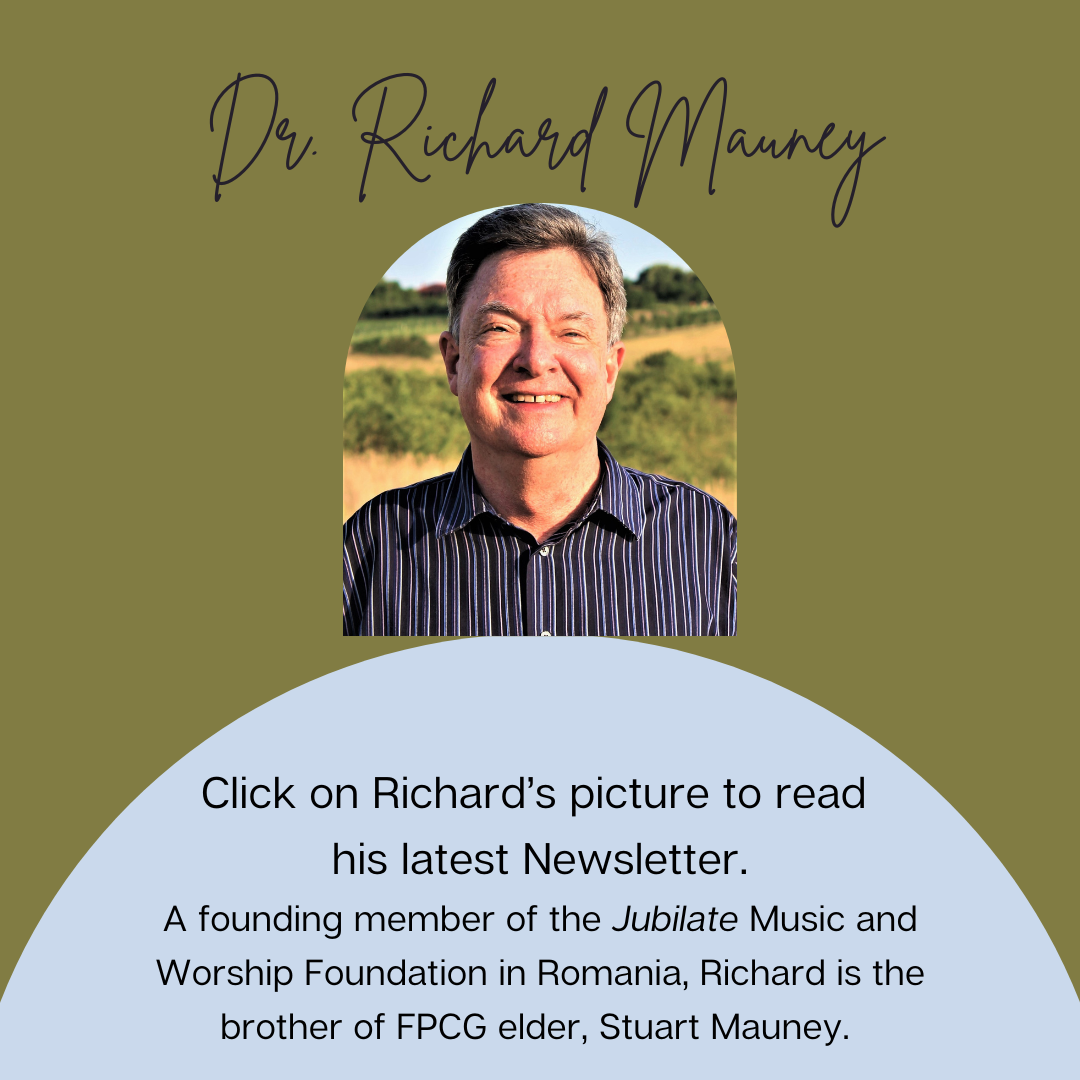
|
“Praise the Infinite”
When we decided to use the Presbyterian Outlook’s Lenten devotional series, Grieving Change and Loss, I wondered if it would be too much to spend forty-six days focused on grief. Some of you might be thinking, “yes, it is too much!” For me, however, it has been a timely exploration of grief and how we deal with it. I have also been reminded that all of us are grieving in some way.
To live is to gain and to lose. The teacher from Ecclesiastes reminds us of this: “for everything there is a season, and a time for every matter under heaven: a time to be born, and a time to die; a time to plant, and a time to pluck up what is planted; a time to kill, and a time to heal; a time to break down, and a time to build up; a time to weep, and a time to laugh; a time to mourn, and a time to dance; a time to throw away stones, and a time to gather stones together; a time to embrace, and a time to refrain from embracing; a time to seek, and a time to lose.”
We humans are born with a deep capacity and desire for love. When we share love with one another, we gain so much. Indeed, it is our love that gives our lives their meaning. But, as we all know well, the more deeply we love, the more profound the pain when we lose the object of our affection. To love, then, is always to assume the risk of grief. Love and grief are inseparable.
The poet Rumi writes poignantly about the truth that there is a time for every matter under heaven and these times are not unrelated but are, rather, a part of a whole.
Your grief for what you’ve lost lifts a mirror
up to where you’re bravely working.
Expecting the worst, you look, and instead,
here’s the joyful face you’ve been wanting to see.
Your hand opens and closes and opens and closes.
If it were always a fist or always stretched open
you would be paralyzed.
Your deepest presence is in every small
contracting and expanding.
The two as beautifully balanced and coordinated
as birdwings.
Love is gain; love is loss. Like birdwings they are a part of the same magnificent, mysterious being. The only way to avoid grief is to shut yourself off from love. But who can survive without love? We Christians, like Rumi, view this dynamic of time through the lens of hope in the eternal. He writes:
This night extends into eternity,
like a fire burning inside the friend.
Truly knowing this is what joy is.
Forgetting it is grief, and a lack of courage.
Life is ending? God gives another.
Admit the finite. Praise the Infinite!
Love is a spring — submerged!
Every separate drop, a whole new life.
During Lent, we focus on the finite, on how we can be faithful in our troubled and difficult world. But this ritual practice of penitence and reflection, like everything we do as Christians, is rooted in the infinite, the eternal. Death and life, mourning and laughing, the cross and the empty tomb, are inseparable. The finite tells us they are separate and that death, mourning, and the cross are the end. And, in the depths of our grief, they certainly feel like it. But as Lent gives way to Easter we are reminded that “love is a spring—submerged!” After the cross, during those long, painful Good Friday hours, those who loved Jesus thought love itself was lost. But love was only submerged. On that third day, it would spring forth again from the grave. “Life is ending? God gives us another. Admit the finite. Praise the Infinite!” Amen!
Grace and peace,
Will
|