Flight Safety Information - May 28, 2026 No. 104 | | |
Incident: India B773 over China on May 27th 2026, TCAS failure
An Air India Boeing 777-300, registration VT-ALL performing flight AI-173 from Delhi (India) to San Francisco,CA (USA) with 230 people on board, was enroute at 9500 meters (FL311) over China when the crew decided to turn around and return to Delhi due to non-working TCAS, which is mandatory for the Oceanic Crossing. The aircraft landed safely back in Delhi about 8:25 hours after departure.
The airline reported a technical malfunction indicating the TCAS was not working properly, so that the airline asked the pilots to return to Delhi.
https://avherald.com/h?article=539c172e&opt=0
| | |
Incident: Aeromexico B788 near Monterrey on May 24th 2026, cracked windshield
An Aeromexico Boeing 787-8, registration N967AM performing flight AM-90 from Monterrey (Mexico) to Seoul (South Korea), was enroute at FL320 about 390nm northwest of Monterrey when the crew decided to turn around and divert to Mexico City (Mexico) due to a cracked windshield. The aircraft landed safely on Mexico City's runway 05L about 3:15 hours after departure.
The aircraft is still on the ground in Mexico City about 77 hours (3 days 5 hours) after landing.
https://avherald.com/h?article=539c0abf&opt=0
| | |
Incident: Express Malta A320 at Stuttgart on May 25th 2026, gear problems on departure
An Avion Express Malta Airbus A320-200 on behalf of Eurowings, registration 9H-AML performing flight EW-2516 from Stuttgart (Germany) to Bilbao,SP (Spain), was climbing out of Stuttgart's runway 07 when the crew stopped the climb at 5000 feet due to problems with the landing gear. The aircraft returned to Stuttgart for a safe landing on runway 07 about 20 minutes after departure.
The airline reported the crew received a warning indication for the landing gear.
The aircraft remained on the ground for about 47.5 hours then departed for a test flight.
https://avherald.com/h?article=539c08b7&opt=0
| | |
Incident: LATAM Chile A319 at Cuenca on May 26th 2026, engine failure
A LATAM Chile Airbus A319-100, registration CC-CYJ performing flight LA-1376 from Quito to Cuenca (Ecuador), was on final approach to Cuenca's runway 06 when the right hand engine began to emit a series of bangs and streaks of flames prompting the crew to go around. The crew subsequently decided to divert to Guayaquil. The aircraft climbed to 17000 feet and landed safely on Guayaquil's runway 03 about 35 minutes after the go around.
The airline reported the aircraft experienced "an event".
The aircraft is still on the ground in Guayaquil about 18 hours after landing.
https://avherald.com/h?article=539c06f9&opt=0
| | |
Did Trump's FAA slash the staffing target for air traffic control?
With air traffic controllers in high demand, former Transportation Secretary Pete Buttigieg said he was baffled to see a new federal hiring plan that would result in even fewer.
"We just saw, quietly, a Friday news dump out of the Department of Transportation at the end of last week saying that they were going to cut the target for air traffic control hiring, slash the air traffic control targets by about 2,000," Buttigieg said May 17 on CNN’s "State of the Union."
Two days prior, the Federal Aviation Administration released its 2026-28 air traffic controller workforce plan that set its new staffing target at 12,563 controllers, down from its forecast of 14,633 outlined in the past two workforce plans.
Buttigieg is right about the staffing target being reduced by around 2,000 people. He leaves out context about why that change happened.
ATC towerFAA wants video game players to be the next generation of air traffic controllers
It’s important to know the new staffing goal followed a legislatively mandated review. However, the air traffic controllers’ union favors a previous alternate staffing model that it helped develop and which calls for more controllers.
The FAA remains below its staffing target; as of April 2026, around 11,000 controllers were employed nationwide. Another 4,000 are in training, which can take two or three years after graduating the FAA Academy before full certification.
Buttigieg spokesperson Sean Manning pointed to news coverage that described the plan as a "slash" of air traffic control staffing targets, and referred to skepticism from air traffic controllers.
In a statement, the National Air Traffic Controllers Association said it was not involved in developing the new workforce plan and was "surprised" to learn it was based on the 2025 Air Traffic Controller Workforce Imperative, the legislatively mandated review of the two staffing models.
The union had dismissed the review’s staffing model as "the root cause of the staffing crisis we now face." When asked if the union will negotiate, a spokesperson declined to comment.
The FAA said it plans to allocate staff more efficiently by using modern scheduling tools and by reviewing schedules and each facility’s operation hours to match staffing levels with periods of high demand.
When PolitiFact asked the FAA about the union’s comments, spokesperson Donnell Evans said, "Our new staffing model and workforce plan will enhance the safety and efficiency of our skies." Evans said the plan originated with an "independent and objective organization with non-partisan experts."
LaGuardia Airport Control TowerFAA makes changes to airport security in wake of LaGuardia Airport crash
FAA staffing model is point of contention
Michael McCormick, air traffic management associate professor at Embry-Riddle Aeronautical University, said the new staffing model is "an ongoing point of disagreement going back for several decades." He was part of the workgroup that developed the alternate staffing model which the union prefers.
The FAA model uses calculations and traffic data to determine preliminary staffing levels per facility, takes each facility’s largest staffing number, then adds up the facility staffing numbers to come up with the overall staffing target.
By comparison, the collaborative workgroup model determines on-position hours in a typical busy day and the number of controllers needed. Its methods include surveying facility leaders to draw on local expertise and crosschecking answers with traffic operations data.
The Transportation Research Board committee said the collaborative workgroup model accounts for controllers’ time off, training and other duties. However, concluding that the FAA should use its own model, the committee said the workgroup’s model lacks the ability to "forecast future staffing standards targets based on traffic projection."
McCormick said automated systems for improving scheduling and productivity are not currently being used, and scheduling changes would be subject to bargaining with the union.
Margaret Wallace, Florida Institute of Technology aviation management assistant professor, said, "Everything depends on what kind of technology they plan to introduce." There’s been no "real" discussion about that, she said.
McCormick said, "The FAA still needs to hire over 2,000 controllers per year for, at least, the next three years regardless of which staffing model they use."
https://www.wbaltv.com/article/trump-faa-staffing-air-traffic-control-fact-check/71425699
| | |
New Aviation Mishap Task Force to Examine ‘Concerning’ Rise in Incidents
The Pentagon established an Aviation Mishap Task Force earlier this year “to address concerning trends” in safety and help produce an action plan, officials say.
The task force was set up Jan. 15, a Pentagon spokesperson said. Accidents declined in 2025, but the impetus for review was that they hit a six-year high in fiscal 2024. The formation of the task force was not previously publicized.
Secretary of Defense Pete Hegseth disclosed the the new task force’s existence in a brief mention among his written testimony submitted to Congress in April, citing Congress’ reliance on continuing resolutions in lieu of passing budgets on time for impacting safety by holding funding increases hostage, including line items for flying hours and maintenance.
Undersecretary of Defense for Personnel and Readiness Anthony J. Tata’s written testimony submitted May 20 expanded on the task force’s purpose.
“A ready, lethal force requires a culture of safety and accountability,” Tata wrote. “To address concerning trends in aviation, we established the Aviation Mishap Task Force, integrating the Joint Safety Council and the Military Departments to identify joint and systemic risk factors, including the readiness degradation associated with repeated Continuing Resolutions, and deliver actionable policy recommendations. These recommendations will help to ensure that our warfighters have the predictable training, maintenance, and equipment needed to operate safely, effectively, and with lethal proficiency.”
Assistant Secretary of Defense for Readiness Maurice L. Todd wrote in separate testimony that the task force’s purpose is “reinforcing maintenance discipline, strengthening aircrew training, and tightening operational risk controls across the fleet.”
The Pentagon spokesperson said the task force’s work “will inform an Aviation Safety Plan of Action that identifies priorities and areas for improvement, including materiel solutions, training adjustments, and resource decisions, and will guide future safety policy, underscoring and reinforcing the importance of safety at every level of the joint force.”
The exact roles and responsibilities of those serving on the task force is unclear; the Pentagon spokesperson said each military departments will provide “essential safety and operational data, ensuring a comprehensive Total Force perspective” but declined to comment further.”
The Air Force declined to comment, referring questions to the Pentagon.
Early this year, about the same time the new task force was established, the Air Force Safety Center rolled out a Unit Risk Forecasting dashboard intended to help commanders understand and manage factors that historically raise mishap risks.
What the Data Shows
In November 2025, Sen. Elizabeth Warren (D-Mass.) shared DOD accident rates for Class A mishaps for every 100,000 flight hours across the Pentagon had generally increased from 2020 to 2024, though her data did not include the final two months of fiscal ’24. Class A mishaps are those that result in any deaths, permanent total disabilities, $2.5 million in costs, or destruction of an aircraft.
Updated data released by the services and compiled by Air & Space Forces Magazine show there were 54 Class A flight and ground aviation mishaps across the military in 2024, the most since 2018. The Air Force and Army in particular had more Class A mishaps in ’24 than they had had in years.
The Air Force and Army’s rate of flight mishaps per 100,000 was also their most in a decade. Complete data for the Navy and Marine Corps was not immediately available.
Data compiled by Air & Space Forces Magazine
Yet 2025 showed signs of improvement. The Air Force recorded its fewest Class A mishaps in a decade, and the Army tied its 10-year low. The 39 total mishaps across the military were the fewest since 2021.
Preliminary Air Force data for 2026, current as of late May, show a continuing decline in accidents; 11 total so far, making for the lowest rate per 100,000 flight hours this decade.
The war in Iran has taken its toll, with 14 USAF aircraft destroyed so far in 2026, already above the decade’s yearly average. Generally speaking, though, the number and rate of USAF aircraft destroyed has declined from a high of 24 in 2016.
https://www.airandspaceforces.com/pentagon-aviation-mishap-task-force-concerning-trends/
| | |
ATSB unable to determine why wheel fell off Link Airways plane during take-off from Canberra Airport
A plane's wheels, with one wheel missing.
The left inboard main landing gear wheel separated from a Saab 340 during take-off. (Supplied: ATSB/Aircraft operator)
In short:
A Link Airways-operated flight bound for Newcastle lost a wheel during take-off from Canberra Airport in January.
An investigation by the Australian Transport Safety Bureau (ATSB) found flight crew quickly returned the passenger plane to Canberra Airport where they landed it safely.
What's next?
The airline has reviewed its fleet and implemented changes to its wheel-bearing maintenance schedule.
A Link Airways flight bound for Newcastle lost a wheel during take-off from Canberra in January, forcing the aircraft to turn back with 19 passengers and three crew members onboard.
A report by the Australian Transport Safety Bureau (ATSB) confirmed that the left inboard main landing gear wheel had separated from the Saab 340 during take-off, but air safety investigators have been unable to determine the exact cause.
According to the report, the flight crew was alerted that the plane had lost a wheel by air traffic control (ATC) staff during the initial climb.
They then placed the plane at "the minimum safe altitude" before reviewing a handbook for guidance, but could not find any checklist relevant to the situation.
As the plane approached the edge of Canberra Airport's control area, the flight crew decided to return to the airport.
A small plane on the tarmac.
A Link Airways flight carrying 19 passengers was forced to return to Canberra Airport after a wheel detached during take-off. (ABC News: Mark Moore)
ATSB director of Transport Safety Stuart Macleod said it was clear the flight crew coordinated well with air traffic control to ensure the plane landed safely.
"ATC and the flight crew demonstrated the importance of effective communication and decision-making in managing an unexpected aircraft malfunction," Mr Macleod said.
"In combination, their actions maintained safety margins and resulted in a safe landing."
Before landing, the flight crew took several safety precautions, including notifying ATC of their plans to return and putting emergency services on stand-by in case they were needed.
The plane's captain also made a radio call, declaring an "urgency condition", which concerns the safety of an aircraft or its passengers.
Airport emergency services reported no fire, smoke or fluid leaks from the landing gear.
Once the plane returned to the runway, the crew shut down both engines, the aircraft was towed away and passengers were able to disembark.
Wheel located near fence
Canberra Airport safety staff later located the missing wheel "against an internal airport fence" on the eastern side of the runway.
In its investigation, the ATSB found the wheel had separated from the plane due to bearing failure, but could not determine the cause.
"Due to the degree of damage sustained by the bearing components, it was not possible to determine the cause of the bearing failure," it wrote in its report.
Canberra Airport
The flight crew flew the plane back to Canberra Airport after they approached the edge of the control area. (ABC News: Mark Moore)
The ATSB said the failure could have resulted from a wide range of factors, including material or manufacturing defects, improper installation, insufficient lubrication and other possible causes.
It also found the aircraft had been well maintained.
"Maintenance records indicated that the wheel was installed and maintained in accordance with the relevant maintenance instructions, and there was a history of replacement of the bearing components," the ATSB said.
Link Airways inspects full fleet after incident
After the incident, Link Airways conducted inspections of wheels across its entire fleet and did not find any faults, the report said.
The airline has also implemented changes to its wheel-bearing maintenance schedule.
The Swedish plane manufacturer provided the ATSB with data on similar incidents involving global Saab 340B operators.
Since 1997, there have been 14 reported incidents involving a main landing gear wheel "departing" an aircraft, the ATSB report said.
One of these incidents was investigated by safety investigators, while two involved bearing failures where the wheel did not separate from the aircraft.
"The aircraft manufacturer advised the ATSB that it had not identified any trends or variations related to loss of wheel or main wheel bearing failure occurrences," the report said.
https://www.abc.net.au/news/2026-05-28/link-airways-saab-340-wheel-canberra-newcastle/106732328
| | |
Aircraft owners lease out engines rather than whole planes as prices soar
Industry-wide shortage has driven surge in value of power units
Companies that lease aircraft to airlines have in some cases begun leasing engines rather than whole planes as an industry-wide shortage has sent their rental values soaring.
The recent grounding of Spirit Airlines in the US has led to almost-new A320neo aircraft being dismantled for their engines, according to industry executives and analysts.
The aircraft are powered by geared turbofan engines from Pratt & Whitney which have been in short supply as the US group has struggled with manufacturing problems. The release of the engines into the market could help ease an industry-wide shortage and reduce the number of aircraft currently grounded, according to industry experts.
Ryanair boss Michael O’Leary said two of the bigger lessors that had reclaimed their aircraft from Spirit in the past two weeks had told him they had “just taken the engines off the aircraft”.
“They’re not trying to redeploy the aircraft,” he told the FT. “There’s simply so much money being made by the engine manufacturers — or spare engine suppliers now — it’s more profitable to just take the engines off the aircraft.”
Engine constraints have been one of the biggest concerns for the industry as manufacturers have struggled to keep up with booming demand for Airbus and Boeing planes. At the same time, problems with some of the newest engines have led to long waits for repairs and a shortage of crucial spares.
Engine lease rates soared last year, prompting some owners to dismantle some Airbus A320neo narrow-body aircraft, equipped with the most fuel-efficient engines.
Whether to lease an aircraft or its engines is “always quite a complex decision but the balance of decision-making right now is in favour of leasing the engines given the demand”, said aviation analyst Rob Morris.
The engine market, he added, is “still really tight”, with engines from CFM International and P&W coming up for scheduled maintenance and people looking for spare engines to keep their planes flying during the overhaul.
Industry executives said decisions on whether to lease engines rather than an entire plane were taken on a case-by-case basis, depending on their relative condition.
Remarketing an aircraft can also entail significant work and cost, including reconfiguring the seating and removing the old branding from the previous airline operator.
“It’s probably easier to move an engine right now than an aircraft,” Morris said.
P&W’s GTF engines power at least 40 per cent of all Airbus A320neos in service. They compete with engines from CFM International, the joint venture between GE Aerospace and France’s Safran.
Airbus has been locked in a dispute with P&W over deliveries of engines for new aircraft. The planemaker has complained that the US group has been prioritising deliveries of engines to the in-service fleet of impacted aircraft rather than delivering new engines for Airbus.
Aengus Kelly, chief executive of AerCap, last month told analysts it had taken back aircraft and engines from Frontier Airlines in the US and re-leased the CFM engines as spares, helping to ease overall supply constraints. As part of the deal, AerCap also secured an agreement with Airbus for 100 new A320neo planes with deliveries starting in 2028.
AerCap is the world’s largest commercial aircraft and engine lessor, as well as providing spare engine capacity.
The company, Kelly told analysts, was “able to take aircraft and engines out of Frontier, put them into our engine leasing pool, and . . . because we did that, that freed up capacity in the Airbus production line, and we were able to exercise options and get [delivery] slots that no one else in the world could get access to . . . they start in 2028”.
Kelly told the FT that AerCap had done a similar transaction involving planes from Icelandic low-cost operator Play last year. Between the Spirit and the Frontier transactions, AerCap has placed more than 60 engines.
“We built the engine pool to support the manufacturers with spares during maintenance,” said Kelly. By releasing engines from the pool, aircraft were able to keep on flying.
Given the “straightened engine production . . . we had to get engines into the short-term pool to keep planes flying,” added Kelly.
https://www.ft.com/content/bd9f59a1-2d60-4122-a7da-6985dd536f94?syn-25a6b1a6=1
| | |
Boeing increasing 737 production after consulting FAA
May 27 (Reuters) - Boeing is increasing 737 production to 47 jets a month, up from 42, after consulting with the Federal Aviation Administration, Boeing CEO Kelly Ortberg said on Wednesday.
"We're off and rolling at the 47 rate, and we should be there in the next couple months," Ortberg said at the Bernstein Annual Strategic Decisions Conference.
The company aims to move to 52 jets a month early next year, after opening a fourth 737 production line in Everett, Washington.
"I think the whole world's watching to make sure we make (rate) 47 and 52," Ortberg said.
A midair panel blowout on a nearly new 737 MAX in January 2024 revealed significant production quality problems at the U.S. planemaker and brought intense scrutiny from customers and the FAA, which capped 737 output at 38 a month. It removed the cap in October.
INCREASING PRODUCTION KEY AFTER LOSSES
Increasing 737 output is critical to Boeing's ongoing turnaround after years of crises that resulted in more than $35 billion in losses from 2019 to 2024. Last year, the company turned a $2.2 billion profit thanks to the $10.6 billion sale of subsidiary Jeppesen, a digital aviation services provider, according to the company's financial filings.
Boeing's shares rose about 4% in morning trading on Wednesday before settling back around the opening price.
Ortberg said Boeing has largely completed certification flight tests for the MAX 7 and 10, the narrowbody jet's smallest and largest variants. Certifying the two models and Boeing's new widebody 777-9 has taken several years longer than expected and been a significant drag on Boeing's earnings.
He said he is "pretty confident that we're not going to see any hiccups in the remaining phase of flight testing" for certifying the new 737 MAX engine anti-ice system.
"The one area I guess I'd highlight where I haven't met my goals was getting the certifications complete on the new commercial airplanes" sooner, he said.
Production of Boeing's twin-aisle 787 is back at eight a month after dipping earlier this year due to delays with engines from GE Aerospace. Certification problems with new premium seats have slowed deliveries of completed 787s, too. Boeing still hopes to raise output to 10 per month later this year, as long as engine deliveries can keep up, Ortberg said.
The planemaker has not had customers ask to delay jetliner deliveries due to the Iran War and higher fuel prices. Instead, many customers have said they will take deliveries earlier if possible, Ortberg said.
CHINA COMMITTED TO FUTURE ORDER
China committed to a future order of 200 Boeing jets earlier this month, during President Donald Trump's summit with Chinese leader Xi Jinping. It was Boeing's first large commitment from China in nearly a decade. Investors, though, had expected a larger order, and Boeing's share price traded down after the announcement.
"I think people focus a little bit too much on the initial quantity," Ortberg said on Wednesday.
China needs hundreds of new aircraft a year to support its economic growth, and this initial commitment should be followed by many more orders, he said.
Demand for Boeing's munitions "is through the roof," Ortberg said, adding that the company is "talking about how many can we build, not how many can we get under order."
The U.S. Air Force is "super pleased" with progress on the F-47 sixth-generation fighter jet program, which Boeing was awarded last year, he said, adding that Boeing is "really focused on doing things differently and having a successful development program."
Over the past decade, Boeing has had to take considerable charges on several fixed-price military aircraft development programs.
But the company is more disciplined on new contracts, Ortberg said. "In fact, we've walked away from some (fixed-price) jobs that we historically would have taken on."
https://finance.yahoo.com/news/boeing-increasing-737-production-consulting-173534721.html
| | |
Boeing CEO says 200-jet China deal an 'initial tranche' with more to come
Deal agreed during Trump's China visit was smaller than 500 jets investors had hoped for
Boeing CEO says 200-jet commitment reopened Chinese narrowbody market after near-decade-long freeze
China could later commit to ordering 300 to 500 more planes, source says
HONG KONG, May 28 (Reuters) - China's commitment to buy 200 Boeing (BA.N), opens new tab jets during a recent visit by U.S. President Donald Trump will be firmed up later this year and is only an "initial tranche" of a potentially far bigger deal, the planemaker's CEO Kelly Ortberg said.
Investors had expressed disappointment over the size of the deal, which was much smaller than a roughly 500-plane package that sources told Reuters was under discussion ahead of a meeting between Trump and Chinese leader Xi Jinping this month.
But at a U.S. conference on Wednesday, Ortberg said his trip to China alongside Trump had been "super successful" and reopened the market to Boeing's narrowbody planes for the first time in nearly a decade after an effective order freeze due to trade tensions between Washington and Beijing.
"It's a good start. And I'm very confident that keeping that market open, that's an initial tranche of aircraft, and there will be more to come," Ortberg said.
The 200-jet commitment is an entirely new deal and does not include previously unannounced orders, according to a source familiar with the matter, who added delivery schedules had yet to be confirmed.
The jets are expected to be distributed primarily among China's big three state-owned carriers, Air China (601111.SS), opens new tab, China Eastern Airlines (600115.SS), opens new tab and China Southern Airlines (600029.SS), opens new tab, the source added on condition of anonymity because the information has yet to be made public.
Boeing declined to comment beyond Ortberg's remarks. China's commerce ministry and the state-owned airlines did not respond immediately to requests for comment.
Ortberg said once the Chinese government commits to a batch of narrowbody aircraft, it allocates them to individual airlines, after which Boeing negotiates firm orders on an airline-by-airline basis.
"The initial commitment of 200 will turn into an order later on in the year," he said. "I never had a plan to go to China and return with a packet full of 500 orders."
China placed an average of 127 orders per year from 2005 through 2017. Since then, Chinese airlines have ordered an average of 6 airplanes a year.
China placed an average of 127 orders per year from 2005 through 2017. Since then, Chinese airlines have ordered an average of 6 airplanes a year.
Trump said after his visit to China that the Boeing purchases could rise to as many as 750 planes.
China intends to buy several hundred more Boeing jets but will not announce the full order at once, opting instead to release commitments in stages, the source said.
China could later commit to purchasing a further 300 to 500 jets, potentially bringing the total to as many as 700 planes, the source said.
But that would be contingent on Boeing fulfilling its obligation to supply critical spare parts for jets already in service with Chinese airlines, which have struggled to secure components amid trade tensions between Washington and Beijing, the source added.
China's commerce ministry confirmed the 200-jet deal last week, though it did not elaborate on the types of planes. The ministry added that the U.S. would provide supply guarantees for aircraft engine parts and components - a condition the source described as a key precondition for any further purchases.
Trump had threatened last year to impose export controls on Boeing plane parts as part of Washington's response to export limits on rare earth minerals.
https://www.reuters.com/business/aerospace-defense/boeing-ceo-says-200-jet-china-deal-an-initial-tranche-with-more-come-2026-05-28/
| | |
Graduate Research Request - 1
candidate in Aviation with a specialization in Human Factors at Embry-Riddle Aeronautical University.
With nearly 40 years of experience in aircraft maintenance and aviation safety, his dissertation research examines how Aircraft Maintenance Technicians (AMTs) experience and describe decision-making during troubleshooting, inspection, and repair activities in Part 121 and Part 135 operations. The IRB-approved study seeks currently employed Part 121 and Part 135 AMTs with at least one year of maintenance experience to participate in one confidential 60 to 75-minute virtual interview focused on real-world maintenance decision-making. Participation is voluntary and confidential, and no proprietary or company-specific information will be requested.
Although employed by the FAA, this research is conducted solely in an academic capacity and is not affiliated with or conducted on behalf of the FAA. Individuals interested in participating or learning more may contact Steve Poiani at poianadf@my.erau.edu.
https://sites.google.com/view/aircraftmaintenancestudy/home
Steve Poiani
Doctoral Candidate
Embry-Riddle Aeronautical University
poianadf@my.erau.edu
| | |
Graduate Research Request - 2
My name is Michail Karyotakis, Lt. Col. (P) HAF, Part-time PhD Student in Aerospace, School of Aerospace, Transport and Manufacturing at the Cranfield University in the UK.
Currently, I am working on the final stage of my Research project, which is focused on developing a Flexible and Dynamic Safety Management Framework for Unmanned Aircraft Systems Operations.
I kindly invite you to participate in this survey validating or arguing against the findings of the respective research. Findings are illustrated in the form of questions. Everyone’s level and kind of experience is considered useful not to mention those with aviation and/or piloting background.
By sharing your perspectives, you will contribute to developing effective and sustainable mechanism of safety risk management for Unmanned Aircraft Operations in the current aviation environment.
Specifically, this Research is focused on:
• Reviewing the existing Safety Management approaches for the UAS operations that are in the scope of the Research.
• Introduce, test and validate the concept of Total System Safety Performance for UAS operations in the scope of this research.
• Assessing Safety risks related to the operations of Urban Air Mobility (UAM) and Package Delivery.
• Assessing the impact of Human Factors, Terrain management and different flight phases in UAS operations.
• How could the current safety management framework for UAS operations be updated and streamlined according to the specific needs of every operator and the specificities of every UAS operation.
Your participation in this survey is entirely voluntary, and it is estimated to take approximately 15 to 20 minutes of your time.
This survey is undertaken as part of my research thesis submission and is not affiliated with any airline, training organisation, or any other.
Participation in the survey is voluntary and anonymous (if desired by the participants, personal info may be shared).
The survey will take about 15 minutes to be completed.
Thank you in advance for your time and patience.
Your participation is highly appreciated.
Please click the link below to enter the survey:
https://cranfielduniversity.eu.qualtrics.com/jfe/form/SV_3fvlBSGnO7TxeJ0
Student email: michail.k.karyotakis@cranfield.ac.uk
| | |
CALENDAR OF EVENTS
.2026 FAA-EASA International Aviation Safety Conference — June 16-18, 2026, in Chantilly, Virginia, with the theme “Safety Together: Innovation, Integration and Trust.”
https://www.easa.europa.eu/en/newsroom-and-events/events/2026-faa-easa-international-aviation-safety-conference
. Aircraft Fire Hazards, Protection, and Investigation Course
7 to 9 July 2026; Woburn MA 01801 USA
: APSCON/APSCON Unmanned 2026 – Ft. Lauderdale, FL - July 13-17, 2026
. ICAO/EASA Third Global RSOO/RAIO Forum for Aviation Safety — September 29–30, 2026, in Georgetown, Guyana., https://www.icao.int/events
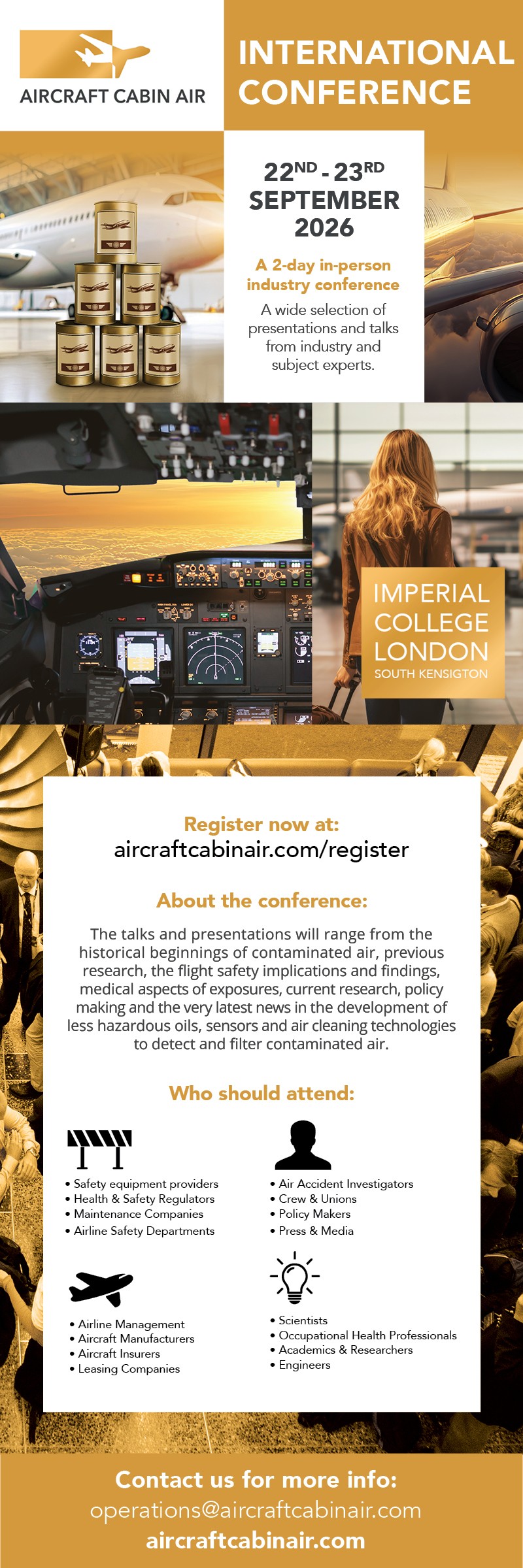
: Aircraft Cabin Air International Conference - 22-23 September 2026
. IATA World Maintenance & Engineering Symposium (23-25 June, Madrid, Spain)
. ISASI - BOSTON 2026 - September 28, 2026 – October 2, 2026
. 2026 NBAA Business Aviation Convention & Exhibition (NBAA-BACE)
Oct. 20-22, 2026 | Las Vegas, NV
| | |
Continental Air Service Porter in Laos
Public Domain
| | | | |