Flight Safety Information - May 29, 2026 No. 105 | | |
Accident: TAP A320 near Lisbon on May 27th 2026, turbulence injures two
A TAP Air Portugal Airbus A320-200, registration CS-TNS performing flight TP-643 from Brussels (Belgium) to Lisbon (Portugal), was in the initial descent towards Lisbon when the aircraft encountered turbulence causing injuries to two passengers, one receiving head injuries and the other a cut. The aircraft continued to Lisbon for a safe landing. The two passengers were taken to a hospital.
The airline reported two passengers received medical assistance after unforeseen severe turbulence during the flight.
https://avherald.com/h?article=539cc490&opt=0
| | |
Incident: PNG AT72 at Goroka on May 25th 2026, rejected takeoff due to flock of birds
A PNG Air Avions de Transport Regional ATR-72-212A, registration P2-ATB performing flight CG-8651 from Goroka to Port Moresby (Papua New Guinea), was accelerating for takeoff from Goroka's runway 17R when the crew rejected takeoff at low speed (about 70 knots) due to a flock of birds. The aircraft slowed and came to a stop with both left hand main tyres burst. There were no injuries.
The flight was cancelled.
The aircraft returned to service 28 hours after the rejected takeoff.
https://avherald.com/h?article=539cc5a2&opt=0
| | |
Gulfstream G600 - Runway Excursion (Alabama)
Date: Wednesday 27 May 2026
Time: c. 13:08 LT
Type: Gulfstream G600
Owner/operator: Spring Creek Aviation LLC
Registration: N600WE
MSN: 73050
Fatalities: Fatalities: 0 / Occupants: 15
Other fatalities: 0
Aircraft damage: Substantial
Location: Birmingham-Shuttlesworth International Airport, AL (BHM/KBHM) - United States of America
Phase: Landing
Nature: Passenger - Non-Scheduled/charter/Air Taxi
Departure airport: Kerry County Airport (KIR/EIKY)
Destination airport: Birmingham-Shuttlesworth International Airport, AL (BHM/KBHM)
Confidence Rating: Information is only available from news, social media or unofficial sources
Narrative:
The aircraft veered off the right side of runway 24 during landing at Birmingham, AL (BHM), damaging the right wing.
https://www.aviation-safety.net/wikibase/571007
| | |
Alaska Airlines Allegedly Let 11 Intoxicated Passengers Board Its Flights, Now FAA Is Threatening Major Fine for Violations
Alaska Airlines says it has made changes to address the FAA's concerns following an audit by the federal agency
The FAA has proposed a $165,000 fine for Alaska Airlines, alleging 11 incidents in which the airline allowed intoxicated passengers to board flights
FAA regulations prohibit airlines from allowing anyone who appears to be intoxicated to board an aircraft
Alaska Airlines says it has made changes to address the FAA's concerns following an audit by the federal agency
Alaska Airlines is facing a steep fine from the Federal Aviation Administration (FAA) after the agency alleged that the airline allowed intoxicated passengers to board flights.
In a statement released on Tuesday, May 26, the FAA announced that it was proposing a civil penalty in the form of a $165,000 fine against the airline for allegedly allowing intoxicated passengers to board 11 different flights that took place between February 2024 and February 2025.
FAA regulations prohibit airlines from allowing anyone who appears to be intoxicated to board an aircraft. However, the agency did not provide specifics about the alleged incidents involved intoxicated passengers.
The agency did not immediately respond to PEOPLE's request for comment.
In a statement shared with PEOPLE, an Alaska Airlines spokesperson says that the airline "take[s] seriously our responsibility to provide a safe and secure environment for our guests and employees."
We participated fully with the FAA’s audit of our policies and practices as it relates to intoxicated guests on board our aircraft," the statement continued. "Since the FAA shared these concerns with us over a year ago, we made meaningful changes to ensure compliance with the FAA’s expectations —including enhanced training for all flight attendants and customer service agents."
"We respect the results of the FAA’s audit and are confident in the changes that have been in place for the last year to ensure our shared standards are being met," the statement concluded.
Never miss a story — sign up for PEOPLE's free daily newsletter to stay up-to-date on the best of what PEOPLE has to offer, from celebrity news to compelling human interest stories.
The period of alleged incidents involving intoxicated passengers did not include December 2025, when an Alaska Airlines passenger was charged in federal court after trying to open an aircraft's cabin door mid-flight.
Kassian William Fredericks was accused of interfering with the duties of flight crew members and attendants during Alaska Airlines Flight 87 from Deadhorse to Anchorage, Alaska on Dec. 10, per a criminal complaint obtained by PEOPLE.
During the flight, a witness saw Fredericks get up to use the restroom in the back of the plane, before he "aggressively" tried to "open the rear cabin door" after exiting the lavatory, the complaint alleged.
Witnesses attempted to stop Fredericks, who admitted he thought he was overdosing and made comments including, “The wings have disappeared. We’re all going to die.”
Alaska will have 30 days after receiving the FAA's letter to respond to the allegations, the agency said.
https://www.yahoo.com/news/videos/4-people-hospitalized-evacuated-plane-032600514.html
| | |
How Flying Measures Up Against Everyday Risks: New Embry-Riddle Study Puts Air Travel Safety Into Perspective
Dr. Mihhail Berezovski, associate professor of Mathematical Sciences and director of Undergraduate Research at Embry-Riddle, is the lead author of a paper on U.S. commercial aviation risks. The paper has been published through Embry-Riddle’s Boeing Center for Aviation and Aerospace Safety.
A new study from Embry-Riddle's Boeing Center for Aviation and Aerospace Safety aims to inform the public about the safety of flying by demonstrating U.S. commercial aviation risk side by side with risks experienced through other activities, such as driving, recreational pursuits, household hazards, and common jobs and actions.
DAYTONA BEACH, Fla., May 28, 2026 /PRNewswire/ -- Feeling nervous about flying lately? New analysis of aviation safety data from Embry-Riddle Aeronautical University may ease some of those concerns among the flying public.
The newly released multi metric study from Embry-Riddle's Boeing Center for Aviation and Aerospace Safety aims to inform the public about the safety of flying by demonstrating commercial aviation risk side by side with risks experienced through other activities, such as driving, recreational pursuits, household hazards, and common jobs and actions. The report will be updated periodically with emergent information.
"Across all metrics considered, airline travel consistently emerges as the safest mode of transportation," said Robert L. Sumwalt, executive director of the Boeing Center for Aviation and Aerospace Safety and former National Transportation Safety Board chairman.
An aggregation of data across recent years and uses, the report, titled "Comparative Risk Metrics for U.S. Commercial Aviation (Part 121)," defines multiple ways of measuring aviation risk exposure to produce stable, comparable estimates for aviation safety. These include per passenger mile, trip or event, hour of exposure, annual risk and lifetime odds.
Ultimately, the findings highlight the exceptional safety of modern commercial aviation and provide an evidence-based foundation for assessing aviation risk within the broader landscape of human activity.
The report notes that "fatal events in commercial aviation are now exceedingly rare." That conclusion is backed by the numbers. On a distance basis, the study finds U.S. commercial aviation produced roughly one fatality per 90.9 billion passenger miles over the analysis period — a rate far lower than highway travel, motorcycle riding or cycling, according to the report.
The study's lead author, Dr. Mihhail Berezovski, associate professor of Mathematical Sciences and director of Undergraduate Research at Embry-Riddle, said the comprehensive multi metric approach gives the public a clearer basis for judgment.
"We want to give people correct, thorough and broad information so that they can assess risk rationally," Berezovski said. "By looking at multiple complementary measures, we can conclude that aviation's safety performance is not an outcome of one assessment methodology. Rather, it is a consistent result across distance, time and event based perspectives."
Beyond direct comparisons, the report also emphasizes that different questions require different metrics. For example, a traveler's intuitive concern about a single trip is best addressed by per-event risk, whereas public health comparisons consider annual or lifetime measures. Using these metrics, the study found that a single airline boarding is far less risky than a day of skiing or a recreational scuba dive, and an hour spent flying is generally safer than an hour spent driving or working in many occupations.
Berezovski further explained that the university's role is to translate technical analysis into a context usable by the public.
"This report helps people place aviation risk in the broader context of everyday activities and occupations," he said. "It's natural to feel fearful or worried after an accident, but decisions — both personal and policy-related — should be based on reliable data, not just fear based on a single event."
The findings are meant to educate rather than celebrate safety success across the industry, according to the experts at the Boeing Center for Aviation and Aerospace Safety.
Sumwalt said aviation safety is the result of decades of global standardization, data driven oversight and continuous technological and regulatory improvement. But he stressed that the findings are not grounds for complacency.
"Low risk does not mean no risk," Sumwalt said. "The aviation community must continue to learn from every accident, incident and near miss. This analysis gives us a clearer baseline from which to measure progress."
Embry-Riddle President P. Barry Butler, Ph.D., commended the center for producing the novel research.
"For over a century, Embry Riddle has acted as a leader in aviation and aerospace safety," he said. "By integrating academic analysis and industry partnerships with public outreach, we're committed to advancing the national conversation on risk and to providing the data and tools that regulators, airlines and the traveling public need to keep improving safety."
The full report, Comparative Risk Metrics for U.S. Commercial Aviation, is available online through the Boeing Center for Aviation and Aerospace Safety and is intended to inform policymakers, industry stakeholders, the media and the public. The publication will be updated periodically.
About Embry-Riddle Aeronautical University
Reporters worldwide contact Embry-Riddle Aeronautical University for content experts in all aspects of aviation, aviation business, aerospace, engineering and STEM-related fields. Our faculty experts specialize in uncrewed and autonomous systems, security and intelligence, air traffic and airport management, astronomy, human factors psychology, meteorology, spaceflight operations, urban air mobility and much more. Visit the Embry-Riddle Newsroom for story ideas.
Embry-Riddle educates over 31,000 aspiring aerospace and aviation professionals at its residential campuses in Daytona Beach, Florida and Prescott, Arizona, and across more than 115 Worldwide Campus locations and online degree programs. In 2024, U.S. News & World Report named Embry-Riddle Worldwide the nation's No. 1 provider of online bachelor's degree programs among private universities. Our residential campuses hold multiple Top 10 rankings. All of our campuses have been ranked Best for Veterans.
https://www.prnewswire.com/news-releases/how-flying-measures-up-against-everyday-risks-new-embry-riddle-study-puts-air-travel-safety-into-perspective-302784890.html
| | |
Plane AC malfunction at Opa-locka airport sickens 4
4 hospitalized for heat-related illnesses due to AC malfunction at Miami-Opa Locka Executive Airport4 hospitalized for heat-related illnesses due to AC malfunction at Miami-Opa Locka Executive Airport
Authorities are investigating after several people were rushed to the hospital after falling ill while on an airplane.
OPA-LOCKA, Fla. — Authorities are investigating after several people were rushed to the hospital Thursday after falling ill while on an airplane.
According to Miami-Dade Fire Rescue, four people required treatment for heat-related illnesses.
Sky 10 was over Miami-Opa Locka Executive Airport, where MDFR crews and Opa-locka police officers were observed at the scene while victims were being taken away on stretchers.
Those passengers fell ill on a GlobalX plane that was bound for Louisiana.
Global X is a charter airline used by U.S. Immigrations and Customs Enforcement for deportations, but it’s unclear if it was being used in that capacity at the time of this incident.
According to airport officials, the aircraft’s air conditioning malfunctioned and MDFR was called to assist passengers who were impacted by the heat.
Operations at the airport were unaffected.
https://www.local10.com/news/local/2026/05/28/plane-ac-malfunction-at-opa-locka-airport-sickens-4/
| | |
Airline Bans Iconic Flight Attendant Accessory in Major Dress Code Change
The new style guidelines will impact international routes from Seattle.
Hawaiian Airlines announced a major dress code change as part of its Alaska Airlines merger.
Flight attendants on certain routes can no longer wear certain parts of their uniform.
Alaska Airlines completed its $1.9 billion acquisition with Hawaiian Airlines in 2024.
One of the airline industry’s most recognizable flight attendant uniforms is getting a major overhaul. As part of its merger with Alaska Air Group’s Alaska Airlines, Hawaiian Airlines just announced new dress code rules for flight attendants on select routes—a change that now bans one of the most identifiable symbols of the airline’s identity.
According to the Hawaii Tribune-Herald, 250 Hawaiian Airlines flights attendants that have been reassigned to new long-haul international routes from Seattle will no longer be able to wear the floral hairpieces, aloha shirts, and flower lei that were previously allowed under the airline’s dress code as a nod to Hawaiian cultural identity over the past few decades.
It’s a major change for Hawaiian Airlines, which has had an iconic “flower of the sky” logo depicting a woman with a flower in her hair since 1973. “Pualani” is inspired by Leinaʻala Ann Teruya Drummond, a woman who was crowned Miss Hawaii in 1964 and later worked as a flight attendant for the airline. Hawaiian flight attendants have been able to wear flowers in their hair since the 1950s, making the change—which will impact certain employees flying out of Seattle-Tacoma International Airport—even more surprising.
In addition, flight attendants now on these routes will be replacing their Sig Zane-designed aloha shirts with “neutral tops accented by Alaska’s Aurora Borealis-inspired livery,” according to the Hawaii Tribune-Herald.
Eric Edge, vice president of brand and marketing for both Alaska and Hawaiian, told the publication that the decision was made to create more of a cohesive brand experience for customers while attempting to merge two companies with unique identities. “It’s not something that has been done by a U.S. airline before,” he said. “There isn’t something that we can point to and say, ‘Let’s do it like them. We’ll copy them.’ We are doing this on our own.”
Per Simple Flying, Alisa Onishi, managing director of Hawaii marketing for Hawaiian and Alaska airlines, told West Hawaii Today in a statement that “not everybody is happy necessarily about the decision.”
However, she revealed that Hawaiian Airlines uniforms will still be worn on different routes. “If you are flying to Hawaii anything that touches Hawaii, even if it’s Alaska branded, if it’s on a 787 [plane] or even the 737s that are served by the Alaska flight attendants, they can wear flowers in their hair. They can wear lei,” she shared.
https://www.instyle.com/hawaiian-airlines-banning-flower-in-hair-lei-aloha-shirts-seattle-routes-dress-code-11985494
| | |
GAMA Reports $6.85B In First-Quarter Aircraft Billings
The association listed 877 civil aircraft shipments worldwide in the first quarter.
The General Aviation Manufacturers Association (GAMA) reported 877 civil aircraft shipments worldwide for the first quarter of 2026, according to its aircraft shipment report released Thursday. Total aircraft billings reached about $6.85 billion. Airplane shipments accounted for 667 units and about $6.07 billion in billings. Helicopter shipments accounted for 168 units and about $788.5 million. GAMA’s 877 total figure also includes certain light-sport and other small aircraft that were not counted in the summary tables.
Piston airplanes made up the largest airplane category in the report. GAMA listed 381 piston airplane shipments, including 345 single-engine piston and electric aircraft and 36 multiengine piston airplanes. The report also listed 124 turboprop airplanes and 162 business jets. U.S.-manufactured airplane shipments totaled 506 units. while European manufacturers accounted for 123 airplane shipments.
By manufacturer, GAMA listed Cirrus Aircraft at 196 airplane shipments, followed by Textron Aviation at 156 and Piper Aircraft at 51. Gulfstream Aerospace was listed at 38 airplanes, followed by Embraer at 29, Bombardier at 24 and Pilatus at 24.
In rotorcraft, Airbus Helicopters and Robinson Helicopter Company were each listed at 56 shipments. The report also listed other military and government aircraft shipments separately, including 19 Sikorsky aircraft, three Air Tractor AT-802Us, two Bell V-22s and one Textron Aviation Beechcraft AT-6.
https://avweb.com/aviation-news/gama-6-85b-q1-aircraft-billings/
| | |
Northern Jet adds two Bombardier Challenger 604s to fleet
Orlando-based Northern Jet added two Bombardier Challenger 604 aircraft to serve clients seeking spacious, long-range private aviation solutions across North America and select international routes.
The additions bring greater access to Northern Jet’s heavy jet category.
The two Challenger 604 aircraft offer seating configurations ranging from 9 to 12 passengers, giving Northern Jet clients added flexibility when selecting the right aircraft for their trip.
Northern Jet said that both aircraft are equipped with Starlink high-speed Wi-Fi.
“Adding two Challenger 604 aircraft is an important step in the continued growth of our heavy jet fleet,” said Chris Bull, CEO of Northern Jet. “These aircraft give our clients more options for longer trips, larger groups, and comfortable private travel. As demand grows for flexible access to heavy jet aircraft, we are focused on building a fleet that delivers performance, consistency, and a high level of service.”
The fleet additions also support Northern Jet’s expanding private aviation programs, including jet card memberships, fractional ownership, and aircraft management.
Earlier this month, Northern Jet also announced addition of 2026 Bombardier Challenger 650.
https://www.corporatejetinvestor.com/news/northern-jet/
| | |
General Aviation Leaders Honored With Neil Armstrong Award
DAYTON, Ohio — The National Aviation Hall of Fame (NAHF) has selected Mark Baker and Bruce Landsberg as the co‑recipients of the 2026 Neil Armstrong Outstanding Achievement Award.
Distinguished leaders in general aviation, Baker and Landsberg have each made profound and lasting contributions to aviation safety, education, and pilot advocacy, collectively elevating the culture of safety across the industry, according to NAHF officials.
Baker, the retired President and CEO of the Aircraft Owners and Pilots Association (AOPA), has dedicated his career to expanding access to general aviation and strengthening the voice of pilots nationwide.
An aviator with more than 10,000 flight hours, Baker advanced pilot engagement and safety through his leadership of AOPA, the AOPA Foundation, and the International Council of Aircraft Owners and Pilots Associations. His efforts to modernize industry outreach, promote airport and airspace protections, and grow the aviation community have helped ensure a strong future for general aviation, NAHF officials said.
Landsberg, retired Vice Chairman of the National Transportation Safety Board, has shaped the national culture of aviation safety through decades of distinguished service. During his tenure with the AOPA Air Safety Foundation and Air Safety Institute, he earned international recognition for advancing safety education, producing industry‑leading training resources, and delivering thousands of seminars to pilots nationwide.
Bruce Landsberg.
With more than 7,500 hours of flight experience and a career spanning the U.S. Air Force, Cessna Aircraft Company, and Flight Safety International, Landsberg has been a steadfast advocate for data‑driven safety innovation and pilot proficiency. He is a recipient of the FAA’s Wright Brothers Master Pilot Award.
“I am deeply honored to receive this recognition alongside Bruce,” said Baker. “General aviation is built on a shared commitment to safety, education, and opportunity, and I am proud to have contributed to that mission.”
“This award reflects the collective efforts of so many individuals dedicated to improving aviation safety,” said Landsberg. “It has been a privilege to serve a community that is committed to learning, improving, and making flight safer for everyone.”
“Mark Baker and Bruce Landsberg embody the very best of aviation leadership through their lifelong dedication to advancing safety, education, and advocacy,” said NAHF Trustee and Chair of the Awards Committee Pat Waddick. “Their contributions have strengthened the foundation of our aviation community and inspired generations of pilots.”
Baker and Landsberg will be honored at the President’s Reception on Sept. 23, 2026, as part of the 62nd Annual Enshrinement events in Washington, D.C.
About the Award
The Neil Armstrong Outstanding Achievement Award is a prestigious aviation award named after Neil Armstrong, the military aviator, test-pilot, astronaut, educator, and 1979 NAHF Enshrinee. The award is for exceptional aviation performance of national or international significance by a U.S. citizen or by a group, the majority of which are U.S. citizens. It may be given for a one-time event that establishes a new level of performance in an aviation activity, a demonstration of an exceptionally high level of personal skill in an aviation event, the development or demonstration of a breakthrough in aviation technology, or an enduring series of events that demonstrate life-long dedication to leadership in promoting aviation and the values of citizenship, dignity, integrity and service.
For more information: NationalAviation.org
https://generalaviationnews.com/2026/05/27/neil-armstrong-award-baker-landsberg/
| | |
FAA proposes AD to address Challenger 600-series flap malfunction risk
The Federal Aviation Administration (FAA) has proposed a new airworthiness directive for 610 US-registered Bombardier Challenger 600-series aircraft. The move comes in the wake of an in-flight flap malfunction that raised concerns about the potential for dangerous loss of handling in the business jet.
The proposed AD, published May 26, 2026, would apply to all Bombardier CL-600-1A11, CL-600-2A12 and CL-600-2B16 aircraft. The models include the Challenger 600, 601, 601-3A, 601-3R and 604 variants.
The FAA noted that the proposal follows an in-flight event in which a CL-600-2B16 experienced uncommanded and unarrested flap movement from 0 degrees to 45 degrees, accompanied by a FLAPS FAIL caution message. The aircraft returned to its departure airport without further incident.
The flap control system should have stopped the flaps at 3 degrees, according to the FAA. However, a failed retract relay prevented the system from arresting the uncommanded movement.
The FAA suggested that the condition, if not addressed, could result in loss of control of the aircraft.
The proposed AD would require operators to revise the aircraft flight manual to provide crews with procedures to follow in the event of uncommanded, unarrested flap movement. The FAA estimates that the action would cost $85 per aircraft, or $51,850 across the affected US fleet.
The FAA declared that the proposal follows Transport Canada AD CF-2024-39, issued November 29, 2024. Transport Canada is the state of design authority for the aircraft.
The underlying event involved a Challenger 604, D-AAAY, that experienced the flap malfunction during climb after departing Farnborough Airport in the UK on August 10, 2022. The UK Air Accidents Investigation Branch later found a latent failure in the No. 1 flap retract relay that had existed for at least 64 previous flights.
According to the AAIB, the failed relay caused the flaps to retract at half their normal speed and prevented the system from arresting an uncommanded flap movement. The fault went undetected before the incident flight.
Transport Canada later issued AD CF-2025-51, effective October 22, 2025, which superseded an earlier 2023 directive and required functional tests of flap extension and retraction, along with life limits for flap extension and retraction relays.
The FAA noted that comments on the proposed US directive are due by July 10, 2026.
https://www.aerotime.aero/articles/faa-challenger-600-flap-malfunction-ad
| | |
Graduate Research Request - 1
candidate in Aviation with a specialization in Human Factors at Embry-Riddle Aeronautical University.
With nearly 40 years of experience in aircraft maintenance and aviation safety, his dissertation research examines how Aircraft Maintenance Technicians (AMTs) experience and describe decision-making during troubleshooting, inspection, and repair activities in Part 121 and Part 135 operations. The IRB-approved study seeks currently employed Part 121 and Part 135 AMTs with at least one year of maintenance experience to participate in one confidential 60 to 75-minute virtual interview focused on real-world maintenance decision-making. Participation is voluntary and confidential, and no proprietary or company-specific information will be requested.
Although employed by the FAA, this research is conducted solely in an academic capacity and is not affiliated with or conducted on behalf of the FAA. Individuals interested in participating or learning more may contact Steve Poiani at poianadf@my.erau.edu.
https://sites.google.com/view/aircraftmaintenancestudy/home
Steve Poiani
Doctoral Candidate
Embry-Riddle Aeronautical University
poianadf@my.erau.edu
| | |
Graduate Research Request - 2
My name is Michail Karyotakis, Lt. Col. (P) HAF, Part-time PhD Student in Aerospace, School of Aerospace, Transport and Manufacturing at the Cranfield University in the UK.
Currently, I am working on the final stage of my Research project, which is focused on developing a Flexible and Dynamic Safety Management Framework for Unmanned Aircraft Systems Operations.
I kindly invite you to participate in this survey validating or arguing against the findings of the respective research. Findings are illustrated in the form of questions. Everyone’s level and kind of experience is considered useful not to mention those with aviation and/or piloting background.
By sharing your perspectives, you will contribute to developing effective and sustainable mechanism of safety risk management for Unmanned Aircraft Operations in the current aviation environment.
Specifically, this Research is focused on:
• Reviewing the existing Safety Management approaches for the UAS operations that are in the scope of the Research.
• Introduce, test and validate the concept of Total System Safety Performance for UAS operations in the scope of this research.
• Assessing Safety risks related to the operations of Urban Air Mobility (UAM) and Package Delivery.
• Assessing the impact of Human Factors, Terrain management and different flight phases in UAS operations.
• How could the current safety management framework for UAS operations be updated and streamlined according to the specific needs of every operator and the specificities of every UAS operation.
Your participation in this survey is entirely voluntary, and it is estimated to take approximately 15 to 20 minutes of your time.
This survey is undertaken as part of my research thesis submission and is not affiliated with any airline, training organisation, or any other.
Participation in the survey is voluntary and anonymous (if desired by the participants, personal info may be shared).
The survey will take about 15 minutes to be completed.
Thank you in advance for your time and patience.
Your participation is highly appreciated.
Please click the link below to enter the survey:
https://cranfielduniversity.eu.qualtrics.com/jfe/form/SV_3fvlBSGnO7TxeJ0
Student email: michail.k.karyotakis@cranfield.ac.uk
| | |
CALENDAR OF EVENTS
.2026 FAA-EASA International Aviation Safety Conference — June 16-18, 2026, in Chantilly, Virginia, with the theme “Safety Together: Innovation, Integration and Trust.”
https://www.easa.europa.eu/en/newsroom-and-events/events/2026-faa-easa-international-aviation-safety-conference
. Aircraft Fire Hazards, Protection, and Investigation Course
7 to 9 July 2026; Woburn MA 01801 USA
: APSCON/APSCON Unmanned 2026 – Ft. Lauderdale, FL - July 13-17, 2026
. ICAO/EASA Third Global RSOO/RAIO Forum for Aviation Safety — September 29–30, 2026, in Georgetown, Guyana., https://www.icao.int/events
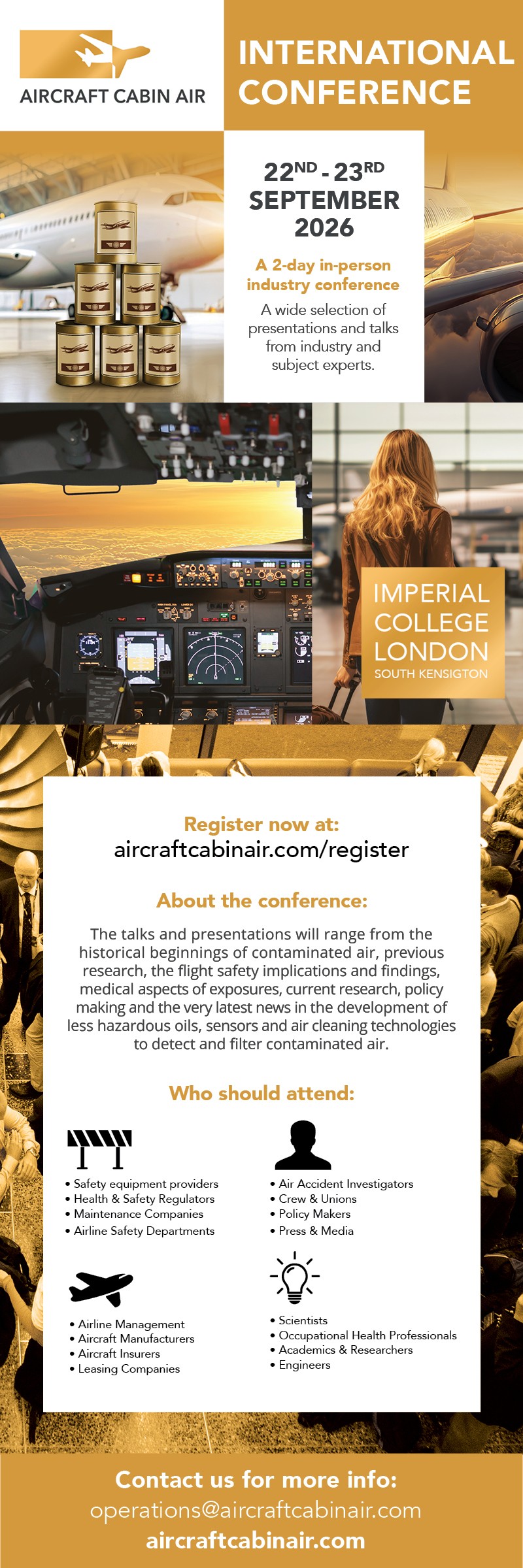
: Aircraft Cabin Air International Conference - 22-23 September 2026
. IATA World Maintenance & Engineering Symposium (23-25 June, Madrid, Spain)
. ISASI - BOSTON 2026 - September 28, 2026 – October 2, 2026
. 2026 NBAA Business Aviation Convention & Exhibition (NBAA-BACE)
Oct. 20-22, 2026 | Las Vegas, NV
| | | | |