| |
 Flight Safety Information Flight Safety Information |
|
 Flight Safety Information Flight Safety Information |
August 1, 2016 - No. 149 |
|
| |
|
| 
|
Texas hot air balloon hit power lines before crash, NTSB says

Kyle, Texas (CNN)Part of the hot air balloon that crashed in Texas hit power lines when it went down, an NTSB spokesman said Sunday after investigators arrived at the accident scene in dusty pastureland south of Austin.
All 16 people aboard the balloon -- 15 passengers and the pilot -- were killed in Saturday's crash.
It's not clear what part of the balloon hit the lines, spokesman Robert Sumwalt said. It's also unclear whether the fire that broke out on the balloon happened before or after the collision, Sumwalt said.
The investigation will look at three main factors to determine the cause of the crash: the balloon, its operators and the environment, Sumwalt said.
He said investigators are "trying to nail down as best we can" whether fog was a factor. Though it was foggy after the accident, Sumwalt said they don't yet know whether there was fog at the time of the crash.
Sixteen victims
Friends of some of the victims identified them Sunday. They include the pilot, Alfred "Skip" Nichols, and newlyweds Matt and Sunday Rowan.
The Rowans got married in February, said Brent Jones, the father of Sunday's 5-year-old son, Jett. "Sunday was a very social person," Jones said. "They have hundreds and hundreds of friends."
Sunday Rowan bought the balloon flight for her husband as a birthday gift last year and it had taken them a while to schedule it, Jones said.
"Sunday was messaging her mom before getting on the balloon. Soon after takeoff, she stopped all communication," he said.
"It's hard, but I want everyone to understand how great our lives were together and how amazing these two people are."
Alan Lirette, the ground crew supervisor for the balloon operator, Heart of Texas Hot Air Balloon Rides, described Nichols as his "best friend, boss and roommate."
Philip Bryant, a balloon pilot, told CNN he knew Nichols.
"I knew him to be a safe, competent pilot," Bryant said. "He has done this for a very long time."
Joe and Tresa Shafer Owens were also killed, said family friend Tricia James, who set up a GoFundMe page to raise money for their funeral.
James told CNN she worked with Tresa Owens for more than two decades at a preschool in Katy, about two hours away from where the balloon trip began.
"They adored their children and grandchildren, and loved nothing more than spending time with them," James wrote on the fundraising site.
"Joe worked hard (to) provide for his family and was always willing to lend an extra hand to anyone in need. Tresa had a long-time career at TigerLand Preschool and made an amazing difference in the lives of the hundreds of children she cared for, their families and also her co-workers and friends.
"So quick to offer up a prayer or a friendly greeting, they will forever be missed by the people who loved them," James wrote.
The NTSB said the identities of all the victims would be made public later by local authorities.
Electronic devices recovered
The FBI has found 14 personal electronic devices from those aboard the balloon, Sumwalt said. They include cell phones, one iPad, and three cameras.
The cameras, he said, are destroyed, but he said he hopes NTSB lab technicians can recover the images.
"They have been able to do miraculous things" in the past to recover information from destroyed and damaged devices, Sumwalt said.
Nichols used an iPad to navigate and a cell phone to communicate with the ground crew.
Some of those aboard posted Twitter images that investigators will examine as well, Sumwalt said.
Deadliest hot air balloon crashes
A sunrise trip
The passengers assembled for the ride at 5:45 a.m. in a Walmart parking lot and rode in a van to the launch site, Sumwalt said.
The planned launch time for the one-hour flight was at sunrise, at 6:49 a.m., but Sumwalt said for some reason it was delayed.
"We will interview the ground crew (Monday) to see if we can find out if there was any particular reason why the launch was delayed by as much as 20 minutes," he said. "We want to find out if there was anything going on there."
 NTSB investigators examine the downed balloon.
The utility company responsible for the lines reported they were tripped at 7:42 a.m. The first 911 call came in approximately one minute later, Sumwalt said.
The gondola, the basket that carries passengers, came to rest below the power lines, in a field, he said. The actual balloon, called an envelope, landed 3/4 mile away.
Clashes over regulations
Saturday's crash is the most fatal hot air balloon crash in U.S. history, according to NTSB figures.
Previously, the country's deadliest hot air balloon crash was a 1993 accident in Colorado that killed six people.
In 2013, 19 people died in a hot air balloon crash in Egypt, near the ancient city of Luxor. That was the world's deadliest hot air balloon accident in at least 20 years.
The NTSB has expressed concern about safety regulations in hot air balloon activities, but the Federal Aviation Administration, which sets regulations for manned balloons, hasn't acted on the NTSB's recommendations, said Deborah Hersman, the board's former chairwoman.
She said she urged the FAA in a 2014 letter to address "operational deficiencies" in the industry after several incidents resulted in injuries and one death.
Hersman cited accidents in 2007, 2008 and 2013, according to the letter, which also urged more stringent regulations and oversight.
"The FAA has not responded in an affirmative way," she told CNN's Sara Ganim on Saturday. "The NTSB (has) classified that recommendation 'open-unacceptable,' which means they really haven't done what the NTSB asked."
Hersman added, "Unfortunately in aviation, they say that the lessons are often written in blood, and it takes more than one event for an action to occur."
NTSB recommendations

This file photo shows a large-capacity balloon gondola carrying tourists in Kenya.
Given that some balloon gondolas can carry more than 20 people per flight, safety deficiencies mean a single accident could result in a "high number of fatalities," Hersman said in the 2014 letter, referring to the 2013 accident in Egypt.
In the letter, Hersman recommended requiring commercial balloon operators to have letters of authorization to hold tour flights and to give passengers a similar level of safety oversight as those on airplane and helicopter tours.
The FAA responded to the NTSB request last year, saying the proposed letters of authorization "would not result in a significantly higher level of operational safety."
The NTSB fired back in a 2016 statement, saying the FAA's reply was unacceptable.
It is unclear whether Heart of Texas Hot Air Balloon Rides implemented any of the NTSB's recommended measures.
Twenty-five balloon accidents, resulting in four fatalities and 25 serious injuries, have occurred since Hersman's 2014 letter and the last warning issued by the NTSB in March 2016, according to the exchange posted on its website.
|
India seeks U.S. help in locating missing air force jet
 India Defense Minister Manohar Parrikar said the government is seeking help from the United States in the search for a missing Air Force AN-32 aircraft, similar to the one seen here, which mysteriously disappeared on July 22 while carrying 29 passengers. Parrikar said the country is looking to determine whether the U.S. satellites had picked up any signal before the plane disappeared. He also assured the plane was fit to fly and ruled out any chance of sabotage. Photo by Toproh/Wikipedia
NEW DELHI, July 30 (UPI) -- India's government announced it is seeking U.S. help from in locating the countrys air's force's AN-32 aircraft, which mysteriously disappeared on July 22.
Defense Minister Manohar Parrikar said the government is looking to determine whether the U.S. satellites picked up signals before the plane, which was carrying 29 passengers, disappeared.
"At the time of disappearance, the aircraft was on secondary/passive radar and there was no SOS or transmission of any frequency. It just disappeared so that is the worrying part," Parrikar said, according to Times of India.
"It is total blank. There was not even a single signal recorded," he said. "That is the reason we are contacting American defense forces to ascertain whether their satellites picked up any signal."
Parrikar said the plane was fit for flight saying that it was an "almost as good as new aircraft" and the pilot had flown for more than 500 hours on the route from Tambaram to Port Blair.
"If aircraft is not fit for flying we don't fly it. We have decided to check up whether we can improve the signalling system," he said.
Parrikar said the incident rate of Indian air force is lower than the worldwide average, dismissing concerns the air force has a high crash rate. He ruled out any kind of sabotage.
"I can't speculate because we are searching for it and I will not like to speculate. But I can say only this much. The possibility, although we are checking all angles, of any sabotage is comparatively very less because they have standard operating procedures," he said.
Ten Indian Navy ships and a submarine are searching for the ship and have discovered several floating objects, but no concrete evidence of the plane's whereabouts.
"If we locate something, then we can send deepwater equipment to pick up. We have also diverted 'Sagar Nidhi' [vessel] from Mauritius," he said. "But we have to locate objects. We have to locate it because at this depth you cannot keep on scratching the bottom."
http://www.upi.com/Top_News/World-News/2016/07/30/India-seeks-US-help-in-locating-missing-air-force-jet/9491469893430/
|
Hail cracks Air Canada jet's windshield, forces emergency landing

Passengers on an Air Canada plane had to make an emergency landing due to a cracked windshield caused by extreme hail.
A hailstorm cracked the windshield of an Air Canada flight on Saturday evening, forcing the pilots to abort their landing at Calgary International Airport and make an emergency stop in Lethbridge Alta.
Air Canada confirms that Flight AC1159 from Toronto ran into hail on its approach to land in Calgary. None of the 144 passengers were injured, but some were shaken by the experience.
Passengers say the Airbus A320 was descending on to the runway in Calgary when the pilots made a last-minute decision to pull back up into the air.
Plane lands due to hail
The plane landed safely in Lethbridge after cracking a windshield in flight.
 A powerful hailstorm swept through the Calgary region on Saturday, bringing hailstones the size of ping pong balls. This image, provided by CTV reader Noradeen Azizi, shows a handful of hail.
"I was a little disturbing when you're going in for a landing and then all of a sudden you are changing your trajectory and then taking off," said one man who was aboard the flight.
|
Tara Air flight 193 crash report: Pilots violated standard operating procedure (NEPAL)
 A file photo shows a Tara Air Twin Otter aircraft with Canadian registration at TIA in Kathmandu. Post file Photo
Aug 1, 2016- Pilots of Tara Air Flight 193, which crashed at Myagdi's Solighopte in February killing all 23 onboard, deliberately entered cloud while operating under the visual flight rules and deviated from the normal track due to the loss of situational awareness, the government's fact-finding committee said on Sunday.
Visual flight rules are a set of regulations under which a pilot operates an aircraft in weather conditions generally clear enough to allow the pilot to see where the aircraft is going. Entering cloud under the visual flight condition is violation of standard operating procedure.
A crash report submitted to the Tourism Ministry after five-and-half-month-long investigation pointed out that the crew had to contend with poor visibility and fog on the Pokhara-Jomsom route, one of the treacherous routes, after the plane reached an altitude of 7,000 ft.
The Pokhara airport had cleared the aircraft under 5,000m visibility, but the visibility report provided by the metrological office was 4,000m, according to the report. Flights are operated when the visibility is 5,000m in Pokhara. The flight was under the command of co-pilot Dikesh Nemkul.
After travelling 5 miles at 10,100 ft, before the Ghorepani passing, Captain Roshan Manandhar, who was acting as pilot monitoring, had said: "Cloud cell still present."
Manandhar then advised Nemkul to continue to climb to 12,000 ft and told him that they will take chance till Tatopani and decide whether to continue or divert, the report said.
Due to adverse weather condition on the flight path, the flight crew had avoided the normal route of Kaligandaki and deviated to the left. Suddenly, over the Ghorepani area, the cockpit started to buzz with ground proximity alert-"terrain...terrain; pull up...pull up", the report said. The aircraft was flying in dark clouds. "However, for a few second, the visibility outside the cockpit had improved," the report states.
The captain then instructed the flight commander to descend and subsequently a shallow descent was initiated. Again, the captain asked: "Whether you can see the visual." Nemkul replied: "Somewhat visual."
Nemkul was then instructed to descend to 10,000 ft. Again, an "over speed" warning sounded in the cockpit for 2 seconds. Then, the terrain alert sounded when the aircraft was at 10,200 ft. However, the captain responded not to worry about it, the report said. "The captain did not respond to the repeated warnings," said Captain Shrawan Rijal, a member of the government's committee.
Finally, at the critical point, a minute before the crash, Captain Manandhar decided to take the control. He then started to climb the aircraft. But the aircraft's belly hit the terrain at 10,700 ft and was destroyed completely by the impact. It rested at an altitude of 10,982 ft. The captain had 1:05 minutes to react, but he did not consider it seriously, the report said.
However, there were also other reasons for Manandhar hesitance to react. "Based on previous flight data recorder of the same aircraft, the area used to witness repeated ground proximity alert in the normal flight situation too," said Rijal. "They had become habitual of the alert so it was not considered seriously."
However, being an experienced pilot, who had 20,800 hours of flying experience, it was "skill error" or "judgemental error" of the captain, the report said. Rijal said there are other areas as well where such types of alerts are persistent and it's a serious issue.
After the submission of the report, a new debate has surfaced whether co-pilots or junior captains should be allowed to fly on treacherous route.
The investigation committee had issued an interim safety recommendation to the Civil Aviation Authority of Nepal (Caan) to enforce a mechanism to stop the tendency of pilot-in-command acting as pilot monitoring and junior pilots or co-pilots as flight commander during critical circumstances or on treacherous routes under the visual flight condition in the domestic sector.
However, some pilots said such a decision would prevent juniors to be experienced on difficult terrain and condition.
The committee has recommended that the Caan devise a mechanism to study en-route weather to ensure safe operation. It has recommended that the Department of Hydrology and Meteorology develop facilities to provide en-route weather information along various routes, particularly for aircraft flying on remote areas.
It has also recommended airlines ensure compliance with the provision of visual flight rules as an aircraft entering cloud under visual flight is considered a crime.
http://kathmandupost.ekantipur.com/news/2016-08-01/tara-air-flight-193-crash-report-pilots-violated-standard-operating-procedure.html
|
A team of ex-fighter pilots have invented a new way for surgeons look inside brains
No surgery required.
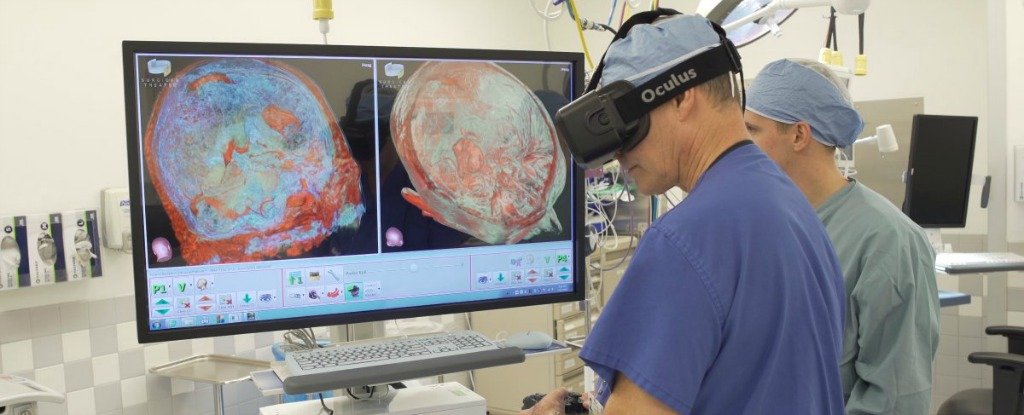
Fighter pilots and brain surgeons have a lot in common. With limited time and a high degree of risk, they must zero in on a dangerous target with the intent to destroy, making sure to minimise any collateral damage.
Perhaps no one understands that relationship better than Alon Geri and Moty Avisar, veterans of the Israeli Air Force and co-founders of Surgical Theatre, an Ohio-based company that brings state-of-the-art virtual reality to brain surgeons.
Physicians in thick black goggles can step inside a patient's skull, explore the malformed region, craft a strategy for entry, elimination, and exit, and even do dry runs of the surgery itself. When it comes time to make the first incision, there are fewer surprises.
The technology, which Surgical Theatre calls SNAP (Surgical Navigation Advanced Platform) uses existing MRI scans to create 3D models, which are compatible with virtual reality. Geri and Avisar, both engineers, developed SNAP after working extensively on flight simulation.
They realised in the early 2000s that the problems facing brain surgeons were nearly identical to those of their fellow pilots.
"You do it wrong the first time, and it's either game over or you spend the rest of the surgery putting out fires," Geri told Tech Insider.
Beginning in 2005, the pair spent three years crafting the solution to flat, colourless MRI scans. In 2013, their technology received FDA clearance. Now, with the explosive growth of VR, doctors can walk their patients through full-colour 3D renderings.
"It's like the difference between a flip book and 4K," Robert Louis, program director of the Skull Base and Pituitary Tumour Program at Hoag Neurosciences Institute in Newport Beach, CA, says of the difference between MRI and SNAP. "They're not even close to the same level."
Hoag has been using SNAP since December of 2015. In that seven-month period, Louis and his team have used the technology on every patient they have seen. "It's really making a big impact on the way we do things," he says.
A great deal of research explains why. When patients take an active role in their procedure, they feel more comfortable, in control, and satisfied with the outcomes. With SNAP, doctors can put the VR goggles on their patients so they can see their own brains before they go under.
The surgeries are also more successful, Louis says. Patients recover faster since SNAP allows doctors to avoid making any unnecessary incisions.
SNAP is being used in nine locations so far, including Stanford, UCLA, and New York's Mount Sinai Hospital. A tenth location will adopt the technology later this year, Geri says. Doctors have performed about 900 surgeries using SNAP to date.
Over time, Louis suspects the technology will provide even more detail.
Already he's seen a jump from last December. Initially, he could just see anatomical structures. Now SNAP lets him look at functional pathways in the 3D model. In excising a tumour, for example, he can more easily avoid nearby structures that govern things like speech or movement.
Without SNAP, that wouldn't be possible. "You can't see those with your naked eye or even with the microscope," Louis says.
Both he and Geri agree that virtual reality is poised to become a mainstay in the operating room. For Louis, the most rewarding element of the technology is how it helps patients understand their disorders and illnesses. For Geri, SNAP's success holds an even deeper significance.
"The first time I was in the operating room, it was very emotional for me," he says. "I remember thinking about how I transitioned from flying war machines to developing life-saving machines."
http://www.sciencealert.com/a-team-of-ex-fighter-pilots-invented-a-new-way-for-surgeons-look-inside-brains
|
62 pilots grounded in 6 months for violating air safety norms (INDIA)
 An Air India plane takes off from Mumbai Airport. (HT Photo)
Civil aviation regulator DGCA suspended 62 pilots in the last six months for safety violations,
up 30% from the corresponding period last year, an RTI query by HT has found.
The Director General of Civil Aviation took action against 93 pilots in 2015 - an average
monthly suspension rate of less than eight. This has gone up to 10 in 2016. Suspensions can last
15 days or go up to several years, depending on the severity of the offence.
The regulator declined information on the breakup of violations, but sources said in 45% of the
cases, pilots failed the breathalyser test that checks alcohol levels in blood. This was followed
by runway violations (30%), flight and duty time limitations (20%) and miscellaneous violations
(4%).
"The details of airlines cannot be provided as the information is exempt from disclosure," the
DGCA said, while a senior official added, "If we start disclosing airlines' names, they will start
hiding violations."
However, minister of state for civil aviation Dr Mahesh Shrama had told Lok Sabha in May that
8/1/2016 62 pilots grounded in 6 months for violating air safety norms
of 122 cases in three years of pilots failing alcohol tests preflight, Jet Airways, Indigo and
SpiceJet topped with 33, 25 and 20 cases, respectively.
Aviation experts said the DGCA was not dependent solely on airlines for reports on safety
violations. It also received information from air traffic control, aerodrome operators and flight
crew.
"In the era of the Right to Information Act, there should be no opaqueness. If an airline has
defaulted, the regulatory body should make it public," said former Air India executive director
Jitender Bhargava.
DGCA spokesperson Lalit Gupta declined comment.
The experts believe the high suspension rate is linked to the United States Federal Aviation
Administration's move to downgrade India's safety ranking in January 2014. "After the
downgrade, the DGCA is doing its work more earnestly," said Bhargava.
A source said, "In 2012, we acted against 109 pilots. The figure dipped to 89 in 2013 but rose to
92 and 93 in 2014 and 2015, respectively. It looks significantly high till now in 2016. It's
because we are seeking out violations more minutely."
The source said breathalyser tests were earlier conducted randomly on 60% of crew of
scheduled (regularly operated) airlines but since August 2015, all crew and nonscheduled
airlines had been covered.
A civil aviation ministry source, however, said the higher suspensions were due to a 2025%
jump in flight operations and stricter enforcement.
Some pilots accused the DGCA of punishing them for reasons beyond their control and
sometimes, in minor cases. "If the breathalyser reads 0:01 instead of 0:00, we are served a
suspension order. Such a reading could be due to several factors, not just because you have
consumed alcohol," said one pilot.
Another said, "There are circumstances where a pilot has to deviate from maintaining a
particular descending speed while approaching the runway. But the DGCA takes punitive action
without asking the pilot for the reason." He added that frequent rule changes by the regulator
also complicated matters.
|
Report: Pilot who crashed WWII aircraft had pot in system

A recently released report has found that the Durango pilot who crashed a World War II aircraft on July 4, 2014 had marijuana levels above the legal limit in his blood.
The Durango Herald reports that according to the report by the National Transportation Safety Board, John Earley's blood tested positive for 6.3 nanograms of THC, above Colorado's legal driving limit of 5 nanograms.
Both Earley and his passenger Michael Schlarb were killed when the vintage plane crashed at the Durango-La Plata County Airport. Schlarb's blood tests were negative for any alcohol or drugs.
Schlarb's wife, Mona Schlarb, says Michael was teaching Earley how to pilot the P-51 Mustang at the time of the crash.
http://www.krdo.com/news/Report-Pilot-who-crashed-WWII-aircraft-had-pot-in-system/40970700
****************
| Date: |
04-JUL-2014 |
| Time: |
09:30 LT |
| Type: |
North American P-51D Mustang |
| Owner/operator: |
Bridgewood Holdings LLC |
| Registration: |
N1451D |
| C/n / msn: |
44-74446A |
| Fatalities: |
Fatalities: 2 / Occupants: 2 |
| Other fatalities: |
0 |
| Airplane damage: |
Written off (damaged beyond repair) |
| Location: |
Near the Durango-La Plata County airport (KDRO), Durango, CO - United States of America |
| Phase: |
Take off |
| Nature: |
Training |
| Departure airport: |
Durango-La Plata County (KDRO) |
|
Destination airport:
|
|
Narrative:
The plane crashed shortly after takeoff under unknown circumstances. Both occupants died in the crash.
Witnesses saw the aircraft takeoff and enter a hard left bank to approximately 90 degrees. The nose pitched up slightly and it continued to turn past 90 degrees to an inverted position when the nose pitched down to approximately a 45 degree angle. The witnesses stated they lost sight as it went behind a hangar and did not witness the impact.
|
Airplane alcohol clampdown could see airports forced to sell booze in sealed plastic bags (UK)
Aviation Minister Lord Ahmad is considering a series of measures in a bid to reduce the number of drink-fuelled air-rage incidents
 Airport bar staff will be trained to deal with disruptive behaviour
Airports could be forced to sell alcohol in sealed bags in a bid to stop drink-fuelled air-rage incidents.
The new Aviation Minister Lord Ahmad wants a clampdown after an airline handed a passenger a £12,000 bill and a lifetime ban when his "abusive and aggressive" behaviour led to a plane being diverted.
Joshua Strickland, 21, of Tadcaster, North Yorkshire, "illicitly" drank alcohol he had brought on to the aircraft on July 13 and threatened a family on board.
The flight from Leeds Bradford to Larnaca, Cyprus, with budget carrier Jet2.com, had to be diverted to Manchester after he made "physical threats" towards a crew member and also began to "punch the seats".
Strickland appeared at Manchester magistrates court on Thursday where he pleaded guilty to being drunk on an aircraft.
At least 442 people were held on suspicion of being drunk on a plane or at an airport in the past two years.
Lord Ahmad said: "If you're a young family travelling on a plane you want to go from point A to B, you don't want to be disrupted.
"I don't think we want to kill merriment altogether, but I think it's important that passengers who board planes are also responsible and have a responsibility to other passengers, and that certainly should be the factor which we bear in mind.
"In terms of specific regulations of timings of outlets (which sell alcohol) and how they operate, clearly I want to have a look at that."
Lord Ahmad, who was appointed aviation minister by Theresa May when she became Prime Minister earlier this month, also highlighted the value of screening travellers before they board planes.
"I think that it's important for the safety and security of all passengers that we ensure that regime is actually fit for purpose," he said.
A code of practice on disruptive passengers was published earlier this week following collaboration between airlines, airports, the police and retailers.
It includes airport shops advising passengers not to drink alcohol they have purchased before or during their flight, and training staff in bars and restaurants to limit or stop the sale of alcohol if they are concerned about disruptive behaviour.
 A new code of practice has been drawn up
Trade bodies representing UK airlines and airports said incidents of disruption are "a very rare occurrence", but warned they can lead to "serious consequences".
Tim Alderslade, chief executive of the British Air Transport Association, and Ed Anderson, chairman of the Airport Operators Association, said in a joint statement: "These incidents can be costly and cause delays.
"With air travel proving more popular than ever, and passenger numbers expected to rise across the whole of the UK in the coming years, now is the time to tackle this problem collectively."
A Department for Transport spokeswoman said: "Airport security is always under review, however there are no plans to specifically address the issue of alcohol at airports."
http://www.mirror.co.uk/news/uk-news/airplane-alcohol-clampdown-could-see-8523105
|
Pakistan's National Airlines Staff Arrested For Plan To Smuggle Heroin
 Six kilogrammes of heroin worth over Rs. 60 million were seized from the toilet of the aircraft
LAHORE: Pakistani authorities today arrested 13 employees of its national carrier Pakistan International Airlines (PIA) here for allegedly trying to smuggle 6 kgs of heroin worth over 60 million rupees to Dubai.
PIA flight PK-203 was ready to leave for Dubai on Saturday from the airport here when the Anti-Narcotics Force (ANF) staff got it vacated on information that a huge quantity of heroin had been concealed in the aircraft, officials said.
After a thorough search of a couple of hours, the ANF team seized 6 kg of heroin worth over Rs. 60 million from the toilet of the aircraft, they said.
Thirteen PIA employees were arrested by the ANF and a thorough probe was launched into the matter.
PIA spokesman Daniyal Gilani confirmed the arrests saying some of the airline employees have been taken into custody in connection with the failed bid to smuggle heroin.
After investigation, if these employees are found guilty, strict action will be taken against them, he said.
During the last few years, there has been a rapid rise in the number of cases in which the PIA employees were caught red-handed while smuggling different items like drugs, cigarettes, mobile phones, illegal passports and laundered money abroad.
In some cases, the PIA employees were caught at Pakistani airports and in others, they were intercepted and arrested in other countries, mostly in the European destinations.
http://www.ndtv.com/world-news/pakistans-national-airlines-staff-arrested-for-plan-to-smuggle-heroin-1438744
|
Missing Malaysia Airlines flight may have deliberately crashed, complicating insurance settlements
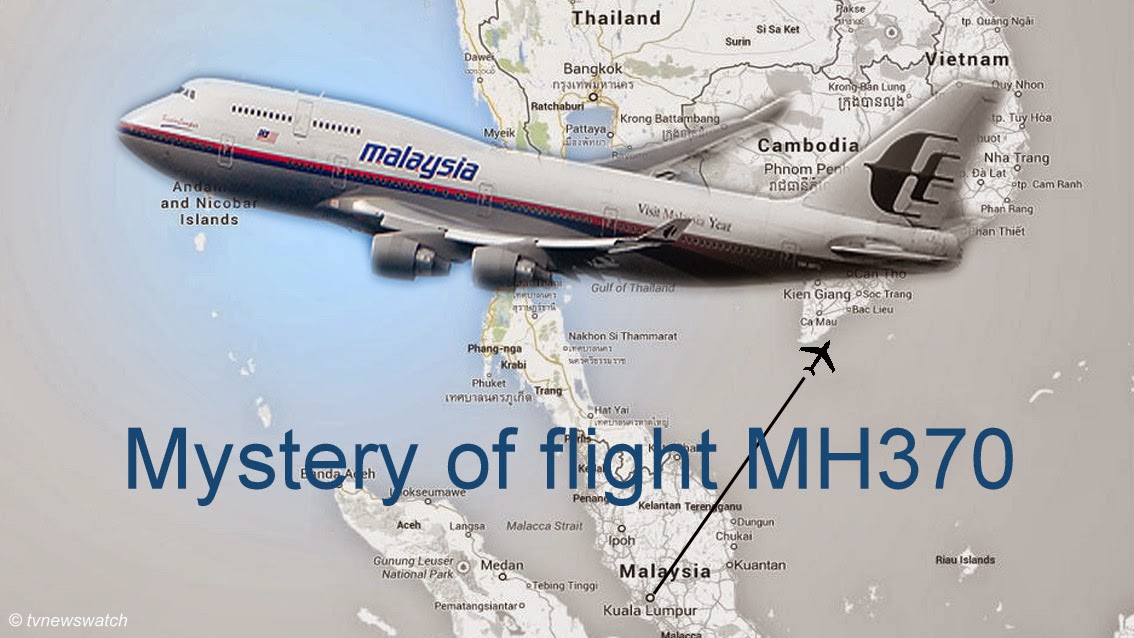
Certain tenets of an international insurance treaty may stymie coverage for families of the victims of Malaysia Airlines Flight 370, as new evidence points to a deliberate crash and potential pilot suicide as the cause of the plane's disappearance two years ago.
Peter Foley, the Australian Transport Safety Bureau's program director of the operational search for MH370, admitted for the first time this weekend that damage found in the recovered wreckage suggests the plane was under the control of pilot Zahari Ahmed Shah when it went into the sea in March 2014. Severe erosion along the trailing edge of two recovered wing parts points to a controlled landing, Foley said.
Australian authorities also admitted that a Malaysian police report suggesting Shah had plotted a route deep into the southern Indian Ocean on his home flight simulator was genuine. Evidence of any such route has since been deleted.
The two admissions throw significant doubt on authorities' preferred theory that the plane's disappearance was an accident, instead pointing strongly to pilot suicide - something that could prevent families of the crash victims from collecting insurance settlements from the airline.
Grace Nathan, a spokeswoman for MH370 next-of-kin group Voice 370, said families of the victims who are suing the airline for negligence may now pursue criminal action as well. However, families who accepted payout offers may no longer be covered by insurance.
Families who missed the March 8 deadline to initiate lawsuits against the Malaysia Airlines may also be stranded if pilot suicide was indeed the cause of the crash, thanks to the 1999 Montreal Convention, which dictates international aviation insurance terms. Under the treaty, claimants have two years from the date an aircraft should have arrived at its destination to file suit for compensation against the carrier.
"You can't start something now because the limitations date has passed," Nathan told The Australian.
Nathan also pointed to the question of airline responsibility in a suicide situation.
Even if Malaysia Airlines can successfully determine the cause of the crash, aviation policies often carry exclusions for terrorism or suicide - under sanction from the Montreal Convention - which may apply here.
"If it is proven to be pilot suicide, then the insurance becomes void," she said.
The Montreal Convention sets a mandated minimum compensation payment of just under $200,000 for claimants in cases where airlines could not produce evidence to defend themselves. Certain families of the victims have filed suit against the airline for the compensation under the assumption that the death of their next of kin was caused by something other than negligence.
Nathan has suggested Malaysia Airlines may not be able to meet this financial standard, calling the company "practically bankrupt," though a spokesperson for the airline has pushed back against those claims.
"[There is] adequate insurance coverage in place to meet any legal liability that we may have in respect of those claiming as a consequence of the incident," the spokesperson said.
Malaysian investigators concluded the Boeing 777 servicing Flight 370 crashed after someone aboard the jet intentionally disabled its tracking devices, turning it south before it plunged into the Indian Ocean and killed all 239 people aboard. The aircraft had been flying under Malaysia Airlines since May 2002 without mechanical or computer troubles. The communications systems aboard the plane were also operating normally until radio and transponder signals stopped during the flight.
The airline's insurers - Allianz Global Corporate & Specialty and Lloyd's of London unit Atrium - have already paid more than $300 million for claims related to the crash.
http://www.ibamag.com/news/missing-malaysia-airlines-flight-may-have-deliberately-crashed-complicating-insurance-settlements-35536.aspx
|
SIA 777 engine fire points to crack tube in oil heat exchanger
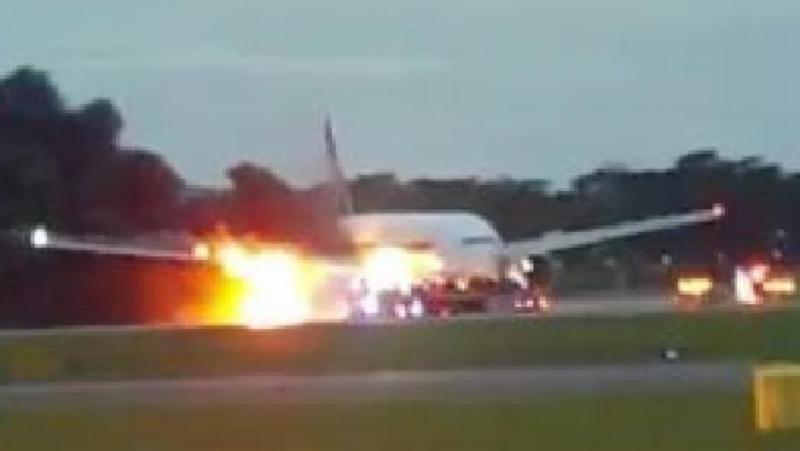
Singapore's Air Accident Investigation Bureau (AAIB) says fuel was found in the oil system of the right engine of the Singapore Airlines Boeing 777-300ER that caught fire upon landing on 27 June.
In the two-page interim statement, the bureau says investigation is still in the preliminary stage but points to three key findings.
It says fuel was found in the oil system of the right engine, which is not a normal condition, and was the result of a crack in a tube in the engine's main fuel oil heat exchanger (MFOHE).
In addition, the affected engine had last undergone an engine shop visit in March 2014, before GE Aviation issued a service bulletin in December 2014. The engine manufacturer had then called for for carriers to identify certain MFOHEs and remove them for inspection of cracks in the fuel tubes, and to repair if necessary.
The SIA aircraft, registered 9V-SWB, had suffered a fire in it its right General Electric GE90-115BL engine upon landing at Changi airport. Flight SQ368 had to make a turn-back while operating a Singapore-Milan service following an engine oil warning.
The AAIB has since made several interim safety recommendations. GE Aviation was asked to review the need to accelerate the implementation of the recommendations in its December 2014 MFOHE service bulletin to prevent the occurrence of a similar event.
Boeing has also been recommended to review operational procedures for future occurrences of a fuel leak situation in-flight, and for the US Federal Aviation Administration to ensure that such reviews are carried out.
"AAIB's investigation is on-going and we will be looking into other aspects of this incident that may have safety implications," it concludes.
www.flightglobal.com
|
A new, independent review of the Orion spacecraft is pretty damning
The capsule is over budget and may need seven more years before flying crews.
 NASA's Orion spacecraft may first carry crew into space in 2023.
At the request of Congress, the nonpartisan US Government Accountability Office reviews the finances and management of federal programs, and this week it released a study critical of NASA's crew capsule, Orion. Most worryingly, the 56-page report (PDF) regularly draws parallels between the Orion program and another large NASA project, the James Webb Space Telescope. The successor to the Hubble Space Telescope is notorious for ballooning from a 10-year, $500 million project to a 20-year, $8.8 billion (£6.7 billion) instrument that may finally launch in 2018.
Although Orion has not yet experienced such dramatic increases in costs, the spacecraft is now into its second decade of development. NASA estimates that it will spend a total of $16 billion (£12 billion) to ready Orion for its first crewed flight in April 2023. However, the GAO review, signed by Director of Acquisition and Sourcing Management Cristina T. Chaplain, did not find these numbers to be reliable.
The federal auditing agency based this conclusion on the fact that only a handful of NASA's methods for estimating costs and schedule were consistent with "best practices." Moreover, the GAO found, in making a number of its estimates, NASA appears to be relying too heavily on data analysis from the primary contractor for Orion, Lockheed Martin. In regard to Orion's cost and schedule estimates, then, the GAO report concludes, "They do not fully reflect the characteristics of quality cost or schedule estimates and neither estimate can be considered reliable."
Some of the major Orion concerns cited by the GAO study are well-known, such as delays by NASA's partner, the European Space Agency, in building the service module that will help power Orion in space. Less widely known, however, are significant cost overruns with Orion's primary contractor, Lockheed Martin. The GAO's analysis of contractor data found that the Orion program faces potential cost overruns of up to $707 million by 2020.
The report comes at an important time for Orion, which will likely face questions about its viability during the next 18 months as a new president comes into office and reviews NASA's programs. Congress supports NASA's development of the vehicle, but there is considerable back-channel discussion in the aerospace community about the time and expense that has gone into developing what is a capable but relatively straightforward spacecraft.
A long time coming
Few blame the NASA engineers themselves for these difficulties, but rather changing requirements and bloated government procurement processes for a program that formally began in 2006. The 5-meter capsule has seen significant modifications during that time, first envisioned as a means to transport astronauts to the space station and now more focused on deep space exploration.
It's nevertheless striking that it will probably take NASA about 17 years to design and develop Orion before finally flying its first crewed mission in 2023. During the same amount of time, from 1964 to 1981, the space program flew the Gemini spacecraft; designed, developed, and flew the Apollo capsule; and designed, developed, and flew the much more complex space shuttle.
The GAO report also notes that there is some question about the viability of the 2023 launch date for Orion's first crewed mission, Exploration Mission-2, a 10- to 14-day crewed flight that will orbit the moon before returning to Earth. NASA has publicly said it has 70 percent confidence in that launch date, but an internal NASA review cited by the GAO found that this launch date may slip six months.
Despite these concerns, NASA is pressing ahead with an effort to try and accelerate development of Orion to enable an August 2021 launch of Exploration Mission-2. Yet the GAO found this scenario improbable. "To stay on the aggressive internal schedule, the agency is counting on receiving higher appropriated funds than what it plans to request, which may not be realistic in a constrained budget environment," the report states. There is low confidence-40 percent-in NASA making the 2021 launch date, and the GAO believes this may not be a "beneficial strategy" for Orion in the long term.
Deferred work
One of the final, most worrisome aspects of the Orion program noted by GAO is NASA's practice of deferring work on the vehicle to later this decade. That is, with constrained budgets now, NASA and Lockheed Martin are delaying development of some spacecraft systems. This positions the program poorly in terms of handling "a bow wave" of deferred work as well as inevitable technical challenges when Orion is integrated with the Space Launch System rocket.
"The Orion program may find itself in a similar situation to that experienced by the Constellation and (James Webb Space Telescope) programs, which had minimal cost reserves in early years to handle technical challenges that manifested and forced the programs to defer work," the report states.
As an example of some of the deferred work, the report notes a number of critical life-support and related systems that were originally planned to fly in Exploration Mission-1, an uncrewed test flight of Orion and the Space Launch System rocket tentatively scheduled for late 2018. These include air revitalization, fire detection and suppression, pressure control and waste management, an active launch abort system, emergency communications, and other systems. It is problematic to fly many of these systems for the first time with astronauts on board, the GAO found.
SS
It remains unclear whether the new report will shake Congress' confidence in Orion. Back in 2009, when the GAO concluded that Orion and another new NASA rocket, the Ares I, lacked a "sound business case," Congress fought against President Obama's efforts to end Orion. But given ongoing concerns about Orion's development, it does not seem likely the Washington wars over NASA's expensive, long-running capsule project have yet reached their conclusion.
http://arstechnica.com/science/2016/07/a-new-independent-review-of-the-orion-spacecraft-is-pretty-damning/
|

|
|
Title
|
Managing Communications Following an Aircraft Accident or Incident
|
|
Co-sponsor
|
Airports Council International - North America (ACI-NA)
|
|
Description
|
The course will teach participants what to expect in the days immediately following an aviation accident or incident and how they can prepare for their role with the media.
|
|
ID Code
|
PA302
|
|
Dates, Tuition
and Fee
|
September 29-30, 2016
$1034 early registration, by August 28, 2016
$1134 late registration, between August 29 - September 24, 2016
$100 processing fee will be added to tuitions for all offline applications.
A tuition invoice can be ordered for a $25 processing fee.
Note: payment must be made at time of registration.
|
|
Times
|
Day 1: 8:30am - 5pm
Day 2: 9am - 3pm
|
|
Location
|
|
|
Status
|
OPEN. Applications are now being accepted.
|
|
Apply to Attend
|
|
|
CEUs
|
1.3
|
|
Overview
|
- How the National Transportation Safety Board organizes an accident site and what can be expected in the days after an aviation disaster from the NTSB, FAA, other federal agencies, airline, airport, media and local community
- Strategies for airline and airport staff to proactively manage the communication process throughout the on-scene phase of the investigation
- How the NTSB public affairs officers coordinate press conferences and release of accident information and what information the spokespersons from the airport and airline will be responsible to provide to the media
- Making provisions for and communicating with family members of those involved in the accident
- Questions and requests likely encountered from the airlines, airport staff, family members, disaster relief agencies, local officials and others
|
|
Performance Results
|
Upon completion of this course the participant will be able to:
- Be better prepared to respond to a major aviation disaster involving a flight departing from or destined for participant's airport
- Demonstrate greater confidence in fielding on-scene questions about the many aspects of the investigation and its participants, including what types of specific information may be requested
- Identify the appropriate Public Affairs roles for the various organizations involved in an accident investigation.
- Be more productive in the first few hours after an aviation disaster by understanding which tasks are most important and why
- Perform job responsibilities more professionally and with greater confidence given the knowledge and tools to manage the airport communications aspect of a major aviation disaster
|
|
Who May Attend
|
This course is targeted to who, in the event of an aviation disaster, will need to provide a steady flow of accurate information to media outlets and/or other airport, federal or local authorities.
|
|
Accommodations
|
|
|
Airports
|
Washington Dulles International (IAD): 10 miles
Washington Ronald Reagan National (DCA): 30 miles
Baltimore/Washington International (BWI): 60 miles
|
|
More Information
|
|
|
|
|
ISASI 2016, Reykjavik, Iceland
17 to 20 October, 2016
The International Society of Air Safety Investigators (ISASI) will hold their 47th annual seminar at the Grand Hotel Reykjavik, Iceland, from the 17 to 20 October 2016. The seminar theme is:
"Every link is important"
Papers will address this theme in conjunction with other contemporary matters on aviation safety investigation, including recent case studies, new investigation methods and aviation safety trends or developments.
Registration and details of the main seminar, tutorial and companion programmes are available at
www.esasi.eu/isasi-2016.
We look forward to seeing you in Iceland
|
RSVP by contacting Erin Carroll, DFRC President by September 1
|
Graduate Research Survey
Helicopter Pilot Trust in Automation Study
My name is Nick Currie and I am a helicopter pilot currently working towards my Masters of Aviation Safety at Florida Institute of Technology. Part of my program requires me to research a topic related to my field of expertise in order to satisfy the requirements of a Master's level thesis. My thesis is focused on the topic of trust in automation. More specifically, how much helicopter pilots trust two types of Enhanced Flight Vision Systems(EFVS): Enhanced Vision Systems (EVS) and Synthetic Vision Systems (SVS). The most common type of EVS technology is Forward Looking Infrared (FLIR), and the most common type of SVS technology is a 3D moving map display. I am interested in gathering responses from any helicopter pilot regarding their trust in each of these system's capabilities. If you have used one, both, or neither of the systems, I am still very interested in gaining your input in this study. Ultimately, by completing this research, I hope to develop a list of recommendations to improve EFVS automation to aid the pilot in accomplishing their primary tasks.
The survey (see link below) takes no more than 10 minutes, and it asks a series of 12 questions on each display. Please consider taking a few minutes of your time to help improve this growing field of cockpit automation. Thank you for your time and consideration.
Nick Currie
|
|
 Contact Information
"Flight Safety Information" is a free service of: Curt Lewis, PhD, CSP, FRAeS Publisher/Editor
CURT LEWIS & ASSOCIATES, LLC
(Targeting Safety & Risk Management)
curt@curt-lewis.com
www.curt-lewis.com
www.fsinfo.org
PH: 817-845-3983
Fax: 682-292-0835 Twitter: curtllewis01 Skype: curt.lewis2
  
Curt Lewis & Associates, LLC is an international, multi-discipline technical and scientific consulting firm specializing in aviation and industrial safety. Our specialties are aviation litigation support, aviation/airport safety programs, accident investigation and reconstruction, safety & quality assessments/audits, system safety (PRA), human factors, Safety Management Systems (SMS) assessment/implementation & training, safety/quality training & risk management, aviation manual development, IS-BAO Auditing, technical writing & editing, airfield/heliport lighting products, patent infringement/invalidity expert testimony and Technical Support. |
|
|
| |
|