> Display difficulties? View as web page

> Stay informed. Join our mailing list

> Be noticed, place an ad. Get our ad rates

> Join FSANA. Application here

FSANA Flight Training News

October 31, 2025

avemco ad

FLIGHT TRAINING NEWS

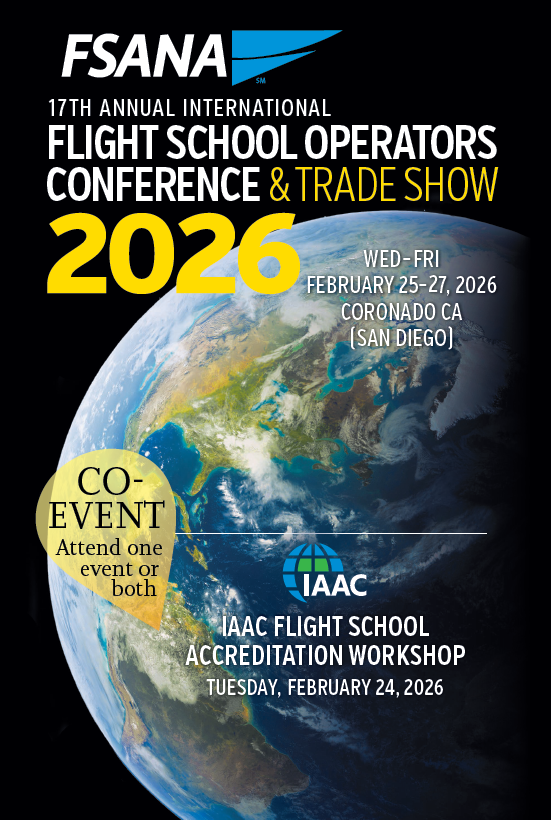
Registration Open for FSANA Conference

The FSANA 17th Annual Flight School Operators Conference & Trade Show will be in San Diego at the Loews Hotel in Coronado Bay, February 25-27, 2026.


Plan to join your peers, friends, and exhibitors at the 2026 Flight School Operators Conference & Trade Show. Come learn, network, and meet government officials, supply chain partners, and others who interface with your industry. Nearly 20 professional sessions to choose from. Don’t miss out on the most important days of the year for your business.


New Track Added = More Sessions


There are now 4 tracks and 7 more educational track sessions over last year -- 19 all together. Attend a mix of sessions from the following track themes:

  • Safety
  • Vendor Showcase
  • Business of Flight Training
  • CFI/Student Focus


This is the annual event that has been having a huge impact on businesses like yours. The FSANA conference experience is about learning how to:

  • Increase profits
  • Engage in growth strategies and new business opportunities
  • Adapt to the latest trends and technology
  • Manage costs and be more efficient


Click here to learn more about the conference and start making your plans today!

Registration Now Open!

Registration includes:

  • Entry to professional sessions and workshops
  • Admission to exhibition hall with over 50 exhibitors
  • Reception
  • Dinner and entertainment
  • 2 luncheons
  • Coffee breaks with exhibitors


Click here to register online.

Room Reservations

FSANA is pleased to be hosting its 2026 Conference & Trade Show at the beautiful Loews Coronado Bay Resort. Be sure to book your hotel soon.

Make your room reservation now

Cleveland ad

FLIGHT TRAINING NEWS

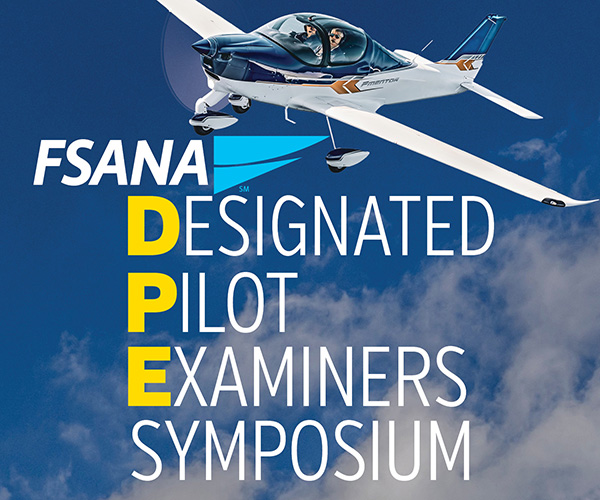
DPE Symposium in Dallas, November 12-14

DPE Symposium

Bringing DPEs together for the fourth time, FSANA again hosts its DPE Symposium in 2025. This year's DPE Symposium is being held in Dallas, Texas, on Wednesday through Friday, November 12, 13, and 14. FSANA will present Wednesday and Thursday's activities.


On Friday, the FAA is conducting a special DPE

online currency training program that will meet the 24-month DPE currency requirements. A separate registration is required for the FAA Program through the Day 3 Course link below.


DPEs, flight school operators, chief flight instructors and anyone serious about becoming a DPE this annual event is for you. The goal of the symposium is to bring DPEs together to help improve standardization and all airman practical testing related processes. Individuals who are interested in becoming DPEs will learn more about the process and potential DPE


This year's Symposium will set a new attendance record with many attendees coming back for the 4th edition of this valuable event. If you have never had the opportunity to attend, it is time to see what all the noise is about.


LEARN MORE / REGISTER DAY 1 AND 2


Schedule


FSANA will host two days of content focused directly on how DPEs do their jobs, how they integrate and work with flight training providers, and some of the challenges they encounter in the work they do.


Topics scheduled for November 12 and 13:


Day 1

  • FAA Designee Program Update from FAA staff
  • Airman Practical Testing Programs Update from FAA staff
  • What MOSAIC Means for DPEs
  • Managing Applicant Scheduling and Practical Test Demand
  • FAA Orders: 8000.95 and 8900.1 - Critical Content for a DPE
  • Plans of Action Development and Management
  • How to Become a DPE


Day 2

  • IACRA and DMS Best Practices, Tips & Tricks
  • Documenting Check rides: Proper Disapproval Notice Practices
  • Working with Training Providers to Best Develop Understanding of What It Takes to Deliver a Good Quality Applicant
  • Standardization of Discrepancies in the Practical Testing Landscape
  • When the DPE and/or Applicant Aren’t Happy with How the Practical Test Went


Each session is led by fellow DPEs and includes open discussion from all attendees. Join us to help improve all that DPEs do and bring forward concerns that DPEs have in the training and testing system.


Day 3 - DPE Online Recurrent Course


Due to the government shutdown, day 3 will now be a live online course. The FAA has extended registration to November 6, 2025. The Friday course will no longer be an in-person event.


To register for the online DPE Recurrent Course offered by the FAA on Day 3, you will need to log into DMS as a DPE. Once you are logged in, you can go to the training option and select the recurrent DPE training sections in which there is an offering for a session in Irving, Texas. You can also follow the link below. This course will count for your 2-year DPE recurrent training. You must sign in to the DMS System and pass the end of course test in order for the course to receive credit.


*NOTE: Day 1 and 2 of the symposium do not satisfy DPE recurrent or yearly managing office meeting requirements. A DPE seeking to satisfy recurrent requirements must register for the Recurrent Course that will be offered by FAA on Day 3.


REGISTER DAY 3 COURSE or copy registration link to your browser: https://designee.faa.gov/courseoffering/443/186

The course offering number is: AFS-474838-2025-018


Any individuals who require assistance enrolling in the FSANA RDPE offering should send an email to designeeseminars@faa.gov. Be sure to include your full name.


Room Reservations


FSANA is pleased to host this year's DPE Symposium at the Dallas/Fort Worth Airport Marriott. The newly renovated hotel at DFW airport is just a short drive from premier shopping, dining, and entertainment at Grapevine Mills Mall, Southlake Town Square, and Downtown Dallas. Located next door to DFW International Airport, the hotel provides complimentary shuttle service to and from the transportation hub.

RESERVE YOUR ROOM NOW

VSE ad oct
FLIGHT TRAINING NEWS

Call to Exhibit - 17th Annual International Flight School Operators Conference & Trade Show in 2026

Thinking of becoming an exhibitor at the 2026 Conference & Trade Show fast approaching in February? Exhibit space is expected to sell out early, so contact FSANA soon to secure a booth. Contact at info@fsana.com or call our office at 610-791-4359. You can also use the link below to reserve immediately.


All FSANA Annual Partners who intend to exhibit are required to submit a registration to save their booth.


Click here to learn more

Brightline ad
Right Rudder Marketing ad
Symbiotics ad
FLIGHT TRAINING NEWS

FAASTeam MOSAIC Pilot Certification Briefing

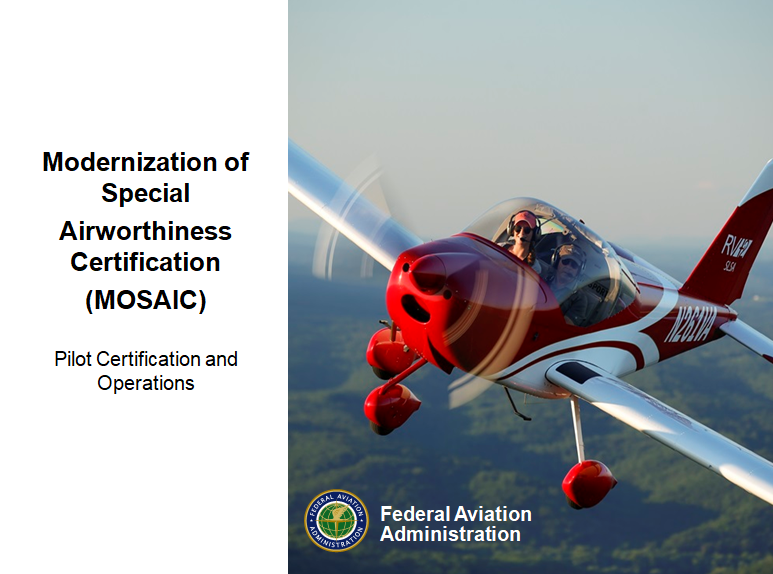
The FAA recently provided a briefing slide deck to the FAA Safety Team focused specifically offering clarifications, details, and more information on a variety of parts of the new MOSAIC related regulations.


This presentation was carefully crafted by FAA staff and includes very specific language with respect to some of the implementation details.


Flight training providers are encouraged to review the content as they work to implement the MOSAIC related changes into their operations.


Click here or the picture to the right to see the briefing content.

Flight Schedule Pro 2025 ad
2026 Conference
Air Power Feb ad
FLIGHT TRAINING NEWS

FAASTeam Notice - TSA Flight Training Security Program Update for Flight Schools & CFIs

The Transportation Security Administration (TSA) published a final rule for the Flight Training Security Program (FTSP) that took effect on July 30, 2024. The updated and finalized regulation retains many of the interim final rule requirements. One major update is that all flight training providers (including those that train U.S. citizens) must register a provider account with FTSP.  


The final rule also makes significant changes to reduce burdens on candidates and providers without impacting security. These changes include:


  1. Flight training providers must establish an account on the FTSP Portal and identify one person as the administrator for their FTSP Portal account. This person may be the security coordinator or another employee. This is required regardless of whether you provide flight training to non-U.S. citizens. (49 CFR §1552.17)
  2. You must designate a security coordinator to act as a single point of contact between you and the TSA. This requirement applies to all flight training providers, including those who only train U.S. citizens. (49 CFR §1552.9)
  3. Initial security awareness training must still be completed within 60 days of hire; however, refresher security awareness training is now required once every two years for each employee who has direct contact with flight students. (49 CFR §1552.13)
  4. Candidates must have a valid determination of eligibility to participate in flight training. (49 CFR §1552.31) NOTE: If a candidate’s determination of eligibility expires due to lawful presence documentation all training must cease until the candidate submits updated documentation of authorization to remain in the United States.
  5. Simplified process for identifying training events. Considerations of weight of the aircraft and training categories are eliminated from the regulation. There are no changes from the interim final rule as to what training events are covered. (49 CFR §1552.3)
  6. The provider notifies the TSA of all training event details. Candidates select providers through the portal; they no longer provide their training event details to the TSA. You must notify the TSA about scheduled candidate training event(s) through your portal account. (49 CFR §1552.51)


The TSA has several online resources available that provide guidance on the FTSP:


For general information about the FTSP, to establish and log in to your account, visit fts.tsa.dhs.gov.


For the full FTSP final rule regulation, go to www.govinfo.gov/content/pkg/FR-2024-05-01/pdf/2024-08800.pdf.


If you have any questions regarding this notice that is policy related, please email FTSP.Policy@tsa.dhs.gov.


If you have any questions regarding FTSP Portal management and access, please email FTSP.help@tsa.dhs.gov. 


You can see the notice by clicking here.

Airtera ad
Lightspeed ad
FLIGHT TRAINING NEWS

GA Awards Nominations Open

The General Aviation Awards (GAA) Board of Directors is accepting applications and nominations for the General Aviation 2026 Awards for Flight Instructors, Aviation Maintenance Technicians, and FAA Safety Team Representatives of the Year. The deadline to submit is midnight on November 30, 2025. For applications, nominations, and full program details, please visit www.generalaviationawards.com/nominate.


The GAA program is a cooperative effort between the industry and the Federal Aviation Administration (FAA), which is dedicated to recognizing individuals for their professionalism and dedication to general aviation (GA). Honorees serve as exemplary models of character and excellence for the broader GA community.


We need your help to find them. Community involvement in the awards program has recently decreased, resulting in fewer nominations and applications. We know that in nearly every aviation community, outstanding instructors, mechanics, and safety representatives deserve recognition for their tireless efforts to improve and secure general aviation.


We strongly encourage you, flight schools, aviation organizations, universities, FSDOs, and other entities to nominate fellow aviators or submit applications. This year, GAA will acknowledge the vital contributions of every single nominee, a significant recognition of the commitment each person makes to their community's health and safety.


Following the November 30th deadline, the selection process begins at the Flight Standards District Offices (FSDO), where district-level Honorees are chosen. These winners then advance to the national level, where a distinguished panel of national judges, composed of industry professionals and past Honorees, selects the final award recipients.


National recognition is only the beginning. Winners are also awarded a trip to AirVenture, a commemorative plaque, numerous gifts from industry sponsors, and the opportunity to share their knowledge during a live broadcast. As a not-for-profit corporation run exclusively by volunteers, GAA relies entirely on financial support from sponsors and donations to provide these well-deserved honors. 


Click here to learn more and nominate someone or yourself!

Pilot Training Marketing ad
Vapor Global Aviation ad
FLIGHT TRAINING NEWS

Capitol Tech Pilots Now on the Fast Track to Airline Transport Pilot Certification

Capitol Technology University recently announced that the Federal Aviation Administration (FAA) has officially authorized their Aviation Professional Pilot Bachelor of Science program to certify graduates for an Airline Transport Pilot (ATP) certificate with reduced aeronautical experience.


This allows them, effective September 12, 2025, allows qualified Capitol Tech graduates to apply for their ATP certificate with 1,000 total flight hours—a 500-hour reduction from the standard 1,500-hour requirement.


Graduates who complete all academic and flight requirements will receive a formal FAA certifying statement from Capitol Tech confirming their eligibility for the reduced-hour ATP pathway.


Click here to see their release on the new opportunity there.

fsana hub ad
beegles ad
FLIGHT TRAINING NEWS

Planning for CFI Transition as Airline Hiring Ramps Up

by Jason Blair


By many indications, the airline industry is setting up for another wave of robust hiring in 2025 and 2026. This has an effect on the flight training community, in that many of the CFIs that flight training providers will be hired and move from flight instruction positions to professional pilot positions at airlines or other jobs. Flight training providers are familiar with how these exodus of certified flight instructors (CFIs) times affect their employee base. With major U.S. airlines expecting to hire over 1,800 pilots in the first half of the year alone, the ripple effects will be felt at the grassroots level of aviation education. Many CFIs who are currently working have already accumulated the 1,500 flight hours (or less for restricted-ATP qualified candidates) required for their Airline Transport Pilot (ATP) certificate and will move quickly to higher-paying roles at regional airlines. This turnover can disrupt the continuity of training programs if they aren’t prepared for it.


As training businesses grapple with this instructor drain, strategic planning becomes essential to backfill or even pre-fill positions while preserving institutional knowledge and training standards. There are actionable strategies flight training providers can leverage to mitigate disruptions to their CFI staffing solutions


The last year has seen reduced hiring by many airlines, do not expect this to continue into 2025, 2026, and beyond. It may not be the same fevered hiring that happened in 2022 and 2023 especially, but it will be measured and active. According to CAE's 2025 Aviation Talent Forecast, the industry will require 1.465 million new professionals over the next decade to accommodate fleet expansions and retirements. Boeing's long-term outlook projects a need for 674,000 new pilots globally over the next 20 years. In the U.S., while hiring has normalized from the post-COVID surge, projections indicate over 10,000 vacancies in 2025, driven by retirements and increasing air travel demand. A couple of major airlines have already started hiring for large classes in the end of 2025 and are moving toward active hiring in 2026. This will trickle down to regional airlines, who will hire actively from our industry’s CFI pool. This environment lures CFIs away, as regional airlines offer competitive salaries—often much higher than instructor pay—and benefits like signing bonuses and improved schedules.


For training providers, the implications are profound. A sudden loss of experienced instructors can lead to scheduling bottlenecks, increased student wait times, and potential revenue dips. Moreover, maintaining consistency in training is critical to student success and safety. Without proactive measures, providers risk losing their competitive edge in a market where students demand efficient, tech-integrated training.


Expect turnover of CFIs.


In one analysis of data from CFI’s resumes on Zippia showed that many CFIs do not stay in their positions very long. In the analysis, it showed the following:


Length of CFI Time in Job

-------------------------

<1 year   23%

1-2 years  37%

3-4 years  13%

5-7 years  13%

8-10 years  4%

11+ years  10%


This shows 60% of CFIs have tenures under 2 years, underscoring the rapid turnover cycle.


Proactive Recruitment: Building a Pipeline of Talent


Anticipating instructor departures requires a robust recruitment strategy. Start by diversifying sourcing channels and building internal ones. Traditional avenues like aviation job boards (e.g., JSfirm or Climb to 350) remain effective, but leverage social media and partnerships with collegiate aviation programs to tap into emerging talent. For instance, collaborate with universities offering reduced ATP pathways, where graduates need instructing hours to bridge to airlines.


Improve hiring practices by streamlining applications and emphasizing cultural fit. Conduct virtual interviews to assess not just technical skills but also enthusiasm for teaching using modern training tools.


Offer competitive starting packages: surveys indicate that salaries or pay rates 10-20% above market average reduce turnover by 15%. Include perks such as flight hour bonuses or training reimbursement for advanced ratings.

Foster a talent pipeline internally. Encourage advanced students to pursue CFI ratings through in-house programs, providing mentorship from senior instructors. This creates loyalty and ensures new hires are familiar with your operations. One effective tactic is "grow-your-own" initiatives, where promising private pilots are groomed for instructor roles, potentially halving onboarding time.


Effective Onboarding and Development: Accelerating Integration


Once recruited, rapid onboarding is key to maintaining momentum. Develop a structured program. Include ground training with a chief instructor or other experienced staff member. Familiarize your new hires with simulator(s) operation if applicable, some supervised flights, and pairing them with more seasoned instructors in your operation. Standardize operations across all staff with established curriculum, syllabus, checklists, and operational materials.


Mentorship programs pair new CFIs with veterans, facilitating knowledge transfer. Weekly debriefs ensure consistency in teaching methods, such as uniform approaches to pre-flight briefings. Track progress with performance reviews, tying them to incentives like pay bumps after 500 instructional hours.


Address the instructor shortage by cross-training staff. Encourage multi-engine or instrument instructor qualifications if you have the aircraft that are so capable. This can expand the utility of your CFI staff.


Ultimately, effective development transforms turnover into opportunity, cultivating instructors who contribute longer and more effectively.


Retention Strategies: Keeping Talent Longer


Retention is the linchpin of stability. Competitive compensation is foundational—consider tiered pay scales based on hours taught or student pass rates. Beyond money, foster work-life balance with flexible scheduling and limits on daily flights to prevent burnout. While it is unlikely that a flight training provider is going to be able to keep all their CFIs from ever going to an airline or other professional pilotage job, they might be able to keep a few key staff members from doing it or keep their CFI staff a little longer than the industry average.


Recognition programs, such as "Instructor of the Month" awards or peer-nominated bonuses can help build morale. Career growth opportunities, like pathways to chief instructor roles or airline partnerships for preferential hiring, incentivize staying.

Cultivate a positive culture through team-building events and feedback loops. Anonymous surveys can identify issues early, while professional development stipends for conferences signal value.


Flexible environments, including remote ground instruction via Zoom may appeal to modern instructors and some customers.

Some additional focus on retention can help providers extend average tenure from 12 to 24 months, and thus preserve some expertise and stability for students.


Standardization and Succession


Succession planning identifies high-potential instructors for leadership, grooming them through shadowed management tasks. Digital platforms can archive lesson plans, enabling seamless handoffs.


Work with your staff to ensure they are all using standardized materials with your customers so that when instructor transitions happen, and they will, the effect on your customers is minimized.


Another way to do this is to stagger hiring of staff. Make sure you don’t have large influxes of staff at the same hours times. Hiring CFI staff who will have spread hours experience bases will help them reach hiring minimums at places like airlines at different times from each other. This can be a long-term approach to CFI staffing that keeps you from losing all your CFIs at the same time and can allow for a continued hiring process that keeps an even in and out flow of CFIs.


High turnover perpetuates shortages, with 75% of CFIs viewing instruction as a stepping stone to airlines. Incentives like higher pay or airline pathways (rated highly in surveys) could extend tenure, but without them, providers struggle to build stable teams, hindering growth in a market projected to need more pilots.


Our industry is very different from many professional training sectors; we have to plan for our line staff who do the job to be there for only short periods of time when it comes to a career perspective. This doesn’t mean we should treat our staff as menial laborers, but as transient professionals. We can plan for this transition if we structure our systems properly and account for that transition.


Think about your upcoming CFI transitions in your business and how you can best recruit to fill them, train in-house to meet hiring needs, or ensure that your CFI staff isn't all leaving at the same time. It is a key factor in meeting customer training demands, and doing so without sacrificing the training process. As we all look toward another period of active hiring at the end of 2025 and in 2026 in the professional pilot job sector, our flight training community needs to review its staffing processes to protect its business models. We don't expect it to be as feverish as it has been at some points, but it will be something to monitor and stay ahead of as a fligh training provider.


By recruiting proactively, onboarding efficiently, retaining strategically, and standardizing rigorously, businesses can maintain a resilient instructor core. This not only upholds training consistency but positions providers as leaders in an evolving industry. Act now—your students' futures depend on it.

enews archive ad
 

ARTICLES OF INTEREST FROM THE INDUSTRY


Nominations open for General Aviation Awards


How to Avoid Junk Instruction


MOSAIC Begins Taking Effect


U.S. Airlines Still Struggling To Fill Cockpits As Pilot Shortage Persists


Airport Alert: Senate Committee Scheduled to Review ADS-B-Related ROTOR Act Next Week — Legislation Limiting Use of ADS-B Data for Fee Collection May Be Considered


FAA Part 141 Modernization: What Universities Should Watch—and How We’ll Help


Piper Announces Largest Ever US Deal with UND


Former Student Pilot Sentenced for Stealing Airplane


New NOTAM System in Testing


Applications Open for AOPA Scholarships


Understanding the Role of the FAA Examiner: What to Expect on Checkride Day


Risk-Based Flight Review Guidance for Instructors


How to Log Your Flight Hours Correctly (And Avoid Common Mistakes)


PilotWorkshops releases Checkride Insights: Private Pilot


Bristell B23 Receives FAA Type Certification, Targets Training Market


Duncan Aviation’s Battle Creek, Michigan, Facility Approved as FAA Testing Center


Meet the ex-American Airlines CEO on a Quest to Make Pilot Training Accessible


EAS Barcelona Expands Training Fleet with Two New Tecnam P-Mentor Aircraft


How The Civil Air Patrol Became America's Quietest Aviation Power


Is Demand for Commercial Airline Pilots Normalizing?


AlphaFlight To Buy Four New Aircraft, Expand Instruction


NTSB Blames Partial Power Loss and Abrupt Maneuver for Fatal Cessna Crash [that killed AOPA’s Richard McSpadden]


DPES AVAILABLE TO TRAVEL

FSANA has been collecting DPE names who have expressed a willingness to travel to help flight training providers secure practical tests.


The latest List of Travel-Willing DPEs with contact information is available on the FSANA website. If you are a flight training provider who is finding a challenge of scheduling DPEs in your local area, feel free to reach out to these individuals. They may be able to serve some of your local testing needs.


If you are a DPE who is not on this list but would like to be, please let us know. Write us at info@fsana.com with your name, city, state, email and phone number and we will add you.


PRACTICAL TEST FEEDBACK


Have feedback concerns about FAA practical tests? Email inquiries here
Email Feedback Concerns about FAA Practical Tests to:
 

GOVERNMENT DIRECTORY


READER FEEDBACK

 
Tell us what is important to you as a school owner, manager or chief flight instructor. We will share comments in an upcoming edition of Flight Training News. Send your thoughts to info@fsana.com.
 

FSANA LEGISLATIVE ADVOCATES

Legislative Advocates are flight schools, businesses and individuals who support FSANA’s efforts to advocate for public policy that benefits the flight training industry.
G O L D
AeroGuard
 
B R O N Z E
Arizona Aero-Tech logo

FSANA SUPPORTING PARTNERS

Annual Partners are flight schools, businesses and individuals who support FSANA’s ongoing efforts to strengthen the flight training industry.
V I S I O N A R Y •• P A R T N E R S
 
Jessica Cox Motivational Services logo
 
Flying Magazine logo
 
IAAC logo
 
Avenger Flight Group
D E V E L O P E R •• P A R T N E R S
Tecnam logo
 
Skybound logo
 
US Aviation Academy logo
Avemco logo
Lehigh Print & Data logo
Right Rudder Marketing logo
 
B U I L D E R •• P A R T N E R S
 
 
Lycoming
Flight Academy Advisors logo
 
Boeing logo
CAE logo
 
VirtualFly NA logo
 
 
AOPA
Pilot Training Marketing logo
 
Collegiate Housing Services
 
 
WB Parts logo
 
AES logo
Wings Industry Network logo
FAAST logo
Southern Cross Aviation
 
Cleveland Wheel logo
 
Air Power Inc logo
 
 
Flight Schedule Pro logo
Symbiotics logo
 
Shell logo
 
Capital Technology University
NeedleNine logo
 
L E A D E R •• P A R T N E R S
Training Aircraft Leasing logo
 
Avidyne logo
 
 
Assured Partners logo
 
Elite Simulation logo
Four Forces logo


Airtera NATA logo
 
Hillsboro Aero Academy
 
JetPubs logo
 
 
Women in Aviation
Simloc logo
Vashon Aircraft logo
 
Flycore
Travers & Associates Aviation Insurance
 
Aviation Supplies & Academics logo
 
 
Redbird Flight Simulations logo
Hartzell Aviation logo
Aviation Marine logo
 
Southern Aeromedical
Flight Training Finance logo
Constant Contact logo
 
 
Pipistrel logo
Phoenix East Aviation
Flight School Manager logo
 
Residco logo
Textron Aviation logo
 
Simbird Montauk logo
Skymark-SMS logo
 
Wings Aero Products logo
True Course Simulations logo
 
 
Talon Systems logo
Aviatize logo
Deltahawk logo
flitesim logo


UpskillAir logo
Kore Aviation
 
Lightspeed Aviation logo


Established in 2009, the Flight School Association of North America (FSANA) is the first association of its kind dedicated solely to the flight training industry. FSANA represents flight schools, firms that provide products and services to the flight training or aviation industry, and other supporting partners.


The Mission of the Flight School Association is to support, promote and advocate for the business of flight training; to provide knowledge, programs and services that help its members thrive and better serve their customers and communities; to foster best business practices; to educate and inspire youth; to increase the global pilot population; to improve general aviation safety; and to work in alliance with the aviation and aerospace industry.


fsana.com / 610-791-4359 / bob@fsana.com