|
Egregious Errors
Errors are rampant. In March, Jacob Rockwell of Pensacola, Florida, received a red-light camera ticket, but he was out of state at the time. Someone had borrowed his vehicle and had run the light. Rockwell didn’t dispute that. His quarrel was constitutional and structural. As he told the City Council: “I am guilty by default. I’ve been convicted by a computer program.”
The camera conducts no driver verification. It photographs the vehicle, identifies the registered owner, and issues a citation. The owner is presumed guilty and must prove innocence. To do so, he must navigate an appeals process run not by any government agency but by a private company — Automated Enforcement Division of Orlando, itself owned by a foreign corporation — with no transparent criteria, no clear timeline, and no meaningful public accountability.
Rockwell told the council that Florida Statute 316.0083 “unduly shifts the burden of proof to the vehicle owner to prove my innocence, rather than the State having to prove my guilt.”
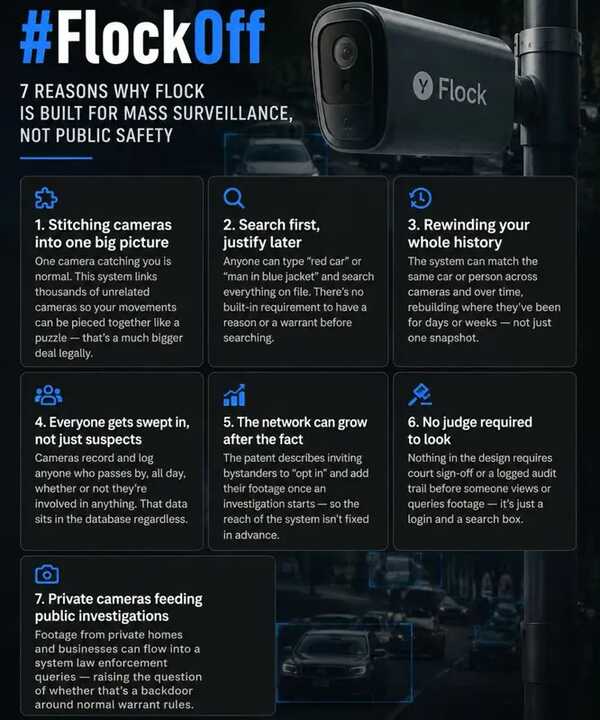
Another case is that of Hugo Parra, a San Diego man, who spent nearly a month in jail over Thanksgiving 2025, missing the holiday with his family and sharing space with murderers. A Flock camera had incorrectly linked him to a carjacking that occurred five miles away from his actual location. Cellphone data corroborated his innocence, as did other Flock cameras along his actual route. Parra and his co-defendant now seek $1.5 million each for civil-rights violations and negligence.
The Institute for Justice identified at least 24 documented cases of Flock errors since 2018 — innocent people detained at gunpoint, handcuffed in driveways, jailed for weeks — including a couple stopped with a six-week-old baby in the back seat because a Flock camera misread a single digit on their license plate. Another camera misread an “O” as “0,” and two grandparents were held at gunpoint while their three-year-old grandchild watched from the car. In another case, a camera misread a “7” as a “2,” leading police to detain an innocent man, sic a dog on him, and jail him for several hours.
Emulating China
Flock Safety, a private company, functions as the de facto surveillance infrastructure of American law enforcement. This is the Chinese model — not imported by force, but adopted voluntarily by municipalities seduced by the promise of cheaper policing. China’s social credit system and its network of 700 million surveillance cameras represent government-by-algorithm in its mature form: a state that tracks, scores, and controls citizens through automated systems too fast and too opaque for any individual to contest through normal legal channels. Western technocrats have watched this experiment with open admiration. The same globalist policy networks that promote digital currencies and the “circular economy” consistently point to China’s governance efficiency as a model worth emulating.
The Dependent Administrative Class
Changes in Western education set the trajectory toward our current dystopia. In his 1895 book The Crowd, Gustave Le Bon identified mass education as the seed of autocracy. Observing the explosion of state-sponsored schooling across Europe, he warned that educating people in trivial matters rather than in skills useful to the economy would create “an army of malcontents.” Having been credentialed for positions that don’t exist, they become “apostles of discontent,” constituting a potential danger to the State as they incline toward revolutionary sentiment. Le Bon wrote that “the French system of education transforms the majority of those who have undergone it into enemies of society, and recruits numerous disciples for the worst forms of socialism.”
Government neutralized the threat by creating meaningless civil servant jobs to absorb these unemployable misfits. The system required higher taxes to manufacture spurious jobs, but it staved off revolution.
Economist Joseph Schumpeter, writing in Capitalism, Socialism and Democracy (1943), refined the observation. The expansion of higher education produces “people who are used to the life of the salaried employee and who lack the aptitude for and interest in independent business enterprise.” They acquire “a vested interest in unrest,” gravitating toward labor organizing, political activism, and permanent bureaucracy, forming a dangerous class whose members “develop group attitudes and group interests” hostile to the productive economy that sustains them. Too elevated for manual work but not talented enough for genuine intellectual contribution, they become a class defined by high self-estimation and low market value.
Douglas Gairdner, in The War Against the Family, quantified what Le Bon and Schumpeter had observed: By the 1990s, roughly one-third of the Western workforce was employed in government and social services, an administrative class living off transfer payments extracted from productive workers with the ostensible purpose of “helping the poor.” A situation emerged whereby two-thirds of the population were living off one-third. The ratio has since worsened dramatically. An economy in which four-fifths of participants live off the productive fifth is not a sustainable system.
Enter the Algorithm
Department of Government Efficiency-style purges of federal workers amount to inevitable fiscal correction when a bureaucracy of blue-haired bipolars becomes too expensive to maintain. The question is: What replaces the system of licensing requirements, code enforcement, and freedom-killing bureaucracy built to employ these civil servants?
A technocrat’s answer is “the algorithm.” Cheaper than a civil servant, faster than a judge, and conveniently unaccountable to any democratic process, the algorithm is being positioned as government’s operating-system upgrade. By dislodging people, our government is completing the authoritarian conquest that our Founders were deliberately trying to avoid.
Reprinted from the New American Magazine
|