LTAP_Header_2021_Quarterly_Making Connections.jpg

Volume 5 | Issue 4

Table of Contents

Scroll Down for Detailed Information


The Florida LTAP Center delivers training, technical assistance, technology transfer, and other transportation needs to local Florida agencies. In this newsletter you will find upcoming trainings, events, and funding opportunities. Click here for more information. 


We encourage you to share relevant trainings, events, and resources which are not included in our emails so that we can add them in future publications.


■ Director's Message: 2024 in Review: Strengthening Transportation Together


■ News: FoRRRwD Peer Exchange for Tribal and Local Agencies | 2025 Florida Build A Better Mousetrap Competition |FHWA Speed Setting Handbook | NOCoE TSMO Awards


■ Upcoming Trainings: IN-PERSON: Work Zone Road Safety Audits 1.5-Day Course | Pavement Preservation Wednesday | How to Create a Walking/Rolling School Bus| Data Analysis and Safe Routes to School | How to Plan a Walk and Bike to School Day


■ Upcoming Events: Florida Bicycle Month | APWA Florida Chapter Expo 2025


■ Funding Opportunities: Rural and Tribal Assistance Pilot Program

Director's Message

2024 in Review: Strengthening Transportation Together


As we move into 2025, March offers an ideal time to reflect on your growth in 2024 and how it aligns with your professional goals for the upcoming year. I take pride in the progress made by the Florida LTAP Center in supporting transportation professionals across the state. 


In 2024, we conducted 76 training sessions, including webinars and in-person workshops, engaging over 17,000 participants. We also expanded our on-demand training catalog, which now offers over 250 webinar sessions. 


I am equally proud of the strength demonstrated by transportation agencies, local governments, and community organizations in responding to the challenges posed by three hurricanes that impacted Florida last year. In December 2024, we held an in-person heavy equipment training in Miami Gardens, where 29 participants gained essential skills in chainsaw safety, tool maintenance, and arboricultural education—knowledge that is crucial for storm recovery operations.


Looking ahead to 2025, I am excited about the future of our program and our continued success. Our collaboration with the Florida Department of Transportation (FDOT), the Federal Highway Administration (FHWA), the American Public Works Association (APWA) Florida Chapter, the Florida Pavement Preservation Council (FPPC), and the Florida Association of County Engineers & Road Superintendents (FACERS) will allow us to introduce new training topics, further strengthening our workforce's commitment to safety, skill development, compliance, and career development.


These achievements in 2024 and our goals for 2025 would not be possible without the ongoing support of our partners, participants, and the Florida transportation community. Thank you for your dedication and support.


Sincerely,


Pei-Sung Lin, Ph.D., P.E., PTOE, FITE

Florida LTAP Center Director

News

FoRRRwD Peer Exchange for Tribal and Local Agencies

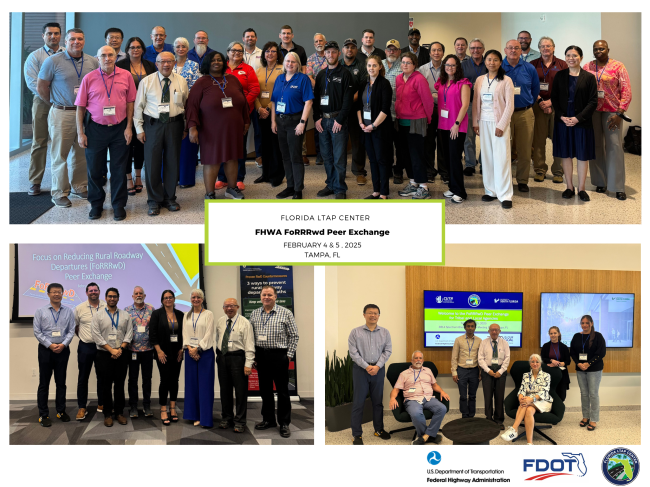
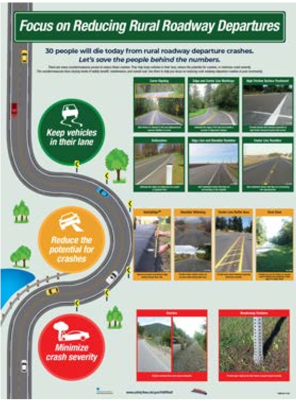
The Florida LTAP (Local Technical Assistance Program) Center recently hosted the FoRRRwD (Federal Highway Administration's Focus on Rural Roadway Departures) Peer Exchange sponsored and organized by the Federal Highway Administration (FHWA), bringing together professionals from seven state departments of transportation (DOTs), local governments, tribal agencies, and other safety stakeholders. The event focused on reducing fatal and serious injury crashes caused by rural roadway departures, a key focus area for the Florida Department of Transportation (FDOT).

With seven states represented, the exchange fostered an open and collaborative environment where experts and practitioners shared innovative strategies, insights, and best practices to reduce the incidence of fatal and serious injury crashes caused by rural roadway departures. Attendees engaged in informative presentations highlighting the unique challenges and solutions they have developed to address this safety issue.


During the FoRRRwD Peer Exchange, the Florida LTAP Center showcased its work in delivering training courses to reduce rural roadway departure incidents. These courses, designed for engineers, planners, and local agencies, continue to provide vital tools to improve road safety through better design and enhanced traffic operations.


We appreciate FHWA’s support and the contributions of representatives from Florida, Illinois, Kansas, Mississippi, Pennsylvania, South Dakota, and Texas, whose active participation made this event a big success. Their dedication to roadway safety will drive continued improvements in preventing and reducing rural roadway departures.

2025 Florida Build A Better Mousetrap Competition - Entries Due May 16

The Florida Local Technical Assistance Program (LTAP) Center is hosting the annual Florida Build A Better Mousetrap (BABM) competition. This competition is a state and national recognition program developed by the Federal Highway Administration’s (FHWA) Center for Local Aid Support Office. The Florida competition celebrates and awards innovative solutions to transportation challenges, focusing on advancements that address everyday issues faced by Florida’s local, state, and tribal transportation professionals.


Participation is open to any government agency in Florida (towns, cities, villages, counties, parishes, states, and tribal organizations). To enter the competition, download and complete the entry form, which requires your contact information, a project description, and a photo or video of your project.

Click to Download the Entry Form

Entries in the Florida competition will be evaluated in four categories: Innovative Project, SMART Transformation, Bold Steps, and Pioneer, with a top honoree selected for each. Benefits for honorees include an award, feature in the Florida LTAP summer newsletter, website, and social media, FHWA national recognition, and the opportunity to showcase their innovation at local and national events. Florida honorees will also be entered into the national competition, where innovations from local and tribal agencies compete for top prizes at the National Local and Tribal Technical Assistance Program (NLTAPA) Conference. Florida’s own Seminole County won the Smart Transformation Award at the national level in 2021.

New FHWA Resource: Speed Limit Setting Handbook

Promoting safer speeds is a focus of the USDOT’s comprehensive approach to eliminating fatalities and serious injuries on our Nation’s roadways. Safety is a responsibility shared by all transportation professionals and everyone who uses our nation’s roadways. The Handbook is available here: https://highways.dot.gov/sites/fhwa.dot.gov/files/Speed-Limit-Setting-Handbook.pdf


This Handbook is the product of a collaborative effort guided by the Federal Highway Administration (FHWA) with input from multiple internal and external stakeholders. The Handbook fulfills the commitment made in the Notice of Final Rule adopting the 11th Edition of the Manual on Uniform Traffic Control Devices for Streets and Highways (MUTCD) to develop such a resource to assist practitioners in their speed management decisions. The Speed Limit Setting Handbook provides practitioners with information on how to conduct an engineering study to set a non-statutory speed limit for a speed zone. The individual chapters within the Handbook provide information on factors to consider, the process, data needs, analysis methods and tools, and evaluation considerations used in an engineering study. The Handbook also includes seven case studies that show examples of jurisdictions’ processes for setting non-statutory speed limits aligned to the steps in this Handbook.


If you have any questions pertaining to this report, please contact the FHWA Florida Division Safety Engineer, Kevin Burgess at kevin.burgess@dot.gov.

2025 NOCoE TSMO Awards 

Deadline: April 4, 2025


The NOCoE TSMO Awards celebrate the TSMO strategies and tools that leverage existing infrastructure to increase safety and reliability. Each year, NOCoE awards winners in four TSMO Award categories. For 2025, the categories are:


■ Best TSMO Project

■ Agency Improvement

■ Emerging Practices and Technologies

■ Cybersecurity and TSMO


Learn More


Upcoming Trainings

IN-PERSON: Work Zone Road Safety Audits 

1.5-Day Course

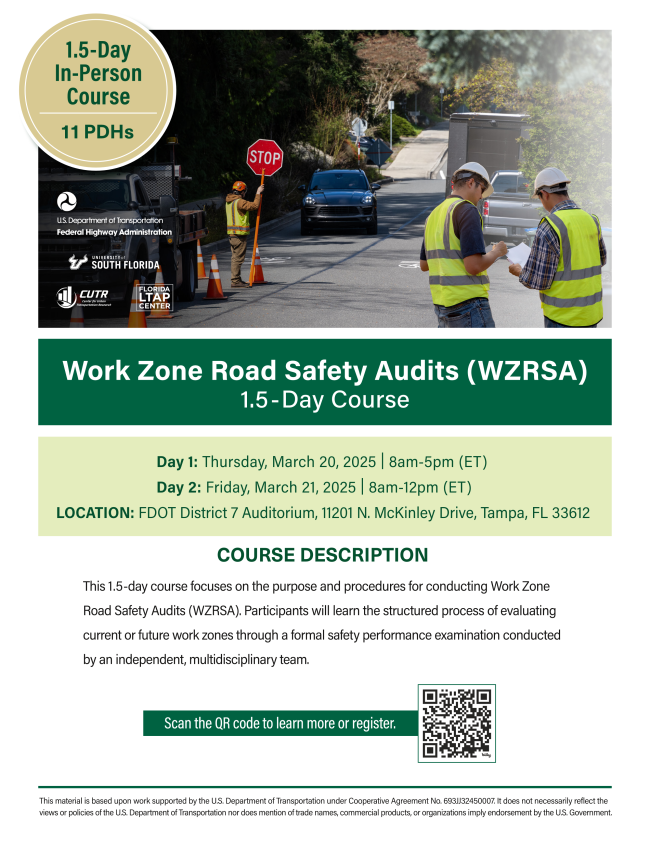
The Federal Highway Administration (FHWA) is dedicated to enhancing the safety of work zone workers through vigilant monitoring, continuous improvement, and proactive advancements. In partnership with FHWA, USF is now offering a selection of free work zone training courses. This 1.5-day in-person training taking place in Tampa, Florida focuses on the purpose and procedures for conducting Work Zone Road Safety Audits (WZRSA). Participants will learn the structured process of evaluating current or future work zones through a formal safety performance examination conducted by an independent, multidisciplinary team.


Target Audience: This course is ideal for engineers, construction inspectors, and project managers interested in enhancing work zone safety and mobility.


This material is based upon work supported by the U.S. Department of Transportation under Cooperative Agreement No. 693JJ32450007. It does not necessarily reflect the views or policies of the U.S. Department of Transportation nor does mention of trade names, commercial products, or organizations imply endorsement by the U.S. Government.

Day 1: Thursday

March 20, 2025

8:00 AM – 5:00 PM (ET)


Day 2: Friday

March 21, 2025

8:00 AM - 12:00 PM (ET)


 LOCATION


FDOT District 7 Auditorium, 11201 N. McKinley Drive, Tampa, FL 33612


Meet Your Instructor


Larry Hagen, P.E., PTOE, RSP

Florida LTAP Instructor


Register Here

AGENDA:


■ Day 1 (Thursday, March 20, 2025 | 8am – 5pm ET): Introduction to Work Zone Road Safety Audits (WZRSAs), WZRSA Process, Common Practices, and Evaluation 


■ Day 2 (Friday, March 21, 2025 | 8am – 12pm ET): Site Visit to Conduct a Work Zone Road Safety Audit 


Upon completion, participants will be able to:


■ Describe the scope of work zone safety issues in the U.S. 

■ Differentiate between WZRSAs, inspections, and process reviews. 

■ Perform a WZRSA following the eight-step process. 

■ Evaluate real-world case studies and apply lessons learned. 


This training is provided at no cost and will award a certificate to those fully attending and completing the session. Professional Development Hours will be provided to those that request these during registration. A total of 11.0 PDHs can be earned for fully attending this training.

Pavement Preservation Posse Panel: Tackling the Challenges and Advancing the Future of Pavement Preservation

This webinar will bring together industry leaders for an engaging panel discussion on pavement preservation as part of the FPPC series, “Pavement Preservation Posse Panel.” During this 90-minute session, we will explore the key principles of pavement preservation, practical solutions for common challenges, and innovative techniques to enhance roadway performance.


Topics will include mastering the fundamentals of pavement preservation, addressing real-world challenges such as limited funding and aging infrastructure, and exploring proven strategies for implementing effective pavement management programs. We will also share actionable insights and best practices that can help stretch maintenance budgets and optimize program results.


Whether you’re developing a preservation program or seeking new approaches to manage your roadways, this webinar will provide practical knowledge and tools to help you succeed.

Wednesday

March 19, 2025

10:00 – 11:30 AM (ET)


Meet Your Presenters


Chris Evers

Executive Coordinator

Florida Pavement Preservation Council


Todd Gonser, P.E.

Western States Manager Cutler Repaving


Rex W. Eberly

On-Call Pavement Preservation Engineer National Center for Pavement Preservation

Register Here

Learning Objectives


■ Master the Fundamentals of Pavement Preservation: Gain a clear understanding of why preservation is critical to infrastructure longevity and how it can lead to significant cost savings.


■ Address Real-World Challenges: Learn practical solutions for overcoming common issues like limited funding, environmental constraints, and aging infrastructure.


■ Explore Innovative Techniques and Best Practices: Discover the latest advancements and proven strategies for implementing effective pavement management programs.


Why Attend?


This webinar is designed to provide actionable takeaways that you can immediately implement in your organization. Whether you’re developing a preservation program, facing challenges with aging roadways, or looking for innovative approaches to stretch your maintenance budgets, this panel will equip you with the knowledge and connections to succeed.


This webinar is provided at no cost and will award a certificate of training listing Professional Development Hours (PDHs) or a certificate of completion verifying your attendance.

How To Create a Walking/Rolling School Bus

A walking school bus (WSB) is a group of children walking to/from school under adult supervision. A WSB program promotes physical activity, teaches pedestrian safety skills, and helps reduce concerns about children traveling to/from school by having trained volunteers supervise. With increased school transportation budget cuts, many districts have eliminated courtesy bussing. As a result, the number of students walking/bicycling to and/or from school and those driven by parents has steadily increased. To help reduce traffic congestion around schools, walking school buses offer a practical travel option for those living near school. Many types of walking school buses have been successful, and each school’s WSB program may differ depending on the neighborhood, volunteers, traffic, and school.

Thursday

March 20, 2025

10:00 – 11:30 AM (ET)


Meet Your Instructor


Jason Jackman

Senior Research Associate

Center for Urban Transportation Research

University of South Florida


Register Here

Learning Objectives


■ Describe the purpose of a walking school bus and bicycle train program.

■ Identify the benefits of a walking school bus program.

■ Identify the ways to get your walking school bus program going.

■ Identify the best approach for selecting a school to participate in a walking school bus program.

■ Identify resources that will help build a walking school bus program while incorporating safety.

■ Illustrate how data collection can benefit a walking school bus program and help measure success and opportunities.


SRTS is a statewide program, funded by the Florida Department of Transportation (FDOT), whose goal is to make it safer for more children to walk and bike to school. This webinar is brought to you by FDOT through the Florida Local Technical Assistance Program (LTAP) Center. The Florida LTAP Center provides quality training, technical assistance, and technology transfer to the Florida local transportation workforce. 


This webinar is provided at no cost and will award a certificate of training listing Professional Development Hours (PDHs) or a certificate of completion verifying your attendance.

Data Analysis and Safe Routes to School

Data analysis is the process of systematically applying statistical and/or logical techniques to describe and illustrate, recap, and evaluate data. With so much data readily accessible these days, data analysis is key to condensing the information into an easy-to-understand format that can be used to achieve your goals.


In this webinar, we will talk about the purpose of data collection for a Safe Routes to School program and we will provide an overview of the data available to analyze walking and bicycle usage, safety, and infrastructure. Attendees will learn about interactive mapping tools, GIS, and other online portals that can help provide the information needed to develop policy campaigns, grant applications, or other proposals to advance Safe Routes to School in Florida. Attendees will also learn strategies for working with local government and other agencies.

Wednesday

April 2, 2025

10:00 – 11:30 AM (ET)


Meet Your Instructors


Jason Jackman

Senior Research Associate

Center for Urban Transportation Research

University of South Florida


Dr. Achilleas Kourtellis

Assistant Program Director

ITS, Traffic Operations and Safety

Center for Urban Transportation Research

University of South Florida

Register Here

Learning Objectives


■ Describe the purpose of data collection.

■ Identify the various tools used for data collection and how they apply towards infrastructure and non-infrastructure projects.

■ Identify Florida’s best practices as a result of data collection used for Safe Routes to School projects.

■ Identify resources that will help with data collection towards proposals and future projects.

■ Describe the benefits of continuing to collect data even after a project is completed.


SRTS is a statewide program, funded by the Florida Department of Transportation (FDOT), whose goal is to make it safer for more children to walk and bike to school. This webinar is brought to you by FDOT through the Florida Local Technical Assistance Program (LTAP) Center. The Florida LTAP Center provides quality training, technical assistance, and technology transfer to the Florida local transportation workforce. 


This webinar is provided at no cost and will award a certificate of training listing Professional Development Hours (PDHs) or a certificate of completion verifying your attendance.

How to Plan a Walk and Bike to School Day

Student transportation safety has been a top priority throughout our Florida communities. The Florida Department of Transportation’s (FDOT) Safe Routes to School (SRTS) program has provided opportunities for schools and communities to work together, helping to improve safety for families walking and biking to school. Some of the efforts that have improved school travel safety include pedestrian and bicycle infrastructure additions and improvements, enforcement, safety education in the schools, and events and activities that encourage families to be more active in their communities. Over the years, Walk and Bike to School day events have given schools and families a chance to be a part of the positive impacts walking and biking has in their communities.

Thursday

April 24, 2025

10:00 – 11:30 AM (ET)


Meet Your Instructor


Jason Jackman

Senior Research Associate

Center for Urban Transportation Research

University of South Florida


Register Here

In this webinar, we’ll provide details on how to plan a Walk and Bike to School Day event. You’ll learn steps for initiating a Walk and Bike to School Day, the planning involved, how to coordinate with schools and local partners, and the steps for carrying out your own event in your community. Attendees will gain a better understanding of the process that goes into a Walk and Bike to School Day event.


Learning Objectives


■ Describe the benefits of Walk and Bike to School events.

■ Identify steps for planning a Walk and Bike to School Day.

■ Provide examples of the various partners involved.

■ Explain assessment of event(s).

■ List and discuss Walk and Bike to School Day event options/opportunities.


SRTS is a statewide program, funded by the Florida Department of Transportation (FDOT), whose goal is to make it safer for more children to walk and bike to school. This webinar is brought to you by FDOT through the Florida Local Technical Assistance Program (LTAP) Center. The Florida LTAP Center provides quality training, technical assistance, and technology transfer to the Florida local transportation workforce. 


This webinar is provided at no cost and will award a certificate of training listing Professional Development Hours (PDHs) or a certificate of completion verifying your attendance.

Upcoming Events

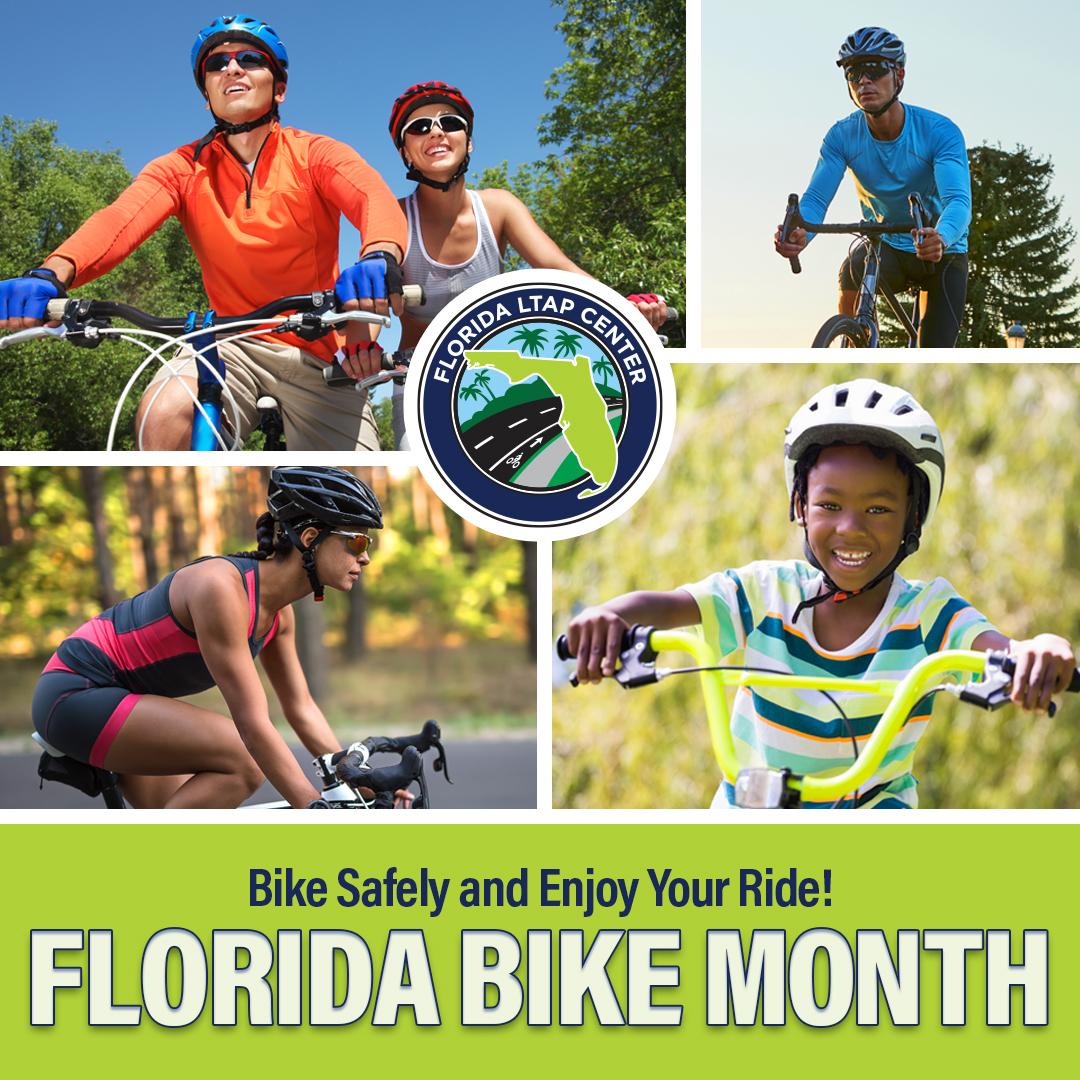
March is Florida Bicycle Month

March 2025


Florida Bicycle Month, celebrated in March of each year, is a chance to showcase the many benefits of bicycling and encourage more folks to give bicycling a try. Let's remember these visibility tips for all road users.

■ Stay Visible: Wear bright or reflective clothing when biking; use front and rear reflective lights and wear a helmet.


■ Stay Alert: Avoid distractions while walking, biking, and driving. Put down your phone and be aware of your surroundings to spot any potential hazards.


■ Slow Down! Look Both Ways: Before crossing an intersection, always look left, right, and left again. Make eye contact with drivers, bicyclists, and pedestrians when possible.


■ Follow Traffic Signals: Obey all traffic signals and signs. Be especially cautious in neighborhoods and school zones where foot traffic may increase. Remember, just because you can cross doesn’t mean it’s safe to do so.


■ Promote Awareness: Share tips and resources about road user safety with friends and family. The more we talk about it, the safer our communities can become.

APWA Florida Chapter Expo 2025

April 28 - May 1, 2025


Attention all public works professionals in Florida! Get ready to connect, learn, and innovate at the APWA Florida Chapter Expo 2025, taking place in Orlando, Florida.


This premier event will bring together industry leaders, practitioners, and innovators for a week of:


■ Educational sessions

■ Networking opportunities

■ Exhibits showcasing the latest technologies and solutions


This event is not being hosted by the Florida LTAP Center. For details about this event, please contact the event organizer directly.


Learn More

Funding Opportunities

Rural and Tribal Assistance Pilot Program

Deadline: April 3, 2025


The U.S. Department of Transportation’s (DOT’s) Build America Bureau (Bureau) released a Notice of Funding Opportunity (NOFO) for the Rural and Tribal Assistance Pilot Program. The NOFO offers $27 million in technical assistance grants to rural and tribal communities for the planning and design phase development of transportation projects. There is no local funding match required to participate in this program. The Bureau designated up to $10 million for Tribal applicants.


Learn More

For additional funding opportunities, visit the Florida LTAP Funding News page.

What is Target Zero? 


Target Zero is a statewide initiative to reduce the number of transportation-related serious injuries and deaths across Florida to ZERO. Florida’s Target Zero initiative is working toward zero fatalities on our roadways, because even one fatality is too many.


Learn more at TargetZeroFL.com

Florida Local Technical Assistance Program (LTAP) Center

Center for Urban Transportation Research

University of South Florida

4202 East Fowler Ave., CUT100

Tampa, FL 33620-5375 USA

T: (813) 974-4450

FloridaLTAP@usf.edu

www.FloridaLTAP.org

Facebook  LinkedIn  X
X Share This Email
LinkedIn Share This Email