Hurricane Preparedness 2023 | |
The 2023 Atlantic Hurricane Season will last until November 30th. Preparing for a hurricane involves having an emergency plan in place, stocking up on supplies, securing your home, and staying informed about the latest updates from local authorities. The Florida Division of Emergency Management encourages Floridians to participate in Florida’s Disaster Sales Tax Holidays.
The next tax holiday will end on September 8. A full list of eligible tax-free items is available here. Floridians can find a full disaster supply kit checklist and other resources to prepare for this hurricane season by visiting FloridaDisaster.ORG.
As the hurricane season progresses, the Florida LTAP Center will continue to keep local agencies informed of any hurricane-related training and funding opportunities.
| |
Florida LTAP Center Offers Nationally Recognized Road Safety Champion Program | |
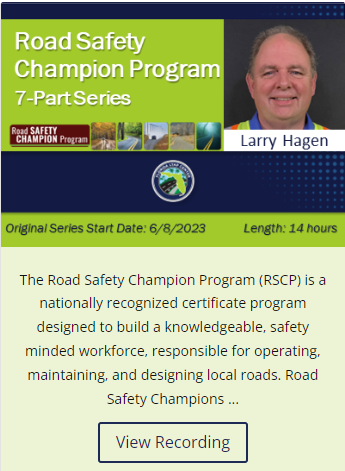
The Road Safety Champion Program (RSCP) is a nationally recognized certificate program designed to build a knowledgeable, safety minded workforce responsible for operating, maintaining, and designing local roads. Road Safety Champions prioritize safety and are motivated to implement safety improvements that reduce fatalities and serious injuries on rural and local roadways. The Florida LTAP Center provided the RSCP program as a 7-part webinar series from June 8 to July 20, 2023, which attracted over 2,000 attendees.
The series was taught by Florida LTAP instructor Larry Hagen, P.E., PTOE, and included the Level 1 Core Modules (CM), required for all Career Pathways. The RSCP is open to all staff from transportation, public health, and law enforcement agencies who are interested in roadway safety but are not safety experts. Think of it as a “Roadway Safety 101” course. All webinars from this series are now available on our recorded webinar page to view on-demand.
| |
Florida Virtual Public Involvement - Using Hybrid Meetings for Flexible Engagement | |
As in-person meeting restrictions eased following the COVID-19 pandemic, FDOT began using hybrid meetings to leverage the benefits of both in-person and virtual meetings. The in-person component is typically a traditional public meeting, while the virtual element is set up as a website with interactive options. Virtual participants can view presentation boards and access collaboration tools which may include comment forms or telephone hot lines. These tools provide participants with a similar experience as if they had attended the meeting in person.
Hybrid meetings have yielded multiple benefits for FDOT. They provide constituents with more choices in when and how they engage in the planning process. This increased flexibility has resulted in more participation online and more comments received overall, while still allowing those who prefer to engage in-person the option to do so.
FDOT institutionalized the use of hybrid meetings, releasing a Guide to Hybrid Public Meetings and Hearings, and documenting their use in the public involvement chapter of the department’s NEPA manual. Additionally, hybrid meetings were written into its broader Public Involvement Handbook. The agency produces sociocultural reports to understand the communities they work in, and how best to utilize hybrid meetings and other tools to reach constituents. More information can be found on the FDOT Community Engagement webpage.
Key takeaways from FDOT’s experience with hybrid meetings include the adaptability of this approach and how they help maintain a positive outlook and fresh perspective on engagement. It is important to use public involvement methods that meet communities where they are and are convenient to them.
Learn More
| |
Florida School Crossing Guard Training Program | |
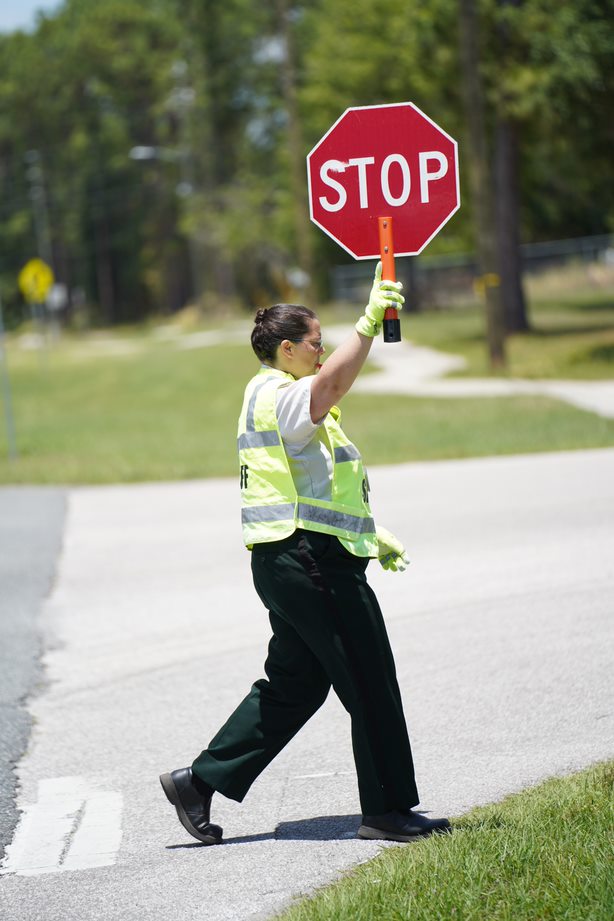
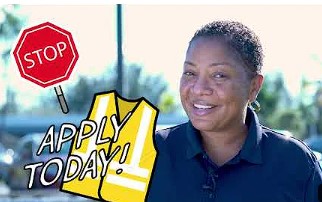
School is back in session, and we want to remind everyone about the importance of prioritizing safety when driving near schools. We can all do our part to keep our children safe, but one group that plays a vital role in this effort is school crossing guards. These dedicated individuals help ensure that children can travel to and from school safely, and they do so with great care and attention to detail.
Currently, there are vacancies in school crossing guard positions across the State of Florida. Therefore, we are reaching out to our transportation community to ask for your help in spreading the word about these vacancies and encouraging interested individuals to consider joining the school crossing guard team.
Florida School Crossing Guards truly are a key element in keeping our school crossings safe for Florida’s children.
Click here to learn more about becoming a Florida school crossing guard.
| |
It is important for drivers to be extra cautious when driving through school zones. Here are some tips to ensure the safety of students, pedestrians, and drivers:
1. Slow down: Reduce your speed when driving through school zones as children may be running around or crossing the street.
2. Pay attention to the signs: School zones have specific speed limits and signs that indicate when to stop. Be sure to follow these signs and signals.
3. Avoid distractions: Avoid using your phone or engaging in any other activity that may distract you from the road. Stay focused on driving.
4. Be patient: School zones can be busy, and traffic may move slower than you expect. Be patient and stay calm.
5. Watch for pedestrians and bicyclists: Students and parents may be walking and biking to and from school. Be aware of their presence and give them the right of way.
By following these simple tips, we can all help ensure the safety of everyone in school zones. Let's work together to make our communities safer for everyone. To learn more about FDOT's commitment to safety, visit the FDOT State Safety Office webpage.
| |
Local Programs Training Resources Page | |
FDOT administers several grant funding programs for subrecipients, more commonly known as “local agencies.” Local agencies have jurisdiction over a transportation facility and include, but are not limited to, a municipality, county, expressway, or transportation authority, special district, or regional governmental unit. The Florida LTAP Local Programs page has information on recorded and upcoming trainings.
| |
|
COURSE ATTENDANCE
With a target audience of Design, Construction, and Maintenance professionals, all transportation disciplines, including Planning, Traffic Ops, and others, will also benefit from the exposure to the federal Americans with Disabilities Act (ADA).
This webinar is provided at no cost and will award a certificate of training listing Professional Development Hours (PDHs) or a certificate of completion verifying your attendance.
| |
|
AGENDA
10:00 AM – 12:00 PM - Historical context of the ADA; Accessibility criteria in FDM 222; Q&A
12:00 PM – 1:00 PM - Lunch break
1:00 PM – 3:00 PM - ADA criteria cont.; Lessons Learned Discussion; Accessibility applied in Construction TTC; Q&A
| | | |
|
⭐Office Hours - FDOT - ADA in Design, Construction, and Maintenance⭐
(BT-05-0062)
Wednesday, September 20, 2023
10:00 AM – 12:00 PM (ET)
Brad Bradley (FDOT), Carey Shepherd (FHWA), and Jorel Lopez Villamil (Puerto Rico DTOP) will be hosting the Office Hours session to answer your questions about ADA. We’ll be taking questions from the August session, as well as providing you with an opportunity to submit questions during registration or through email.
To learn more and sign-up, visit: https://floridaltap.org/office-hours-for-fdot-ada-in-design-construction-and-maintenance/
We will NOT be providing certificates of completion or PDH certificates for this Office Hours session.
| |
|
Join us for an interactive and informative discussion with the Florida Department of Transportation District 7 Secretary, David Gwynn, and his team. You will have the opportunity to learn from a seasoned professional who has practical experience in crafting and managing strategic transportation initiatives.
LEARNING OBJECTIVES
■ Learn about the current and upcoming transportation initiatives of regional significance.
■ Understand the crucial role of visionary thinking in strategic initiatives.
■ Learn about collaboration strategies to move people, not cars and trucks anymore.
This webinar is provided at no cost and will award a certificate of training listing Professional Development Hours (PDHs) or a certificate of completion verifying your attendance.
| |
|
In this series, participants will learn about different intersection types – including signalized and unsignalized intersections – and the assortment of issues associated with them. Participants will also learn about the various users that need to be accommodated at an intersection. Most importantly, participants will also learn effective safety countermeasures to be applied at intersections and where to find more information on intersection safety treatments.
This webinar series is provided at no cost and will award a certificate of training listing Professional Development Hours (PDHs) or a certificate of completion verifying your attendance.
| |
Additional Training Opportunity | |
Introduction to the Bipartisan Infrastructure Law and Federal Requirements Webinar | |
September 6, 2023, 2:00 - 3:30 PM (ET)
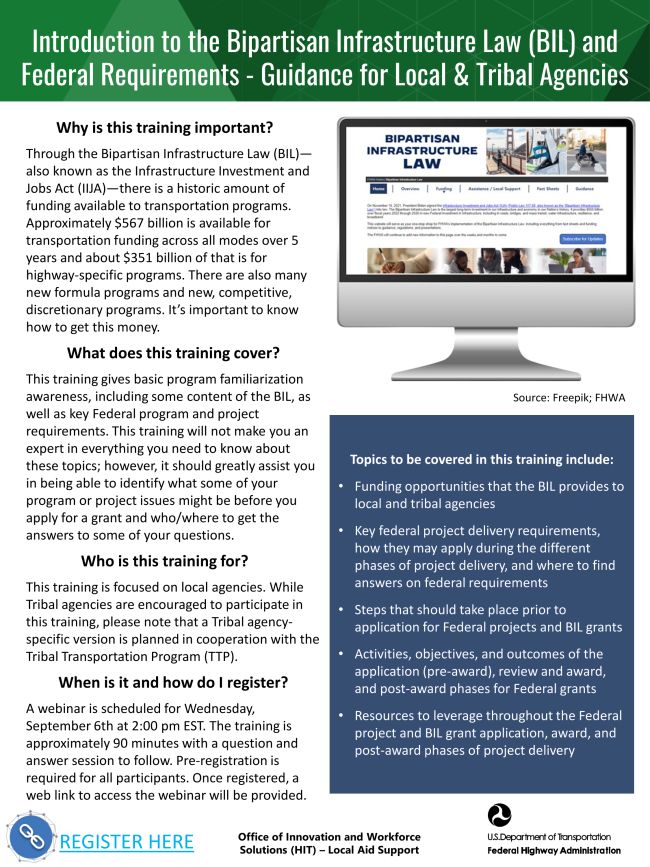
The Federal Highway Administration is introducing new training to assist local and Tribal agencies with applying for transportation funding under the Infrastructure Investment and Jobs Act (IIJA). Approximately $567 billion is available across all transportation modes over five years with about $351 billion of that for highway-specific programs.
Some of the training topics to be covered include funding opportunities, federal project delivery requirements, steps to take prior to application, pre-award requirements and resources to leverage throughout the Federal project and grant application processes. Local and Tribal agencies are encouraged to participate.
This webinar is not managed by the Florida LTAP Center. Please send your questions to FHWA Local Aid Support Program Manager, Hans Anker at hans.anker@dot.gov.
Learn More
| |
FDOT Transportation Symposium 2023 | |
Now through December 13, 2023
Keep staff and industry partners up-to-date with FDOT policies, procedures, and best practices. Visit https://transportationsymposium.fdot.gov/.
Professional Development Hours (PDHs) will be offered for the live version of the webinar. The recorded version will be posted to view at a later date.
| |
4th National Summit for Rural Road Safety | |
September 12 - 14, 2023
The National Center for Rural Road Safety brings together state, local and tribal agencies – and their stakeholders – to share, create and improve effective safety tools and strategies. While the National Association of Development Organizations (NADO) promotes regional development strategies, partnerships and initiatives that strengthen economic competitiveness; their emphasis on local communities includes sharing innovative tools and resources and developing new approaches and strategies for communities across the country.
By attending this summit you will have access to:
■ Sessions and trainings customized specifically for rural transportation practitioners
■ Ideas on how you can partner with law enforcement and public health professionals in your area to make roads safer
■ Networking with local and national rural professionals like you
■ Practical takeaways you can use right away
Learn More
| |
Hazard Mitigation Grant Program | |
Deadline: October 20, 2023 (Nicole)
The Hazard Mitigation Grant Program is authorized by Section 404 of the Robert T. Stafford Disaster Relief and Emergency Assistance Act. It is a partnership that is designed to assist states, local governments, private non-profit organizations and Indian Tribes in implementing long-term hazard mitigation measures following a major disaster declaration.
Although the Hazard Mitigation Grant Program is federally funded, the program is administered by the Florida Division of Emergency Management. The process of selecting eligible mitigation projects to be submitted for funding consideration has been delegated to each county’s Local Mitigation Strategy Working Group (LMSWG) in accordance with 27P-22 of the Florida Administrative Code.
Learn More
| |
USDOT Technical Assistance Grants for Transportation Projects in Rural and Tribal Communities | |
Deadline: September 28, 2023
The Infrastructure Investment and Jobs Act (also known as the Bipartisan Infrastructure Law or BIL) created the Rural and Tribal Assistance Pilot Program, which makes $10 million available over five years to provide states, local governments, and tribal governments with grants to support project development leading to future applications to DOT credit or grant programs. The grants can support legal, technical, and financial advisors to help advance infrastructure projects.
Learn More
| |
Reconnecting Communities and Neighborhoods (RCN) Grant Program | |
Deadline: September 28, 2023
The Office of the Secretary of Transportation (OST) has released a joint Notice of Funding Opportunity (NOFO) for the Reconnecting Communities Pilot (RCP) and Neighborhood Access and Equity (NAE) programs, which will combine two major discretionary grants into one NOFO. Together, this combined program will be known as the Reconnecting Communities and Neighborhoods (RCN) Program. While they remain separate programs for the award, the programs share many common characteristics, including Prioritizing disadvantaged communities; Aiming to improve access to daily needs such as jobs, education, healthcare, food, and recreation; Fostering equitable development and restoration; Reconnecting communities by removing, retrofitting, or mitigating highways or other transportation facilities that create barriers to community connectivity, including to mobility, access, or economic development. Attend an upcoming RCN webinar to learn more about this $3.155 billion funding opportunity: https://www.transportation.gov/grants/rcnprogram/rcn-webinars.
Learn More
| |
Safe Routes to Parks Accelerator Program | |
Deadline: October 9, 2023
Applications are now open for the Safe Routes to Parks Accelerator Program. Three states will be selected to assemble an interagency team to make funding and practice changes to support safe, convenient, and equitable access to parks and other everyday destinations across their respective states. Safe Routes Partnership will provide consulting services customized to support each state team over a 12-month period.
Through this program, you can expect to:
■ Maximize the opportunities of existing state funding and staff capacity to support park access and identify opportunities and models for expanding on those existing resources.
■ Strengthen the agency practices and policies that can transform roadway networks for safer and more convenient walking and biking
■ Build lasting, productive working relationships between state agencies to support safe access to everyday destinations.
■ Develop the messaging that works best to frame your work on Safe Routes to Parks to agency leadership and local partners.
Learn More
| |
|
What is Target Zero?
Target Zero is a statewide initiative to reduce the number of transportation-related serious injuries and deaths across Florida to ZERO. Florida’s Target Zero initiative is working toward zero fatalities on our roadways, because even one fatality is too many.
Learn more at TargetZeroFL.com
| |
|
Florida Local Technical Assistance Program (LTAP) Center
Center for Urban Transportation Research
University of South Florida
4202 East Fowler Ave., CUT100
Tampa, FL 33620-5375 USA
T: (813) 974-4450
FloridaLTAP@usf.edu
www.FloridaLTAP.org
| | | | |