Volume 6 | Issues 1 & 2
Table of Contents
Scroll Down for Detailed Information
| | |
The Florida LTAP Center delivers training, technical assistance, technology transfer, and other transportation needs to local Florida agencies. In this newsletter, you will find upcoming trainings, events, and funding opportunities. Click here for more information.
We encourage you to share relevant trainings, events, and resources not included in our emails so we can add them to future publications.
■ Director's Message: Celebrating Innovation
■ News: Florida LTAP Celebrates 2026 Build A Better Mousetrap Recognition Program Winner | National Preparedness Month - Florida Edition
■ Upcoming Trainings: Developing and Implementing Transportation Management Plans 3-Part Series | Broward Safety Action Plan: Safe Streets Design Guidance Manual | Tips to Improve Your Public Speaking Instantly | Traffic Signal Timing 301 – Putting It All Together, 3-Part Series | Signing, Pavement Markings, and the MUTCD, 3-Part Series | Basic Highway Plan Reading, 3-Part Series | From Silos to Synergy: Transforming Leadership through Collaboration
■ Upcoming Events: See Tracks? Think Train Week (National Rail Safety) | Suicide Prevention Awareness Month | National School Bus Safety Week | Walk, Bike, & Roll To School Day | Pedestrian Safety Awareness Month
■ Funding Opportunities: Florida Safe Routes to School - Safety Infrastructure Grant | Promoting Resilient Operations for Transformative, Efficient, and Cost-saving Transportation (PROTECT) Competitive Grant Program
| |
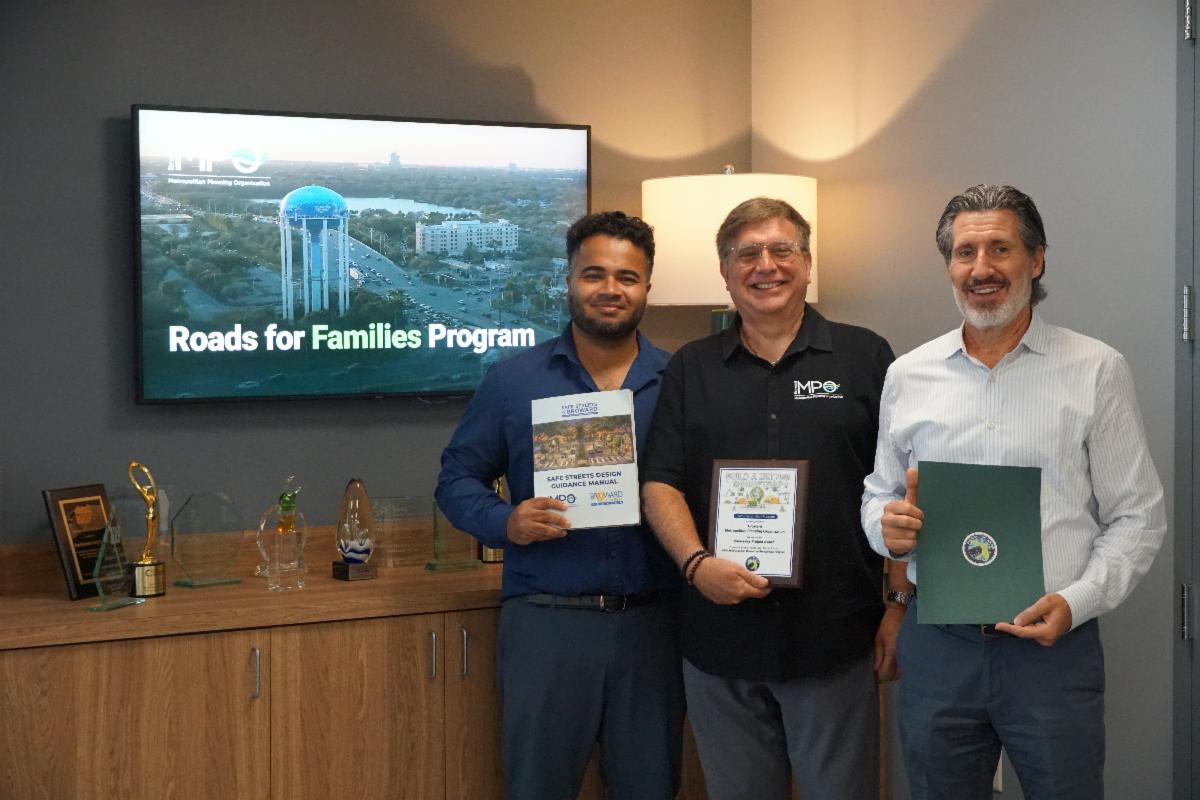
| |  | Instead of producing a theoretical policy document, the Broward MPO focused on creating a practical manual that agencies could directly use for real-world transportation projects. The guidance was specially designed for urban and suburban settings, land use, roadway user needs, and the characteristics of the transportation network. The development process was highly collaborative and data driven. The MPO gathered diverse stakeholders, including FDOT, Broward County, municipal staff, and other transportation professionals, to ensure the manual's feasibility and usability. The originality of this solution lies in its structure and practical application. The project team, led by Broward MPO's Deputy Executive Director James Cromar and Senior Engineer Fazal Qureshi, reviewed guidance from groups such as FHWA, NACTO, AASHTO, State DOTs, various Counties/Cities, and other leading transportation organizations to pinpoint innovative design methods that could enhance roadway safety, accessibility, and multimodal connectivity.
As we celebrate this remarkable accomplishment, we invite other local leaders and innovators to participate in the 2025 competition cycle. This is an opportunity to showcase your achievements and contribute to the continued growth and success of the transportation sector.
For more information about the BABM competition, visit https://www.fhwa.dot.gov/clas/babm/. Join us in congratulating Broward MPO on this remarkable achievement and celebrating excellence in transportation.
| | |
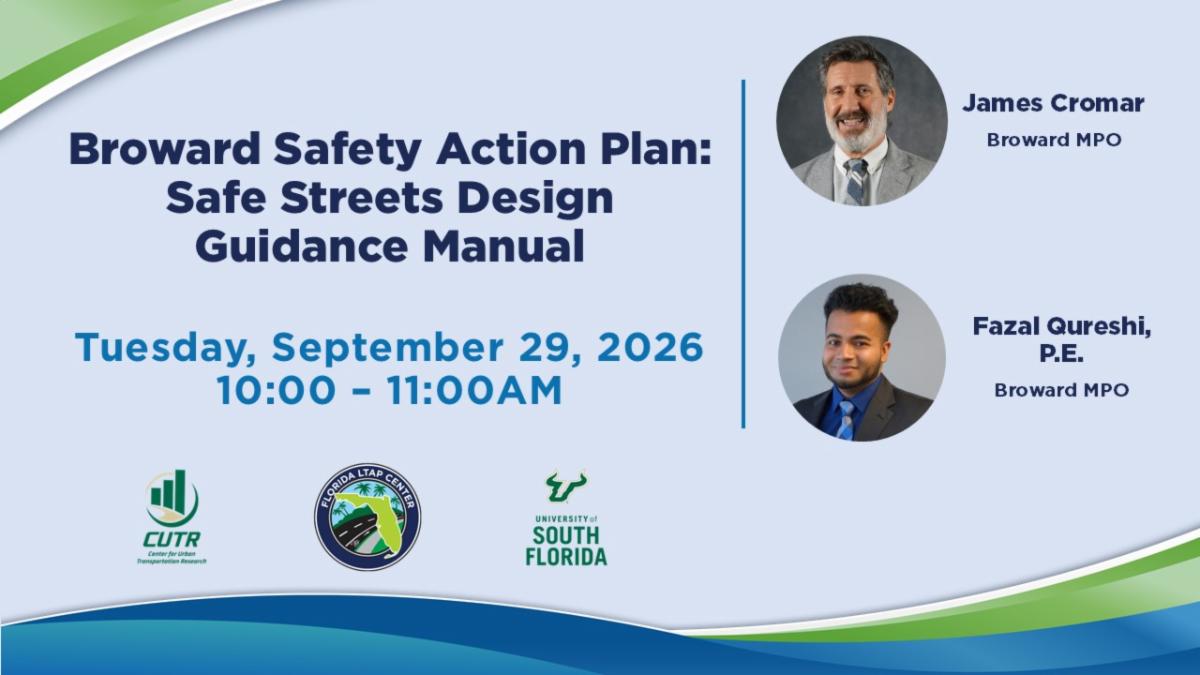
Participants will learn how the Manual connects the goals and strategies of the Broward Safety Action Plan with day-to-day transportation planning and design decisions. The training will introduce the Manual’s approach to identifying safety needs, selecting context-sensitive design treatments, and developing solutions that support safer outcomes for everyone. Topics will include the Safe System Approach, safety-focused corridor and roadway design, speed management, intersection and crossing treatments, pedestrian and bicycle safety, and other proven safety countermeasures. The training will also discuss how practitioners can use the Manual as a resource when planning new projects, evaluating existing streets, advancing safety consistently, and aligning countermeasures with appropriate contexts.
📝 Learning Objectives
■ Describe the purpose of the Broward Safety Action Plan and the role of the Safe Streets Design Guidance Manual in advancing Broward’s goal of eliminating traffic fatalities and serious injuries.
■ Explain the principles of the Safe System Approach and how they can be incorporated into transportation planning, roadway design, and project development.
■ Identify key safety considerations and design criteria to evaluate when developing or modifying streets and corridors.
■ Recognize appropriate safety countermeasures for roadways.
■ Apply the Safe Streets Design Guidance Manual to develop context-sensitive design solutions that improve safety for all roadway users.
■ Identify opportunities to incorporate the Manual’s recommendations into local agency planning, design, operations, maintenance, and capital improvement processes.
This webinar is provided at no cost and will award a certificate of training listing Professional Development Hours (PDH) or a certificate of completion verifying your attendance. AICP Certification Maintenance (1.0 CM) is being provided by the Sun Coast Section of APA Florida.
| | National Preparedness Month - Florida Edition | |
Each September, FEMA’s Ready Campaign celebrates National Preparedness Month. Since 2004, the campaign has taken the month to encourage Americans to prepare for emergencies. The month is a great time to take small steps to be better prepared, and now Florida calls September 'Florida Preparedness Month'.
Preparedness looks different for every household, but every Floridian can take steps now to become more resilient. Whether it is signing up for local alerts, packing essential supplies for your children, checking your evacuation zone, or identifying a safe place to go, preparing before a storm is on the horizon is always better than waiting until it arrives.
The Florida Division of Emergency Management plans for and responds to both natural and man-made disasters. They have a comprehensive dashboard of resources to assist with the planning, recovery and mitigation of disasters. Visit, https://www.floridadisaster.org/ for details.
| | |
Floridians should know and follow these Steps of Hurricane Preparedness:
■ Know Your Home, Know Your Zone – Know your evacuation zone and understand your home’s ability to withstand potential storm conditions. Based on these factors, determine whether you may be able to shelter in place or will need to evacuate if instructed by local officials. Identify where you would go to a local shelter. To identify your evacuation zone, visit FloridaDisaster.org/Know.
■ Make a Plan: Develop a disaster plan with everyone in your household/business, including how you will communicate before, during, and after a disaster or emergency. To create a customized preparedness plan for your household or business, visit FloridaMakeAPlan.com.
■ Build a Kit: Build a disaster supply kit with enough food, water, medications, and other essential supplies for your household for up to seven days. Consider the needs of everyone in your household, including children, older adults, individuals with disabilities and pets. Visit FloridaDisaster.org/Kit for a comprehensive disaster supply checklist.
■ Halfway Full is Halfway There: Keep your vehicle’s gas tank at least halfway full or your electric vehicle at least halfway charged throughout hurricane season. Storm preparation and evacuation orders can lead to increased demand at gas stations and charging locations. Visit FloridaDisaster.org/HalfwayFull.
■ Evacuate Tens of Miles, Not Hundreds (If Necessary): Always follow evacuation orders and guidance from local officials. Sign up for local emergency alerts through AlertFlorida, and visit your county's local emergency management site at FloridaDisaster.org/counties for information about shelters. In many cases, moving tens of miles inland, to higher ground or outside an evacuation zone may be enough to get out of harm’s way.
■ Community Engagement: From volunteering in your community to learning skills like first aid and CPR, you can take steps to prepare for disasters, keep your family safe, and make your neighborhood and community more resilient. Take a training course through FEMA’s Training and Education Program, the American Red Cross, or your local emergency management agency to build or gain skills to protect yourself, family, friends, and community.
| | |
AGENDA
Part 1: TMP Foundations and the Work Zone Safety and Mobility Rule (8/31/26 | 2-4 pm ET) - Recording Available
This session introduces the purpose and structure of Transportation Management Plans and the federal requirements that guide TMP development. Participants will review the Work Zone Safety and Mobility Rule, significant project criteria, TMP fundamentals, required components, and the difference between a TMP and a Temporary Traffic Control Plan. The session will also highlight why TMPs are needed and how they support safer, more effective work zone planning.
Part 2: TMP Coordination and Work Zone Impact Assessment (9/14/26 | 2-4 pm ET) - Recording Coming Soon
This session focuses on the coordination and analysis needed to develop an effective TMP. Participants will identify key internal and external stakeholders, discuss roles and responsibilities across planning, design, and construction, and examine how agencies assess expected work zone impacts. Topics include safety, mobility, business access, pedestrian considerations, transit, emergency response, and other project-specific impacts that may require mitigation strategies.
Part 3: TMP Strategies, Approval, Implementation, and Monitoring (9/28/26 | 2-4 pm ET)
This session reviews the strategies used to manage anticipated work zone impacts and the process for moving a TMP from development to implementation. Participants will explore temporary traffic control, transportation operations, and public information/outreach strategies, along with TMP review, approval, pre-construction coordination, field implementation, inspection, monitoring, revisions, and post-project evaluation. The session will also reinforce how lessons learned can improve future work zone performance.
This webinar series is provided at no cost and will award a certificate of training listing Professional Development Hours (PDHs) or a certificate of completion verifying your attendance.
| | |
📝 You will learn:
■ Why you (and everyone else) are afraid of public speaking.
■ Some common mistakes made by even big-time public speakers.
■ Three practical tips that will improve your public speaking instantly.
This webinar is provided at no cost and will award a certificate of training listing Professional Development Hours (PDHs) or a certificate of completion verifying your attendance.
| | |
■ Develop and calibrate traffic signal models to reflect existing field conditions and operational characteristics.
■ Apply optimization techniques to develop and evaluate timing plans for coordinated traffic signal systems.
■ Implement optimized timing plans within controller databases and verify field operations.
■ Conduct before-and-after evaluations using travel times, delays, stops, and other performance measures to assess operational improvements and system benefits.
■ Recognize the importance of documentation, quality control, and ongoing fine-tuning in successful traffic signal timing projects.
| | |
AGENDA
Part 1 of 3 - Project Development and Data Collection (October 8, 2026 | 2:00 – 4:00 pm ET)
In this first session, we will introduce the overall signal timing project workflow and discuss how to identify timing needs, define corridor limits, review existing conditions, and collect the data needed to support a successful retiming effort. Topics will include corridor prioritization, equipment inventory, operational checks, existing timing data, traffic counts, travel time studies, and field observations.
Part 2 of 3 - Modeling and Optimization (October 22, 2026 | 2:00 – 4:00 pm ET)
In this second session, we will discuss how traffic signal models are developed, reviewed, and optimized. Topics will include modeling concepts, simulation and optimization tools, model calibration, Synchro modeling considerations, pattern development, cycle length selection, and comparison of optimization results.
Part 3 of 3 - Implementation and Evaluation (November 5, 2026 | 2:00 – 4:00 pm ET)
In this third session, we will focus on moving from optimized timing plans to field implementation and evaluation. Topics will include controller database development, quality control, timing implementation methods, field checks, fine-tuning, documentation, and before-and-after studies to evaluate project outcomes.
Bonus Office Hours - Traffic Signal Timing 301 (November 19, 2026 | 2:00 – 3:00 pm ET)
This optional bonus office hours session will provide participants with an additional opportunity to ask questions, explore course topics in more detail, and discuss practical traffic signal timing scenarios. Participants may submit questions, photos, field examples, timing scenarios, or other real-world situations in advance for possible discussion during the session. Attendees will also have the opportunity to unmute and ask questions during the live session, allowing for instructor-led discussion and practical application of concepts covered throughout the Traffic Signal Timing 301 series.
This webinar series is provided at no cost and will award a certificate of training listing Professional Development Hours (PDHs) or a certificate of completion verifying your attendance.
| | |
AGENDA
PART 1 of 3 – Basics of Signs and Signing (October 9, 2026 | 2:00 - 4:00 pm ET)
In this session, attendees will learn how to read and interpret the MUTCD, the basic requirements of signs and how to meet them, and how the MUTCD achieves uniformity and why it’s important. We will also review how to determine a sign location and how to meet the retro-reflectivity requirements.
PART 2 of 3 – Warrants and Use of Signs (October 23, 2026 | 2:00 - 4:00 pm ET)
In session two, attendees will learn reasons and warrants for sign installation, signs found in the MUTCD and their use, and how to select curve warning signage. We will also consider how to enhance the conspicuity of signs and review guidelines for object markers and delineators.
PART 3 of 3 – Pavement Markings, Temporary Traffic Control, and Liability (October 30, 2026 | 2:00 - 4:00 pm ET)
In session three, attendees will learn the guidelines for longitudinal markings (striping) and transverse markings (words, symbols, stop lines, crosswalks, etc.). We will also review the basics of temporary traffic control and how to protect yourself from potential liability.
This webinar series is provided at no cost and will award a certificate of training listing Professional Development Hours (PDHs) or a certificate of completion verifying your attendance.
| | |
AGENDA
Part 1 of 3 – Introduction to Plan Reading (10/12/2026 | 2:00 - 4:00 pm ET)
In this first session, we will introduce the basic concepts of plan reading. The following topics will be covered: Scale: What does it mean?; Stationing as a reference system; Views: Different ways of looking at a project; and Decoding Symbols and Abbreviations. We will introduce a sample set of roadway plans for the webinar series.
Part 2 of 3 – Title Sheet, Typical Sections, Summary of Quantities, and Plan Sheets (10/19/2026 | 2:00 - 4:00 pm ET)
In this second session, we will begin walking through our sample set of roadway plans. We will cover the following: Layout/Title Sheet, Typical Sections, Summary of Quantities, and the Plan Sheets. Attendees will have an opportunity to practice their plan reading knowledge.
Part 3 of 3 – Profile Sheets, Right of Way, Erosion Control, and Pipe Sheets (10/26/2026 | 2:00 - 4:00 pm ET)
In this third session, we will work on the second half of our sample set of roadway plans. We will cover the following: Profile Sheets, Right of Way Sheets, Erosion Control Sheets, Pipe Sheets, and the Cross Section Sheets. Attendees will have an opportunity to practice their plan reading knowledge.
This webinar series is provided at no cost and will award a certificate of training listing Professional Development Hours (PDHs) or a certificate of completion verifying your attendance.
| | |
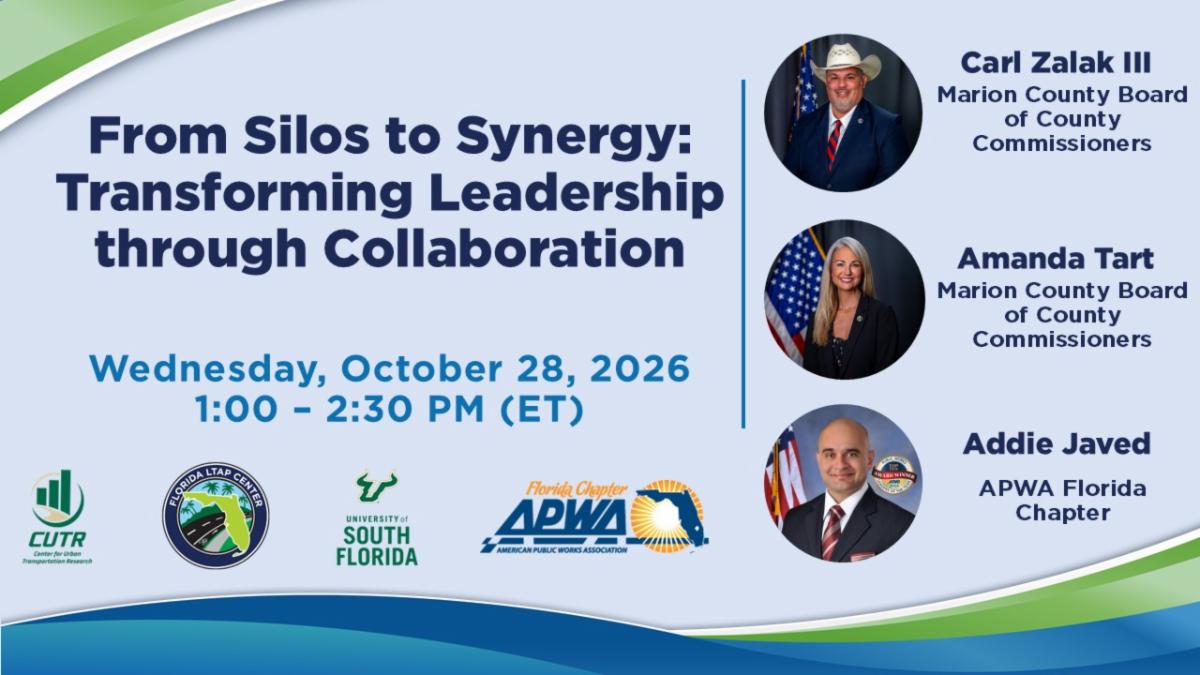
The webinar will include a presentation followed by a Q&A session, with attendees able to submit questions either during registration or in real time. The Florida LTAP Center is pleased to partner with the American Public Works Association Florida Chapter (APWA-FL) to bring you this webinar.
🔑 Key Takeaways
■ Understand the link between leadership development and employee engagement.
■ Recognize how DiSC personality styles impact communication and team dynamics.
■ Identify strategies to break down silos and improve cross-functional collaboration.
■ Explore practical approaches for developing emerging leaders.
■ Learn about cost-effective resources and funding opportunities for leadership training.
■ Build a roadmap for creating a more connected, engaged, and collaborative workforce.
This webinar is provided at no cost and will award a certificate of training listing Professional Development Hours (PDHs) or a certificate of completion verifying your attendance.
| | See Tracks? Think Train Week (National Rail Safety) | |
September 21 -27, 2026
See Tracks? Think Train Week 10th Anniversary
First held in the U.S. in 2017, this collaborative effort among Operation Lifesaver Inc., State Operation Lifesaver Programs and rail safety partners across the U.S., Canada and Mexico is now called See Tracks? Think Train Week throughout the U.S. to better reflect the purpose of this week-long observance:
You Can Help #STOPTrackTragedies
■ Share the rail safety message during Rail Safety Week and beyond.
■ Know the facts.
■ Recognize the signs.
■ Make good decisions around tracks and trains.
■ Take the Rail Safety Pledge.
Learn More
| | Suicide Prevention Awareness Month | | |
September 2026
The construction industry has one of the highest suicide rates of any occupation. Suicide deeply impacts workers, families, and communities. Fortunately, like other workplace fatalities, suicides can be prevented. Everyone in the construction industry has a role to play in suicide prevention.
Learn the steps for initiating and normalizing conversations around suicide and mental health. Creating a safety culture also means addressing suicide prevention as a health and safety priority through training, raising awareness, and ultimately decreasing the risks associated with suicide in construction. This recorded webinar, Suicide Prevention & Mental Health Awareness in the Construction and Public Works Industry, is brought to you by the Florida Pavement Preservation Council (FPPC) in concert with the Florida LTAP Center.
Learn More
| | Walk, Bike, & Roll To School Day | |
October 7, 2026
Small steps for kids and families, giant leaps for safe, active travel! Register now for the National Walk & Roll to School Day on October 7, 2026!
Whether addressing the need to make active routes to school safer or encouraging children to be more active, Walk & Roll to School Day events come in many forms to meet the different needs of communities. Equally important, they are lots of fun! Your community is welcome to celebrate any day in October that best fits your schedule.
The FDOT Safe Routes to School (SRTS) program provides opportunities for schools and communities to work together to help improve the safety of families walking and biking to school. Learn the steps for initiating a Walk & Bike to School Day, the planning involved, how to coordinate with schools and local partners, and the steps for carrying out an event in your community by watching the How to Plan a Walk and Bike to School Day webinar brought to you by FDOT through the Florida LTAP Center.
Learn More
| | National School Bus Safety Week | |
October 19-23, 2026
Millions of children across the nation ride on a school bus every day – that’s why school bus safety is important in every community.
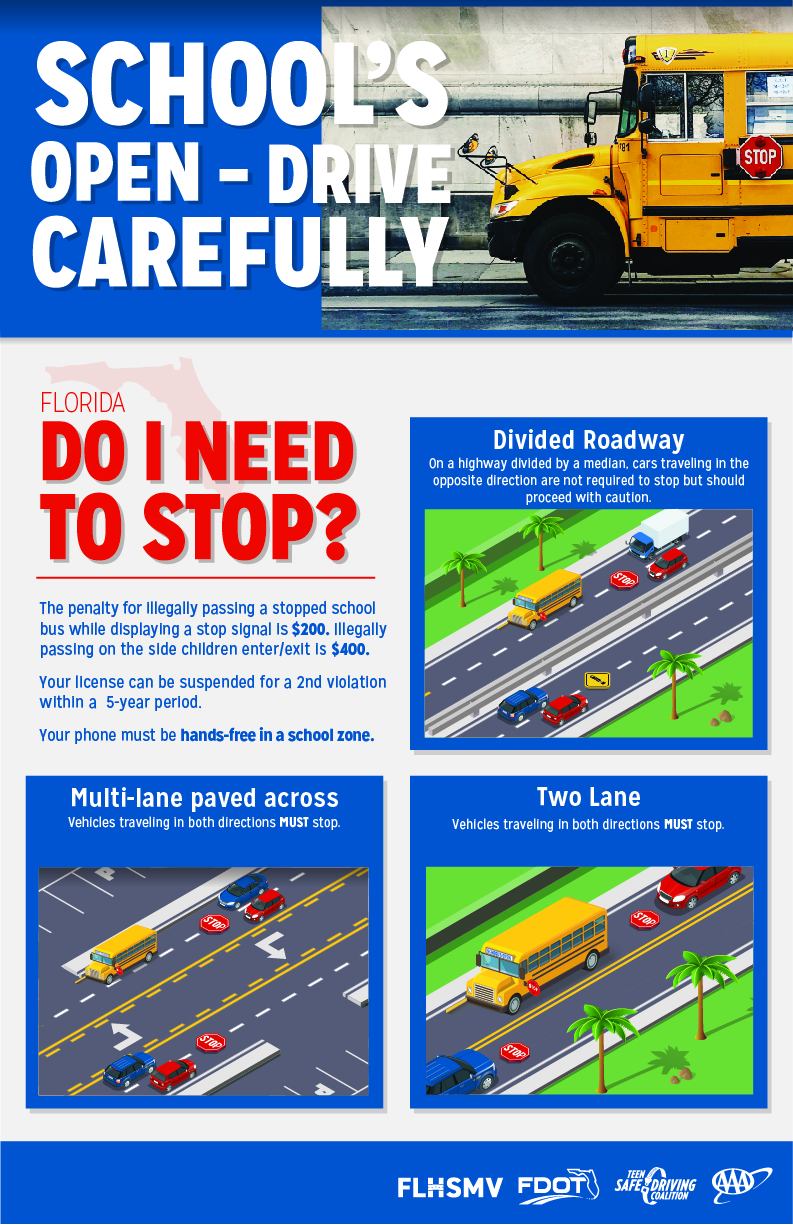
DO I NEED TO STOP? Consider these tips for safe driving:
■ TWO LANE: Vehicles traveling in both directions MUST stop.
■ MULTI-LANE PAVED ACROSS: Vehicles traveling in both directions MUST stop.
■ DIVIDED ROADWAY: On a highway divided by a median, cars traveling in the opposite direction are not required to stop but should proceed with caution.
Learn More
| | Florida Safe Routes to School - Safety Infrastructure Grant | |
Application Portal Opens: September 30, 2026
The Florida Safe Routes to School (SRTS) program is a statewide program that aims to make it safer for more children to walk and bicycle to school. This grant program is funded by the Florida Department of Transportation (FDOT) to improve safety in the vicinity of schools. Eligible applicants for the grant include schools or local government agencies that will be the maintaining agency responsible for the project.
Learn More
| | Promoting Resilient Operations for Transformative, Efficient, and Cost-saving Transportation (PROTECT) Competitive Grant Program | |
Deadline: October 9, 2026
The intent of the PROTECT Competitive Grant Program is to fund projects to improve the resilience of the surface transportation system, including highways, public transportation, ports, and intercity passenger rail. Program goals include protecting the continued operation or rapid recovery of surface transportation systems; coastal infrastructure; and natural infrastructure that protects and enhances surface transportation assets.
Grant Program funding of up to $787 million from FYs 2024 through 2026, plus any remaining PROTECT Competitive Grant Program funding from prior years.
Learn More
| | |
What is Target Zero?
Target Zero is a statewide initiative to reduce the number of transportation-related serious injuries and deaths across Florida to ZERO. Florida’s Target Zero initiative is working toward zero fatalities on our roadways, because even one fatality is too many.
Learn more at TargetZeroFL.com
| | |
Florida Local Technical Assistance Program (LTAP) Center
Center for Urban Transportation Research
University of South Florida
4202 East Fowler Ave., CUT100
Tampa, FL 33620-5375 USA
T: (813) 974-4450
FloridaLTAP@usf.edu
www.FloridaLTAP.org
| | | | |