Flowers for Bats campaign
Hi USA-NPN,

This year's Flowers for Bats campaign has come to a close. Thank you for your efforts tracking flowering of cacti and agave!

Read on to find out what we learned from your observations this year. Your data are making important contributions to help the USFWS understand when and where nectar sources are available for the lesser long-nosed bat, and how these nectar sources respond to changes in the environment.

We hope that you will join us again next year. Your observations made at the same sites over multiple years are especially valuable in helping us to understand the variation in flowering in cacti and agave.

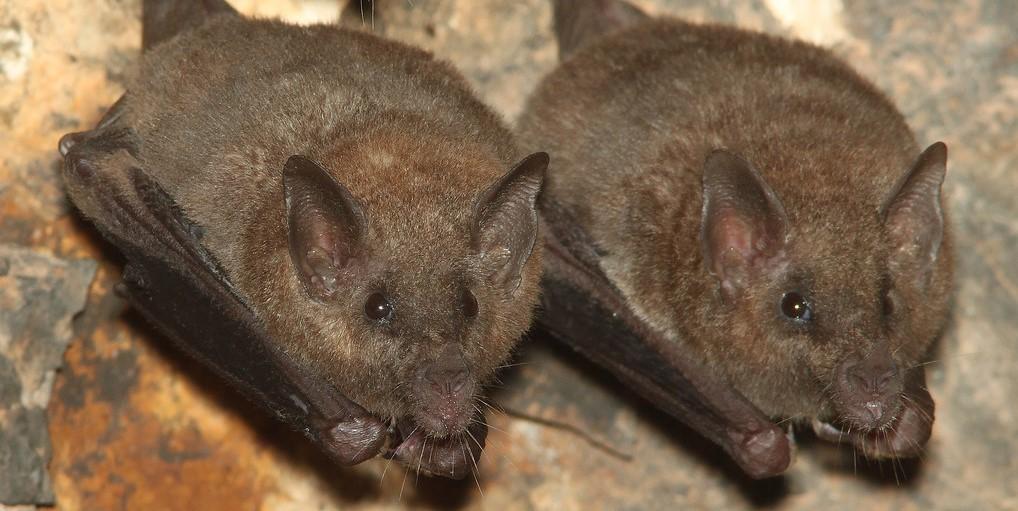
Photo: Lesser long-nosed bats by Alan Schmierer

What you reported on saguaro and agave this year

This year, 91 observers reported data at 83 sites - thank you for your efforts!


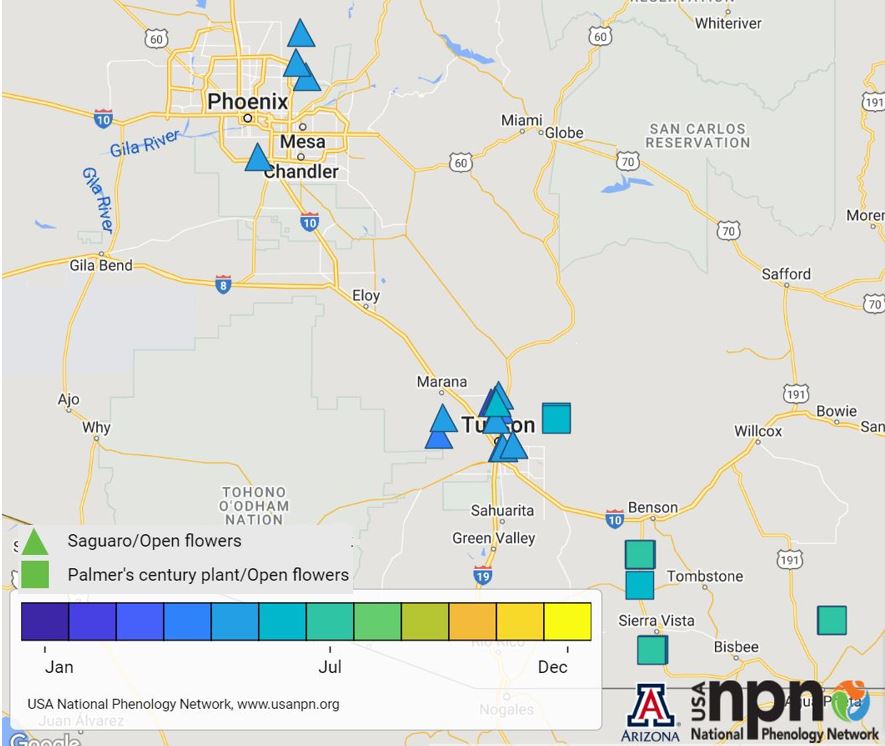
The map below shows your reports for open flowers in the two most reported Flowers for Bats species - Saguaro (triangles) and Palmer's century plants (square).

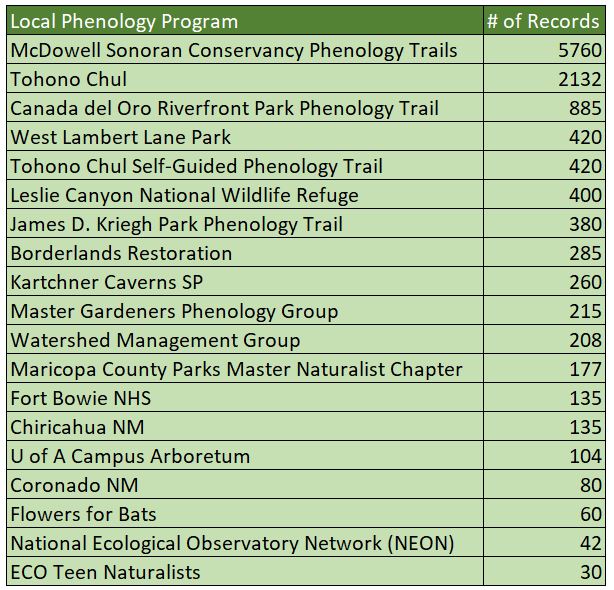
We had 19 local phenology programs report data on cacti and agave this year, along with 39 backyard observers. We appreciate our partners because they provide training for volunteers, bring in data from hard to reach locations, and participate in a variety of other conservation efforts related to the lesser long-nosed bat. Our backyard observers provide critical information about flowering timing across the urban to rural gradient.

In 2021, you captured a total of 56 onsets of open flowers for all species - 28 for saguaro, 26 for Agave palmeri, 1 for Agave deserti, and 1 for Agave americana.


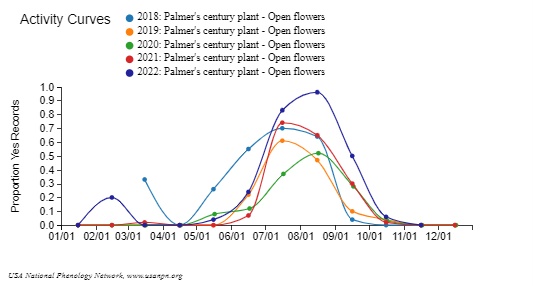
The two most commonly observed species, saguaro and Agave palmeri, provide nectar for bats at different times of the year. Now that we have multiple years of data, we can start to look at timing of nectar availability in these species.


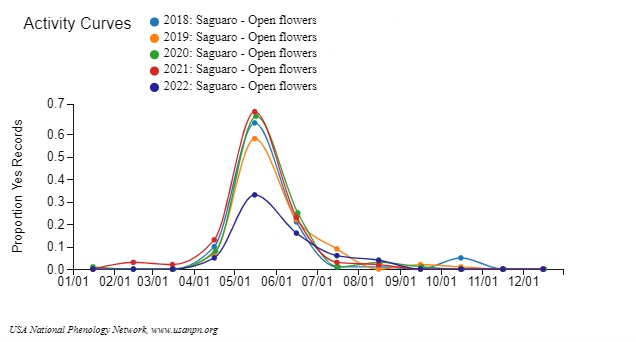
In the past five years, saguaro flowers opened in early April, peaked in May, and ended in mid-July. In 2022, the average onset date for open flowers in saguaro was June 2nd, and the average duration of open flowers was 19 days. The average date on which saguaros had at least 75% of flowers open was June 5th. This year had an unusually low proportion of open flower reports for this species in May.

Agave palmeri open flowers varied more between years than did saguaro. This year had a similar peak in open flowers as 2020. In 2022, the average onset date for open flowers in Agave palmeri was June 22nd, and the average duration of open flowers was 43 days. The average date on which Agave palmeri had at least 75% of flowers open was August 12th. In 2022, the proportion of yes records for open flowers in July and August was higher than in previous years.

As we continue to add to this dataset, we'll continue to discover patterns of when agave and saguaro have flowers, when the peak occurs, and explore how climate variables such as temperature and precipitation influence flowering phenology. 

We hope that you will join us again next year to continue reporting on your saguaros and agaves. You are helping us to learn more about when and where flowers are available for bats and other pollinators!  

Would you like a Flowers for Bats sticker (pictured at right)? Send your mailing address to samantha@usanpn.org and we will mail one to you.


Thank you for your contributions to this important project, we couldn't do it without your efforts!


Contact

Samantha Brewer

samantha@usanpn.org

bio

Share with a friend
LinkedIn Share This Email