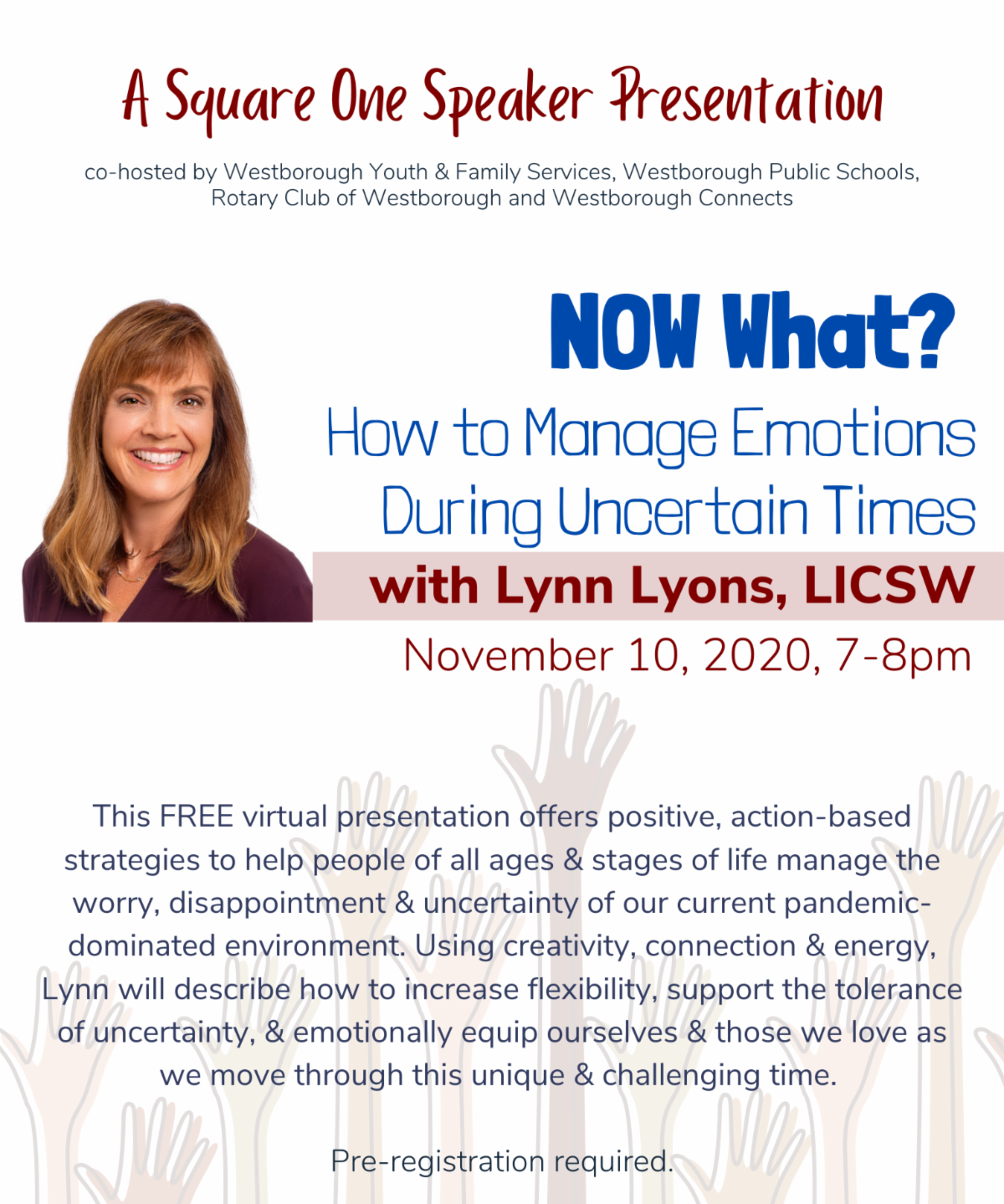
Please Note: You received this email because you registered for the November 10th Square One Speaker Presentation: NOW What? How to Manage Emotions During Uncertain Times with Lynn Lyons. Please feel free to forward this to anyone else who would be interested! If you are not on the Westborough Connects mailing list and wish to receive future emails, including periodic newsletters, information about upcoming community programs and more, you may do so by clicking HERE.
|
|
Square One Speaker Presentation: NOW What? How to Manage Emotions During Uncertain Times with Lynn Lyons
Resources & Follow-up
|
|
The Square One Team wishes to thank Lynn Lyons for another great program. While the program was not recorded, our team took furious notes while Lynn stepped us through information and practical strategies for managing anxiety - for children and adults. Please read below for some specific points from the program as well as noteworthy resources related to the topics discussed.
If you attended the program and haven't yet filled out the feedback form, please click HERE as feedback helps guide future programming.
The team is looking ahead to additional community programming in 2021. As a reminder, Square One is a collaborative partnership between Westborough Public Schools, Westborough Youth & Family Services, Rotary Club of Westborough, and Westborough Connects. Square One plans free programs and offers resources designed to support community resilience, particularly around substance use and mental health. Reach out to westboroughconnects@gmail.com to share your ideas or join our planning team. This is a true community effort and we welcome your input on important topics you would like to see in future programming.
Thank you,
The Square One Team
Rotary Club of Westborough, Westborough Youth & Family Services, Westborough Public Schools and Westborough Connects
|
|
Notes from the Presentation |
|
We took many notes from Lynn's presentation! Here are some of the noteworthy takeaways: |
|
|
-
It’s important to “normalize” and “contextualize” our emotions. We are having normal reactions to an abnormal situation. “Of course you’re feeling…”
-
Worrying happens. Events that cause worry aren’t going anywhere, and our bodies are wired to react in a certain way to the worry, in part to keep us safe (think "fight or flight"). However, we can educate ourselves about how worrying and anxiety “work” to try to interrupt our natural reactions in order to keep anxiety and worry from taking over. While we can’t remove anxiety provoking things, we can work on the “emotional management” piece.
-
Lynn encourages the practice of giving your anxiety a name, becoming an observer of it, and creating some distance in order to be better about recognizing it and identifying what makes it better and what makes it worse.
-
Anxiety is demanding. It wants certainty and comfort. It's natural for us to want to take the anxiety away from our children or loved ones and make them feel better. Instead, Lynn stresses learning about how anxiety works and developing strategies and skills for managing anxious feelings. But, how?...
|
|
|
|
...In the language we use and our ways of thinking, it’s helpful to:
|
|
-
Be flexible rather than rigid (For example, when things don’t go as planned, discuss what you did to manage it, so that you can draw on it in future situations. Have a wall of flexibility where you put post-it notes up with ways you were flexible).
-
Focus on parts (What are the 3 things that are ok right now? How can I consider the beginning, middle and end so things don’t seem so overwhelming?) rather than the global picture (Global language is the language of being overwhelmed -everything, always, nothing, nobody).
-
Avoid catastrophic thinking. Focus instead on problem solving (let’s think about what I/we can do) rather than a catastrophic view (try not to ruminate and get caught up in the worry.)
-
Remember that things are temporary and changeable, not permanent. This is especially important for teens. Everyone needs to remind themselves that feelings, patterns we’ve established, bad habits we’ve formed, and situations are not permanent. Things can be changed. We need to work on having a “positive expectancy” and begin to believe that things will get better. (“When things are better…,” “When I/we can be around more people…” ). It’s ok to look ahead and start thinking about when things will be better. Hope is helpful.
-
Modeling healthy reactions ourselves has a huge impact on how our children react. While stress and worry can be contagious, we can have a positive impact on the way those around us react (no matter what their age).
-
It’s helpful for our mental well being to have an external focus and think beyond ourselves. Think about how we can help others. Pick a “Day of Joy” and do 3 things that help someone else (can be as simple as waving across the street at a neighbor).
-
For children, feelings of autonomy are very important. We need to “lengthen the leash,” and think about what we can have our children do for themselves successfully- whether it’s preparing their own breakfast, picking out their outfits, helping with something around the house. What are some things you do for your children that they can be doing for themselves?
-
Loneliness and isolation are troublesome in normal times. They are even more troubling and prevalent in the time we are currently living. Therefore, feelings of acceptance and belonging are critical right now. Make sure you and your loved ones are maintaining connections, even in simple, small ways.
|
|
-
Flusterclux is a weekly podcast by Lynn Lyons, where she explores different topics related to anxiety in children. (As Lynn pointed out in her presentation, the principles are the same for people of all ages, not just children).
-
As an author of several books centered around anxiety in children and families, Lynn recommended reading her books for a deeper dive: Anxious Kids, Anxious Parents: 7 Ways to Stop the Worry Cycle and Raise Courageous & Independent Children (Reid Wilson and Lynn Lyons) available in e-book format at Westborough Public Library; Playing with Anxiety: Casey's Guide for Teens and Kids (Reid Wilson and Lynn Lyons); Using Hypnosis With Children: Creating and Delivering Effective Interventions (Lynn Lyons). Visit Lynn's website for more information, including how to order her books.
-
In September, Westborough Youth & Family Services and the Westborough Public Schools Wellness Department launched a monthly publication called Community Wellness Guide, which is designed to empower users to take a closer look at issues of mental health, racism/anti-racism and the intersections between them. The November edition focused on anxiety. Read it HERE. (For September and October editions, click HERE).
|
|
-
Looking for some social connection for your teen? As Lynn pointed out, it is important! Check out the Teen Zone at the Westborough Public Library and sign up for their e-newsletter HERE. The Kids' Department also has great free resources and programs for younger kids (they have an e-newsletter too!).
|
|
-
Westborough Youth and Family Services offers free counseling services for residents of all ages who have had a difficult time accessing behavioral health services elsewhere. Clinical consultation and resource and referral services are provided free to any and all residents with no wait. To inquire about services, call 508-366-3090.
-
Westborough Youth and Family Services has launched free, anonymous, online mental health screening for adults and parents. Resources are provided after your screening to address your behavioral health service needs.
-
Call the INTERFACE Helpline 1.888.244.6843, M-F, 9am-5pm - This free matching service assists Westborough residents to connect with providers of outpatient mental health services.
|
|
Community Programs hosted or co-hosted by Westborough Connects are always free to attend. However, they are not free to produce. If you wish to support Westborough Connects in bringing future programming to the community, please consider a donation. |
|
|
About Westborough Connects
Westborough Connects is an emerging organization focused on building a more-connected and kind community where everybody feels like they belong. We are a volunteer group of parents, educators, community leaders and engaged citizens. Westborough Connects creates opportunities to support and celebrate the diversity, spirit, and character of Westborough through programs and events that are community-based, strengths-based and dedicated to connecting people to resources and each other. For more information, visit http://www.westboroughconnects.org
|
|
|
|
|
|
|