June 9, 2026

Egleston Hall has welcomed the faithful, the stranger, the neighbor, and the seeker for over a century. That's not changing.

A BUILDING MADE FOR PEOPLE

Do you remember this children's nursery rhyme?


Here's the church and there's the steeple, Open the door and see all the people.

That has always been the mission of the church: the people.


And that was Egleston — before it housed staff offices. Built in 1918 as an extension of our beautiful sanctuary, Egleston Hall had a single purpose: to welcome people in.


More than a century later, that purpose hasn't changed. This would not be Egleston's first transformation. It has always changed in service of its calling.


A JOURNEY THROUGH EGLESTON'S STORY

Egleston Hall has always evolved to meet the moment — and the people — in front of it.


● 1918 — Egleston Hall opens as a parish house and community gathering space, built with a $25,000 bequest in the Akron Plan style — a design explicitly meant to bring people together


● Early decades — The hall becomes a hub for Atlanta civic and social life, hosting dances, receptions, and community events at a time when few such welcoming spaces existed in Midtown


● Agnes Scott & Georgia Tech dances — Young Atlantans crossed town to gather here, finding friendship and, sometimes, something more. One Canterbury Court resident still remembers meeting his future wife on that dance floor


● Civil rights era — When many doors in Atlanta were closed, All Saints' was open. That commitment to welcome has defined this parish ever since.


● Recent decades — Concerts, exhibitions, funeral receptions, staff offices, ministry programming — Egleston has kept saying yes to whatever the parish and the neighborhood needed


This would not be Egleston's first transformation. It has always changed in service of its calling.


THE THREAD THAT RUNS THROUGH ALL OF IT

Every chapter of Egleston's story shares the same thread: radical, generous, consistent welcome.


Welcome to the young and the old. To the well-resourced and the struggling. To the parishioner and the stranger. To the neighbor who has never set foot in a church.

That is the legacy we are stewarding.


This sacred place has always been common ground. The question before us now is how we honor that legacy for the next hundred years.


PLANTING A SEED: THREE PATHS, ONE LEGACY

In the coming weeks, we'll walk you through the range of design options the Egleston Task Force is evaluating. What we want you to know now is this:

Every option under consideration honors Egleston's legacy of hospitality and welcome. The scenarios differ in how — not whether — that legacy is carried forward. Because whatever is built on this sacred ground, it will carry forward the spirit of All Saints' — for all the saints today and tomorrow.


● One path focuses on restoring and renewing what stands

● Another reimagines the space while preserving what matters most

● Another asks how a new building on this sacred ground could welcome even more


Each path is rooted in the same conviction: that this corner of West Peachtree and Ponce exists to make room for people.


WHAT THE TIMELINE LOOKS LIKE

The Egleston Task Force — co-chaired by Meg Fogel, Holly Stevens, and Melanie Hardin — is working toward a recommendation this summer. An announcement is expected in August. We'll be with you every step of the way.

STAY CONNECTED

Want to go deeper? Every report, document, and forum recording is available here: 👉 allsaintsatlanta.org/futureofourblock

Get In Touch

WRITTEN BY:

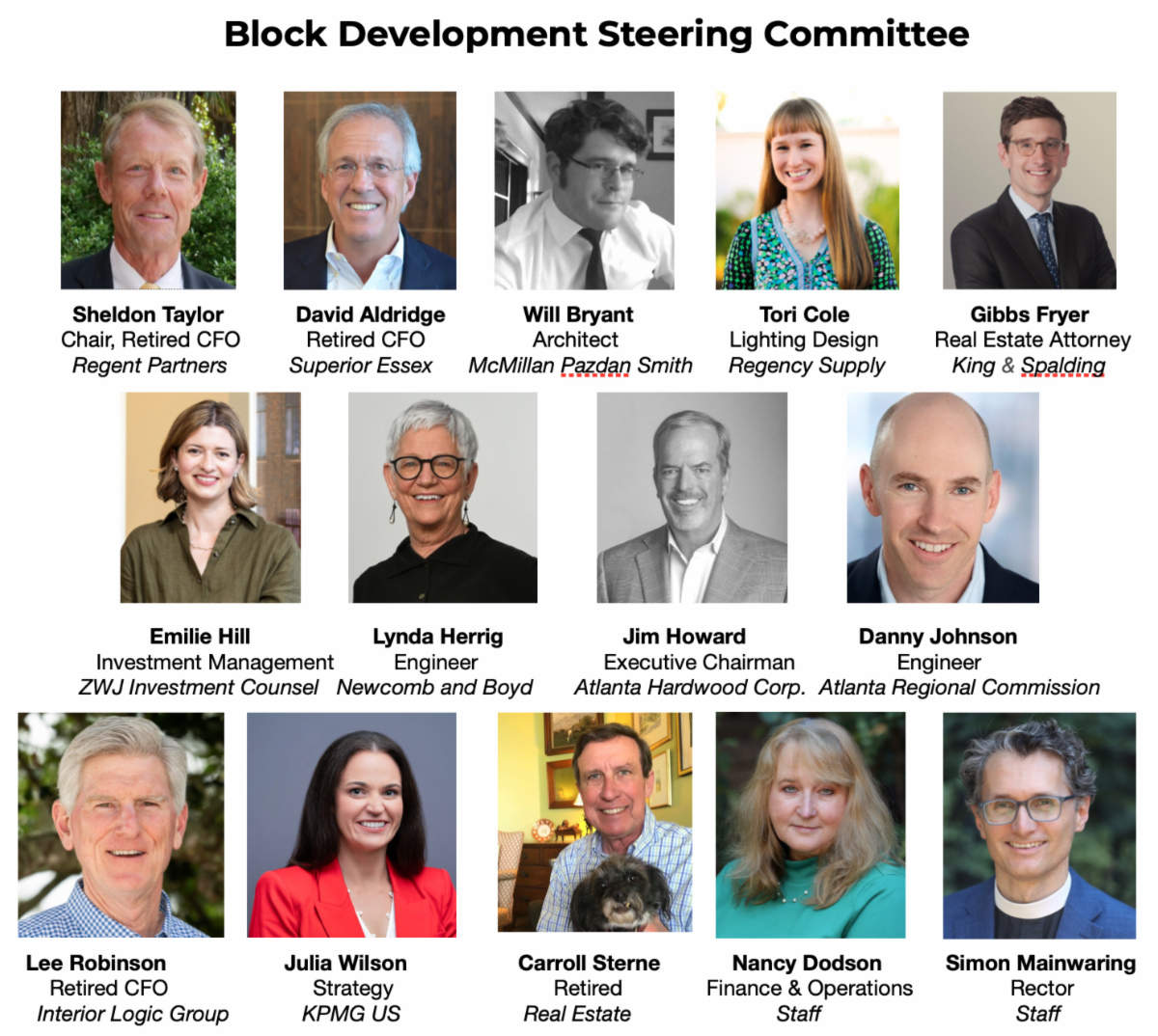
Tori Cole

Emilie Hill

Julia Wilson

Facebook  Instagram  YouTube