|
While many of the principles that make up our Multifamily Impact Framework™ are related to social concerns, a healthy environment is also fundamental to sustainability. As such, the importance of climate issues cannot be overemphasized as part of a well-rounded approach to multifamily impact investment.
When discussing the impact of multifamily properties on the environment, the topic of climate and resilience is a central component. In fact, many investors consider climate resilience – the ability to prepare for, recover from, and adapt to negative impacts on climate – to be the focus of their impact investment strategy.
| |
|
|
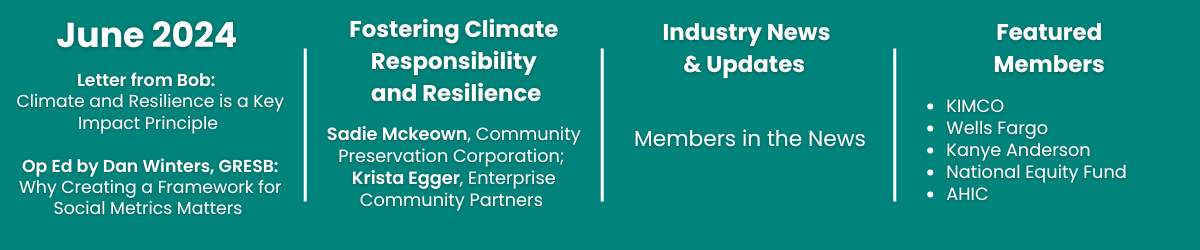
This is why we strive to provide you with best practices on climate and resilience from industry leaders, including the interview in this issue with Sadie Mckeown of Community Preservation Corporation (CPC) and Krista Egger of Enterprise Community Partners. Both organizations, which are MIC members, were recently awarded funding from the federal government to support green initiatives: CPC was a lead partner in Climate United, which received $7 billion, and Enterprise Community Partners received $2 billion. The interview discusses seminal points about climate and resilience and what multifamily stakeholders should know about this topic.
Our June issue also features a special op ed from Dan Winters of GRESB on the value of building out standardized metrics for social as well as environmental sustainability. With the wealth of information on quantifying progress on the environmental front, we can sometimes forget that social metrics are equally relevant to multifamily impact investors. I know you’ll find Dan’s insights on this topic enlightening and helpful.
On a related note, I’m excited to announce our newest collaboration with GRESB – the leader in ESG benchmarking for real estate and infrastructure investments across the world. This collaboration represents the growing interest of affordable and multifamily operators to participate in third-party benchmarking, and GRESB's appreciation for MIC and its valued members. And, this is just the start of deeper integration to come.
The collaboration will grant MIC members, who are first-time GRESB reporters, support as they begin their GRESB reporting journey. Reporting is due this year by July 1.
To take advantage of this amazing opportunity, please contact Rachel Mavrothalasitis at rachel@multifamilyimpactcouncil.org to learn more.
We look forward to continuing to support efforts to build transparency and advance our industry's outcomes, alongside valued collaborators, members, and peers!
Bob Simpson
President and CEO
| | |
|
|
When it comes to ESG, the “E” is easiest to define: it’s about preserving the environment.
The “S,” which represents “social,” is more difficult to define. Multifamily real estate is squarely in the “S” business, delivering great places that enable people to thrive. However, it can be difficult to identify and track metrics that support the “S” – it’s why we sometimes refer to this component as “squishy.”
Social elements can appear rather subjective, making social impacts hard to track and quantify. Yet quantifying the “S” represents an important step forward for the industry – especially for impact investors – who are equally focused on “making a difference” while simultaneously achieving strong ROI.
| |
|
GRESB and MIC have taken a deep dive into determining relevant “S” metrics for multifamily investors – our collective members understand how critical it is to have a standard language for measuring social impact. With these standards, the industry can further advance by demonstrating that socially aware investing delivers superior human-based outcomes and makes a positive difference for investors’ portfolios. Without measurable metrics, investment professionals run the risk of “social washing” or “blue washing,” as Pension Real Estate Association (PREA) defines it: firms promoting themselves more socially conscious than they actually are.
In a white paper released by the PREA Social Impact Committee in December 2023 titled “What is the ‘S’ in ESG? A Guide for Real Estate Investors,” the organization presented some excellent viewpoints on creating metrics and a framework for socially aware investing. The paper asks and answers the question of why investors should care about the “S” in the first place: all real estate assets are, in some way, affected by social factors. Properties are more valuable if surrounded by vibrant communities, occupied by healthy and financially stable occupants, with attributes responsive to the needs of society. These important factors should be considered by all investors—not just by those self-described as “impact investors.”
PREA points out that socially aware investments are those that provide at-market, risk-adjusted financial performance as the primary goal along with additional metrics that reflect benefits to society. Pointedly, the paper emphasizes how impact investments don’t need to sacrifice financial performance to achieve social or environmental goals.
The details may vary, but for all investors the ultimate focus of socially aware investing remains financial performance via risk-adjusted returns. There are many additional advantages to socially aware investing, including risk mitigation, value creation, and accountability and compliance – all of which matter to investors regardless of their goals.
As ESG evolves, guidelines and standards on incorporating the “S” alongside financial performance metrics will continue to refine by property sector. MIC’s Multifamily Impact Framework™ represents a great market advance – an outstanding tool designed to help multifamily property investors determine the best course of action for delivering social impact.
Dan Winters, CRE
Senior Director
GRESB
| |
Sadie Mckeown, President, Community Preservation Corporation
| | |
|
Sadie Mckeown leads the development and implementation of CPC’s growth strategy and oversees all the company’s field offices, initiatives, and its equity and impact investing platforms. She has overseen the development of numerous guides, tools, and case studies to help lenders, owners, and developers understand the benefits of energy-efficient construction and retrofits, including CPC’s “Underwriting Efficiency Handbook” and its companion guide titled “Financing High-Performance” which focus on guiding lenders and developers through the underwriting of efficiency methodology for both retrofit and new construction projects. | |
Krista Egger, Vice President of Building Resilient Futures, Enterprise Community Partners
| |
Krista Egger manages national sustainability efforts, including the Enterprise Green Communities Criteria, the nation’s only national green building program designed explicitly for green affordable housing construction. She has more than 15 years of experience leading energy efficiency and healthy housing initiatives with affordable housing stakeholders, including leading the technical development and public roll-out of the 2015 and 2020 Enterprise Green Communities Criteria and providing strategic oversight for its certification program and Health Action Plan framework, which pairs public health professionals with affordable housing development teams. | |
|
Your organizations recently received funding from the Administration for green initiatives. Tell us about these initiatives and why you believe the funding was so critical. | |
|
Krista Egger: Power Forward Communities – the coalition that Enterprise co-leads with Habitat for Humanity International, the Local Initiatives Support Coalition (LISC), Rewiring America, and United Way Worldwide – received a $2 billion award from the Environmental Protection Agency’s National Clean Investment Fund. Through Power Forward Communities, we’ll make cleaner, more affordable homes possible through a combination of financing and technical assistance. That will allow us to drive down expenses for renters and housing providers, stabilizing housing costs.
Right now, a patchwork of state and local policies and incentives means an uncertain marketplace for contractors, electricians, and other industries that could help upgrade our homes. Small businesses need predictability and certainty to ensure they can keep the right equipment in stock, train workers, and plan for the future. Enterprise and Power Forward Communities will work with communities, local governments, homeowners, and property owners to aggregate demand and help business owners anticipate needs and reach the right customers at the right time. Our coordination efforts, investments, and technical support will help local businesses grow and help keep costs down, supporting job creation and economic growth in the evolving economy.
This funding made possible through this unprecedented award is critical because the nation’s chronic housing affordability crisis has transformed into an acute crisis afflicting all parts of the country. While prices have stabilized somewhat, low-income renters face persistently high costs – nearly half of all renter households spend over 30% of their income on rent. The share of renters facing severe cost burdens, spending more than half their income on rent, rose to over 26% in 2022.
With its national reach, our coalition will serve communities in big cities, small towns, Tribal areas, and rural communities. We’ll work to pinpoint areas of highest need, focusing our efforts on serving low-income families who otherwise might be left behind in the energy transition. Building on our decades of success partnering with rural, Tribal, and urban communities, Enterprise will work with partners in all pockets of the country to ensure no one is left behind and all households stand to benefit.
We are currently working with EPA to finalize our funding agreement and refine our strategy, with the goal to begin delivering resources to communities this fall. Folks can sign up for updates on the exciting work and opportunities ahead.
Sadie Mckeown: As members of the Climate United Coalition, CPC and nonprofit partners Calvert Impact and Self-Help are deploying a $7 billion award from the National Clean Investment Fund (NCIF), part of the EPA’s Greenhouse Gas Reduction Fund (GGRF), for a once-in-a-generation investment in reducing carbon pollution while building a stronger economy for all Americans.
Through its newly created subsidiary CPC Climate Capital, CPC will deploy $2.5 billion of the $7 billion award to decarbonize multifamily housing nationwide with a focus on low-income and disadvantaged communities and affordable housing.
The capital will support low-cost subordinate debt financing to increase proceeds for deep green decarbonization improvements for multifamily housing, while decreasing the overall cost of mortgage capital.
As Low Income and Disadvantaged Communities (LIDAC) disproportionately bear the effects of climate change, this work is an extension of CPC’s 50-year history of using our capital to address the most pressing challenges facing communities. At least 40% of investments through Climate United will be in LIDAC.
| |
Which green initiatives should multifamily owners and operators focus on regarding climate and resilience? | |
|
Krista Egger: One of EPA’s main goals with this funding is to drive towards zero emissions. That is not a term people talk about every day. So, it might be helpful to know that by reaching zero emissions, we mean three things: 1. It means being highly energy efficient, with which many building owners and operators do have experience. 2. It also means not using any fossil fuels on site. That means only paying an electric bill – no other fuels used on site. Building owners and operators can start to evaluate if anything that is not fueled by electricity on site could be. 3. Lastly, it means looking at the type of power you’re using for your electricity and making sure it’s clean and renewable, like solar.
As housing providers focus on emissions, it’s important to think about this work in the context of how these building upgrades may also present an opportunity to improve resident health outcomes. We want to be sure that in working to protect the environment, we also continue to find ways to create a healthy living environment for residents and communities. For example, when we rolled out the latest version of Enterprise’s Green Communities criteria, we collaborated with the International WELL Building Institute so that housing properties meeting our green building standard are now jointly certified under Green Communities and the WELL Building Standard.
Also key is identifying ways to use this influx of capital to really help housing providers solve for some of their hardest challenges. For example, we know that preservation of affordable housing is critical. Let’s look at opportunities to use building efficiency upgrades as part of a preservation strategy.
Sadie Mckeown: Multifamily owners and operators today should be focused on decarbonization, and decarbonization can’t be done alone. It must come in conjunction with deep energy efficiency to keep costs neutral or drive savings and preserve affordability in housing.
There are many opportunities in the Inflation Reduction Act to bring affordable onsite or community solar to projects to offset the increased electric costs and drive overall savings. Owners of portfolios should also be planning portfolio-wide to grow relationships with contractors and learn how to access incentives, credits, and low-interest capital to help with the costs.
| |
How can these stakeholders avoid potential pitfalls in this area? | |
|
Krista Egger: It’s so important not to skip the important step of connecting with communities to make sure their needs and aspirations are centered in decision-making. And when building upgrades are made, you also cannot bypass communicating with residents about new ways to interact with the building. For example, if folks haven’t used a heat pump or an induction stove before, spend the time to ensure they’re confident in how to operate these systems.
Enterprise partnered with the Housing Partnership Network and Rocky Mountain Institute to provide a roadmap of sorts to help housing providers navigate the transition to green energy. It’s called the Affordable Housing Decarbonization Hub. It features a wealth of resources available through a searchable library, news about funding and events, and an Ask the Expert feature that allows users to submit questions and get an answer from an expert in the field.
Sadie Mckeown: The best way to avoid pitfalls is to plan. An owner can’t wait until their heating and cooling system fails; they need to plan ahead to replace it at its useful life. If an owner wants to add solar, doing so along with a roof replacement is the best time. Benchmarking portfolios and properties for energy consumption will also help show where focus is needed. Driving efficiency, pursuing favorable capital sources and building relationships with vendors and contractors will certainly help avoid problems and pitfalls.
| |
Where do you see climate and resilience heading in the multifamily space? | |
|
Krista Egger: I’m hopeful that in the multifamily space we’re looking both at adaptation and mitigation together – so we’re considering how we can reduce emissions and make homes more resilient to the impacts of climate change. We’re starting to see that alignment more and more.
On my team, we often say that climate change is a threat multiplier, a risk that folks living in affordable housing face every day. As long as we’re incorporating that mindset and considering how climate impacts the decisions you make about preserving or constructing affordable housing, we will continue to move in the right direction.
Sadie Mckeown: The effects of climate change create uncertainties that could affect any property at any time, whether through fires, floods, sea-level rise, storms, etc. To protect our affordable housing nationally, resiliency needs to become a standard part of how we build new and redevelop existing affordable units.
So, federal and state housing quality standards need to address aspects of resiliency relevant to a particular multifamily property given its location and risk of climate impact.
| |
Anything else you would like to add? | |
Sadie Mckeown: Engaging private first mortgage capital is critical to driving decarbonization and electrification of multifamily housing. Unless and until first mortgage lenders begin to routinely incorporate these measures at the time of refinancing, we will never move the needle on decarbonization of the built environment. | |
|
The demand for multifamily impact investing is strong, and innovative individuals and organizations like the Multifamily Impact Council are stepping up to meet this need. If you haven’t yet done so, be sure to check out MIC’s Multifamily Impact Framework™, a market-based set of standards for multifamily industry impact principles and reporting guidelines. The framework is invaluable and available to download and adopt free of charge.
We’re proud to report that MIC recently held our Quarterly Impact Collaborative Call for Q1. The call provides an update on our members’ activity in the impact investing space and where this sector is heading. The recording of this call is now available. To receive this recording, please complete the form at https://multifamilyimpactcouncil.org/multifamily-impact-collaborative-call/.
|
|
Know someone who might be interested in this newsletter? Share it with them. |
|
©2024 LinkedIn Corporation, 1000 West Maude Avenue, Sunnyvale, CA 94085. LinkedIn and the LinkedIn logo are registered trademarks of LinkedIn. | | | | |