|
As we enjoy the warmth of summer and the long, sunny days, we also find ourselves preparing for the upcoming school year. This is a time of both relaxation and anticipation, a moment to reflect on our achievements and plan for the future.
At the Community Foundation of Northwest Mississippi, we're committed to fostering a healthy vision for the future of our community. This month, we're excited to share updates, educational insights, and opportunities to get involved in your community.
| |
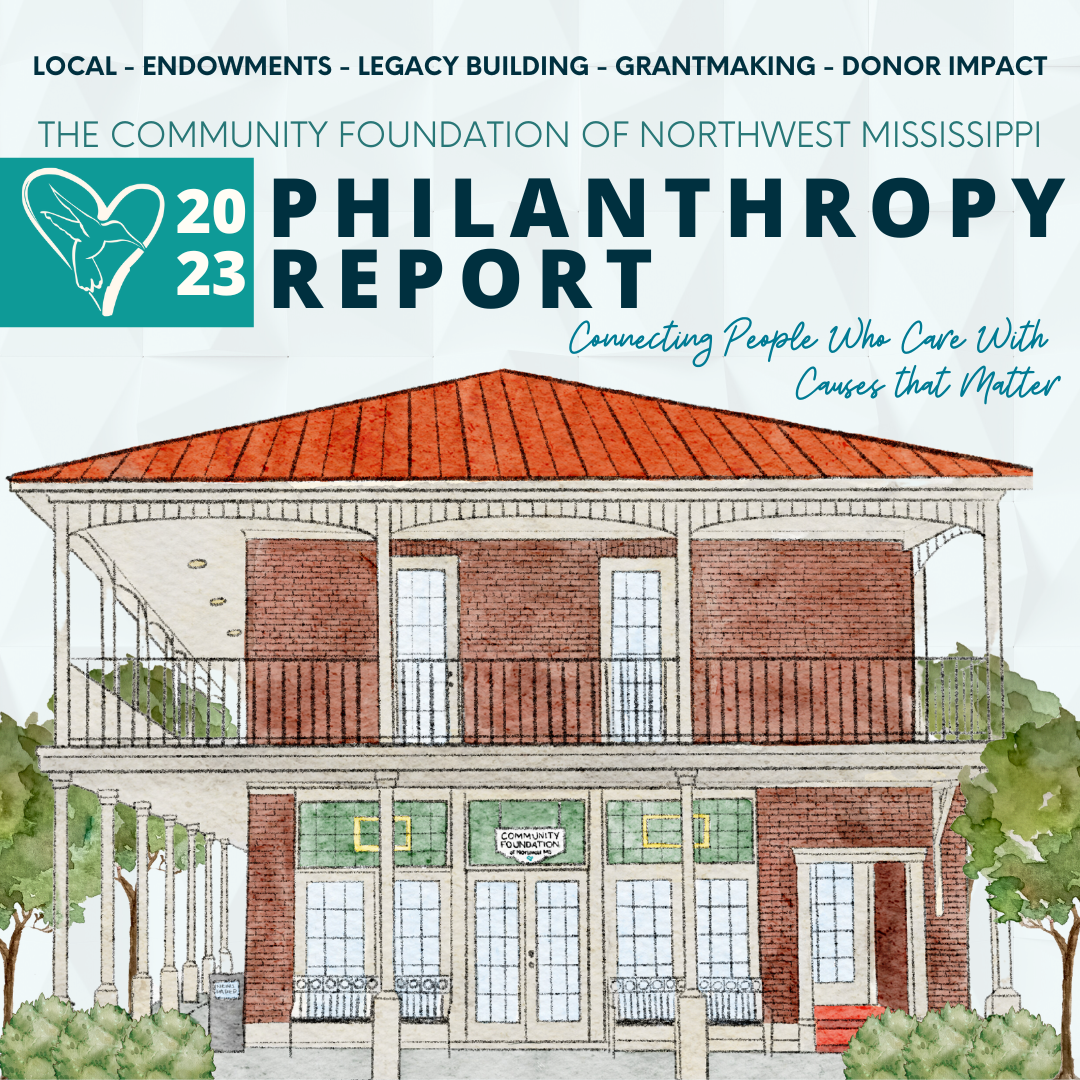
Our 2023 Philanthropy Report is Here! | |
Explore the Community Foundation of Northwest Mississippi's impact in 2023 through our latest philanthropy report. Our mission, "Connecting People Who Care with Causes That Matter," drives our efforts. This report highlights the projects and initiatives we've supported, showcasing the connections and positive changes made possible by our dedicated donors and partners. | |
|
The summer months are a great time to regroup with your family about your charitable giving plans and ensure that you’re coordinating with your advisors to accomplish key estate and financial planning priorities before the year-end rush.
Here are a few topics that tend to be popular as we head into the second half of the year:
- Whether you’ve been involved in philanthropy for many years or you're just starting out on your charitable giving journey, you’ve likely noticed that there are many, many ways to support the causes you love. The Community Foundation can help you evaluate various giving vehicles based on your own “charitable giving personality type.”
-
The team at the Community Foundation wants to help you help your advisors stay up to date on legal and tax developments that might impact the charitable giving components in your estate and financial plan. We’re happy to offer tips and reading material to share with your attorneys, accountants, and financial advisors, and our team is always available to join a discussion.
- Whether you’ve already established a donor-advised or other type of fund at the Community Foundation, arranged for a bequest to the Community Foundation, or are currently evaluating whether to work with the Community Foundation, we are here for you! Please reach out any time to review your charitable plans. We’re here to help you make a difference in our region and support local nonprofits that are working every day to improve the quality of life for so many people. Thank you for the opportunity to work together!
| |
Up In The Air: Charitable Planning in a Shifting Tax Landscape | |
|
It’s an election year, which means you may have more questions than answers as you work with your advisors to build out your financial and estate plans. In particular, the looming sunset of key provisions of the Tax Cuts and Jobs Act (TCJA) of 2017 has created a tremendous amount of ambiguity.
For many taxpayers, the potential sunset of the TCJA’s higher estate tax exemption is top of mind. Unless Congress intervenes, the exemption is set to fall after December 31, 2025, from roughly $27 million per couple to approximately $14 million per couple (depending on inflation adjustments).
No one has a crystal ball, and it is impossible to know whether or when you should implement planning strategies to address potential changes in the law. Nevertheless, if you are among those who would be affected by the estate tax exemption’s precipitous drop, it’s important to know that charitable strategies can fit nicely into a gifting plan that would help offset the sunset’s impact.
If you’re a business owner, for example, you could explore launching a gifting program now to transfer shares of the business not only to your heirs to take advantage of the higher exemption, but also to a donor-advised or other fund at the Community Foundation. With these gifts, you could reduce the value of your taxable estate while also executing a business transition and philanthropy plan that aligns with your overall intentions regardless of the tax laws.
Along those lines, some families may decide to lean into annual exclusion gifts ($18,000 per gifting spouse per recipient in 2024) to family members and other individuals to reduce taxable estates without eating into the lifetime gift and estate tax exemptions.
If you’re considering ramping up your annual exclusion gifts, you might consider adopting a parallel strategy for charitable gifts. Gifts to charities are deductible for gift and estate tax purposes (as well as for income tax purposes) and therefore will also reduce the value of your taxable estate without using your exemption. Some philanthropists report that they like the idea of making annual exclusion gifts to family members, and, while they’re at it, making stock gifts of an equal amount into a donor-advised fund at the Community Foundation.
Given the uncertainty about what might happen with the estate tax exemption, some people are updating their estate plans to increase a bequest to a donor-advised or other fund at the Community Foundation. This would help blunt the impact of estate taxes, and the bequest can be adjusted during lifetime as planning goals and estate tax laws evolve.
| |
Philanthropy: It’s not one size fits all | |
|
Charitable giving traditions are a big part of many peoples’ lives. The ways philanthropic values translate into action and behavior, however, vary widely from person to person. And that’s a good thing! When you align your charitable giving activities with your own personality, the results yield more enjoyment and possibly more involvement in your favorite cause.
The causes you support may be based on personal experiences. You may also find that philanthropy fosters personal growth and self-discovery. Some people find that getting involved in the community creates opportunities for networking and building relationships based on shared values and goals.
That’s why it’s important to acknowledge that not everyone likes to “do good” in exactly the same way. To figure out what mix of charitable activities might best suit you, consider reflecting on whether you tend toward an "investor,” “connector” or “activator” profile.
| |
Investor type of philanthropist: | |
- You like to get involved in community activities where you can act independently, rather than scheduling dedicated time.
- You may feel that you often have more money than time.
- You’re happy to write a check or purchase a product that supports a cause.
| |
Connector type of philanthropist: | |
- You like community activities where you can collaborate with friends and family.
- You enjoy the opportunity to meet people who care about a variety of causes, not necessarily a specific charity.
- You like attending charities’ fundraising events, and you might even regularly promote your favorite causes on social media.
| |
Activator type of philanthropist: | |
- Your philanthropic passion lies with one or two specific causes.
- You like the idea of playing a small part in “changing the world” and impacting a single issue that could potentially benefit society on a broad scale.
- You might enjoy serving on charities’ boards of directors.
| |
Planning for a Sunset: Lock in a high exemption, unlock a legacy | |
|
Without legislation to prevent it, the sunsetting of current estate tax laws at the end of 2025 will dramatically reduce the federal estate tax exemption from $13.61 million per person in 2024 to approximately $7 million in 2026 (this includes adjustments for inflation). This change would affect many high net-worth individuals and families, likely exposing many more estates to federal estate taxes.
It is impossible to predict whether or not legislation will prevent the sunset. Even so, it is important for donors to talk to their advisors to prepare and consider estate planning strategies now, especially techniques that incorporate multi-generational gifts and charitable planning.
Donors who are charitably inclined, making larger lifetime gifts to charity and arranging for charitable bequests will help reduce the taxable estate because of the charitable estate and gift tax deduction. Donor-advised, field-of-interest, designated, and unrestricted funds at the Community Foundation are flexible and effective charitable recipients of both lifetime and estate gifts.
For some donors, they may wish to begin exploring a comprehensive, multi-generational wealth transfer plan, potentially using key tax-planning vehicles:
| |
Charitable lead trusts (CLTs) may be particularly effective in the current environment. These trusts can provide income to your client’s fund at the Community Foundation for a set period of time, with the remaining assets passing to family members. Right now, the higher exemption allows for potentially significant initial funding of such trusts. This is because the value of the remainder interest counts toward the client’s estate and gift tax exemption. | |
Generation-Skipping Trust | |
A generation-skipping trust is an irrevocable trust that can benefit the donor’s grandchildren and later generations. This trust utilizes a donor’s generation-skipping transfer (GST) tax exemption (which parallels the estate and gift tax exemption). This type of trust could allow a client to take advantage of the higher exemption before it potentially decreases in 2026. It is possible under some states’ laws for these trusts to go on for many generations in a “dynasty” format, such that each generation benefits from the trust’s income (and potentially principal for health and education) without the trust’s assets being included in the beneficiaries’ estates for estate tax purposes. | |
Multi-Generational Fund at The Community Foundation | |
Alongside a charitable lead trust or generation-skipping trust, or as a standalone, a donor can establish a donor-advised fund at the Community Foundation that can function much like a family foundation, with successive generations serving as advisors, or the Community Foundation stepping in after the first or second generation, to recommend grants from the fund to carry on a tradition of supporting the causes that have been most important to the donor during their lifetime. | |
|
The ENDOW Mississippi state income tax credit applies only to gifts made to new or existing endowment funds at the Community Foundation.
Minimum gift is $1,000 ($250 tax credit) Maximum gift is $500,000 ($125,000 tax credit) Deadline to submit application is September 30, 2024.
The allocation is limited per year on a first come-first service basis. Additional allocations may be available after October 1, 2024 but are not guaranteed.
| |
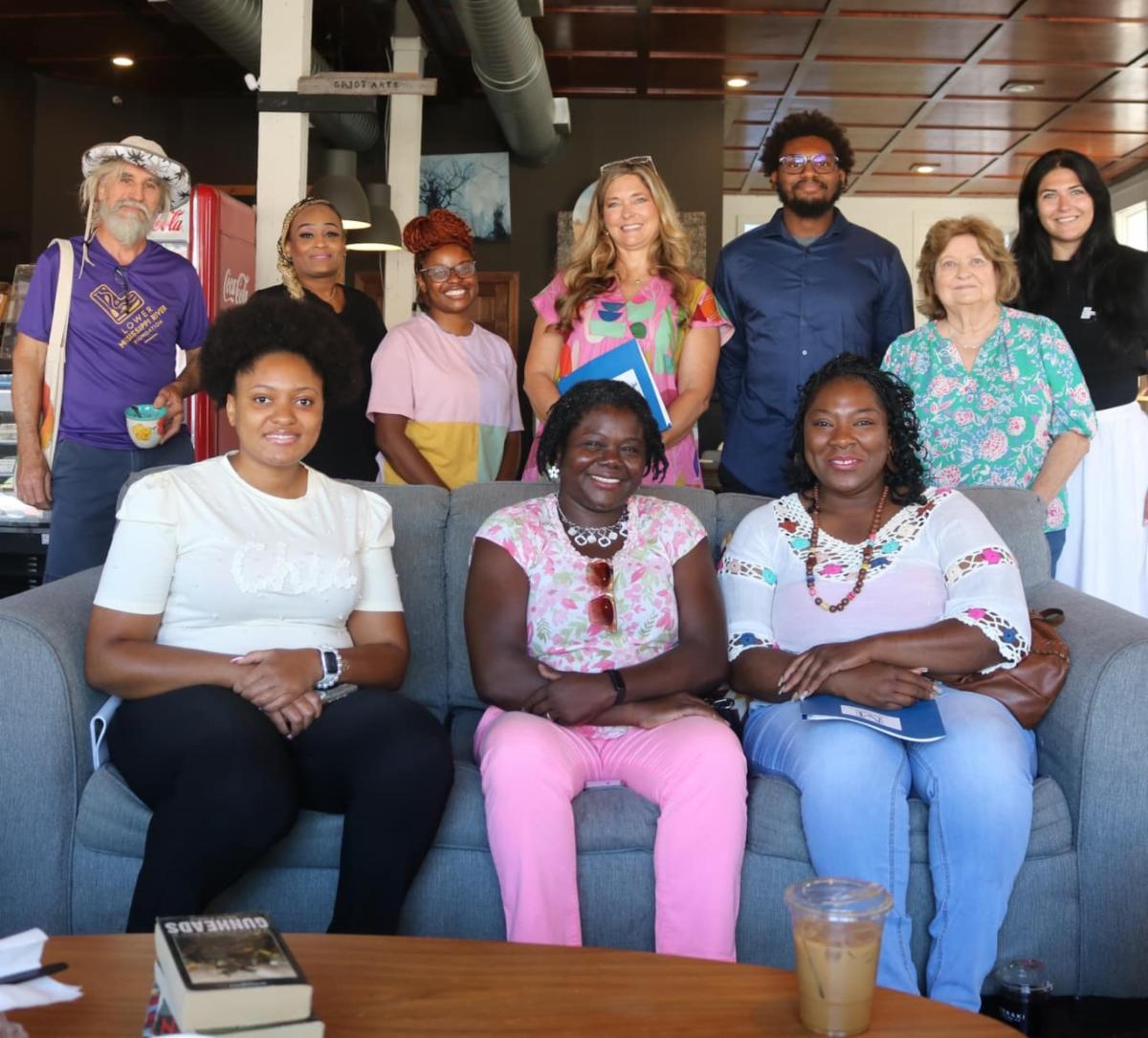
June Coffee & Conversations | |
Clarksdale, MS: Held at Griot Arts on 6/13/2024 | |
|
These gatherings provided a platform for attendees to discuss the pressing needs of their counties and share the impactful ways their organizations have been supporting the community. Aimed at fostering connections between nonprofits, the event series is designed to increase awareness of the services available in our service region.
Stay tuned for more Coffee & Conversation Events listed below in our upcoming events. To RSVP or find out more, please contact Brenda Smith or Kara Dulaney.
| |
J's Grocery Groundbreaking | |
|
Staff attended the Groundbreaking for J's Grocery Sin Clarksdale, MS on May 3rd. (L-R Kara Dulaney, Keith Fulcher, Natalie Minton, Jillian Morrison, and Brenda Smith.)
Partnership for a Healthier America is collaborating with J’s Grocery, a local store in Clarksdale, MS, to enhance the availability of fresh produce in the Brickyard neighborhood. This project, supported by Novo Nordisk and completed with Kudzu Collective and Griot Arts Inc., involves store renovations and improved access to healthy food options.
Additionally, Clarksdale received a $25,000 Asphalt Art Grant from Bloomberg Philanthropies to enhance public spaces and walkability around J’s Grocery. This art-driven initiative aims to connect the store with nearby schools, fostering community engagement and promoting health.
The combined efforts of these projects aim to support local economic development and drive positive change in the community food system of the Mississippi Delta. For more information, visit https://rootswell.org/
The renovations have been spearheaded by public policy scholar Tyler Yarbrough, Manager of Mississippi Delta Programs at Partnership for a Healthier America, and his dedicated team.
| |
Greenwood Mentoring Group | |
|
On Saturday May 4th, the Greenwood Mentoring Group held its 18th annual prayer breakfast at the Leflore County Civic Center. Stacye Trout, Kara Dulaney, and Brenda Smith are presenting a check to Bill Clay with the GMG to provide healthy snacks for upcoming youth programs daily for the neighborhood youth they serve.
Think about supporting GMG forever by starting an endowment for them.
| |
|
Will Brown, a Board Member of the Community Foundation, presented this year's Wesley Williamson Memorial Scholarship to Isabella Fleer.
Pictured above (L-R) are Wesley's parents, Wayne and Jane Williamson; Isabella Fleer; Ireland Little; Will Brown; and MaryAddyson Harville. This scholarship was established by Kudzu Playhouse in memory of Wesley Williamson.
| |
Hunger Summit Mini Session on May 15th | | | | |