Applications open for free shade trees, February 1-8
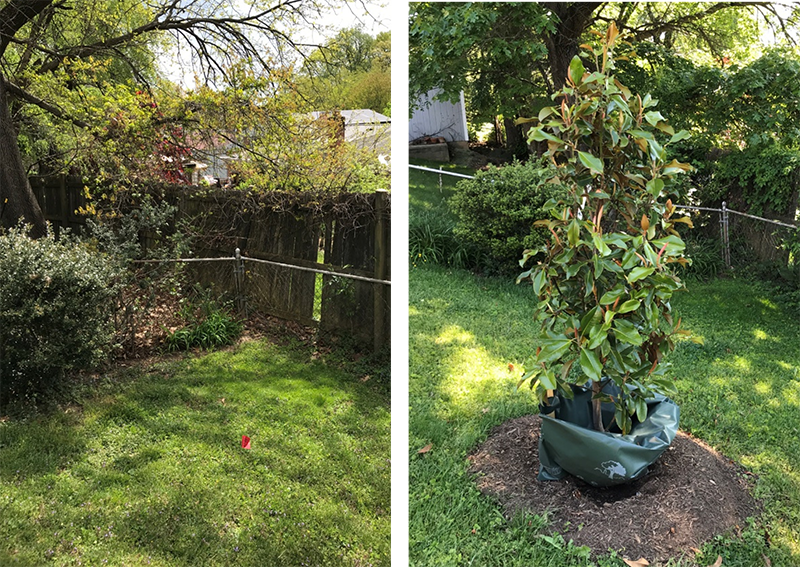
Applications for free shade trees for our Fall 2025 planting season will be open from this Saturday, February 1 to Saturday, February 8. As with our most recent application periods, preference will be given to properties in the county’s Equity Focus Areas and the remaining slots will be filled using a random drawing. Read more about our application process, and learn about the county’s Equity Focus Areas.
Check to see if your property is eligible, and apply here. Only one application per address or HOA common property will be considered. If you applied for a previous planting season and we were unable to accept your application, you will need to reapply this season for your application to be considered for Fall 2025. Applications received before February 1 or after February 8 will not be considered.
After you apply, our team will tell you if your application is accepted by the end of February. If your application is accepted, we will reach out to schedule an initial site visit to your property to observe site conditions and make recommendations.
Questions about this or any of our other Reforest Montgomery programs? You can reach our team at reforest@montgomeryplanning.org.
|
Invasives to Know: Mimosa (or Silk) Tree (Albizia julibrissin)
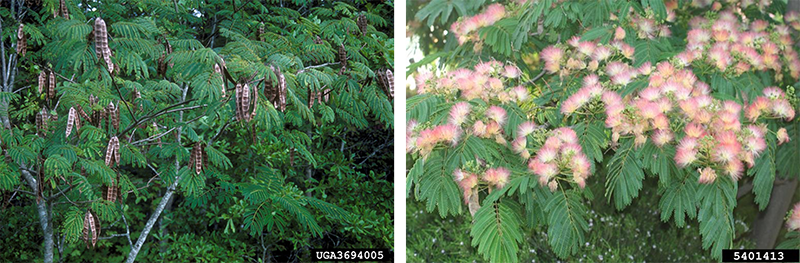
First introduced in the United States in 1745, the mimosa tree is a small to medium-sized flowering, deciduous tree that is fast-growing and relatively short-lived. The flowers of this tree are fragrant, and resemble pink pompoms made of silky threads. Mimosa trees are commonly found along roadsides, vacant lots, clearings, or flood plain areas. The height of the tree can range from 10 to 50 feet. The fruits of this tree are flattened legumes that contain seeds that can be toxic to dogs and livestock when ingested because they contain a neurotoxin.
Mimosa trees produce abundant seeds and grow rapidly. This causes competition with native trees and plants for resources (sun, water, nutrients). As a legume, this tree can “fix” nitrogen from the atmosphere and change the soil’s nutrient composition. While increasing nitrogen levels of the soil might be a good thing in specific, controlled settings, this can cause harm to many already-established native species that have adapted to grow in nutrient-poor soils. This type of invasive tree is also extremely susceptible to a disease called Fusarium wilt which can kill trees completely to the ground. Upon the death of the central tree, dozens of mimosa sprouts pop up from the roots which can be extremely difficult to control.
To get rid of a mimosa tree, cut down the tree down to a stump. To prevent the tree from re-sprouting, you can drill large holes into the stump and any of its roots that are visible. Fill these holes with Epsom or rock salt, and pour a little bit of water on top of the salt. After, cover the salted roots and stump with a tarp to prevent the salt being rinsed away by rain. To keep a mimosa tree from returning, repeat these steps every few weeks. It is important to use salt in moderation and be careful of it getting onto other nearby plants as salt is damaging to their root systems.
| |
Images courtesy of James R. Allison, Georgia Department of Natural Resources (left) and Lesley Ingram (right), both via Bugwood.org | |
Winter Tree Care
Winter is an important time to care for young trees. Here’s a list of tips from the International Society of Arboriculture:
- Add a thin layer of hardwood mulch in a ring or donut shape around the base of the tree to insulate the roots.
- Continue to water trees if the temperature is over 40 degrees Fahrenheit and the ground is not frozen.
-
Check your trees for pruning needs. Winter dormancy is the best time to prune your trees and will encourage a burst of new growth in the spring. It is also easier to identify dead, damaged, or poorly located branches that need pruning when deciduous trees are bare. Be sure to prune only when necessary and remove no more than a quarter of the tree’s canopy at a time. If you are unsure whether your tree needs pruning, contact an International Society of Arboriculture (ISA) Certified Arborist.
- Clear snow from branches to make sure they aren’t weighed down or broken.
- Keep salt away from the ground under the tree’s canopy. Salt can damage roots and prevent them from absorbing water.
| |
Solicitudes abiertas para árboles de sombra gratuitos del 1 al 8 de febrero
Las solicitudes de árboles de sombra gratuitos para nuestra temporada de plantación del otoño de 2025 estarán abiertas desde este sábado 1 de febrero hasta el sábado 8 de febrero. Al igual que con nuestro período de solicitud más reciente, se dará preferencia a las propiedades en las áreas de enfoque en la equidad del condado, y las parcelas restantes se cubrirán mediante un sorteo aleatorio. Obtenga más información sobre nuestro proceso de solicitud e infórmese sobre las Áreas de enfoque en la equidad del condado.
Verifique si su propiedad es elegible y presente su solicitud aquí. Solo se considerará una solicitud por dirección o propiedad común de la Asociación de Propietarios (HOA). Si presentó su solicitud para una temporada de plantación anterior y no pudimos aceptar su solicitud, deberá volver a presentar la solicitud para esta temporada para que su solicitud sea considerada para el otoño de 2025. No se considerarán las solicitudes recibidas antes del 1 de febrero o después del 8 de febrero.
Después de presentar la solicitud, nuestro equipo se pondrá en contacto con usted si la solicitud es aceptada antes de finales de febrero. Si su solicitud es aceptada, nos comunicaremos con usted para programar una visita inicial a su propiedad para observar las condiciones del sitio y hacer recomendaciones.
¿Tiene preguntas sobre este o cualquiera de nuestros otros programas de Reforest Montgomery? Puede ponerse en contacto con nuestro equipo en reforest@montgomeryplanning.org.
|
Reconocer invasores: árbol de mimosa (o árbol de la seda) (Albizia julibrissin)
Introducido por primera vez en los Estados Unidos en 1745, el árbol de mimosa es un árbol con floración, caducifolio, de tamaño pequeño a mediano que crece rápidamente y tiene una vida relativamente corta. Las flores de este árbol son fragantes y se asemejan a pompones rosados hechos de hilos sedosos. Los árboles de mimosa se encuentran comúnmente bordes de carreteras, terrenos baldíos, descampados o llanuras aluviales. La altura del árbol puede variar de 10 a 50 pies. Las frutas de este árbol son legumbres aplanadas que contienen semillas que pueden ser tóxicas para los perros y el ganado cuando se ingieren porque contienen una neurotoxina.
Los árboles de mimosa producen abundantes semillas y crecen rápidamente. Esto provoca competencia con árboles y plantas nativos por los recursos (sol, agua, nutrientes). Como legumbre, este árbol puede “fijar” nitrógeno de la atmósfera y cambiar la composición de nutrientes del suelo. Si bien aumentar los niveles de nitrógeno del suelo puede ser algo bueno en entornos específicos y controlados, esto puede causar daño a muchas especies nativas ya establecidas que se han adaptado para crecer en suelos pobres en nutrientes. Este tipo de árbol invasivo también es extremadamente susceptible a una enfermedad llamada marchitamiento por Fusarium que puede acabar con los árboles completamente hasta el suelo. Tras la muerte del árbol central, decenas de brotes de mimosa emergen de las raíces, lo que puede ser extremadamente difícil de controlar.
Para deshacerse de un árbol de mimosa, corte el árbol hasta un tocón. Para evitar que el árbol vuelva a brotar, puede perforar orificios grandes en el tocón y en cualquiera de sus raíces que sean visibles. Llene estos orificios con Epsom o sal de roca y vierta un poco de agua sobre la sal. Después, cubra las raíces saladas y el tocón con una lona para evitar que la sal se diluya con la lluvia. Para evitar que un árbol de mimosa vuelva a crecer, repita estos pasos cada algunas semanas. Es importante usar la sal con moderación y tener cuidado de que no llegue a otras plantas cercanas, ya que la sal es perjudicial para sus sistemas radiculares.
| |
Imágenes cortesía de James R. Allison, Departamento de Recursos Naturales de Georgia (izquierda) y Lesley Ingram (derecha), ambas a través de Bugwood.org | |
Cuidado de árboles en invierno
El invierno es un momento importante para cuidar los árboles jóvenes. Esta es una lista de consejos de la Sociedad Internacional de Arboricultura:
- Agregue una capa delgada de composta de madera dura en forma de anillo o rosquilla alrededor de la base del árbol para aislar las raíces.
- Continúe regando los árboles si la temperatura es superior a 40 grados Fahrenheit y el suelo no está congelado.
-
Revise sus árboles para ver si necesitan poda. La latencia invernal es el mejor momento para podar sus árboles y fomentará una explosión de nuevo crecimiento en la primavera. También es más fácil identificar ramas muertas, dañadas o mal ubicadas que necesitan poda cuando los árboles caducifolios están podados. Asegúrese de podar solo cuando sea necesario y retire no más de un cuarto de la copa del árbol a la vez. Si no está seguro de si su árbol necesita poda, comuníquese con un arborista certificado de la Sociedad Internacional de Arboricultura (International Society of Arboriculture, ISA).
- Despeje la nieve de las ramas para asegurarse de que no estén ahogadas ni rotas.
- Mantenga la sal alejada del suelo debajo de la copa del árbol. La sal puede dañar a las raíces y evitar que absorban agua.
| |
|
About Reforest Montgomery
Reforest Montgomery, supported by the Forest Conservation Fund, plants trees and forests throughout Montgomery County. This program offers residents a variety of options to get involved with reforestation programs in Montgomery County and provides property owners incentives to plant trees within the county such as free trees and reforestation for property owners, discounts on native trees, and more.
| | | | |