July 2024

Applications open for free shade trees August 1-8


The application period to get free shade trees has changed dates! Applications for our spring 2025 planting season will be open from this Thursday, August 1 to Thursday, August 8. As with our most recent application period, preference will be given to properties in the county’s Equity Focus Areas, and the remaining slots will be filled using a random drawing. Check to see if your property is eligible and apply. Learn about the county’s Equity Focus Areas.


Only one application per address or HOA common property will be considered. If you applied for a previous planting season and we were unable to accept your application, you will need to reapply for your application to be considered for spring 2025. Applications received before August 1 or after August 8 will not be considered.


Our team will tell you if your application is accepted by the end of August. If your application is accepted, we will reach out to schedule an initial site visit to your property to observe site conditions and make recommendations.

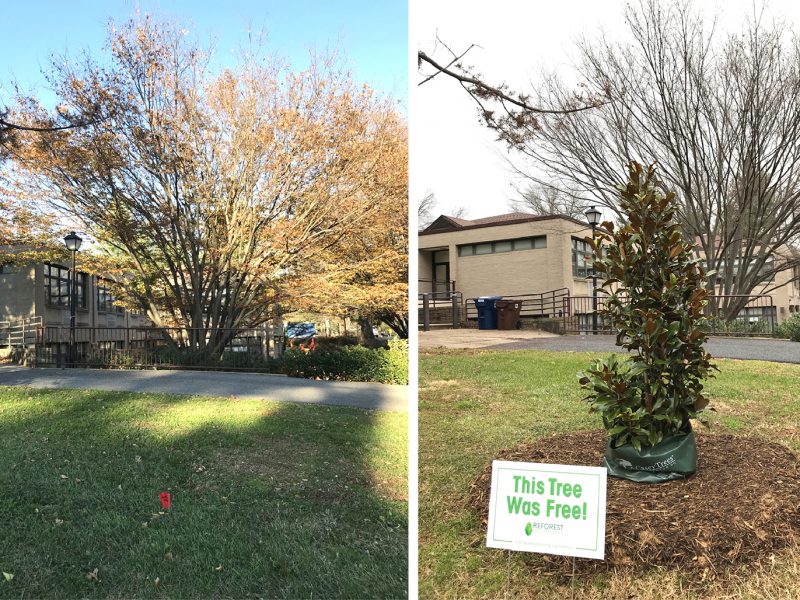
Before and after photos of a previously open area later filled by a newly planted Southern magnolia that now adds privacy between a driveway and a busy road.

The Power of Forests: Cooling down cities

Cool City Streets & Air

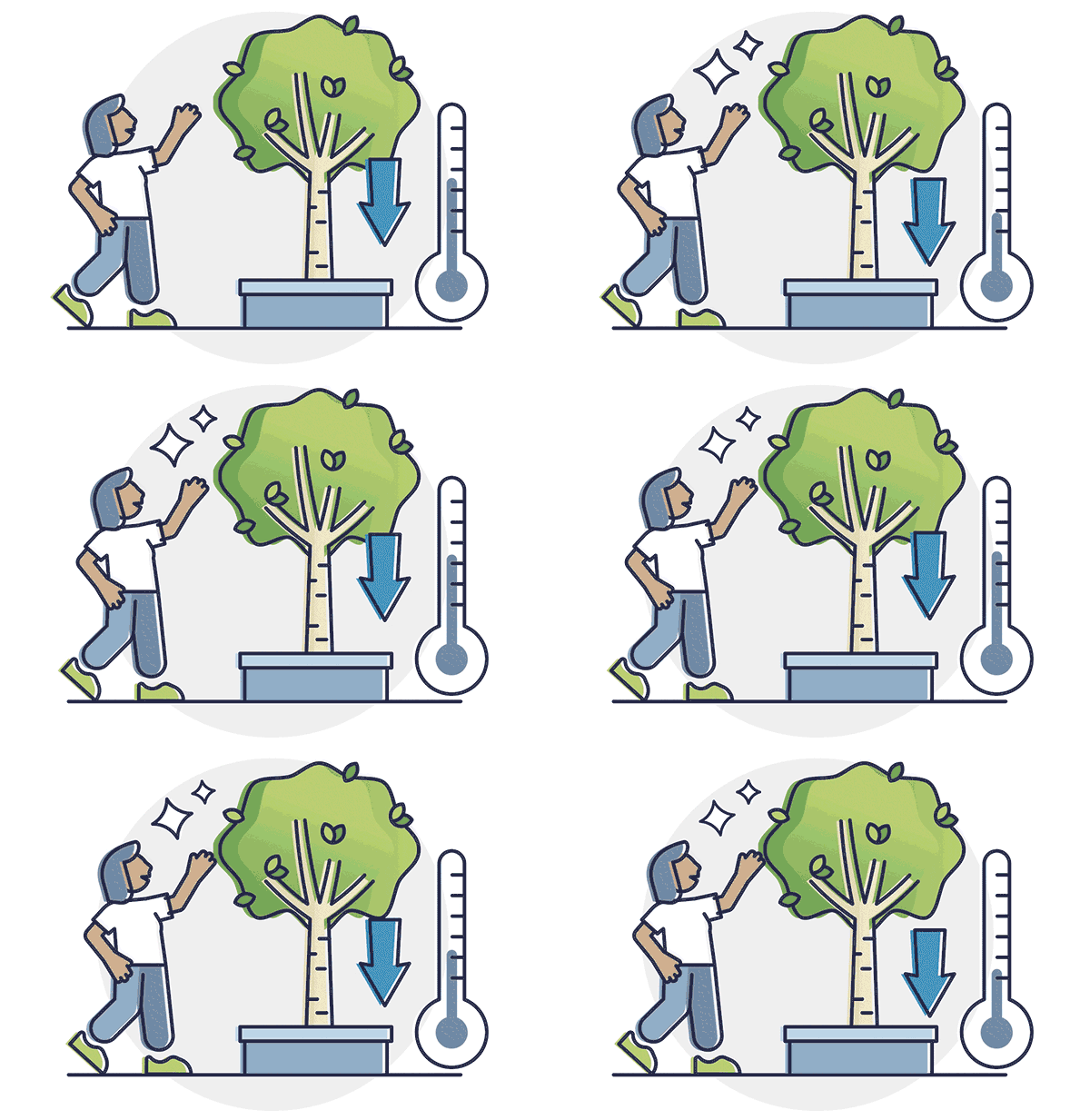
A person is cooled by a nearby tree.

Trees can cool city streets 2-4 °F, reducing deaths from heat and cutting energy use.

Urban areas nationwide are getting hotter each summer. In particular, the southern and central portions of the county experience something called the Urban Heat Island Effect. Heat islands are areas that have higher temperatures than their surroundings. Human-made structures, such as roads and buildings, absorb heat from the sun and re-emit it. Conversely, forests and agricultural areas absorb this heat. Densely populated urban areas tend to be hotter than their rural counterparts.

Heat islands have a significant impact on human health and well-being. Vulnerable populations including children, older adults, and people without access to air conditioning face special risks. Higher temperatures also mean increased demand on our energy grid, further stressing our environment.


The good news is that our forests have a significant cooling effect. Trees cool cities in two ways—by shading human-built structures and through evapotranspiration. Impervious surfaces are areas that cannot absorb water (e.g. sidewalks and roads). Increasing our forested lands decreases impervious surfaces that absorb and re-emit heat. Trees absorb water and release it into the atmosphere. This process, evapotranspiration, can cool the surrounding air.   


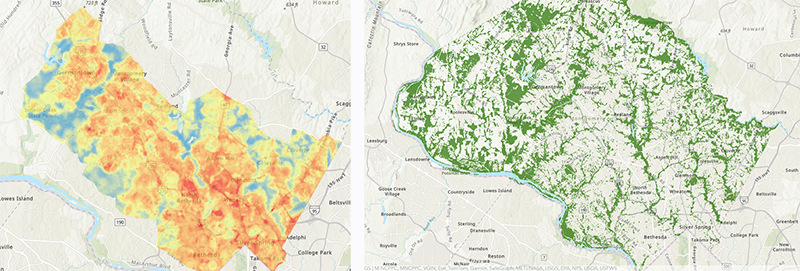
Consider the maps below. The map on the left is from a Montgomery County Community Science project in 2023 of temperatures at 7 p.m. on a given hot day. The map on the right shows tree canopy. As you can see, the areas with lower tree canopy tended to be hotter.

Two maps shown side-by-side: map showing temperature at 7 p.m. on left and map showing tree canopy coverage on right.

Visit the Reforest Montgomery website to learn more about how you can reduce heat in your community through our reforestation and planting programs. Applications for our free reforestation program are open year-round and, as mentioned above, applications for our free shade tree program open August 1. Montgomery County residents can use our $50 native tree coupon at any time.

Sign up for our weekly Watering Alert system


We offer helpful watering reminders through the Reforest Montgomery Water Alert. Alerts are sent weekly during periods of high heat and/or low rain. Sign up to receive watering reminders in your inbox!


It’s important to water your trees! Young or newly planted trees need at least 25 gallons of water each week, and it is vital that they receive water slowly for better absorption. Here are two methods for watering your young trees:


  • Leave your hose on a trickle or use the mist setting on your hose attachment. Place the hose at the base of the tree (under the tree’s canopy but not touching the tree’s trunk) for 1-2 hours, moving it around the base of the tree regularly.
  • Use a 15-25 gallon watering bag, which can be found at local nurseries or home improvement stores


To keep your young trees healthy and well-watered, use the hose method or fill a watering bag at least twice a week during the summer, especially when high temperatures are above 85 degrees Fahrenheit, and rain is infrequent.

Solicitudes abiertas para árboles de sombra gratuitos del 1 al 8 de agosto


¡El período de solicitud para obtener árboles de sombra gratuitos ha cambiado de fecha! Las solicitudes para nuestra temporada de plantación de la primavera de 2025 estarán abiertas desde este jueves 1 de agosto hasta el jueves 8 de agosto. Al igual que con nuestro período de solicitud más reciente, se dará preferencia a las propiedades en las áreas de enfoque equitativo del condado, y las vacantes restantes se cubrirán mediante un sorteo al azar. Verifique si su propiedad es elegible y envíe su solicitud. Aprenda sobre las áreas de enfoque equitativo del condado.


Se considerará solamente una solicitud por dirección o propiedad común de la HOA. Si se inscribió en una temporada de siembra anterior y no pudimos aceptar su solicitud, deberá volver a presentar su solicitud para ser considerada para la primavera de 2025. No se considerarán las solicitudes recibidas antes del 1 de agosto ni después del 8 de agosto.


Nuestro equipo le informará a fines de agosto si su solicitud es aceptada. Si es aceptada, nos comunicaremos con usted para programar una visita inicial a su propiedad para observar las condiciones del sitio y hacer recomendaciones.

Fotos de antes y después de un área al aire libre abierta y posteriormente con una magnolia sureña recién plantada que ahora agrega privacidad entre una entrada privada y una carretera concurrida.

El poder de los bosques: enfriar las ciudades

Calles y aire frescos en las ciudades


Una persona se refresca bajo un árbol cercano.

Los árboles pueden enfriar las calles de la ciudad entre 2 y 4 °F, lo que reduce las muertes por el calor y disminuye el uso de energía.

Las áreas urbanas de todo el país se están calentando más cada verano. En particular, las partes sur y central del condado experimentan algo llamado efecto isla de calor urbano. Las islas de calor son áreas que tienen temperaturas más altas que sus alrededores. Las estructuras hechas por el hombre, como carreteras y edificios, absorben el calor del sol y lo vuelven a emitir. Por el contrario, los bosques y las áreas agrícolas absorben este calor. Las áreas urbanas densamente pobladas tienden a ser más calientes que sus contrapartes rurales.


Las islas de calor tienen un impacto significativo en la salud y el bienestar humano. Los segmentos de la población vulnerables, incluidos los niños, los adultos mayores y las personas sin acceso al aire acondicionado, enfrentan riesgos especiales. Las temperaturas más altas también significan una mayor demanda en nuestra red de energía, lo que constituye una carga adicional para nuestro medio ambiente.


La buena noticia es que nuestros bosques tienen un efecto de enfriamiento significativo. Los árboles enfrían las ciudades de dos maneras: al brindar sombra en las estructuras construidas por el hombre y a través de la evapotranspiración. Las superficies impermeables son áreas que no pueden absorber agua (p. ej., aceras y carreteras). Aumentar nuestras tierras boscosas disminuye las superficies impermeables que absorben y reemiten el calor. Los árboles absorben agua y la liberan en la atmósfera. Este proceso, llamado evapotranspiración, puede enfriar el aire circundante. 


Examine los siguientes mapas. El mapa de la izquierda es de un proyecto de ciencias de Montgomery County Community que muestra la temperatura a las 7:00 p. m. en un día caluroso determinado en 2023. El mapa de la derecha muestra el dosel de árboles. Como puede ver, las áreas con menos dosel de árboles tendieron a ser más calientes.

Two maps shown side-by-side: map showing temperature at 7 p.m. on left and map showing tree canopy coverage on right.

Visite el sitio web de Reforest Montgomery para obtener más información sobre cómo puede reducir el calor en su comunidad a través de nuestros programas de reforestación y plantación. Las solicitudes para nuestro programa gratuito de reforestación están abiertas todo el año y, como se mencionó anteriormente, las solicitudes para nuestro programa de árboles de sombra gratuitos abrirán el 1 de agosto. Los residentes del condado de Montgomery pueden usar nuestro cupón de $50 para un árbol nativo en cualquier momento.

Inscríbase en nuestro sistema semanal de alertas de riego


Ofrecemos útiles recordatorios de riego a través de la alerta de agua de Reforest Montgomery. Las alertas se envían semanalmente durante períodos de mucho calor o poca lluvia. Regístrese para recibir recordatorios de riego en su bandeja de entrada


¡Es importante regar los árboles! Los árboles jóvenes o recién plantados necesitan al menos 25 galones de agua por semana, y es vital que reciban agua lentamente para una mejor absorción. Estos son dos métodos para regar sus árboles jóvenes:


  • Deje la manguera goteando o utilice el ajuste de llovizna en el accesorio de la manguera. Coloque la manguera en la base del árbol (debajo de la copa del árbol pero sin tocar el tronco) durante 1 a 2 horas, moviéndola alrededor de la base del árbol regularmente.
  • Utilice una bolsa de riego de 15 a 25 galones, que se puede encontrar en viveros locales o tiendas de mejoras para el hogar


Para mantener sus árboles jóvenes sanos y bien hidratados, utilice el método de manguera o llene una bolsa de riego al menos dos veces a la semana durante el verano, especialmente cuando las altas temperaturas están por encima de 85 grados Fahrenheit y la lluvia es poco frecuente.

Questions, comments?


Contact the Reforest Montgomery team:

301-495-4597

reforest@montgomeryplanning.org


Follow us: @montgomeryplans 

Like us: Facebook.com/montgomeryplanning

Meet us: Visit the Planning Department in Silver Spring or invite us to your meeting.

Learn more: www.montgomeryplanning.org  

Facebook  Twitter  Instagram  


About Reforest Montgomery


Reforest Montgomery, supported by the Forest Conservation Fund, plants trees and forests throughout Montgomery County. This program offers residents a variety of options to get involved with reforestation programs in Montgomery County and provides property owners incentives to plant trees within the county such as free trees and reforestation for property owners, discounts on native trees, and more.