|
Dear Clients and Friends,
As we approach the end of the year, I want to express my sincere gratitude for your partnership with FHC and your confidence in our team. Collaborating with you to advance health policy—to make health care better, cheaper, more accessible, and fairer—has been a pleasurable challenge, and together, we have achieved significant strides.
Thank you for choosing us to tackle your critical health policy issues. We are excited about the opportunities that 2025 brings and look forward to exploring innovative ways to amplify our collective impact and drive meaningful improvement.
As we enter this festive and contemplative season, I wish you and your family peace, joy, warmth, laughter, and well-deserved relaxation. Thank you for your continued dedication to better healthcare.
Warm regards,
John Freedman
CEO
| | |
Freedman HealthCare in 2024 | |
|
Best Practices in the Collection & Reporting of R&E, SOGI, and SDOH Data:
The FHC team met in Boston in November for its end-of-year onsite event. The event included a comprehensive session on best practices in collecting and reporting race and ethnicity, sexual orientation and gender identity (SOGI), and social determinants of health data (SDoH). FHC hosted three experts for this session, each focused on one of the three types of emerging data. Colin Planalp, Senior Research Fellow at the State Health Access Data Assistance Center, discussed the impact of new federal guidance on maintaining, collecting, and presenting race and ethnicity data. Sharon Ulery, Research Associate at HSRI, reviewed the terminology related to SOGI data, discussed how the information is currently collected, and offered considerations for sharing this information. Matthew Isiogu, Chief Revenue Officer at Contexture, focused on state use cases for SDoH data. Contexture is the health information exchange for Arizona and Colorado, which supports those states with SDoH data exchange. The three speakers also participated in a lively and thoughtful question-and-answer session with the FHC team. In follow-up conversations, the FHC team brainstormed opportunities to share what they learned with our clients and partners.
| |
Expanding Public Access to Health Care Quality and Cost Data | |
|
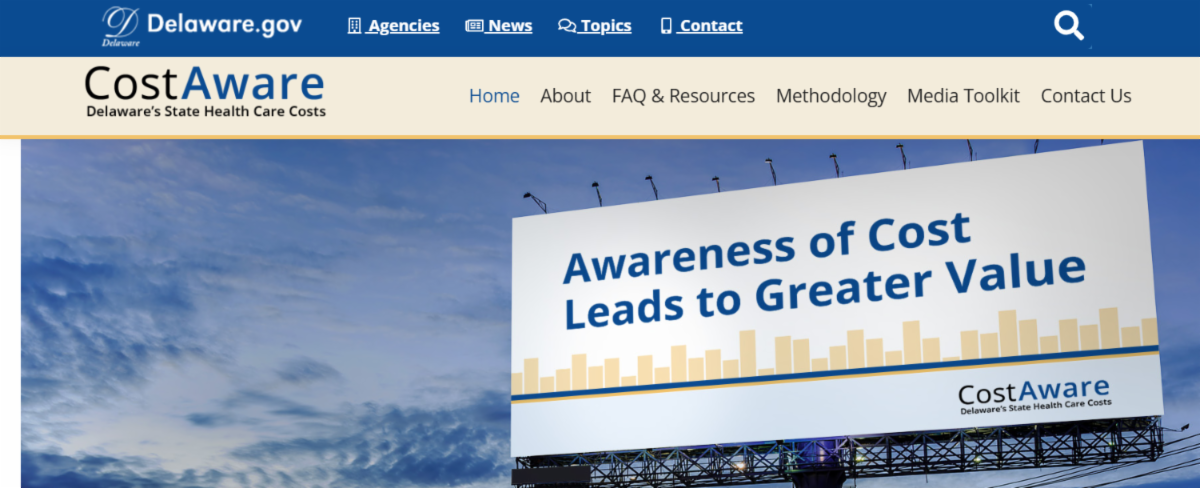
DE CostAware
Using APCD data managed by Delaware Health Information Network (DHIN), the FHC program and data science staff led the design and delivery of updated interactive healthcare cost and quality dashboards for CostAware, a website developed by the Delaware Health Care Commission and Department of Health and Social Services. This website, updated annually, includes dashboards comparing average cost and quality measures for common procedures and medical services to help consumers find high-value care, improve health outcomes, and foster collaboration among Delaware providers and health plans. Recent updates include enhanced reporting on brand and generic prescription drug costs, psychoses treatment, and cervical cancer screening rates.
| |
RI Cost Trends
Freedman HealthCare is proud to partner with Rhode Island’s Office of the Health Insurance Commissioner (OHIC) to provide analytic expertise in developing interactive dashboards that utilize HealthFacts RI, the RI All-Payer Claims Database (APCD). HealthFacts RI is jointly managed by the Executive Office of Health and Human Services (EOHHS), OHIC, and HealthSource RI, the state’s health insurance marketplace. These dashboards comprehensively view healthcare spending and utilization patterns across various service categories and demographic variables. They are designed to support providers, payers, purchasers, policymakers, and state residents seeking to drive improvements in healthcare affordability and accessibility in Rhode Island.
The dashboards provide insights into healthcare cost and utilization trends by payer type and service category, including hospital inpatient procedures, outpatient, emergency department and professional services, retail and medical pharmacy drugs, and behavioral and mental health services. The dashboards highlight critical cost drivers and deliver actionable insights that inform policies to enhance care access, improve cost efficiency, and promote a healthier Rhode Island. This initiative fosters a data-driven understanding of healthcare system performance and helps policymakers identify specific opportunities to improve access while controlling cost growth.
| |
Using Data to Track Payment Innovation | |
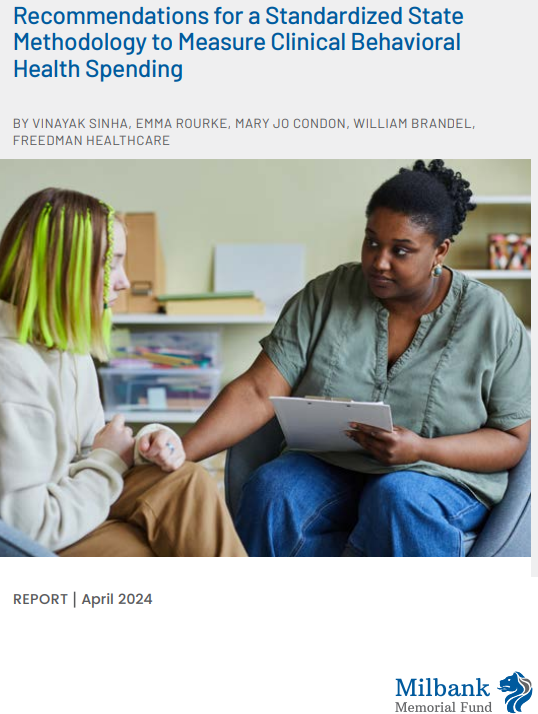
Standardized State Methodology to Measure Clinical Behavioral Health Spending
States are facing an unprecedented rise in the rates of behavioral health conditions such as depression, anxiety, and opioid addiction. To address this health crisis, officials are focused on identifying ways to improve access to high-quality behavioral health care. An early step is often defining and tracking how much it costs to treat behavioral health conditions. Today, 12 states measure how much payers spend on clinical care to treat behavioral health conditions, including three — Maine, Massachusetts, and Rhode Island — that measure these costs most comprehensively. The three states’ approaches to measurement are largely similar, using behavioral health diagnoses, procedures, and providers. Yet, there is still variation across state definitions.
A shared definition for behavioral health spending supports cross-state comparisons, streamlining data analysis and decision-making. This spring, the Milbank Memorial Fund published a report developed by FHC Senior Consultant Vinayak Sinha, Project Manager Emma Rourke, and Principal Consultant Mary Jo Condon, offering recommendations for this shared definition. The methodology is based on input from an Advisory Group of state behavioral health leaders and subject matter experts. The recommendations provide a framework for clinical behavioral health claims and non-claims spending, including an exhaustive code set. Following the publication of the report, FHC met with payers, state agencies, and national behavioral health measurement experts to discuss the implementation of this methodology, developing technical specifications and a policy brief based on these discussions.
| |
Expanded Non-Claims Payment Framework
FHC worked with states and national organizations to put to use the Expanded Non-Claims Payments Framework (Expanded Framework), developed with the California Department of Health Care Access and Information (HCAI) in 2023. In April, the National Association of Health Data Organizations (NAHDO) included the Expanded Framework in their national Non-Claims Payment (NCP) Data Layout to standardize the collection of non-claims payment data across the nation. FHC hosted a webinar with NAHDO to discuss details on the Expanded Framework, the use cases it supports, and the NCP Layout. In November, the Maryland Health Care Commission, with support from FHC, included a modified NCP Layout using the Expanded Framework in their Alternative Payment Model Adoption and Primary Care non-claims payment data collections for 2025.
| |
Alternative Payment Model Standards and Adoption Goals
FHC is excited about our work with the California Office of Health Care Affordability (OHCA) within the Department of Health Care Access and Information. FHC supports their work on Alternative Payment Models, Primary Care, Behavioral Health, and Hospital Spending.
In June, the California Health Care Affordability Board passed OHCA’s Alternative Payment Model Adoption goals through 2034, accompanied by a set of APM Standards to support healthcare entities in moving towards value-based care provided in APMs. The goals push healthcare payers to shift between 60-95% of members, depending on the payer and product type, from fee-for-service-based payments to APMs via advanced APM models linked to quality. The goals are accompanied by stakeholder-endorsed, first of their kind, APM Standards for payer and provider contracting focused on affordability, equity, transparency, and data sharing and analysis. The goals, in combination with the standards, seek to empower stakeholders to better align financial incentives for equitable, high-quality, and cost-efficient care.
In October, the California Health Care Affordability Board passed the highest Primary Care Investment Benchmark at 15% of total medical expenses! OHCA’s Primary Care Investment Benchmark works two-fold: It aims to have 15% of total medical expenses invested in primary care statewide by 2034, and it pushes payers to increase their investment by 0.5-1% of total medical expense each year from 2025 until they hit that 2034 benchmark. FHC is proud to have brought experience working with 11 states and national organizations on primary care investment to stakeholders in California to inform this trailblazing benchmark to revitalize primary care and improve patient care.
| |
North Carolina Primary Care Payment Reform Task Force
This spring, Freedman HealthCare supported the facilitation of North Carolina's Primary Care Payment Reform Task Force and helped develop a report to the Joint Legislative Oversight Committees on Health and Human Services and Medicaid. This report laid the groundwork for data-driven improvements in primary care across the state and offered key recommendations to strengthen primary care delivery and funding. The report reflects North Carolina's commitment to enhancing health outcomes and equity through improved primary care services.
FHC commends North Carolina for its dedication to improving health outcomes and equity through enhancing primary care services.
Explore the report and its strategic insights here.
| |
Massachusetts Primary Care Investment and Quality
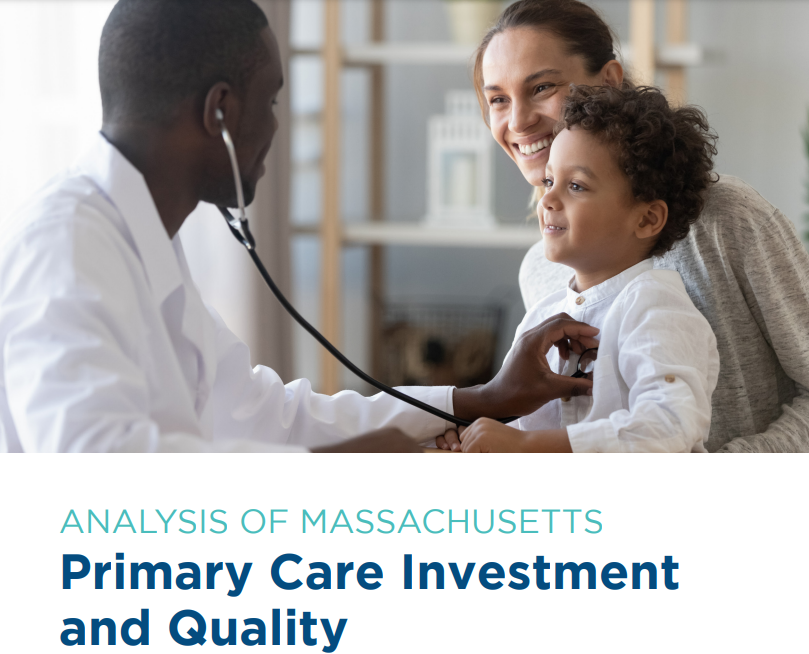
Published this summer with support from the Commonwealth Fund, FHC developed a new report examining primary care quality and spending among Massachusetts provider organizations. The report “An Analysis: Massachusetts Primary Care Investment and Quality” found that as primary care investment increases as a percentage of total spending, organizations performed significantly better on standardized quality measures and had significantly lower spending on inpatient and outpatient hospital services. It also found that these provider organizations did not have significantly higher total spending. This suggests that increased primary care spending did not lead to an increase in overall healthcare spending while also improving the quality of care. Read the full report at the Primary Care Collaborative.
| |
|
FHC has had an exciting 2024. We’ve taken on work in several new states, expanded our workforce by nearly 50%, and streamlined many of our internal operations. All this allowed us to serve the cause of improved health care better than ever.
In keeping with FHC’s tradition and in honor of our terrific clients, we support various charities that provide vital community services. For 2024, we have donated to:
Thank you for supporting us in our work, and best wishes for 2025.
| |
|
We extend our sincere gratitude for reading our newsletter. Your continued support and engagement are valuable to us. If you have any questions, please reach out to us!
We appreciate your commitment to staying informed and look forward to providing you with more valuable content in the future.
| | |
Freedman HealthCare LLC. | Contact Us | FAQs | Privacy Policy | |
© 2024 Freedman HealthCare, LLC | | | | |