April 25, 2025

Facebook  Instagram  LinkedIn  X

Members of the Senate worked throughout the day Tuesday and Wednesday debating and passing their version of the $14 billion FY 2025-26 state budget (H. 4025) and Capital Reserve Fund (H. 4026). The Senate also passed a resolution (S. 534) calling for the removal of State Treasurer Curtis Loftis from office after a multi-hour proceeding on the Senate floor.


The House spent the week working through several bills on the calendar in preparation to receive and provide further amendments to the budget. A House Labor, Commerce, and Industry subcommittee also met this week and advanced S. 171, a bill to provide financial relief to counties for the increasing cost of waste tire disposal.


Calls to Action:

This week’s report contains a wealth of information and several action items within. A quick overview of ways you can advocate for county government this coming week are to:


  • Contact your House members and ask that they vote to remove the DJJ capital expenditure charge proviso from the budget!
  • Ask your House members to oppose H. 3858 on boat property tax reductions due to the detrimental fiscal impact it will have on your county’s finances and the burden it will place on other taxpayers!
  • Thank your senators for keeping their promise to counties and working to return much-needed funding to county governments throughout the state!


The budget and bills of interest to counties are discussed below.

2025-26 State Budget


Budget — H. 4025. The Senate gave second and third readings to its version of the FY 2025-26 Appropriations Act this week, which includes increased funding to the Local Government Fund (LGF) by $14,566,488 statewide. This represents full funding to the LGF under the statutory formula. See the estimated LGF county allocations for FY 2025-26.


Items the Senate funded this year include:


  • $66 million to cover a base pay increase for state employees (see proviso 117.141);
  • $112 million to cover all the state employees’ and retirees’ share of a projected 4.6% increase in premiums for the State Health Plan (see proviso 108.6);
  • $12 million in recurring money for the Rural County Stabilization Fund;
  • $750,000 in recurring money for PTSD treatment for first responders;
  • $3 million in recurring money to Labor, Licensing, and Regulation for the V-SAFE Fund;
  • $3.784 million in recurring money for the Firefighter Cancer Benefit Plan;
  • $4.5 million to the Department of Mental Health for the Alternative Transportation Program.
  • $1 million in recurring money to supplement the Councils of Governments;
  • $1.1 million in additional recurring funding for State Aid to County Libraries to raise the per pupil funding to $2.75;
  • $6 million to the Department of Parks, Recreation & Tourism (PRT) for destination-specific marketing grants;
  • $5 million in one-time money to the Housing Finance and Development Authority for first-time homebuyers workforce housing;
  • $5 million in one-time money to the Rural Infrastructure Authority for the Rural Infrastructure Fund and $5 million for the statewide water and sewer fund;
  • $35 million in one-time money and $1 million in recurring money to the Department of Commerce for LocateSC site readiness and $30 million in one-time money for airport enhancements;
  • $9 million in one-time money to the Office of Resiliency for the Disaster Relief and Resilience Reserve Fund;
  • $5 million in recurring money and $25 million in one-time money to the Conservation Bank for grant funding; 
  • $100 million in one-time money to the South Carolina Department of Transportation (SCDOT) for bridge modernization and $25 million for repairs needed due to Hurricane Helene;
  • $5.35 million in recurring money to the Division of Aeronautics for airport safety and development;
  • Over $198 million in one-time money to the South Carolina Emergency Management Division (SCEMD) to match Federal Emergency Management Agency (FEMA) funds for declared disaster relief (including Hurricane Helene) and $1 million for the revolving loan fund;
  • $1.5 million in additional recurring money to the Department of Environmental Services (DES) for the air quality program and almost $3.5 million in additional recurring money for the drinking water program;
  • $4 million to the Department of Health and Human Services in addition to $10 million from the federal government for opioid treatment services;
  • Almost $4 million in recurring money to the Election Commission for annual election costs;
  • Almost $20 million in new recurring money to the Department of Veterans’ Affairs (DVA) for veteran homes; and
  • $7.5 million in one-time money to the Attorney General’s Office for the Crime Victim Assistance “SAVS” Program.


Please thank the members of the Senate for keeping their promise to counties and working to return much-needed funding to county governments throughout the state!


Provisos


The following provisos of interest were added or substantially amended by the Senate this week during floor debate on the budget:


67.17. DJJ: Capital Expenditure Charge. This new Senate proviso was amended on the floor requiring local governments using the juvenile detention services provided by the Department of Juvenile Justice (DJJ) to pay a capital expenditure charge of $125 per day per child not to exceed 25 days to DJJ to cover capital expenditures and investments in the facilities that house such juveniles. This charge is in addition to the per diem charge of $50 that offsets operating expenses. If full funding is not received by the local governments, then the remainder of the funds due shall be transferred to DJJ from the Local Government Fund on behalf of local governments. The transfer to DJJ on behalf of the local government shall be deemed to have been distributed to the local government. This is more than three times the amount that counties currently pay!


SCAC continues to negotiate with the DJJ director and other stakeholders to work on a permanent solution to this issue through S. 374, a bill that is currently on the Senate calendar.


Please contact your House members and ask that they vote to remove this proviso from the budget!


117.202. GP: Political Subdivision Reimbursement. This new Senate proviso requires manufacturing property currently receiving the partial value exemption to continue to receive the exemption in FY 2025-26. The proviso also increases the reimbursement cap from $170 million to $300 million. To the extent that funds exceed the amounts necessary to make the full reimbursement for the property tax exemption are unavailable, then the balance in the Trust Fund for Tax Relief may be expended to make the reimbursements in full.


27.1. LIB: Aid to Counties Libraries Allotment. The Senate amended this existing proviso that provides that the amount appropriated for "Aid to County Libraries" shall be allotted to each county on a per capita basis according to the official U.S. Census for 2020, as aid to the county

library. No county shall be allocated less than $150,000 under this provision. The amendment requires the funds to be distributed in two equal installments. It also requires that county libraries have an adopted policy in place that they do not offer books or materials that appeal to the prurient interest of children under 17 in the children's, youth, or teen book sections and are only made available with explicit parental consent. A failure to adopt such a policy will result in immediate withholding of the allocation. If the local legislative delegation presents evidence that these requirements are not being met by a county library, the delegation may request a comprehensive review of the certification by the State Library. All remaining funds shall be withheld until the State Library verifies full compliance and issues a written determination of compliance to the delegation.


37.RPS. DAODAS: Real Property Sale Approval. This new proviso, adopted on the Senate floor, provides that no county drug and alcohol authority receiving state funds shall sell, transfer, or otherwise dispose of any real property owned by the authority without prior written approval from a majority of the local legislative delegation representing the county in which the property is located.


43.7. FC: Response to Declared Emergencies. This new Senate proviso transfers up to $3 million to the South Carolina Forestry Commission to help with the control and management of wildfires when declared as an emergency.


55.26. DES: Permitting Timeframes. This existing proviso requires DES to issue a decision on a completed application for a permit no later than 90 days after the date the application is received by the department. DES and the applicant may mutually agree in writing to extend this review period, and the department may not stop, stay, or otherwise alter the review period without a written agreement. The Senate amended this proviso to exclude energy projects whose timeframes are set forth in their version of the comprehensive energy bill, H. 3309.


62.25. SLED: PTSD Treatment Program. This new Senate proviso allows coroners and deputy coroners to be eligible for the PTSD treatment program administered through the South Carolina Law Enforcement Division and the South Carolina Law Enforcement Assistant Program.


63.8. DPS: School Resource Officers. The Senate this week amended this existing proviso relating to the School Safety Program, to allow school districts in “Tier IV Counties” to contract with private companies to hire Class I law enforcement officers to serve as school resource officers.


73.10. ORS: Rural Community Centers. This new Senate proviso directs the Office of Regulatory Staff (ORS) to provide $250,000, subject to funding, to expand the availability of broadband, free wi-fi, and telehealth services in rural community centers.


73.CPC. ORS: Coal Plant Conversion. The Senate adopted this new proviso on the floor this week to require ORS to evaluate the feasibility of converting retiring coal-fired power plants into biomass plants fueled by woodchips or other organic matter. ORS may engage third parties with relevant experience to conduct evaluations, and all costs will be assessed to the electrical utilities on a pro-rata basis and shall be recoverable by the utilities through their base rate fuel costs.


84.17. DOT: Waiver Valuations. This new Senate proviso provides that for state or federal funds appropriated to SCDOT, cause estimates of $20,000 or less for uncomplicated acquisitions of real property—defined as those involving unimproved strips of land with no damage, no changes in highest and best use, or no significant cost to cure—are considered waiver valuations as defined by the Federal Highway Administration and shall not be subject to the Uniform Standards of Professional Appraisal Practice. SCDOT must submit a detailed report on the waiver valuations to the Senate Transportation Committee and the House Education and Public Works Committee by June 30, 2026.


96.OO1. SS: Oath of Office. The Senate adopted this new proviso this week to require that the secretary of state shall notify all boards, commissions, and each clerk of the 46 county councils, that all boards and commissions must provide certification in writing of taking the oath of office by July 31, 2025. A failure to submit the timely certification to the secretary of state would result in a forfeiture of any direct or indirect funding to the board or commission as provided within the Appropriations Act.


100.4. ADJ: Public Assistance Program. This new Senate proviso creates a public assistance program to support disaster recovery under SCEMD, in coordination with the Office of Resilience. This program may be used by local governments experiencing a disaster that is localized and if the statewide damage meets the FEMA threshold of $9 million.


102.1. ELECT: County Board of Voter Registration and Elections Compensation. The Senate amended this existing proviso to increase the compensation rate of board members from $1,500 for each member to $2,500 for each member and from $13,500 per county to $22,500 per county.


102.7. ELECT: Training and Certification Program. The Senate amended this existing proviso, relating to training and certification programs for County Boards of Voter Registration and Elections, to prohibit the State Election Commission from canceling a training course if one or more members are scheduled to attend. The proviso was further amended to provide that all stipends that are withheld due to the failure of a member to attend a required training course must be paid if the member signed up for a course that was subsequently canceled.


108.6. PEBA: State Health Plan. The House version of the budget amended this existing proviso relating to employer premium increases to update the plan year reference and to provide for a subscriber increase of $36.76 per month. The Senate amended the proviso to have the state cover the state employee and state retirees’ share of the increase and to provide for a 4.6% premium increase for employers.


113.DOF. AS-TREAS: Disgorging of Funds. The Senate adopted this new amendment this week to provide for a clawback of Local Government Funds from a municipality if the municipality, by ordinance, prohibits medical and mental health professionals from providing conversion therapy or reparative therapy to minors at any time during the fiscal year.


117.82. GP: Civil Conspiracy and Defense Costs. The existing proviso states that for any claim that has not reached a judgment, if a state or local government employee or former state or local government employee ("government employee") is personally sued for civil conspiracy, the employee must be provided legal counsel by the governmental entity and/or their insurer upon the submission of an affidavit executed by the agency head or his designee that the employee was acting within the scope of employment or in good faith. No insurer that provides insurance for any governmental entity may exclude coverage for civil conspiracy.


The Senate amended the proviso on the floor this week to delete the following language:


“Prior to trial, the court must make a final determination whether the action or decision giving rise to the suit was made by the government employee within the scope of their official duty or in good faith. If the court finds that the government employee was acting outside the scope of the employee's official duties or not in good faith, the government or their insurer shall not expend any funds to pay or defend the claim including funds for the employee's legal counsel. If the court finds the government employee was acting within the scope of their official duties, the employee is immune from suit, liability, and damages with respect to the civil conspiracy claim. The government may only expend funds to defend the claim if the determination is that the employee was acting within the scope of their official duties or in good faith. Nothing in this proviso prevents an insurance provider from defending and paying, respectively, any claims that the provider has contractually agreed to defend and pay.”


117.105. GP: Refugee Resettlement Program. The Senate amended this existing proviso to remove a county council’s authority to approve a refugee resettlement program before state funds can be expended.


117.164. GP: Land Acquisition. The Senate amended this existing proviso to provide that for funds distributed to acquire interests in land for natural resource preservation or rural preservation, the Department of Natural Resources (DNR), PRT, the Office of Resilience, the Forestry Commission, and the Conservation Bank must collaborate to maximize the most cost effective options for purchasing property and providing the greatest public benefit. Budget requests must be submitted to the Executive Budget Office, which must prepare a report to the General Assembly by Aug. 15 each fiscal year.


117.TPG. GP: Third-Party Grants and Contracts. The Senate adopted this new proviso this week to require each state agency receiving funds that are then awarded as a grant or contract to a third-party organization, including local governments, to submit a plan of how the state funds will be spent and how the expenditures will provide a public benefit. Prior to distributing the funds, state agencies must acknowledge that they will be subject to civil and criminal penalties for any misuse and that records of funding are subject to review by the Office of Inspector General, State Auditor, or the granting agency. Each receiving entity, including local governments, must retain relevant records for five years.


The Senate adopted the following provisos of note that were added in the House version of H. 4025:


118.20. SR: Homestead Exemption Fund. Amends the existing proviso to direct over $121,000,000 in one-time money from the Homestead Exemption Fund to be distributed as a one-time, nonrecurring appropriation by Sept. 30, 2025, to the General Fund to provide income tax relief.


117.141. GP: Employee Compensation. Amends the existing proviso to provide a salary increase to state employees. Salaries shall be increased to either the minimum of the new state pay grades established by the Department of Administration, or 2%, whichever is greater.


117.191. GP: Fraud Mitigation. Requires all state agencies that issue checks as a benefit to the general public—rather than as payment for services rendered, and that do not use the procurement process for such disbursements—to develop and implement measures to mitigate the risk of fraud. The Senate amended the proviso to delete language from the House that would have required agencies to also compile a report detailing fraud mitigation measures implemented, any incidents of fraud detected, and corrective actions taken.

Revenue, Finance and Economic Development


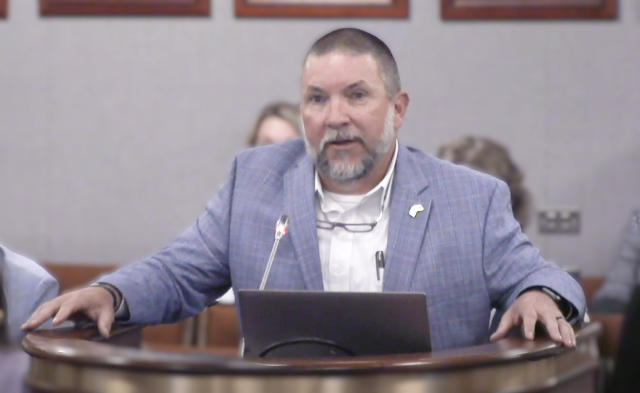
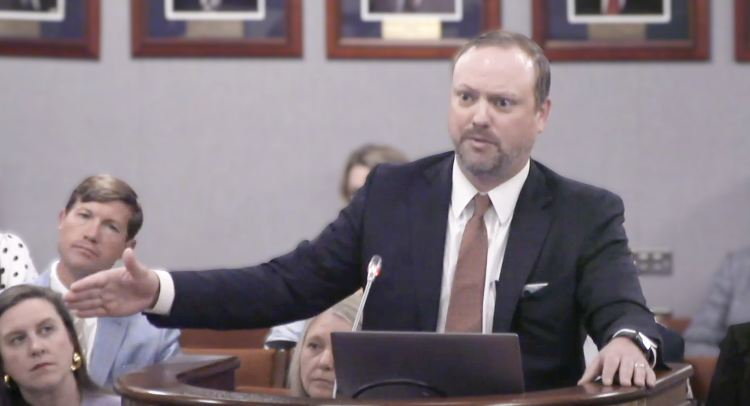
Boat Property Tax Reduction — H. 3858. This bill gives boat owners a 50% property tax reduction on boats registered and titled in South Carolina, which would ultimately be subsidized by small businesses, car owners, renters, and other taxpayers. The bill also eliminates the titling and taxing of all outboard motors. SCAC staff, Charleston County Auditor Peter Tecklenburg, Oconee County Auditor Christy Hubbard, and Union County Auditor Brad Valentine testified in opposition to H. 3858 on Wednesday. A House Ways and Means subcommittee voted to advance H. 3858 forward, and the bill will likely be on the agenda at the next full committee meeting.


House members are being repeatedly contacted by members of the boating alliance. It is vital that lawmakers also hear arguments on behalf of other taxpayers who don’t own a luxury item that supposedly warrants a special tax break.


Please continue to talk to your House members and ask them to oppose the bill due to the detrimental fiscal impact it will have on your county’s finances and the burden it will place on other taxpayers!

Union County Auditor Brad Valentine testifies at a House Ways and Means subcommittee on H. 3858, a bill to reduce boat taxes.

SCAC Assistant Director of Governmental Affairs Owen McBride testifies on H. 3858 at a House Ways and Means subcommittee hearing.

Collection and Remission of Accommodations Taxes — H. 3876. This bill provides updates to the process of collecting and remitting accommodation taxes, with an emphasis on providing guidance when third-party platforms (“intermediaries”) or other online booking services are involved. Third parties are required to collect and remit state and local accommodations taxes if they facilitate a booking unless a professional property company (“merchant of record”) is involved. Intermediaries must also share transaction details with the merchant of record within one business day. Local governments imposing new lodging taxes or changing rates must notify the Department of Revenue and the state treasurer 60 days in advance of the implementation or change. A House Ways and Means subcommittee gave H. 3876 a favorable report, as amended, and the bill will be on the agenda at the next full committee meeting.


Firefighters Workers’ Compensation Coverage — H. 3163. This bill revises the list of existing occupational diseases that are currently compensable under the South Carolina Workers’ Compensation Law to include the occurrence of a stroke as one of the conditions that are presumed to have “arisen out of and in the course of employment” for firefighters. SCAC staff testified in support of an amendment to the bill clarifying that this presumption only applies if the condition or conditions develop while a firefighter is actively engaged in fighting a fire, participating in a technical rescue incident or training exercise that involves stressful or strenuous physical activity, or within 24 hours thereof. The presumption does not apply to clerical, administrative or sedentary activities. The House gave the bill third reading, and it has been referred to Senate Judiciary Committee.

Public Safety, Corrrections and Judicial


Emergency Scene Management — H. 4249. This bill requires the driver of a vehicle to ensure that the vehicle is kept under control when approaching or passing a motor vehicle stopped on or near the right of way of a street or highway when the stopped vehicle is displaying flashing hazard lights. The driver must also yield right of way by making a lane change, if possible, and must maintain a safe speed for road conditions. The bill specifies that a person who fails to exercise control of a vehicle, yield the right of way, and maintain a safe speed for road conditions when approaching or passing a motor vehicle that is stopped on or near the right of way of a street or highway while displaying flashing hazard lights must be fined $300 to $500. The House Education and Public Works Committee gave H. 4249 a favorable report, and the bill is pending second reading on the House calendar.


SC Public Expression Act (Anti-SLAPP) — H. 3305. This bill details specific court actions that must be followed during the proceedings of a civil case brought against a person who is exercising their right to free speech or other similar activity in certain situations. A Senate Judiciary subcommittee gave H. 3305 a favorable report, and the bill will be on the next full committee agenda.


Small Estates in Probate — H. 3472. This bill increases the limit of a small personal estate from $25,000 to $45,000 to allow more estates to go through summary administration in probate. The Senate gave the bill second reading, and it is pending third reading on the Senate calendar.


Firefighter Registration Requirements — S. 101. This bill revises and clarifies requirements related to the registration of firefighters by the Office of the State Fire Marshal, which is under the administration of the Department of Labor, Licensing and Regulation. A House Labor, Commerce, and Industry subcommittee adopted an amendment to clarify and expand the definitions in the bill. The subcommittee gave S. 101 a favorable report as amended, and the bill will be on the next full committee’s agenda.

Land Use, Natural Resources and Transportation

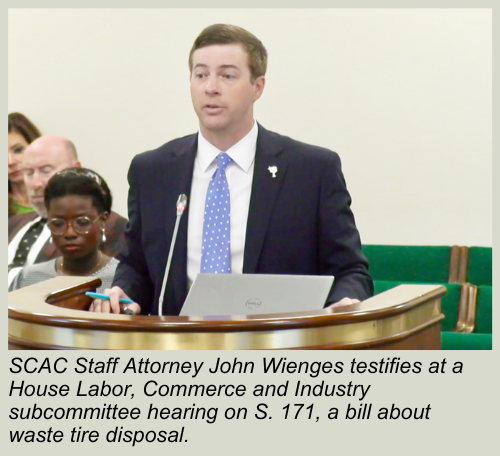
Waste Tires — S. 171. This bill represents the efforts of SCAC, the South Carolina Manufacturers Alliance, and several other entities to address the financial challenges that counties across the state are facing regarding the management and processing of waste tires. One of the most important aspects of the bill includes an increase of the $150-per-ton cap on tipping fees that a county may charge for recycling and disposal of undocumented waste tires to $400 per ton. This is an SCAC policy position.


Additionally, the bill addresses the sale of unsafe used tires and includes updated manifest and registration requirements for waste tire haulers that will require the placement of a new decal, provided by the DES, on certain vehicles involved in the hauling of waste tires. Other notable aspects of the bill include:

  • increasing economic development efforts to provide alternative uses of waste tires;
  • exempting SCDOT from the waste tire hauler registration requirements;
  • updating the current tire rebate program to encourage retailers to use waste tire haulers;
  • adding tire manufacturers and the Department of Commerce as members of the Solid Waste Advisory Council Grants Committee; and
  • encouraging the development of a statewide market infrastructure for tire-derived products.


A House Labor, Commerce and Industry subcommittee adopted an amendment to the bill removing a reference to new car sales and clarifying that that the $2 advanced recycling fee would apply to all “unmounted” tires sold. S. 171 received a favorable report as amended, and the bill will be on the agenda at the next full committee meeting.

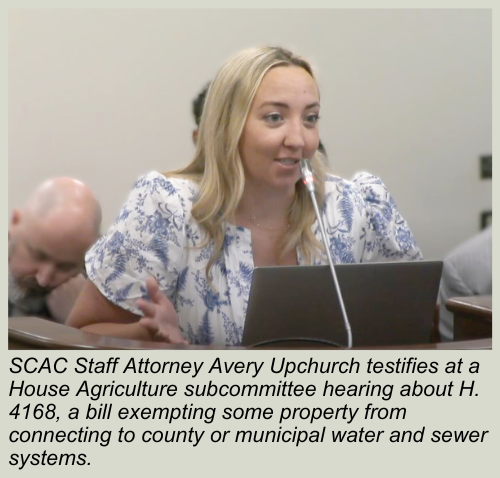
Water and Sewer Systems – H. 4168. This bill exempts property from connecting to municipal or county water or sewer systems if those systems lack the capacity to extend services to the property. Additionally, property owners within any municipality or county limits are allowed to install a well or septic tank if it is more economical than connecting to the municipal water or sewer system. An amendment was adopted at subcommittee that requires the providing entity to notify the property owner in writing within 30 days of the request for service if the entity cannot provide services. A House Agriculture subcommittee passed H. 4168 out favorably as amended, and the bill is scheduled to be on the next full committee agenda Tuesday.


Please contact your House members and ask them to oppose this legislation.


Litter Officers — H. 3222. This bill revises the means for determining the limit on the number of litter control officers that a county may have to be updated with the most recent census and corrects an incorrect reference in the code. A Senate Judiciary subcommittee gave H. 3222 a favorable report, and the bill will be on the next full committee agenda.


SC811 — H. 3571. This bill updates definitions, including what constitutes a large project, requires operators to become members of the Operators Association Notification Center, and outlines penalties for failure to notify about an excavation or demolition or for failure to join the association. The bill requires notification to the Operators Association Notification Center not less than three full working days prior to the commencement date and no less than 10 days prior to the commencement date for a subaqueous facility. The bill also requires quarterly reports of damage caused by excavation or demolition, creates exemptions for notice requirements in cases of emergency, and provides for a complaint process through the Attorney General’s office as well as penalties. The House adopted a committee amendment to allow the Attorney General’s office to authorize prima facie cases to go to court and to increase the penalty for certain violations from $1,000 up to $25,000. A Senate Judiciary subcommittee gave H. 3571 a favorable report, and the bill will be on the next full committee agenda.


Abandoned and Derelict Vessels — S. 367. This bill establishes protocols for DNR and local law enforcement agencies to handle abandoned, derelict, and sunken vessels. Any person may remove and dispose of derelict, abandoned, and sunken vessels and may bring a civil action in magistrates court against a responsible party to recover the costs of removal and disposal, attorney’s fees, and court costs within three years. DES, in cooperation with DNR, must also develop and maintain a website for law enforcement and the public to report vessels that are sunken, wrecked, or junked. A House Agriculture, Natural Resources and Environmental Affairs subcommittee gave S. 367 a favorable report, and the bill will be on the next full committee’s agenda.


Personal Delivery Devices — H. 3129. This bill regulates the operation of personal delivery devices (PDDs) in public areas, allowing businesses to use them on sidewalks and highways under specific conditions, such as speed limits and safety requirements. Local governments can regulate PDD operations but cannot prohibit their use. PDDs must be monitored by an operator, equipped with safety features like lights and braking systems, and have insurance coverage for liability. The provisions contained in H. 3129 would be repealed three years after their enactment. The House gave the bill third reading, and it has been referred to the Senate Transportation Committee.


Coastal Permitting — H. 3931. This bill sets timelines for DES to act on certain permit applications within the coastal zone and critical areas. The House amended the bill to clarify that DES must act on a permit application within 90 days after the request is determined by the department to be administratively and technically complete. Additionally, if DES requests additional technical information from the applicant, the request must be made within 15 days after the conclusion of the public notice period. DES may also hire a qualified third-party or independent engineer to assist the department in processing permit applications in coastal zones. H. 3931 received a second and third reading, and the bill was sent to the Senate and referred to the Senate Medical Affairs Committee.


EV Charging Stations — S. 275. This bill amends definitions for electric vehicles (EVs) and direct-current fast-charging stations. The bill also provides that electrical utilities and other local governments must provide and appropriately charge for infrastructure that is required to serve the electrical load for EV charging needs or to meet the requirements of any state and federal grant funding. Additionally, electrical utilities or local governments that provide, own, or maintain direct-current fast-charging stations for public use must offer fair, reasonable, and nondiscriminatory rates and service to all entities providing a similar service to avoid providing an unreasonable advantage for its direct-current charging stations. The Senate amended the bill to limit the revenue received from services other than those provided by the charging stations from being used for subsidizing investments in these types of EV-charging stations that are owned and operated by utilities or local governments going forward. The amendment also clarified that local governments with existing “Level 2” charging stations may continue offering free charging for public use and are not affected by the provisions of the bill. A House Agriculture Wildlife subcommittee gave S. 275 a favorable report, and the bill will be on the agenda at the next meeting of the full committee.

County Government and Intergovernmental Relations

Military Advisory Council — S. 89. This bill renames the South Carolina Military Base Task Force to the South Carolina Military Affairs Advisory Council. Additionally, the bill revises the council's mission and increases its membership by adding the chief executive officer of the Aiken Chamber of Commerce, the chairperson of Aiken County Council, and the mayor of North Augusta. The bill also requires the Council to meet at least once each calendar year. The House adopted a committee amendment adding the chairperson of Edgefield County Council to the Advisory Council and then adjourned debate on the bill until April 29.


Electronic Records Disclosure — S. 74 . This bill authorizes a law enforcement officer, circuit solicitor, or the attorney general to subpoena stored wire, digital, or electronic communications, as well as transactional records and subscriber information from the provider of an electronic communication service or remote computing service as a part of an ongoing investigation. Last week, the House Judiciary subcommittee amended S. 74 to limit this authorization for the attorney general to only during an ongoing investigation for child pornography. The House gave S.74 a third reading and returned it to the Senate with amendments concerning procedural changes to obtaining a subpoena.


Oversight of County Veterans’ Affairs Offices — H. 3563. This bill requires the secretary of the DVA to evaluate each county office annually to assess service levels and procedural compliance. If deficiencies are found, the DVA will help develop a corrective action plan and re-evaluate within six months. The secretary must also submit a written report of the final inspection results to the legislative delegation and county administrator within 90 days. Additionally, a county officer who does not participate in the evaluation will be ineligible for reappointment by the county legislative delegation. The Senate gave H. 3563 a second reading, and the bill is pending a third reading on the Senate calendar.


Commercial Property Assessed Clean Energy and Resiliency (C-PACE) — S. 256. This bill would enact the “South Carolina Commercial Property Assessed Clean Energy and Resilience Act,” to authorize the establishment of commercial property assessed clean energy and resiliency (C-PACE) programs that local governments may voluntarily implement. The programs would ensure that owners of agricultural, commercial, industrial, and multifamily residential properties can obtain low-cost, long-term financing for qualifying improvements by freely and willingly agreeing to have an assessment levied on their properties. A Senate LCI subcommittee made some technical amendments and gave the bill a favorable report as amended.

Newly Introduced Legislation and Ratifications

See below link for summaries of legislation introduced this week and bills sent to the governor that are of interest to counties:


House Bills


Senate Bills


Ratifications


View/Download Full Text for Newly-Introduced Legislation


You can also go to www.scstatehouse.gov and click on "Legislation," then "Introduced Legislation."


Note: If you would like to offer comments to the SCAC staff, please call us toll-free at 1-800-922-6081, fax to (803) 252-0379, or send an email.

 
X Share This Email
LinkedIn Share This Email