|
The state budget, roads and data centers headlined action in the General Assembly this week. The Senate began their debate on the South Carolina Department of Transportation (SCDOT) modernization bill and continued discussing the hemp regulations bill. A Senate Agriculture and Natural Resources subcommittee continued hearing testimony on one of the data center bills.
The House gaveled in Monday and began floor debate on the appropriations bill. After hours of proposed amendments and discussion ending around 9 p.m. Tuesday, the House gave the budget and Capital Reserve Fund (CRF) bills second readings. The House then debated the income tax reform bill, ultimately concurring with the Senate amendment, which would bring the highest rate down to 5.21%. The House reconvened Wednesday giving the budget and CRF bills third readings and sending them to the Senate before adjourning for the week. The House is on furlough next week but will return the week of March 24.
The budget and other bills of interest are detailed below.
| |
Upcoming Action Item
Municipal Capital Project Sales Tax
S. 866 would enact the “Municipal Tax Relief Act,” authorizing a municipality located wholly or partially in a county that does not impose a 1% sales tax to impose a 1% municipal sales tax, subject to a referendum. At least 20% of the revenue must be used for property tax relief with the remaining revenue available to be used for transportation, infrastructure, parking lots or garages, core local government services, administration buildings, civic centers, police stations, fire stations, or any combination of the above projects. The tax could be imposed for up to eight years and can be reimposed for up to an additional seven years.
Status: SCAC’s policy position is to oppose such legislation. Although SCAC testified against the bill, a Senate Finance subcommittee gave the bill a favorable report, and S. 866 will be on the next full committee’s agenda.
Cities already help decide which projects are funded by a countywide sales tax. However, there are no provisions in this bill for county participation. Unincorporated area residents who pay sales tax within the city get no vote on the projects being funded by the potential municipal capital projects sales tax. Also, if a municipal sales tax was adopted, the likelihood of getting a countywide sales tax would significantly decrease while the municipal tax is imposed. This could significantly hinder a county’s ability to raise sufficient funds to keep up with growth and fund much needed infrastructure projects.
S. 866 would create a disincentive for municipalities to support the reimposition of a countywide sales tax that they would otherwise support. The bill will be heard by the Senate Finance Committee sometime in the next few weeks. If you have concerns about this bill, please contact your Senators and ask them to oppose S. 866!
| | | | |
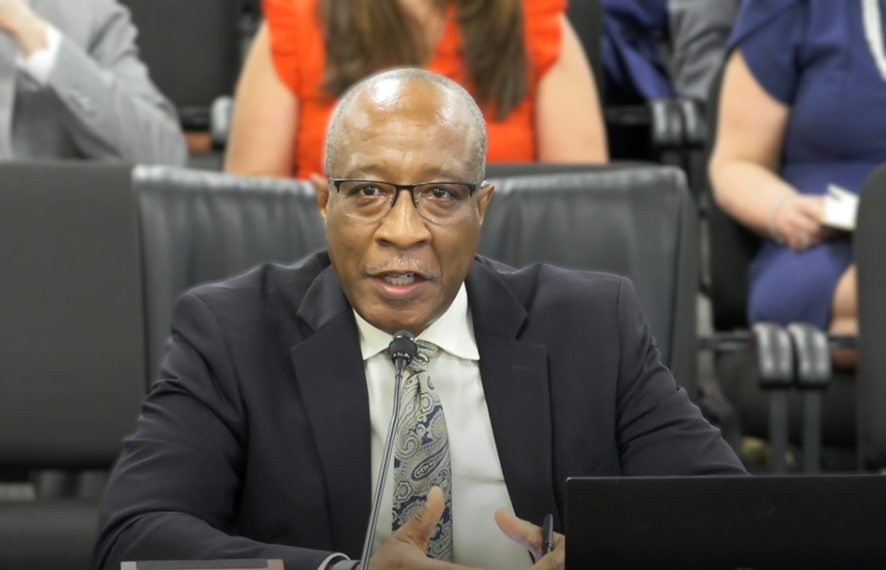
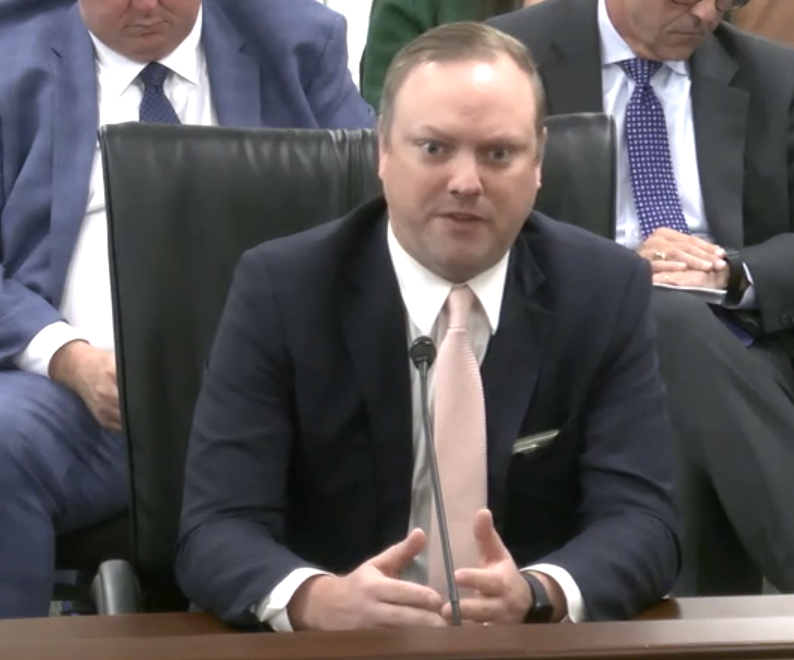
Kent Lesesne, of counsel for SCAC, testifies against a municipal capital project sales tax bill (S. 866) at a Senate Finance subcommittee hearing.
| | | “I don’t think that it should ultimately be on the county to have to provide infrastructure just because someone wants to go and develop an area.” – Senate President Thomas Alexander of Oconee County while debating the concurrency bill, an SCAC policy position, in the Senate Labor, Commerce, and Industry Committee. | |
Bills of Direct Interest to Counties | |
The House passed its version of the $15.4 billion budget bill this week. The budget increased funding to the Local Government Fund (LGF) by $15,294,812 statewide. This represents full funding to the LGF under the statutory formula. See the estimated LGF county allocations for FY 2026-27. The budget also includes $12 million for the Rural Stabilization Fund, the same amount that was allocated last year.
Note: The House-passed version of the state budget has not been published. Below is a summary based on documents and information SCAC staff has received. We will continue to share any additional funding details or provisos once they are finalized.
Items the House funded this year include:
- $67 million to cover a 2% base pay increase for state employees;
-
Nearly $119 million for income tax relief (see H. 4216);
- $750,000 in recurring money for PTSD treatment for first responders;
- $3 million in recurring money to Labor, Licensing, and Regulation for the V-SAFE Fund;
- $3.784 million in recurring money for the Firefighter Cancer Benefit Plan;
- $1 million in recurring money to supplement the Councils of Governments;
- $1.2 million in additional recurring funding for aid to public library systems;
- $825,000 to the Department of Parks, Recreation, and Tourism for regional tourism promotions, $9.275 million for destination-specific marketing grants, and $7.5 million in one-time money for beach renourishment grants;
- $7.25 million in one-time money and $1 million in recurring money to the Rural Infrastructure Authority for the Rural Infrastructure Fund and $8.2 million for the statewide water and sewer fund;
- $27.5 million in one-time money to the Department of Natural Resources for land conservation;
- $1 million in additional recurring money to the Department of Commerce for LocateSC site readiness;
-
$1 million in one-time money to the Department of Public Health for disaster readiness (see proviso 31.49 below);
- $90 million to the South Carolina Emergency Management Division (SCEMD), within the Adjutant General’s Office, for Federal Emergency Management Agency matches for federally declared disasters;
- $35 million in one-time money to the Conservation Bank for land conservation;
-
Almost $250 million to SCDOT for bridge modernization, $125 million in one-time money for interstate acceleration, and $25 million for a road buyback program (see proviso 84.18 below);
- $100 million in one-time money to County Transportation Funds for the County Transportation Committee (CTC) Acceleration Program;
- $70 million to the Division of Aeronautics for airport development programs;
- Almost $20 million in one-time money to the Judicial Department for a Rural County Courthouse Stabilization Fund and $20 million in one-time money for modernizing the case management system;
-
$13.4 million in one-time money to the State Law Enforcement Division (SLED) for the service contract for an 800MHz radio system (see proviso 117.200 below);
-
$1.382 million in one-time money to the Commission on Indigent Defense for public defender technology and digital storage (see proviso 61.14 below);
- $10.5 million in one-time money to the Election Commission for statewide voting system upgrades;
- $190,000 from the General Fund to exempt poll worker pay from income tax; and
- $10 million to the Department of Veterans Affairs for the Military Enhancement Fund.
Please thank the members of the House for keeping their promise to counties and working to return much-needed funding to county governments throughout the state! The House budget includes three SCAC policy positions—an annual increase to the LGF, a minimum grant of $200,000 per county in the Aid to County Libraries, and funding for affordable and workforce housing.
| |
Shortly after 9 p.m. Tuesday, the House of Representatives passed second reading of the state FY 2026-27 budget.
| |
Provisos
In addition to the provisos that remain in the budget from last year, the House adopted the following new and amended provisos of interest:
27.1. (LIB: Aid to County Libraries Allotment) The amount appropriated in this section for "Aid to County Libraries" will be allotted to each county on a per capita basis according to the official United States Census For 2020, as aid to the county library. No county will receive less than $200,000 (updated from $150,000). Counties will receive their allocations in two equal parts.
31.49. (DPH: Disaster Readiness Fund) Establishes an interest-bearing Disaster Readiness Fund within the Department of Public Health to support emergency response activities, including medical sheltering and medical equipment power shelters. All FY 2026-27 disaster readiness appropriations and any related funds must be deposited into the fund. Unexpended balances may be carried forward, and any reimbursements or cost recoveries must be returned to the fund for future disaster response needs.
42.7. (HFDA: Workforce Housing) Authorizes the House Finance and Development Authority to use any appropriated funds for the Made it Home! Program to address the lack of affordable home ownership across the state by facilitating the new construction of affordable single-family homes. The authority is authorized to expend federal or other funds for the same purpose. The authority shall develop program guidelines, reporting requirements, down payment assistance, and homebuyer eligibility requirements and establish criteria for awarding distribution to participating partners. Also, the authority may establish a fund separate from the state General Fund that consists of monies received or authorized and any other sources of revenue, public or private, including donations for the purpose of the program. Any of the remaining $5 million appropriated to the First-time Homebuyers Workforce Housing Program in the 2025-26 budget may be carried forward for this purpose.
43.7. (FC: Response to Declared Disasters) In the event of a declared emergency requiring the response of the South Carolina Forestry Commission, the state treasurer and comptroller general are authorized and directed to pay from the state Disaster Trust Fund funds necessary to cover the cost incurred, if available. If funding is insufficient, the General Fund may be used, with a cap of $5 million (updated from $3 million) transferred to the commission. The commission must return any funds later reimbursed to the General Fund.
50.28. (CMRC: Rural Development) Specifies that from funds appropriated to the Department of Commerce for rural development, all allocations must be used for projects in Tier III and Tier IV counties, as well as census tracks that qualify as Opportunity Zones in Tier I and Tier II counties. Maximum awards for these community and rural development projects are $1.5 million and will require a 10% match.
54.7. (RIA: Aiken Wastewater Treatment Plant Regional Assessment and Master Plan) Directs Aiken County to complete an evaluation of long-term regional wastewater treatment needs and provide the evaluation to the Aiken and Edgefield Legislative Delegation by Nov. 2, 2026.
55.26. (DES: AI Pilot Program) Requires the Department of Environmental Services (DES) to develop and implement a framework to identify, pilot, and scale artificial intelligence solutions that improve efficiency, transparency, and service delivery in environmental permitting to support modernization.
61.14. (PCC: Public Defender Technology and Digital Storage) Directs the $1.382 million appropriated be distributed to the judicial circuits in quarterly installments, with $720,000 allocated evenly at $45,000 per circuit and the remaining $662,000 distributed based on population.
67.16. (DJJ: Capital Expenditure Charge) The House adopted the amended proviso at the request of municipalities. Local governments, except for municipalities with populations of 3,000 or less, utilizing the juvenile detention services provided by the Department of Juvenile Justice (DJJ) shall pay a capital expenditure charge of $125 per day per child not to exceed 25 days to the department for new admissions after July 1, 2025, to cover capital expenditures and investments in the facilities that house juveniles. Municipalities with populations of 3,000 or less using the juvenile detention services provided by DJJ shall pay a capital expenditure charge of $50 per day per child not to exceed 25 days to the department for new admissions after July 1, 2026, to cover capital expenditures and investments in the facilities that house such juveniles.
This capital expenditure is in addition to the per diem charge of $50 that offsets operating expenses. If full funding is not received from the local governments, then the remainder of the funds due shall be transferred to the department from the LGF on behalf of such local governments. The transfer to the department on behalf of the local government shall be deemed to have been distributed to the local government.
84.18. (DOT: Road Buyback Program) Directs SCDOT to identify and compile a list of roads in the state highway system that may be eligible for transfer in accordance with Section 57-5-80. SCDOT will evaluate roads that may no longer serve a statewide purpose and determine whether those roads are more properly maintained by a county, municipality, or another appropriate political subdivision. SCDOT will consider functional classification, traffic volume, connectivity, and consistency with the statewide transportation plan when making the determination. Roads deemed eligible for transfer will be those which, in the opinion of SCDOT, no longer serve the purpose of the state highway system. The department may negotiate with the governing bodies of the appropriate political subdivisions for the transfer of maintenance responsibilities for those roads. Road Buyback Program funds must be used to assist with costs related to the transfer of roads from the state highway system including, but not limited to, resurfacing, design improvements, documentation, and transition-related expenses agreed upon by SCDOT and the political subdivision. SCDOT will submit the list of identified roads, along with criteria used for selection and any recommendations regarding the transfer process, to the chairman of the Senate Finance Committee, the chairman of the House Ways and Means Committee, and the governor by Feb. 28, 2027.
92D.1. (South Carolina Office of Resilience: Catastrophic Weather Event) Updates the fiscal year reference and includes additional programs funded by the Disaster Relief and Resilience Reserve Fund for property improvements. Additionally, when a weather event leads to a new home replacing a damaged mobile home or manufactured home, the property may be reassessed, but any increase may not exceed the prior personal property tax value of the demolished unit. The reassessed value must remain unchanged for the current fiscal year unless an assessable transfer of interest occurs.
100.25. (ADJ: Emergency Reimbursement Eligibility) Authorizes SCEMD to reimburse eligible costs for state governmental agencies, local governments, nonprofit electric cooperatives, and Santee Cooper, as needed, for disaster recovery.
108.5. (PEBA: State Health Plan) Amends the existing proviso relating to employer premium increases to update the plan year reference and to provide for a 0% increase in employer premiums, which will result in no increase for subscribers. The FY 2025-26 increase was 4.6%.
108.14 (PEBA: PORS Return to Work) Adds that the current earnings limitation does not apply if compensation received by the retired member from the covered employer is for employment in a critical needs law enforcement position as determined by the Law Enforcement Training Council (LETC). The LETC must review and approve, from the documentation provided by the covered employer, that no qualified, nonretired member is available for employment in the position and that the member selected for employment meets the requirements of this provision. No later than Jan. 1 of the current fiscal year, the LETC must submit a report to the chairman of the Senate Finance Committee and the chairman of the House Ways and Means Committee of the positions requested for inclusion in the earnings limitation exception. The exception only applies to those approved by action of the General Assembly for the fiscal year in response to the report LETC submits. The LETC shall develop guidelines and curriculum for these officers to be recertified.
113.11. (AS-TREAS: Employment Contracts and Political Subdivisions) Prohibits a political subdivision receiving aid from the LFG from including a term in any contract of employment allowing for a settlement amount to be paid by the subdivision as part of the mutual dissolution of the contract that exceeds one year’s salary or the remainder of the contract value, whichever is less.
117.152. (GP: Statewide Mobile Health Units) Establishes the Center for Rural and Primary Healthcare as the support center for mobile health units with the goal of increasing the capacity, services, and impact of the units in improving access to high-value care for underserved populations, especially in rural communities. The proviso also would clarify the type of technical assistance and support provided.
117.197. (GP: Aid to Fire Districts Fund) Creates the Aid to Fire Districts Fund, separate from the state General Fund. That portion of fire premium tax revenues and the state portion of the broker premium tax revenues that are required by statute to be distributed to county treasurers for local fire service must be deposited in the fund. Also, the Department of Insurance must ensure that the fund has an appropriate balance, and the state treasurer shall distribute the fund’s revenues in the fund to the county treasurers.
117.200. (GP: First Responder Interoperability) Directs SLED to administer and coordinate First Responder Interoperability operations for the statewide Palmetto 800 radio system to enhance public safety radio communications. Funds appropriated by the new proviso will cover radio user fees for eligible state agencies and first responders, with allocations based on a minimum number of radios per participant. Grants will be available for county and municipal systems to improve interoperability but are subject to a required matching of funds to receive support. Any remaining funds may be used to expand the statewide Palmetto 800 system.
The Senate continues to hold budget hearings in subcommittee and is expected to begin full Senate Finance Committee deliberations during the week of April 7.
| Revenue, Finance and Economic Development | | |
SCDOT Modernization
The Senate continued discussing the comprehensive SCDOT modernization bill this week. The Senate adopted, at SCAC’s request, the committee amendment clarifying that the transfer of roads from SCDOT to counties must be agreed to by mutual consent (an SCAC policy position), removing the requirement that any roads transferred to counties always be maintained in good condition under SCDOT’s standards, and creating a pothole remediation program, to allow residents to report potholes to SCDOT through a mobile app or website. The amendment would direct $15 million from the General Fund to pay for this program.
Status: The Senate debated S. 831 Tuesday and Wednesday this week, adopting an amendment on the floor to exempt certain purchases for road construction projects from the procurement code, before carrying the bill over. There is expected to be one amendment offered next week to reform the composition of CTCs and another to require SCDOT to amend their priority list when a county uses sales tax money to complete a road project currently on the list.
Financial Agreements
S. 891 would expand the definition of financing agreements subject to constitutional debt limits to include lease purchase agreements. Further, the bill would provide that any member of a local governing body who knows or should have known that a proposed action violates the debt limits set forth under the state Constitution or enters into lease purchase agreements as an alternative to issuing general obligation bonds to fund capital projects and votes in favor of such an action would be guilty of misconduct in office.
Status: A Senate Finance subcommittee adopted an amendment to remove “should have known” from the penalty clause before carrying the bill over due to concerns offered in testimony from several groups, including SCAC.
| | |
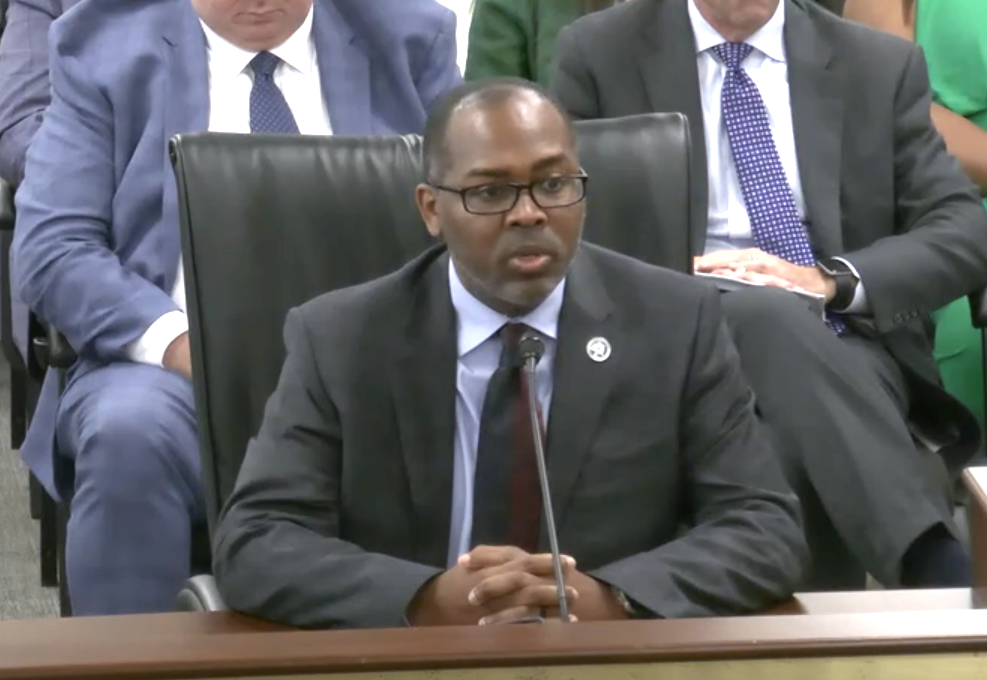
Richland County Administrator Leonardo Brown testifies at a Senate Finance Constitutional subcommittee hearing on S. 891, a bill about local government financing agreements.
SCAC Director of Governmental Affairs Owen McBride testifies at a Senate Finance Constitutional subcommittee hearing on S. 891.
| | | Land Use, Natural Resources and Transportation | | |
Data Centers
S. 867 would create a regulatory framework under DES for permitting and siting requirements that data centers must meet to locate in South Carolina.
Status: A Senate Agriculture and Natural Resources subcommittee continued hearing testimony for S. 867 on Tuesday. The subcommittee meeting focused on hearing from energy and utility companies; however, no action was taken on the bill. Please contact SCAC staff if you would like to speak at future data center meetings.
Concurrency Programs
S. 227 would define concurrency programs and authorize local governments to enact them, an SCAC policy position. These programs allow a county or municipality to manage the strain that growth and new development place on existing infrastructure. A local government could require a developer to pay impact fees, build, or fund improvements, phase in the project, or wait until infrastructure is expanded before approving a development project. A Senate Labor, Commerce, and Industry subcommittee amended the bill to allow counties, property owners, and other governmental entities to enter into written agreements providing for phased improvements, reimbursement mechanisms, capacity credits, or excess capacity contributions.
Status: The Senate Labor, Commerce, and Industry Committee adopted the above subcommittee amendment and gave the bill a favorable report. S. 227 is pending second reading on the Senate calendar.
Utility Relocation During Transportation Projects
H. 3768 would extend the sunset provisions relating to transportation improvement projects in Act 36 of 2019 from July 1, 2026, to July 1, 2031. This act sets forth a system of cost-sharing for the relocation of utilities during transportation projects.
Status: A Senate Finance Sales and Income Tax subcommittee gave H. 3768 a favorable report, and the bill will be on the next full committee’s agenda.
| | Public Safety, Judicial and Corrections | | |
HALO Act
S. 175 and H. 4763, as introduced, would create the Helping Alleviate Lawful Obstruction (HALO) Act, which would make it a misdemeanor offense to obstruct a first responder or emergency medical care provider performing their official duties, an SCAC policy position. The first responder or health care worker must first warn the obstructer to remove themselves at least 25 feet away. This offense would be punishable by a fine of no more than $500 and imprisonment for no more than 60 days.
Status: The Senate Judiciary Committee struck the language of H. 4763, which included lowering the penalty to 30 days and requiring a reasonable effort to obtain parental or guardian consent for medical treatment by an emergency medical care provider and inserted the contents of S. 175. The committee gave H. 4763 a favorable report as amended, and the bill is now pending second reading on the Senate calendar.
Interference with Critical Service Workers
S. 808 would classify the harassment or threat of a worker restoring critical services during a state of emergency (electric and gas, water and sewer, road and highway repair, telephone or cell, satellite or internet, or other services necessary for home and commercial properties) as a misdemeanor and tampering with an electric utility system or assault or endangerment of a worker restoring critical services as a felony.
Status: The Senate Judiciary Committee adopted the subcommittee amendment, which removes other services necessary for home and commercial properties from the list of critical services, and gave the bill a favorable report as amended. S. 808 is pending second reading on the Senate calendar.
| | County Government and Intergovernmental Relations | | |
Joint System Governance
S. 829 would allow joint water and wastewater systems to use weighted voting, create member or governor-appointed commissions with county legislative delegation recommendations, and add a governor-appointed tie-breaking commissioner when needed. The bill also would establish eligibility and conflict of interest rules, require automatic forfeiture for disqualifications or certain convictions, and allow commissions to adjust as new members join. The bill also would permit system reconstitution while protecting existing contracts and strengthening bond security by extending member payment obligations to match the term of issued debt. A Senate Judiciary subcommittee adopted an amendment that would centralize financial authority at the commission level and make it easier for a governor-appointed board to issue bonds without additional local government approval.
Status: The Senate Labor, Commerce and Industry Committee gave the bill a favorable report as amended, and the bill is pending second reading on the Senate calendar.
Discrimination of Contracts
S. 686 would prohibit public entities from awarding contracts and grants that discriminate based on race and establishes that any such contract is void and unenforceable.
Status: A Senate Finance subcommittee voted on S. 686, but a tied vote prevented the bill from advancing, resulting in it being carried over.
American Heroes Bingo
H. 4137 would create a new class of bingo license, Class G, for veterans’ organizations operating an American Heroes Bingo Game, which costs $1,000 per license. This bill also creates guidelines for American Heroes Bingo Game and adds definitions. This bill specifies that 15% of the monthly net hold derived from American Heroes Bingo, which is total revenue paid by players less any prizes, must be paid to the Veterans’ Trust Fund. In addition, 10% percent of the monthly net hold must be distributed equally to the South Carolina state headquarters of the American Legion, Veterans of Foreign Wars, and Disabled American Veterans. Other chartered Veterans’ Service Organizations with membership over 4,000 also may submit a claim for the proceeds from American Heroes Bingo.
Status: A Senate Finance subcommittee amended the bill to, among other things, allow the holder of an American Heroes Bingo License (Class G) to concurrently hold a Class B, Class C or Class F Charitable Bingo License. H. 4137 was given a favorable report as amended and will be on the next full committee’s agenda.
Hospital Beds
H. 5164 and S. 958 would create building and fire code exceptions for the placement of hospital beds in hallways during emergencies.
Status: A House Medical, Military, Public, and Municipal Affairs subcommittee amended H. 5164 and gave it a favorable report. The bill will be on the next full committee’s agenda. SCAC will report on the amendment once it becomes available.
A Senate Medical Affairs subcommittee made some technical amendments to S. 958, gave it a favorable report, and the bill will be on the next full committee’s agenda.
Rural Emergency Hospitals
S. 895 would include within the definition of “hospital” all hospitals that convert to rural emergency hospitals for purposes of the State Health Facility Licensure Act and Medicare reimbursement. These hospitals provide outpatient/emergency services but do not maintain inpatient units.
Status: A Senate Medical Affairs subcommittee gave S. 895 a favorable report, and the bill will be on the next full committee’s agenda.
| | Other Statewide Bills of Interest | | |
Income Tax Reform
H. 4216, which was passed by the House in 2025, would change South Carolina’s individual income tax structure by reducing the tax rate over time until it reaches 1.99%. The tax rate for 2026-27 would be 1.99% on taxable income up to $30,000 and 5.39% on $30,000 and over. The Senate adopted an amendment to decrease the percentage of taxable income from 5.39% to 5.21% on $30,000 and over. The House concurred with the Senate amendment, but only provided enough funding in their version of the budget to bring the tax rate down to 5.39% on income $30,000 and over. Additional funding to fully implement the 5.21% rate will be appropriated in either the Senate version of the budget or when the appropriations bill returns to the House later this session.
Hemp-Derived Products
H. 3924, as originally introduced, would make it unlawful for a person under 21 to possess or consume hemp or THC products, such as CBD gummies and oil. The Senate Agriculture Committee in February amended the bill to limit the regulation to hemp or THC beverages, thereby treating them like alcoholic beverages. On Thursday, the full Senate adjourned with multiple amendments pending and will continue to debate the bill next week.
| | Newly Introduced Legislation | | | | |