Both chambers worked through their respective calendars in advance of the April 11 crossover deadline. Bills that have not crossed over from their originating chamber will require a two-thirds vote after the deadline to be considered by the other chamber. In advance of furlough next week, the House passed one of its priority pieces of legislation — a comprehensive 10-year energy bill (H. 5118) — and sent it to the Senate. A Senate Finance subcommittee took testimony from SCAC staff and county auditors on S. 1114, a bill to change the way boats and watercraft are titled and taxed. This and several other bills of interest to counties are discussed below. | |
Revenue, Finance and Economic Development | |
|
Attorney General Judicial Retirement — H. 5230. This bill would add the Attorney General to the Judges and Solicitors Retirement System (JSRS). A Ways and Means Committee member proposed an amendment to also add magistrates to the system. SCAC quickly notified Committee members and staff that adding magistrates would lead to a 350% increase in counties’ contribution rates. After debate, the amendment was tabled. Thanks to Reps. Cobb-Hunter, Hewitt, and B. Newton for voicing their concerns and looking out for our counties!
Prior to adjourning, another Committee member proposed an amendment to add full time masters-in-equity to the JSRS. There was little debate about the $17 million fiscal impact this will have on counties before the amendment was adopted and the bill was given a favorable report, as amended. SCAC believes this proposal needs closer study as this amendment was added last minute with almost no discussion of the fiscal impact during a meeting where no testimony was allowed.
Counties with a full-time masters-in-equity should contact their House members and express concern over the fiscal impact the increase in contribution rates will have on their county.
H. 5230 is pending second reading on the House calendar.
| | |
|
|
Titling of Boats and Motors — S. 1114. This legislation would remove the statutory requirement that outboard motors must be titled by the Department of Natural Resources and would exempt outboard motors from individual taxation.
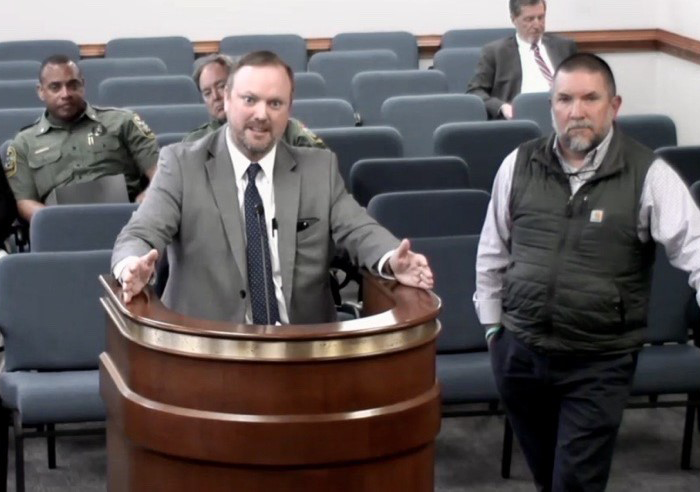
SCAC Assistant Director of Governmental Affairs Owen McBride (center) testifies on S. 1114, a bill on taxation and registering of boats/motors, alongside Charleston County Auditor Peter Tecklenberg (not pictured) and Union County Auditor Brad Valentine (right).
| |
|
SCAC’s policy position is to oppose any legislation that would amend the current process of titling boats and motors separately by only requiring the titling of boats.
This would potentially cost counties revenue, as the motor of a boat costs as much or is more expensive than the boat itself and could be purchased aftermarket or transferred between watercrafts without the county’s awareness. Additionally, the bill would require that boats or watercraft be taxed in the county in which the boat or watercraft is principally located unless it is principally located in a county other than the owner’s county of residence. If the boat or watercraft is in a county different than the owner’s county of residence, then the property tax return must be made to the auditor of the county where the boat or watercraft is principally located.
SCAC staff, along with Union County Auditor Brad Valentine and Charleston County Auditor Peter Tecklenburg, testified in opposition to the current bill by expressing concerns over the fiscal impact it will have on counties. A Senate Finance subcommittee gave the bill a favorable report under the condition that counties and the boating industry work on a compromise amendment to be presented at full committee next Tuesday.
Ten-Year Energy Transformation Act — H. 5118. This bill would enact the “South Carolina Ten-Year Energy Transformation Act” in an attempt to address the state’s energy needs over the next decade.
The House adopted an amendment on the floor to prohibit an electric utility from offering a tariff, rider, or rate proposal for a reduced electric rate, or any other form of incentive that would result in a reduced electric rate to a data center until July 1, 2034. SCAC staff was informed this may affect current or future economic development projects throughout South Carolina.
The House gave H. 5118 second and third readings this week and sent the bill to the Senate.
Fire District Millage Cap Exemption — H. 4294. This bill would allow a fire protection district in a rural county created pursuant to Chapter 19, Title 4, or Chapter 11, Title 6 to exceed the millage cap to support fire services, an SCAC policy position. The House Ways and Means Committee adopted an amendment to tie the population threshold for defining a rural county to the 2020 Census and to cap the exemption at 102% above the Consumer Price Index. The House gave H. 4294 second and third readings this week and sent the bill to the Senate.
Department of Defense Property Tax Exemption — H. 4912. This bill would allow certain civilian employees of the Department of Defense to continue to claim the 4% assessment ratio when the civilian receives certain orders for a change of station. This exemption could also be applied to the property for the past three property tax years that the civilian was stationed away. The House adopted an amendment to delete the requirement that an applicant for 4% must provide a copy of their most recently filed South Carolina individual income tax return or any other confidential tax records throughout the application process.
The House also adopted an amendment to include the language of H. 5310 (see below), which would exempt 36.8421% of the fair market value of all aircraft of each airline from property tax and define time on the ground for purposes of tax liability as 30 minutes for each landing and two hours for each overnight stay or maintenance day.
The House further amended the bill to require the county treasurer, in the case of an error by the county in levying real or personal property tax, to accept partial property tax payments from the taxpayer affected by the error. The taxpayer must pay at least one-sixth of the payment due each month. Also, no penalties or interest may be assessed against the taxpayer for six months after the taxpayer is made aware of the error. The House gave H. 4912 second and third readings this week and sent the bill to the Senate.
Airline Aircraft — H. 5310. This bill would exempt 36.8421% of the fair market value of all aircraft of each airline from property tax and define time on the ground for purposes of tax liability as 30 minutes for each landing and two hours for each overnight stay or maintenance day. The House Ways and Means Committee gave H. 5310 a favorable report and the bill is pending second reading on the House calendar.
Perpetual Recreational Trail Easement — H. 3121. This bill would provide an income tax credit to a property owner who encumbers their property with a perpetual recreational trail easement held by a municipality or county within the state or by a Land Trust Alliance accredited land trust. The easement must be recorded with the register of deeds and must include an agreement with the municipality, county, or land trust. Special purpose tax districts are also included in the list of entities that can hold the easement. The Senate amended the bill so that the legislation applies to tax years beginning after 2023 and sunsets the provisions in 2029. The House concurred with the Senate amendment and H. 3121 will be enrolled for ratification.
Redevelopment Authorities (RDAs): Tax Increment Financing for Affordable Housing — H. 4552. This bill would add certain affordable housing projects to what qualifies as a redevelopment project for federal military installations. It includes an affordable housing project (defined by referencing median income percentages according to the U.S. Department of Housing and Urban Development) where all or a part of new property tax revenues generated in the tax increment financing district (TIF) are used to provide or support publicly and privately owned affordable housing in the district or are used to provide infrastructure projects to support affordable housing. The bill also extends the bonding period for redevelopment projects from 15 years to 30 years and allows municipalities to spend TIF dollars outside of the RDA for items such as infrastructure support. The Senate Labor, Commerce and Industry Committee gave the bill a favorable report, and the bill is pending second reading on the Senate calendar.
Conformity — H. 4594. This legislation would update the conformity of the state tax law to the Internal Revenue Code (IRC) through the year 2023, including any expired provisions of the federal code that are extended, but not otherwise amended, by congressional enactment during 2024. The bill would also ensure that any extensions of the IRC sections apply to South Carolina for income tax purposes. The House gave H. 4954 second and third readings and sent the bill to the Senate.
| |
Public Safety, Corrections and Judicial | |
|
Prosecutors Privacy — S. 841. This bill would create the “Prosecutors Personal Privacy Protection Act” and would apply to active or former solicitors, deputy or assistant solicitors, attorneys general along their deputies and assistants, and U.S. Attorneys and their assistants for the District of South Carolina. It would ensure to these individuals that their personal identifying information held or maintained by any state or local governing entity would be confidential and must not be disclosed to the public if they have filed a formal request with the entity. The South Carolina Commission on Prosecution Coordination is required to create the necessary request form within 30 days after this bill becomes law. Any government entity that redacts or withholds information under this article would be required to provide the request or a description of the redacted or withheld information.
The Senate Judiciary Committee adopted a subcommittee amendment to include the provisions of S. 1034, a cleanup bill to Act 56 of 2023 that created the personal privacy act for current and former law enforcement officers and members of the judiciary. This amendment would limit the redaction request to county databases and online documents containing their personal identifying information, an SCAC policy position. The South Carolina Commission on Prosecution shall coordinate with the South Carolina Criminal Justice Academy and Court Administration in creating the request form to ensure consistency. The Committee also adopted an amendment to include public defenders before giving S. 841 a favorable report, as amended. The bill is pending second reading on the Senate calendar.
SC Justice Act (Joint and Several Liability) — S. 533. This bill would modify the South Carolina Contribution Among Tortfeasors Act, Chapter 38 of Title 15, to permit a court to consider the percentage of fault of any nonparty or party with a settlement agreement when determining the percentage of fault of the named parties. Section 15-38-65 specifies that Chapter 38 of Title 15 is not applicable to governmental entities. A Senate Judiciary subcommittee adopted an amendment to restore Section (F), which provides that the section does not apply to a defendant whose conduct is determined to be willful, wanton, reckless, grossly negligent, or intentional or to conduct involving the use, sale, or possession of alcohol or the illegal or illicit use, sale, or possession of drugs. The Senate adopted the amendment, and S. 533 is pending third reading in a special-order slot on the Senate calendar.
State Tort Claims Act — S. 87. This bill would increase the liability limits under the South Carolina Torts Claims Act to $500,000 for a single person and $1 million total for a single occurrence, regardless of the number of agencies or subdivisions involved in the occurrence. Additionally, this bill allows a party who makes an offer of judgment that is not accepted, pursuant to §15-35-400, to recover any administrative, filing, or other court costs and 8% interest computed on the amount of the verdict or award from the date of the offer, regardless of the liability limits. A Senate Judiciary subcommittee adopted an amendment to provide that upon approval by the Governor, this act takes effect July 1, 2024, for causes of action with a date of loss on or after July 1, 2024. The amendment was adopted by the full committee, and S. 87 is pending second reading on the Senate calendar.
Representation in Magistrate Court — H. 4029. This bill allows a housing authority to designate an employee or principal to represent it in magistrate court. The designation must be in writing and must be submitted to the magistrate when the initial pleading in the case is filed by the party. The Senate Labor, Commerce, and Industry Committee gave H. 4029 a favorable report, and H. 4029 is pending second reading on the Senate calendar.
Juveniles Offenses — S. 266. This bill would prohibit a child from being placed in confinement in an adult jail for more than six hours; limit the amount of time a child may be detained after being taken into custody to 48 hours, excluding weekends and holidays; lessen the severity of the implications of status offenses; and require automatic expungement of juvenile records when the juvenile turns 18 as long as they have had no other criminal convictions and have completed any sentence or requirements imposed for a status offense. It would also provide that before the S.C. Department of Juvenile Justice (DJJ) would accept a juvenile referral for a status offense or before a petition for a status offense may be filed in family court, there must be documented evidence that the parent or guardian of the child has made reasonable efforts to resolve the issues through family counseling, therapy, or other means. The Senate Judiciary Committee amended the bill to eliminate the automatic expungement provision and gave the bill a favorable report, as amended. S. 266 is pending second reading on the Senate calendar.
Probate Proceedings — H. 4559. This is one of several bills that would amend Section 62-3-108 to allow a probate action to be brought specifically for death-related claims due to exposure to the contaminated water at Camp Lejeune, regardless of when the decedent died, an SCAC policy position. The House gave H. 4559 second and third readings this week and sent the bill to the Senate.
Voter Qualifications — S. 1126. This joint resolution would amend the South Carolina Constitution to clarify that only a citizen of the United States and of South Carolina who is at least 18 and properly registered is entitled to vote. The Senate Judiciary Committee adopted a technical amendment and gave the bill a favorable report, as amended. S. 1126 is pending second reading on the Senate calendar.
Telecommunicator CPR Training Law — H. 4867. This bill would require all 911 telecommunicators that provide dispatch for emergency medical conditions to be trained in high-quality telecommunicator CPR. The House Medical, Military, Public and Municipal Affairs Committee adopted a subcommittee amendment to protect local governments from potential liability under 23-23-45(D), among other things. The Committee then gave H.4867 a favorable report, as amended. The bill received second and third readings in the House and has been sent to the Senate.
SC Street Gang and Criminal Enterprise Prevention and Anti-Racketeering Act — S.154. This bill provides enhanced penalties and eliminates the patterns, profits, proceeds, instrumentalities, and property facilitating criminal gang activity, including criminal gang recruitment. S. 154 revises definitions along with offenses and penalties. Additionally, the bill establishes anti-racketeering provisions to compliment the street gang and criminal enterprise prevention article and creates offenses and penalties for violations. The Senate Judiciary Committee amended the bill to clarify that criminal activity requires at least three people being assembled and to allow the Department of Corrections, DJJ, and local jails and detention centers to house gang members together due to spacing constraints. The Committee then gave the bill a favorable report, as amended, and S. 154 is pending second reading on the Senate calendar.
Liquor Liability — S. 1048 & H. 5066. S. 1048 provides the basis for liability for a person or establishment who illegally furnishes alcohol to an individual who injures a third party based upon what the furnisher knew or should have known under the circumstances. The Senate Judiciary Committee reported S. 1048 out favorably with amendments, and the bill is pending second reading on the Senate calendar.
H. 5066 attempts to help make liquor liability more affordable for businesses. The House Judiciary Committee amended the bill to require insurance companies to provide mitigation measures to allow businesses to reduce their coverage from the $1 million statutory requirement to as low as $250,000. The House further amended H. 5066 before giving the bill second and third readings and sending it to the Senate.
Dram Shop Liability — S. 1175. This bill provides that an individual who suffers death, bodily injury, or property damage by an intoxicated person has a cause of action for damages against the holder of a permit to sell beer, wine, or liquor if the permit holder knowingly sold, furnished, or served alcohol to the intoxicated person and the sale, furnishment, or service was the proximate cause of the injury giving rise to the claim. The bill also provides that an individual who suffers death, bodily injury, or property damage by a person under the lawful drinking age has a cause of action for damages against the holder of a permit to sell beer, wine, or liquor if the permit holder knowingly sold, furnished, or served alcohol to the person under the lawful drinking age and the sale, furnishment, or service was the proximate cause of the injury giving rise to the claim. The Senate Judiciary Committee reported the bill out favorably after adopting a technical amendment, and S. 1175 is pending second reading on the Senate calendar.
Coroners: First Responders Advisory Committee — H. 4681. This bill would increase the number of members who represent associations on the First Responders Advisory Committee from nine to 10 by adding a representative from the South Carolina Coroners’ Association. The Advisory Committee is responsible for researching, studying, and analyzing the needs of first responders, including personnel involved with fire, law enforcement, emergency medical, emergency planning, and 911 communications. The House gave H. 4681 second and third readings this week and sent the bill to the Senate.
Xylazine — S. 849. This bill would add xylazine to the list of Schedule III controlled substances and includes exceptions for the distribution or possession of xylazine by a licensed vet; the possession of xylazine with a prescription from a licensed vet; or the possession of xylazine in an injectable form for use in an animal. The bill also makes it unlawful for any person to produce, manufacture, distribute, or possess with intent to produce, manufacture, or distribute xylazine for a use other than use on an animal and provides for penalties. The Senate Judiciary Committee gave the bill a favorable report after adopting a technical amendment, and S. 849 is pending second reading on the Senate calendar.
| |
Land Use, Natural Resources and Transportation | |
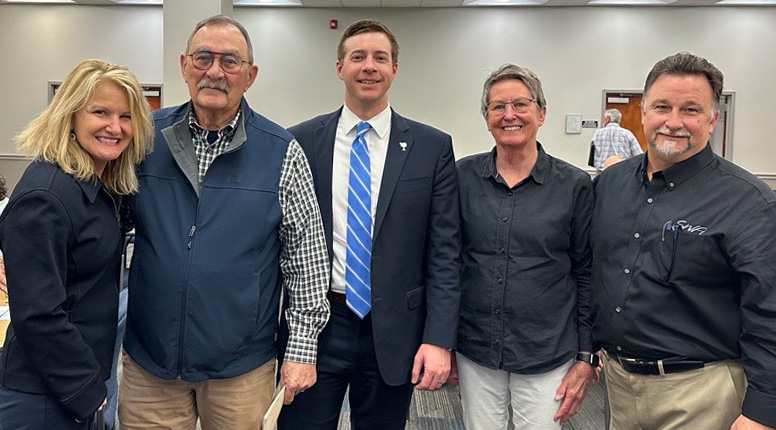
County officials this week worked with the SC Scrap Tire Coalition on the Waste Tire Disposal bill (S. 736). From left: Greenville County Director of Solid Waste Compliance Susan Turner, Saluda County Council Chairman Jim Moore, SCAC Staff Attorney John Wienges, Greenville County Director of Solid Waste Marcia Papin and Horry County Solid Waste Authority Assistant Executive Director Ed Marr. | |
|
|
International Energy Conservation Code — S. 1171. This bill would require new and renovated commercial construction to comply with the 2021 version of the International Energy Conservation Code. The Senate Labor, Commerce, and Industry Committee recommitted S. 1171 to subcommittee for further debate.
Wetlands — H. 4843. This bill would allow a business with a deck, dock, or other structure located in a critical area to use the structure for purposes related to the operation of the business as long as the business receives local zoning approval. The House Labor, Commerce, and Industry Committee amended the bill to replace requiring local zoning approval with requiring approval from the Department of Health and Environment Control (DHEC). DHEC must determine that the dock is being used for a commercial purpose to grant approval. The Committee gave H. 4843 a favorable report, as amended, and the bill is pending second reading on the House calendar.
Homeowner’s Association Foreclosure Limitations — H. 3180. This bill would prohibit a homeowner’s association (HOA) from foreclosing on a property of one of its members for failure to pay dues, fines, or other fees. However, the HOA would be able to place a lien on the property for failure to pay. The House Labor, Commerce, and Industry Committee amended the bill to add a due process provision to provide the property owner with recourse in the event the HOA seizes the property. It gave the bill a favorable report, as amended, and H. 3180 is pending second reading on the House calendar.
Golf Cart Ordinances for Nighttime Operation — H. 4609. As introduced, this bill would allow municipalities within a county with a population between 150,000 and 250,000 to enact an ordinance allowing golf carts to operate in designated areas within their jurisdiction at night. Previously, only municipalities on barrier islands were authorized to enact such ordinances. An amendment would allow all counties and municipalities across the state to issue ordinances to allow for the operation of golf carts at night in designated areas prescribed in their ordinance. The House gave H. 4609 second and third readings this week and sent the bill to the Senate.
| |
County Government and Intergovernmental Relations | |
|
Veterans’ Cemeteries — H. 4953. This bill amends Section 25-11-80 to remove residency requirements for a veteran to qualify for a plot in a state veterans’ cemetery. The Department of Veterans Affairs will no longer be able to waive the residency requirement as it has been eliminated. This means that veterans or their immediate family members only need to qualify for burial at a state veterans’ cemetery with a veterans’ honorable discharge. The House gave the bill received second and third readings this week, and H. 4953 has been sent to the Senate.
Insurance Reserve Fund Coverage — S. 543. This bill would extend coverage of employees of entities insured by the Insurance Reserve Fund, provided the employees acted in good faith and within the scope of employment. The Senate Judiciary full committee reported the bill out favorably as amended, and it is pending second reading on the Senate calendar.
Veterans’ Trust Fund Authority — H. 4928. This bill would allow the Veterans’ Trust Fund of South Carolina Board of Trustees to fundraise and make disbursements from the trust fund in support of fundraising activities. The Senate Family and Veterans’ Services Committee adopted a subcommittee amendment providing fundraising parameters and gave the bill a favorable report, as amended. H. 4928 is pending second reading on the Senate calendar.
Firefighter Cancer Healthcare — S. 728. As initially drafted, the bill (companion bill. H. 4680) would revise the definition of the term “firefighter,” relating to the Firefighter Cancer Health Care Benefit Plan, so that the term includes certain non-residents of the state. A Senate amendment removed the residency requirement, added South Carolina State Fire for the purpose of fire protection, added a retroactivity provision to apply as of July 1, 2021, and added that the diagnosis must occur within 10 years of employment separation. The Senate gave S. 728 third reading and sent the bill to the House.
Election Regulations — A House Regulations and Administrative Procedures subcommittee gave a favorable report to several regulations that will impact elections and how they are conducted. Regulations are available for download and review on the State House website. The subcommittee gave Documents 5192, 5193, 5194, 5195, 5196, 5198, 5199, 5201, 5202, 5203, 5204, 5205, and 5225 favorable reports. Document 5197 was withdrawn and will be resubmitted and Document 5224 was withdrawn.
| |
Newly-Introduced Legislation | |
|
View/Download Full Text for Newly-Introduced Legislation
You can also go to www.scstatehouse.gov and click on "Legislation," then "Introduced Legislation."
Note: If you would like to offer comments to the SCAC staff, please call us toll-free at 1-800-922-6081, fax to (803) 252-0379, or send an email.
House Bills
H. 5328 (Reps. King, O'Neal, Guffey and Pope) — Adds Section 12-45-440 to require the county treasurer to accept partial property tax payments from a taxpayer affected by an error by the county.
H. 5329 (Rep. Rutherford) — Adds Article 5 to Chapter 2, Title 56 to supply definitions and to create provisions for the operation of personal delivery devices. Further, the legislation provides that, for the purpose of assuring the safety of people using highways and sidewalks, a local government having jurisdiction over public streets, sidewalks, alleys, bridges, and other ways of public passage may, by ordinance, regulate the time and place of the operation of a personal delivery device, but shall not prohibit its use.
H. 5330 (Rep. Bauer) — Amends Section 16-23-20, relating to the unlawful carrying of a handgun, to clarify when carrying a handgun is impermissible in a publicly owned building other than a courthouse where court is held.
H. 5331 (Rep. Bauer) — Adds Section 16-23-540 to create the offense of negligent carrying of a firearm in a motor vehicle when a motor vehicle is unattended and unlocked and contains a firearm subsequently stolen and used in the commission of a crime. This bill also provides graduated penalties.
H. 5347 (Reps. Pendarvis and Williams) — Adds Section 57-1-100 to provide the Department of Transportation shall conduct a study and undertake a project to establish commuter rail service in the state.
H. 5348 (Reps. Gilliard and Williams) — Creates the "Shipping Transportation and Port Bridge Safety Study Committee" to examine current state and federal safety standards and measures concerning the navigation of large vessels under major waterway bridges while entering or leaving harbors, ports, and canals in this state. Among other things, the bill requires the study committee to prepare a report with findings and recommendations for the General Assembly and provides for the membership and duration of the study committee.
H. 5351 (Reps. Brewer, Mitchell, Caskey, Lawson, T. Moore, Bustos, Hartnett, Guffey, Rutherford and Hewitt) — Amends Section 12-37-3210, relating to tax notices for boats, boat motors, and watercraft, to allow the auditor to consolidate the tax notice.
H. 5356 (Rep. Gilliam) — Amends Act 171, relating to fiscal matters and the imposition of school taxes for Laurens County School Districts 55 and 56, to eliminate an equalization formula and provide each district with fiscal autonomy and specifies how the equalization formula applies to previous tax years.
Senate Bills
S. 1205 (Sen. Davis) — Adds Section 48-52-690 to require any new state-owned building to comply with the latest edition of American Society of Heating, Refrigerating and Air Conditioning Engineers and requires any new state-owned building over 15,000 square feet to be commissioned by a third-party commissioning agent prior to final acceptance.
S. 1214 (Sen. Tedder) — Adds Chapter 56 to Title 46 to regulate the sale and distribution of products containing hemp-derived cannabinoids.
S. 1220 (Sen. Loftis) — Amends Section 57-3-640, relating to driveways and roads in state parks, to provide the Department of Transportation must obtain approval from county legislative delegations before adding or changing encroachments or access points in state parks.
| | | | |