|
An Introduction to:
Paul Scott
Paul Scott Dec 7, 2020 1 min read
KJV in Vietnam
I'm not much of a facebook person, but recently a young Vietnamese man sent a note via fb. This is his note:
"Hi teacher Paul, I has lived and taught in Hanoi for 1 year. And one study now are reading the KJV. Does anyone have your book in Hanoi."
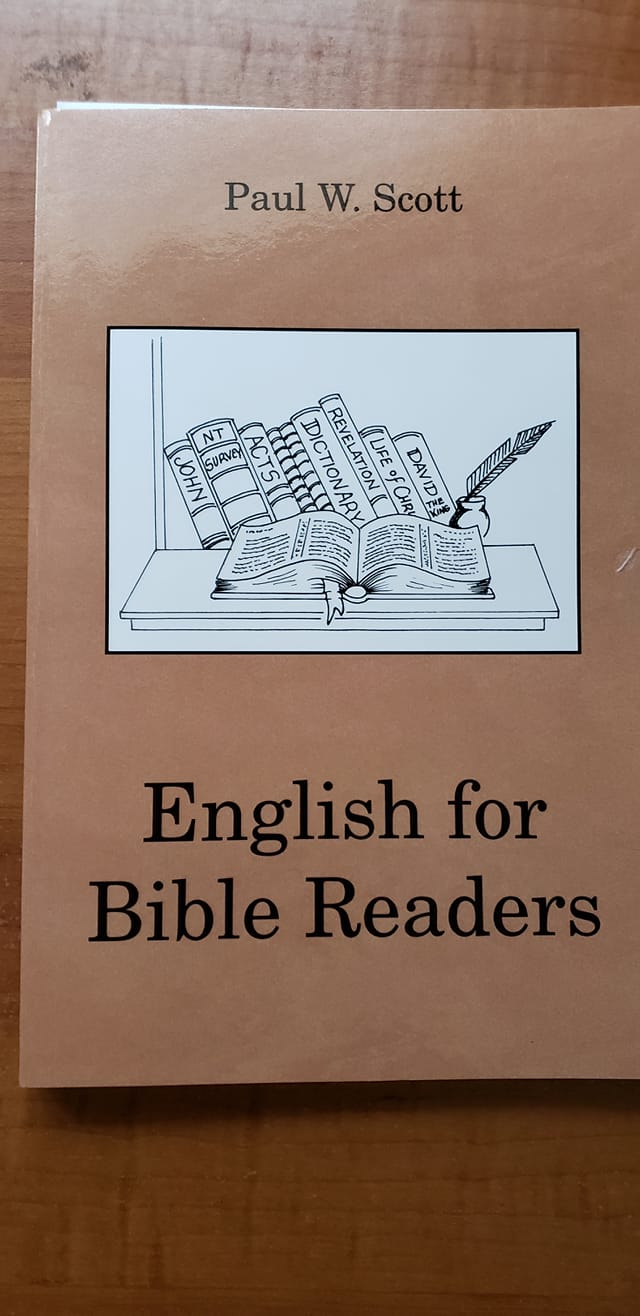
He refers to English for Bible Readers, and we are trying to get him a copy. Well, this is a great blessing! Imagine, in Hanoi, the capitol of Vietnamese Communism, not only is there a Bible study, they are conducting a King James Bible study! (Many of the younger Vietnamese speak some level of English.)
"Therefore, my beloved brethren, be ye stedfast, unmoveable, always abounding in the work of the Lord, forasmuch as ye know that your labour is not in vain in the Lord" (1 Cor. 15:58).
Amen.
Pastor John Asquith, New York, USA: We live in a time when it seems everyone is trying their hand at writing about the King James Bible. Very few of these books and articles have anything new to offer. My surprise was great when I was given a copy of Paul Scott's excellent work, English For Bible Readers.
Here was a book that filled a great void in explaining the vocabulary and the rules (grammar) for the English of the King James Bible. I have long rued the absence of such a book and have seen much mischief done by those ignorant of the rules for the King's English. This book was intended for Vietnamese Christians reading the King James Bible, but in providing for their need, Brother Scott has provided for his own nation's need. To God be the glory.
I can only hope that the reader will find the same satisfaction in reading this work. I have spent thirty years studying the King James Bible, but I felt like a boy in short pants as I turned the pages of this book: I learned something from almost every page. Every Christian English program in every King James-believing school should have this book for a textbook.
Pastor John Asquith, New York, USA
"I consumed English for Bible Readers in short order and am determined to get it into the hands of other men. - Pastor Stephen Charette, Massachusetts, USA
|
|
|
|
Before approaching English for Bible Readers, I had no idea about the deep and wonderful vocabulary as well as the style of the King James Bible. I have seen many people using the other versions, which seem easier to read and understand. However, through this book, I realized that English for Bible Readers is indeed an accurate and wonderful aid in exploring the Bible. I am amazed at the way the King James Bible expresses God's Word, and thanks to Teacher Paul Scott's work, I have explored many interesting revelations that may only exist in the King James Bible.
As you read through English for Bible Readers, you will find this book a very helpful tool to understand more clearly about the powerful Word of God. Also, you can approach a larger knowledge of history, grammar etc, and above all, you can find many answers to your very own needs in this book.
It was a great pleasure for me to be the translator of English for Bible Readers-Vietnamese version. As a translator, and also as a young Vietnamese reader, I have found my inspiration from this source. My prayer is that all readers, especially the readers in Vietnam, will enjoy this book. An amazing point of view is waiting for you to explore and meditate.
Teacher Bao Chau, Vietnam
English for Bible Readers
by Paul W. Scott
English for Bible Readers
Copyright @ 2008 Paul Scott
Unless otherwise indicated, all Scripture quotations are taken from the King James Bible.
ISBN: 978-0-692-00076-2
Cover design by Grant Miller
For more information or additional copies, please contact: Paul Scott 746 Norton Street Rochester, NY 14621 pwscott61@gmail.com
Printed in the United States by Morris Publishing" 3212 East Highway 30 Kearney, NE 68847 1-800-650-788
Table of Contents
Acknowledgments ...... a
Prologue .... .c
Introduction ...... l
History ..... .7
Fidelity & Focus ......... 17
Original Debate ......... 25
Vocabulary ...... 41
Personal Pronouns ....... 51
Reflexive Pronouns .... 63
Relative Pronouns ...... 71
Verbs ..... 79
Auxiliary Verbs ......... 91
Verbs: Past Tense ....... 97
Verbs: Present Tense ..... .101
Verbs: Future Tense ... .. 109
Punctuation ... .113
Conclusion .121
Common Questions ... .125
Final Exam ........... 135
Testimony ................. 139
|
|
|
|
Reconciling Contradictory Passages
Hebrews 9:3 And after the second veil, the tabernacle which is called the Holiest of all;
Hebrews 9:4 Which had the golden censer, and the ark of the covenant overlaid round about with gold, wherein was the golden pot that had manna, and Aaron's rod that budded, and the tables of the covenant;
When the Apostle Paul wrote of the inner chamber of the Tabernacle and listed those things contained therein, he included the golden censer. There is a revelation here and there is a clue here. The revelation is that the High Priest's censer was made of gold. The clue tells you that the Apostle Paul is zeroing in on a particular day when he describes for us what is in the Most Holy Place.
First, let's get one thing straight. There is no "Holy of Holies" in your King James Bible. "Holy of Holies" would be a literal translation of the Hebrew into English if "Holy" was a noun in English like it is in Hebrew. It is not. When you hear a preacher say Holy of Holies, his speech bewrayeth him. You know that he learned his doctrine from the particular point on which he is speaking from commentaries not from reading a King James Bible. Our bible correctly interprets the Hebrew phrase as "the Most Holy Place".
(There are older preachers much more spiritually sound than I will ever be who consistently use unbiblical terms such as Holy of Holies. Our awareness of the majesty of the King James Bible and the profusion of excellent resources to prove its inspiration and excellence were missing in their younger days. Leave them alone. If you want to provoke my ire, run up and rebuke one of these godly men in my presence. What we need to do is train today's younger preachers ( 60 and under) to speak biblically. If the older ones feel a need after years of pleasing God to sharpen their preaching so be it.)
Why did the Apostle Paul place the golden censer in the Most Holy Place when Moses only lists the Mercy Seat for furniture in there? In Hebrews 9:4, the NIV in its never ending bid to make scripture unintelligible clearly contradicts Moses by placing the Golden Altar of Incense in the Most Holy Place; which had the golden altar of incense and the gold-covered ark of the covenant. This ark contained the gold jar of manna, Aaron’s staff that had budded, and the stone tablets of the covenant. The ESV does the same thing.
Fortunately the King James translators were not that ignorant. The truth is that the golden censer was in the Most Holy Place one day every year. Moses describes the High Priest's duty on the Day of Atonement; And he shall take a censer full of burning coals of fire from off the altar before the LORD, and his hands full of sweet incense beaten small, and bring it within the vail, Leviticus 16:12. The clue that we get when reading Hebrews 9:4, is that the Apostle Paul is describing the Most Holy Place as it was on the Day of Atonement while the High Priest was present.
The golden censer is in the Most Holy Place because the High Priest was commanded to take it in with him once a year. You can be sure he also brought it back out. The Apostle Paul has given a snapshot of that day.
If you read the rest of Hebrews Chapter 9, that becomes obvious. To whom is it not obvious? It is not obvious to those who have been taught that the bible is too hard to perfectly translate and that they must always seek outside sources to understand difficult passages. The truth is not obvious to those who search through all of the other versions to get a consensus for the truth.
For those of us who by the grace of our God know that he has fulfilled his promise of a perfect bible by giving us the King James Bible, we wait when we are confused by a seeming contradiction. We approach the contradiction with a humility that says that we are but flesh and our bible is eternally holy. We bow our heads and ask the God of all comfort to comfort us with the understanding that we so clearly lack. We then trust the written words of a King James Bible to show us and we trust the Holy Ghost to enlighten us by using those words.
The King James Bible is the words of the Holy Ghost. He will not speak outside of it. There are passages in my bible in which God has revealed their sense to me in in mere minutes and there are some in which he has taken 5, 10, 15, and even 40 years to ground me in the precepts that I need to understand that given passage. What I will never do is grope in the burning garbage heaps of the new translations or search the draught pits of the lexicons to gain insight. "Trusting your King James Bible" and "trusting God" are synonymous phrases.
|
|
MORE STUDY MATERIALS FROM
AUTHOR JOHN ASQUITH:
CLICK HERE FOR MORE STUDY INFORMATION
John Asquith, Pastor
Black Creek Baptist Church
PO Box 110
Black Creek, NY 14714
FOR ADDITIONAL INFORMATION: GO TO
asquithjm@gmail.com
|
|
|
Further Thoughts on the Word of God: Revised and Expanded Edition
Kindle Edition
This book will: Defend the Integrity of the 400 year editing process that gave us our modern King James Bible.
This book will dispel rumors that the King James Bible was re-translated in the mid 1700s, and also contains history that has not yet been published.
It will strengthen a preacher's confidence in the Bible that he holds in his hand.
John Asquith, Pastor
Black Creek Baptist Church
PO Box 110
Black Creek, NY 14714
FOR ADDITIONAL INFORMATION: GO TO
www.onesoulatatime.net
www.purecambridgetext.com
asquithjm@gmail.com
|
|
|
|
Who Moved the Goal Posts: A Critique of Soul Winning
in the 21st Century
Kindle Edition
This book is: A serious discussion of why we are not seeing new blood in our churches. An Alarm to all who sense that something is wrong. An explanation of why churches cannot show tangible results from soul-winning.
This book will examine changes in our nation's culture and our inability to respond biblically.
John Asquith, Pastor
Black Creek Baptist Church
PO Box 110
Black Creek, NY 14714
FOR ADDITIONAL INFORMATION: GO TO
www.onesoulatatime.net
www.purecambridgetext.com
asquithjm@gmail.com
|
|
|
|
|
Builded or Built
Paul Scott
Sep 12, 2021 4 min read
Both builded and built are past participles of build. Dictionaries, even my beloved Oxford, dismiss the difference. They declare, Builded = Built; it’s simply a poetic, and now archaic, version of built. I have never believed this, but for years wondered without understanding why the Bible translators used both, sometimes within the same sentence:
“For every house is builded by some man; but he that built all things is God.”
- Hebrews 3:4
Surely they knew what they were doing, and didn’t just randomly throw in an archaic or poetic participle. Why would they use one, and then, in a seemingly identical case, use the other?
“…and there builded an altar unto the Lord….and there he builded an altar unto the LORD….” Genesis 12:7, 8
Poetic? Hmmmm, later, the same man, doing exactly the same activity:
“…and Abraham built an altar there….” - Genesis 22:9
We’ve looked into transitive / intransitive verbs, object and subject, and other such grammatical escape hatches – but nothing was conclusive. Until, in daily reading in Nehemiah, something caught my attention. This is early in the eureka!! reaction and so with both excitement and trepidation I present my findings to the blog readers and humbly ask you to judge the value of the nugget: is it real or fool’s gold?
Wall Building
In Nehemiah, chapter 3, the Jews were repairing the wall. In 3:1, they builded. In 3:2, next to him builded. Then, and not randomly, in 3:3, “But the fish gate did the sons of Hassenaah build…” Ah, with the helping verb did, the base verb is used. Why? Why not builded? Keep reading: “…who also laid the beams thereof, and set up the doors thereof, and locks thereof, and the bars thereof.” Something included here that the sentences of builded (3:1,2) did not have: Beams, doors, locks, and bars. Everything necessary to complete this section of wall.
Moving ahead to Nehemiah chapter 3:14,15.
“He built it, and set up the doors thereof, the locks thereof, and the bars thereof.”
He gathered together a complete set of materials and hardware: built is used. This pattern is repeated in 3:15.
Now, the opponents mocked the Jews as they began to repair the wall (4:1-3), word came to Sanballat that “we builded the wall.” (Far from complete or secure: even a fox, if he jumped on the wall, would knock it down!)
But, after the prayers and hard work of the Jews, this declaration,
“So built we the wall, and all the wall was joined together…” (4:6)
Notice the words used in context: all and together. Again, built, not builded, is used. Curious.
It’s my conclusion that Built is associated with the descriptors of the subject: all and together.
So, according to this thesis, in the opposite corner sits builded – and the descriptors associated with this supposed archaic participle are the opposites of all and together: incomplete and separated.
Let’s read on and see if this pans out. Being physically threatened, the Jews had to divide the repairmen into groups, one to affect repairs (while bearing arms) and the other stood guard. While they all were involved, not all were involved with the action of TO BUILD.
“They which builded on the wall….and so builded…” (Neh. 4:17,18)
Here, in describing the actual builders, the poetic past participle is used: builded.
To prove my case, that the KJV translators weren’t just randomly throwing in poetic words (such as builded), but were in fact revealing great details. So, we read on regarding the condition of these builded repairmen:
“The work is great and large, and we are separated upon the wall, one far from another.” - Nehemiah 4:19
Builded = separated (not together). Interesting
Is it tedious to continue with these proofs? I hope not! One more from Nehemiah: in chapter 6: 1, Nehemiah states that the enemies “…heard that I builded the wall…” Here builded is used; but, the wall had no breach left therein. It would seem the wall was completed, and therefore built, instead of builded, should be used. I wonder if the translators, led by the Holy Spirit, recognized the apparent contradiction – for the sentence continues with a parenthetical clause:
“…(though at the time I had not set up the doors upon the gates;) …”
(Neh. 6:1)
Not quite finished; the doors were not set up. Builded is used. Then, after additional intrigue and prayers, he makes a point to tell us he did get the doors set up, and he reports in this context “…the wall was built…” (7:1)
"Now it came to pass, when the wall was built, and I had set up the door…."(7:1)
Now it’s finished, including the doors. Built isused.
Altar Building
Back to Genesis 12:7, 8; 22:9. Is there anything incomplete that would require the use of builded, rather than built? Check out the text of Gen. 22:9: Abraham built an altar there; why use built here? The answer is in 22:8: “ … so they went both of them together.”
Back in the accounts of chapter 12: Isaac, the sacrifice, wasn’t with his father. Builded is used. Later, as recorded in chapter 22, Isaac is present, they are together. Built is used.
House Building
One more case:
“For every house is builded by some man; but he that built all things is God.”
Hebrews 3:4
Following our logic, we would expect to find words such as together and all connected with built; and a sense of incompleteness with builded. And, yes, this holds true here: all things follows built. Also note the actors (the builders): some man = builded; God = built. One is obviously secure, one isn’t.
And yet again, this is consistent with the theme of Hebrews. The First (O.T. system), represented by Moses and the Law, and revealed as some man, was incomplete; unable to complete the job of our salvation. Builded.
The Second (N.T. faith), presented by Christ, revealed as God, is better than the First in every way. It’s complete, it’s all. Built.
And, again, from Nehemiah:
“Now the city was large and great: but the people were few therein, and the houses were not builded” (Neh. 7:4).
Clearly the focus has been on building the wall, not their houses. Their houses were not completed; this is confirmed by the participle builded.
Dictionaries and “experts” have their place, but they often take the east route to explain differences between words like built and builded. Give the translators and the Holy Spirit the benefit of the doubt and thereby find real nuggets along the way. What an excellent communication tool we have in the Early Modern English of the Authorized Version (KJV).
Nugget or fool’s gold?
|
|
|
|
|
5 min read
A Simple Bible Study
But the anointing which ye have received of him abideth in you, and ye need not that any man teach you: but as the same anointing teacheth you of all things, and is truth, and is no lie, and even as it hath taught you, ye shall abide in him, 1st John 2:27.
Perhaps one of the greatest stumbling blocks to really understanding the bible is the lie that you need some man to teach you. This statement may seem hypocritical coming from a man who teaches the bible. I think that everyone can agree that the simple basics of the bible should be taught to everyone in their youth or sometime after they first become acquainted with the bible. Such teaching is for beginners or for those who have strayed through carnality. For when for the time ye ought to be teachers, ye have need that one teach you again which be the first principles of the oracles of God; and are become such as have need of milk, and not of strong meat, Hebrews 5:12.
At the Black Creek Baptist Church as I am sure many churches do, we use Sunday School to augment the bible instruction for young people who do not get it at home. There we hope to give the students the general body of Christian knowledge concerning the bible itself and important bible stories and principles. We are blessed to have teachers who truly love their students and truly care that they learn the precepts of God.
Where we differ from many churches is our encouragement to the people to study their bibles for themselves. Evangelist Timothy McVey has pointed out that in most revival meetings the emphasis of altar calls is to call the people to greater service. An evangelist gets up and preaches one of his 20 or so stock messages. When he is done, he gets the piano player to play some hymn while he softly asks all of the people who have heads bowed and eyes closed if they are doing enough for God. He then invites them up to the altar to get that right with God.
The result in most of our Fundamental Baptist Churches is a body of members who are worn out as the church shrinks year by year. We have not had to emphasize service here in Black Creek. God has blessed us with a few who are happy to serve. What we emphasize is for them to know God better. They won't do that by hours of prayer. If you think that hours of prayer will help you know God better, go join a cloistered monastery or convent. Prayer is when you talk to God. I'm all for that, but you don't learn about a person by talking to them. You learn about a person by listening to them.
The King James Bible is how to listen to God. The better you know your bible, the more you will know about God. I am not denying that there are times when the Holy Ghost impresses certain thoughts or ideas onto someone's consciousness. I just know that all cults, false teachers, mystics, bible correcters and just about everyone else claims to get special prodding or insight from God. The only way to discern whether or not that prodding is holy and from God is to be in harmony with a King James Bible. To the law and to the testimony: if they speak not according to this word, it is because there is no light in them, Isaiah 8:20. The way false teachers get around that is to search through various versions until they find one that agrees with their inner thoughts. A King James Bible is security against that.
One study that I give my people is the study of the Tabernacle. Once it finally occurs to you that there is no revelation on this earth about the Tabernacle that is not contained in the words of a King James Bible, you can research the Tabernacle for yourself without teaching aides. Get a piece of paper and draw a simple outline of the Tabernacle walls. Make an inch to be a cubit or use some other ratio, but draw an outline of the walls by just using the text of your bible.
Once you have that basic outline, begin to make simple drawings of each piece of the Tabernacle. Keep in mind that everything that God told Moses is written for us in English. We may not know what a horn looked like, or how Bezaleel formed the crown of certain objects, but we can know the exact dimensions of each object. Draw them with what ever skill level you have. I have almost no skill in drawing but with a ruler for a straight edge and with a King James Bible, I was able to draw each piece.
The next step is to locate the place of each piece in the simple drawing you have of the Tabernacle itself. Even these simple things that I have instructed you to do can be vexing. If you wrestle them out and not cheat by looking up other drawings of the Tabernacle, you can eventually get it. There are few greater satisfactions in bible study than to be stymied by something that you just can't seem to see, pray to God to help you find it, and then eventually find the key to that puzzle written in some other place in the bible than where you had been looking.
It is this kind of study that will turn you into a doctrinal bible believer. The King James Bible movement is a big tent. There are many in its ranks who can expound the historical accuracy of our King James Bible and then ignore what it says doctrinally. I teach my people that there are historical bible believers and there are doctrinal bible believers.
It is the King James Bible and the King James Bible alone which will make you into a doctrinal bible believer. I see my role as a pastor and a teacher not as a quarterback calling the plays, but as a blocker in a running play. I give my people the ball and try to use my preaching to block all of the pitfalls that will slow them down or tackle them. It is my joy to see my people run with the word of God and slowly be able to comprehend with all saints what is the breadth, and length, and depth, and height; And to know the love of Christ, which passeth knowledge, that ye might be filled with all the fulness of God, Ephesians 3:18,19. Learning the breadth, and length, an depth, and height is joy to a bible believer. Start with the Tabernacle.
Trust your King James Bible.
CLICK HERE FOR MORE STUDY INFORMATION
|
|
|
|
Dr. John M. Asquith 10/17/21
4 min read
Reconciling Contradictory Passages
Hebrews 9:3 And after the second veil, the tabernacle which is called the Holiest of all;
Hebrews 9:4 Which had the golden censer, and the ark of the covenant overlaid round about with gold, wherein was the golden pot that had manna, and Aaron's rod that budded, and the tables of the covenant;
When the Apostle Paul wrote of the inner chamber of the Tabernacle and listed those things contained therein, he included the golden censer. There is a revelation here and there is a clue here. The revelation is that the High Priest's censer was made of gold. The clue tells you that the Apostle Paul is zeroing in on a particular day when he describes for us what is in the Most Holy Place.
First, let's get one thing straight. There is no "Holy of Holies" in your King James Bible. "Holy of Holies" would be a literal translation of the Hebrew into English if "Holy" was a noun in English like it is in Hebrew. It is not. When you hear a preacher say Holy of Holies, his speech bewrayeth him. You know that he learned his doctrine from the particular point on which he is speaking from commentaries not from reading a King James Bible. Our bible correctly interprets the Hebrew phrase as "the Most Holy Place".
(There are older preachers much more spiritually sound than I will ever be who consistently use unbiblical terms such as Holy of Holies. Our awareness of the majesty of the King James Bible and the profusion of excellent resources to prove its inspiration and excellence were missing in their younger days. Leave them alone. If you want to provoke my ire, run up and rebuke one of these godly men in my presence. What we need to do is train today's younger preachers ( 60 and under) to speak biblically. If the older ones feel a need after years of pleasing God to sharpen their preaching so be it.)
Why did the Apostle Paul place the golden censer in the Most Holy Place when Moses only lists the Mercy Seat for furniture in there? In Hebrews 9:4, the NIV in its never ending bid to make scripture unintelligible clearly contradicts Moses by placing the Golden Altar of Incense in the Most Holy Place; which had the golden altar of incense and the gold-covered ark of the covenant. This ark contained the gold jar of manna, Aaron’s staff that had budded, and the stone tablets of the covenant. The ESV does the same thing.
Fortunately the King James translators were not that ignorant. The truth is that the golden censer was in the Most Holy Place one day every year. Moses describes the High Priest's duty on the Day of Atonement; And he shall take a censer full of burning coals of fire from off the altar before the LORD, and his hands full of sweet incense beaten small, and bring it within the vail, Leviticus 16:12. The clue that we get when reading Hebrews 9:4, is that the Apostle Paul is describing the Most Holy Place as it was on the Day of Atonement while the High Priest was present.
The golden censer is in the Most Holy Place because the High Priest was commanded to take it in with him once a year. You can be sure he also brought it back out. The Apostle Paul has given a snapshot of that day.
If you read the rest of Hebrews Chapter 9, that becomes obvious. To whom is it not obvious? It is not obvious to those who have been taught that the bible is too hard to perfectly translate and that they must always seek outside sources to understand difficult passages. The truth is not obvious to those who search through all of the other versions to get a consensus for the truth.
For those of us who by the grace of our God know that he has fulfilled his promise of a perfect bible by giving us the King James Bible, we wait when we are confused by a seeming contradiction. We approach the contradiction with a humility that says that we are but flesh and our bible is eternally holy. We bow our heads and ask the God of all comfort to comfort us with the understanding that we so clearly lack. We then trust the written words of a King James Bible to show us and we trust the Holy Ghost to enlighten us by using those words.
The King James Bible is the words of the Holy Ghost. He will not speak outside of it. There are passages in my bible in which God has revealed their sense to me in in mere minutes and there are some in which he has taken 5, 10, 15, and even 40 years to ground me in the precepts that I need to understand that given passage. What I will never do is grope in the burning garbage heaps of the new translations or search the draught pits of the lexicons to gain insight. "Trusting your King James Bible" and "trusting God" are synonymous phrases.
CLICK HERE FOR MORE STUDY INFORMATION
|
|
|
|
Understanding
Dr. John M. Asquith
Oct 7, 2021 3 min read
Understandest thou what thou readest?, Acts 8:30.
There are still places in a King James Bible that I have no idea why they say what they say. For over 40 years, when I have read such a passages I have wondered. The last things that I ever intend to do about those passages is to consult a commentary or to consult a lexicon in an attempt to decipher the meaning by borrowing some alternative meaning for a Greek or Hebrew word.
In that period of time, I have had many passages come alive for me. Passages that for 25 to 30 years had seemed incomprehensible to me suddenly made sense as I read them. Over the many years when those passages had seemed dark to me, I slowly built my knowledge and understanding in other passages. Like tumblers in a combination lock, as I slowly learned and understood more about supporting passages to a particular place, the passage that had so vexed me unlocked its meanings for me.
There is simply no substitute for understanding the word of God other than to allow precept to be added to precept and line to be added to line.
Isaiah 28:10 For precept must be upon precept, precept upon precept; line upon line, line upon line; here a little, and there a little:
Isaiah 28:11 For with stammering lips and another tongue will he speak to this people.
We have the word of God in this other tongue and through it God speaks to us. What is all too often lacking is understanding. The devil has wrought havoc in the churches by this lack of understanding. Through thy precepts I get understanding: therefore I hate every false way, Psalm 119:104.
There is a three pronged approach to understanding the bible.
1. There must be a perfect bible that the reader can trust. Recently, Brother Paul Scott published a post titled Builded or Built. Some time ago, he had contacted me and noted that the King James Bible used both forms of the word "build". When he saw that both words were in use and even were used in the same verse (Hebrews 3:4) he realized that each word had a slightly different meaning. How did he know that? He knew that they had different meaning because he believed the text in front of him. He knew that it was never arbitrary or haphazard for any particular word to be used. There is always a reason and it is to God's pleasure to reveal that reason. Trusting that the bible in front of us is always the first step.
By believing what he saw written, Brother Scott was able to resist the dictionaries that said that the words were synonymous. Clearly they were not synonymous in a King James Bible. He then was able to look at each word as it was used in context and God showed him the difference.
2. God must give a person understanding. Apart from receiving the Holy Ghost in John 20:22, and utterly separated from the Day of Pentecost, Jesus Christ opened the understanding of his disciples. Then opened he their understanding, that they might understand the scriptures, Luke 24:45. Understanding does not come naturally to men. The Apostle Paul spoke of the natural state of man when he said; There is none that understandeth, there is none that seeketh after God, Romans 3:11.
No man ever sought God until God enabled him to seek. Just as a palsied man could not stretch forth his hand until he heard Jesus Christ command him to do so, a sinner is unable to seek God until he hears the command to seek God through the preaching of the word of God. So is the man who would seek to understand the things of God. Let him ask the Lord to open his understanding. That was some of the best advice that I ever got as a young man.
3. A man or woman who seeks to understand must pay a price. Study to shew thyself approved unto God, a workman that needeth not to be ashamed, rightly dividing the word of truth, 1st Timothy 2:15. Solomon said; much study is a weariness of the flesh, Ecclesiastes 12:12. There is a occasional joy to bible study, but there is more often than not a weariness to the flesh. Reading the bible and studying the bible are two distinctly different things. a person who seeks to understand and know God must do both.
|
|
Does Gender Matter?
Dr. John M. Asquith
Sep 22, 2021 3 min read
That every man should let his manservant, and every man his maidservant, being an Hebrew or an Hebrewess, go free; that none should serve himself of them, to wit, of a Jew his brother, Jeremiah 34:9.
The Prophet Jeremiah was very specific when he recorded the liberty that King Zedekiah proclaimed for the people. Every man was to release his manservants, and every man was to release his maidservants. Whether the person was an Hebrew (male) or a Hebrewess (female) mattered to God. Our King James Bible preserves that gender specific language. The new bibles gloss over such old fashioned gender specific terms as Hebrewess by just saying, "whether they be male or female". Does that matter?
It matters if you want a perfect bible without error. A Moabite was not allowed into the Congregation of Israel even unto the 10th generation. An Ammonite or Moabite shall not enter into the congregation of the LORD; even to their tenth generation shall they not enter into the congregation of the LORD for ever, Deuteronomy 23:3. If a Moabite could not enter into the Congregation of the Lord forever, how did Ruth enter in? Why was David made King if a Moabite could not enter in even to the tenth generation?
The answer is simple. Ruth was not a Moabite. The NIV calls her a Moabite as in Ruth 1:22: So Naomi returned from Moab accompanied by Ruth the Moabite. The ESV calls her a Moabite in the same place as well as every other place that it can: So Naomi returned, and Ruth the Moabite her daughter-in-law with her. The word of God does not call her a Moabite; So Naomi returned, and Ruth the Moabitess, her daughter in law, with her, which returned out of the country of Moab: and they came to Bethlehem in the beginning of barley harvest, Ruth 1:22.
We have an exact bible. Even though there are distinct different words for a male and a female Moabite or Moabitess, God did not ban a Moabitess from entering the congregation. He banned the Moabite. God made provision for bringing enemy females into the congregation.
Deuteronomy 21:10: When thou goest forth to war against thine enemies, and the LORD thy God hath delivered them into thine hands, and thou hast taken them captive,
Deuteronomy 21:11: And seest among the captives a beautiful woman, and hast a desire unto her, that thou wouldest have her to thy wife;
Deuteronomy 21:12: Then thou shalt bring her home to thine house; and she shall shave her head, and pare her nails;
Deuteronomy 21:13: And she shall put the raiment of her captivity from off her, and shall remain in thine house, and bewail her father and her mother a full month: and after that thou shalt go in unto her, and be her husband, and she shall be thy wife.
The problem with the new versions is that no one expects minute accuracy. God intended that we have a bible that is correct in every jot and tittle. It is impossible for a King James Bible to contradict itself in any passage as long as the reader keeps in mind the context with which he is dealing. No other version can say that. Surprise, surprise, gender matters in the word of God! You probably have friends who are angry over the modern gender confusion going on in our culture and then proudly carry a new version which coyly goes along with the confusion. Stick to your King James Bible. There are no errors in it.
|
|
Dr. John M. Asquith Sep 9, 2021 5 min read
Principles of Interpretation II
But they could not shew the interpretation of the thing, Daniel 5:15.
Why couldn't the wise men of Babylon show the interpretation?, because they did not have the word of God. The first and foremost principle of interpretation is that without the word of God there can be no certainty. I am not saying that all King James Bible believers have identical interpretations of all major passages of the bible. What we have in harmony is that we know that the truth is contained within the pages of our King James Bible. The truth is in the actual text itself, and that any person with average intelligence who can read English, and has a relationship with the Holy Ghost can be given an understanding as good as any person who ever read the original manuscripts.
In fact, we have an advantage over any person with the original manuscripts. The people at Thessalonica who received Paul's two letters had those and copies of some other letters as well as access to the Old Testament. In our King James Bible we have the complete infallible scriptures in a readable and accessible format, all in one language. What follows will be three principles of interpretation that can guide the bible believer.
How do we know when a psalm is messianic? In other words, just as the Ethiopian Eunuch asked Phillip, of whom speaketh the prophet this? of himself, or of some other man?, Acts 8:34. How do we know when we read a psalm whether the writer is speaking of himself or he is speaking of the coming Messiah? We follow Peter's lead in Acts 2.
When Peter addressed the crowd who gathered on the Day of Pentecost, he had their attention, but the crowd came out of curiosity not out of a sense that he had apostolic insight. When he quoted Psalm 16 he stated that David was speaking of Jesus Christ. Today we accept that because we know that he spoke as given understanding from God. The crowd before him needed to be convinced.
Acts 2:25: For David speaketh concerning him, I foresaw the Lord always before my face, for he is on my right hand, that I should not be moved:
Acts 2:26: Therefore did my heart rejoice, and my tongue was glad; moreover also my flesh shall rest in hope:
Acts 2:27: Because thou wilt not leave my soul in hell, neither wilt thou suffer thine Holy One to see corruption.
Acts 2:28: Thou hast made known to me the ways of life; thou shalt make me full of joy with thy countenance.
What Peter did was to reason with them.
Acts 2:29: Men and brethren, let me freely speak unto you of the patriarch David, that he is both dead and buried, and his sepulchre is with us unto this day.
Acts 2:30: Therefore being a prophet, and knowing that God had sworn with an oath to him, that of the fruit of his loins, according to the flesh, he would raise up Christ to sit on his throne;
Act 2:31 He seeing this before spake of the resurrection of Christ, that his soul was not left in hell, neither his flesh did see corruption.
What he reasoned was that Psalm 16 could not possibly apply to David the author of the psalm because the psalm stated, neither wilt thou suffer thine Holy One to see corruption. It was obvious to all who listened to Peter that day that King David did see corruption. He was in a tomb in Jerusalem. Peter left them no choice. If a psalm says something in the first person such as saying "I" or "me", and it was not possible for that psalm to be speaking of the author himself, the psalm is a messianic psalm. It speaks of Jesus Christ.
Using that reasoning, look at Psalm 22: 16, they pierced my hands and my feet. Ask yourself the question, in all of the passages describing the life of David, is there a time when his hands and feet were pierced? No, there was not. Therefore the Messiah will have his hands and his feet pierced. It really is that simple. As you go through the psalms, there will be places where the psalms disrupt certain theologies when that rule is applied, but either Peter's reasoning was right or it was wrong. If a psalm states something as if it is happening to the author, and yet it cannot be the author, then the psalm is messianic.
Having an exact bible means that you can trust whether a word is plural or singular. That may seem like a very small matter but the Apostle Paul found meaning in passages such as Genesis 22:17 wherein Moses wrote, and thy seed shall possess the gate of his enemies. Earlier, when Moses wrote of Abraham's seed he made it plural. Know of a surety that thy seed shall be a stranger in a land that is not theirs, Genesis 15:13.
Even though the Book of Genesis was written 1400 years earlier, the apostle trusted whether a word was plural or singular. He didn't say, " By revelation I know that Christ is the seed of Abraham". He merely trusted that those who read his letter would trust a 1400 year old text. He didn't need any divine revelation beyond the word of God itself as it sat in front of him after 1400 years.
The next thing that the Bible believer can use to properly interpret a passage is to look at the tense of a verb. When the Sadducees tempted Jesus Christ about the doctrine of the resurrection from the dead, they made up a scenario in which after a man had died without his wife ever giving birth, the man's brother married him. In turn, that brother died only to be replaced by another brother. Then the Sadducees played their trump card; Therefore in the resurrection whose wife shall she be of the seven? for they all had her, Matthew 22:28.
Jesus Christ quoted Moses to answer them and in doing so he trusted the tense of the verb in a verse that on the surface had nothing to do with the resurrection.
Mat 22:31: But as touching the resurrection of the dead, have ye not read that which was spoken unto you by God, saying,
Mat 22:32: I am the God of Abraham, and the God of Isaac, and the God of Jacob? God is not the God of the dead, but of the living.
God did not say "I was the God of Abraham", he said, I am the God of Abraham. As the Lord spoke to Moses, it was understood that Abraham was with God at that moment. Their relationship was not ended by his death. The absolute only thing that God used to prove that was the tense of the verb from a 1400 year old text.
When you are reading the words of a King James Bible, there is no need to run to commentaries, lexicons or other devices to understand what a passage is saying. Trust it as it is. One of the truly great things that I learned from Dr. Peter Ruckman was that if a man changes any word in a text, it is because what he is teaching is not what the text actually says. Look at what the text says. If you can not understand it, bow your head and pray.
I have had passages allude me for decades only to come to life at a far distant time when I was better prepared to understand. I am so glad that I did not run to some man's writings to get the understanding. By trusting the verse just as they were written, and by patiently waiting, the Lord was eventually able to give me an understanding such as I never would have had if I had had a man teach me.
The first rule of bible interpretation is to trust the word of God as it is written. That is a King James Bible.
|
|
Dr. John M. Asquith Sep 1, 2021 4 min read
Principles of Interpretation: Part I
Do not interpretations belong to God? Genesis 40:8.
Most people do not get their bible interpretations from the bible itself. They subscribe to a particular theology or understanding of certain bible doctrines based on their denomination, peer group, or commentaries. The idea that the average person of average intelligence and average education can pick up a bible and understand it to the point of settling major theological questions is simply absurd to the world at large.
One barrier in the world's thinking is that they don't believe that they have the complete and accurate word of God. To them, reading a bible is a religious exercise, not a means of gaining infallible truth. When they see a King James Bible believer exposit a doctrine or defend a position based on the words of the King James Bible and only on the words of a King James Bible, they assume the King James Bible believer is trapped in some legalistic web wherein he is afraid to peek at other versions.
The best mathematicians in the world could not solve an algebraic inscription on an ancient wall if some of the numbers were missing or their veracity was in doubt. Different mathematicians would get differing answers if the scholars who fed them data gave them differing numbers based on their hunches as to what the original equation said. Likewise, any puzzle involving logic can not be solved with any accuracy if any of the facts are in doubt or missing.
The bible works no differently. Granted, we have an advantage over the mathematician seeking to solve an ancient inscription or the logician who seeks to solve an ancient logistical puzzle. We have the spirit of the author of the bible living within us. Now we have received, not the spirit of the world, but the spirit which is of God; that we might know the things that are freely given to us of God, 1st Corinthians 2:12. Nevertheless, God communicates to us in words. His spirit is there to give us an understanding of those words, but without those words the spirit does not communicate anything above the level of feelings. God promised us something better.
As for me, this is my covenant with them, saith the LORD; My spirit that is upon thee, and my words which I have put in thy mouth, shall not depart out of thy mouth, nor out of the mouth of thy seed, nor out of the mouth of thy seed's seed, saith the LORD, from henceforth and for ever, Isaiah 59:21. Heaven and earth shall pass away, but my words shall not pass away, Mark 13:31. Could anything be more clear than those two verses? The first principle that needs to be understood in being able to interpret the bible is that the words of God have been miraculously preserved on this earth and that they are accessible to the common man.
Where could a person find such words? Hint! Hint! The Apostle Paul told you where to look:
Romans 3:1: What advantage then hath the Jew? or what profit is there of circumcision?
Romans 3:2: Much every way: chiefly, because that unto them were committed the oracles of God.
When the Apostle Paul spoke of the Jews in the Book of Romans, he was not talking about converted Jews who had embraced the cross of Jesus Christ. He went so far as to tell us that; As concerning the gospel, they are enemies for your sakes: but as touching the election, they are beloved for the fathers' sakes, Romans 11:28. God has not stopped his love for the Jews, but they have rejected the gospel of Jesus Christ. It is to these same people that God committed the oracles of God. It was to them that the promise of Isaiah 59:21 was made. They are the people carrying about a perfect Old Testament in Hebrew.
It is telling that the modern versions uniformly reject the text carried by those same Jews. The translators and compilers of the new bibles do not believe that there is a book anywhere on this earth that is 100% the words of God. The Old Testament in the King James Bible is the interpretation of those Hebrew words carried by those Jews and commended by the Apostle Paul into a classical form of English writing that preserves the nuances and accuracy of the Hebrew Language.
The new versions are a hodge-podge of guesses by various scholars as to what they think the text should be based on many sources other than the text the Apostle Paul endorsed. The very premisses of those versions are that you, the average person on the street are not smart enough to think in the carefully crafted words of the King James Bible even though all of your forefathers who did not speak King James English could. And, they believe that the promises of Isaiah 59:21 and Mark 13:31 misfired.
If your King James Bible is practically the only English version that believes the Hebrew Text as the good apostle told us to trust it, you can have great confidence that it has the New Testament straight also. The history of how that text came to us is long and meanders through many people and places, but is available in books written by many different authors. A person does not have to tie up part of his or her intellect to believe that they have a perfect scripture. There is a perfectly accessible road map from the present day back to the apostles' time which documents the accuracy of the King James Bible for those who care to look.
To interpret the bible properly, you must have the proper words.
|
|
INTRODUCTION TO THE NEW SERIES ...
LONG OVER DUE! (9/28/21)
GOOD INTRODUCTION
INCLUDING MOST RECENT POSTS!
One of the most important responsibilities
Christians have is to study the
Scriptures for themselves.
IF WE STUDY AND LEARN THE TRUTH … THEN THE LIES WILL STICK OUT LIKE A ‘SORE THUMB” … IF YOU ARE A BORN-AGAIN BELIEVER IN CHRIST INDWELLED BY THE HOLY SPIRIT AND HAVE DISCERNMENT! … I Corinthians 2:14
This is true of any subject in life! Any subject! The Bible is a benchmark for the TRUTH! Any TRUTH! If you study and learn the truth about the Historical Baptist Distinctives you will readily see the falsehoods that (most) of all the (other) ‘religions and cults’ that are not based on Baptistic Theology and Distinctives have. If you use modern versions and not the King James Bible and listen to false teachers (Jude 3) you will become very confused!
|
|
ANNOUNCING THE NEW SERIES ...
LONG OVER DUE! September 24, 2021
Behold, the days come, saith the Lord GOD, that I will send a famine in the land, not a famine of bread, nor a thirst for water, but of hearing the words of the LORD: Amos 8:11.
There has been a 50 year push in most Evangelical or Fundamental churches to tell as many people as possible about Jesus Christ. At the end of that 50 year push, far fewer people know or understand Jesus Christ than ever before. Regardless of anyone else's theology, I have found that explaining to people that God's word is here on this earth, that it is perfect and that they can know it has done more to awaken people to righteousness than anything else.
Booker T. Washington once said that he wearied of young ex-slaves who had been sent off to Europe for a fancy education by wealthy do-gooders. He said they could dress fancy and discourse for hours on the various interest rates of European bonds and stocks but couldn't understand why their fathers lost a dollar on every bale of cotton they sold. Our bible colleges and local church institutes have spewed forth their modern equivalent in the ministry.
We have young men who dress right, preach well, and have very fundamental theologies. They cannot get a neighborhood to change. They can't get a family to change and they can't get an individual to change. They are utterly impotent. Their idea of soul winning is the Baptist Sacrament wherein they get people to pray their little prayer and pretend that these people truly believed.
What do tadpoles become? If you said, "frogs" you are about .001% right. Most tadpoles become fish food. Very few ever become frogs. What do these hapless victims of the Baptist Sacrament become? If you said, "saints of God" you are less accurate than your first answer. Our towns and cities all over America are filled with people who have been run through the mill of easy believism only to blend back into the sin laden lifestyles wherein the preacher found them.
The Black Creek Baptist Church is in Allegany County New York which lost 5% of its population in the last census and is down to 46,456 people. Most industry has moved out. Our township which is quite large has 700 people. A good portion of them are Amish who would never come to one of our services. In 14 years we have gone from an average attendance of 15 to 25 to an average of 60 to 80. We have drawn many people from broken drug sotted homes who had fallen through every safety net. Many of their lives are irrevocably changed. Doctors have noticed, social workers have noticed and the men who stock beer in the convenience stores have noticed.
My emphasis to the broken victims of New York State's overworked welfare system and the broken families and discouraged population is that there is a bible. It is the King James Bible. God speaks to us. We have the absolute, 100% true words of the living God. I teach them to read it. I teach them to apply it to their lives. As their lives improve, they begin to realize that the bible they are reading is indeed true. At some point they begin to tremble over the sin in their lives and become soundly converted by Jesus Christ.
I am no longer interested in debating the "theologically pure" who are quite sure that my ways are wrong. I just intend to teach a lost a dying world that the King James Bible is the word of God and that it is infallible and that they themselves can know what it says. The people who have received that teaching can't get enough church. They come for Sunday School, two services on Sunday, Wednesday Night, and they come to Thursday Night Bible Study. I hear complaints that we don't have enough meetings. My church is filled with actual converts as well as some who have drifted from other churches.
With all of that said, I am developing a bible institute degree to teach the King James Bible itself. I want them to know its vocabulary, its history, the history of England and of the English Language. I want them to be familiar with the various arguments for and against it. I want them to be sound in presenting the word of God, defending the word of God and then, and only then, preaching the word of God. If a man does that, Jesus Christ will be glorified and lives will change.
Here is a representative course that we are offering. If you want to take the course on your own, please feel free to do so. For this course we are using Will Kinney's website which he has graciously made available to the world at large. He is not associated with us, but we are indebted to him.
Brand Plucked Web: The Essential Will Kinney
Course Description:
This course will familiarize the student with the writings and research of Will Kinney. His website, Brandplucked.webs.com is probably the largest and most comprehensive compilation of defenses and explanations for the integrity of the King James Bible. As long as the internet continues in its current form, most challenges to the King James Bible whether they be historical, doctrinal, or linguistic can be successfully researched on Mr. Kinney’s site. The goal of this course is to make the student able use this site when researching difficult questions concerning our King James Bible.
Requirements:
1. Watch the first video under the heading; KJB Videos titled, Did God preserve His Inerrant words and are they found in the. King James Bible.
A. What are the four positions outlined by Will Kinney as the only four possible positions concerning the preservation of the word of God? List them and give a brief explanation of each position.
B. Considering position #4, explain in detail how Mr. Kinney helped you understand the position of an inerrant King James Bible.
C. Take one of the other 3 positions and refute it in more detail using your own words as if you were defending the King James Bible from a person who held that position.
2. Read the Article, Reasons why the King James Bible is the absolute Standard- God’s Historic Witness to the Truth.
A. Write a 500 words or more essay summarizing Mr. Kinney’s reasoning.
3. Read the Article, The Old Fashioned language of the King James Bible, subtitled, The “Old Fashioned Language” of the King James Bible “Archaic and Inerrant” beats “Modernized and Wrong Any Day of the Week.
A. Read the link on the 40 concrete examples of falsehoods taught by these fake bible versions. Choose 5 of them and explain why they are so dangerous.
4. Under the Heading KJB Videos, select 25 of the videos. Watch each of the 25 and summarize each video.
5. Using Google, type in a verse from scripture and then write Brandplucked after it. Briefly write what you found.
6. Write a final paper on how Will Kinney has helped you to appreciate the King James Bible. In that paper explain how his refutation of false versions helped as well as his explanations about the truth of the King James Bible. Minimum 1000 words.
|
|
THE FOLLOWING ARE PREVIOUSLY
PUBLISHED POSTS FOR YOUR EDIFICATION
|
|
Matthew 7:13-14 KJV By Bill Brinkworth
Enter ye in at the strait gate: for wide is the gate, and broad is the way, that leadeth to destruction, and many there be which go in thereat: 14 Because strait is the gate, and narrow is the way, which leadeth unto life, and few there be that find it.” Matthew 7:13-14 KJV
There are many that claim to be Christian, but are not! They are heathen. Heathen are the unsaved, and those bound for Hell. Calling themselves Christians will not make them saved. Examine what the Bible says about heathen cloaked under the name “Christian”:
- Heathens are sometimes called Christians or God’s people.
- “… That they may possess the remnant of Edom, and of all the heathen, which are called by my name, saith the LORD that doeth this.” Amos 9:11-12
- This verse is speaking of a time not yet come, but the principle applies to these latter days. Not all that claim to be children of God are children of God
- Heathens pray.
- “… But when ye pray, use not vain repetitions, as the heathen do: for they think that they shall be heard for their much speaking.” Matthew 6:6-7
- It is ironic that the outline for prayer (Matthew 6:9-13) that follows these verses is what many so-called “Christian” faiths vainly (without thought or meaning, empty of feeling) pray over and over.
- Heathens have religion also!
- “… This people draweth nigh unto me with their mouth, and honoureth me with their lips; but their heart is far from me. But in vain they do worship me, teaching for doctrines the commandments of men.” Matthew 15:7-9
- There have always been those that believe themselves to be children of God, but were not. It was the religious that had killed Jesus and persecuted His followers.
- Heathens can think God is using them. (However, many times Satan, the deceiver, is blinding them, and deceiving them with false miracles from “God”.)
- “Wherefore by their fruits ye shall know them. Not every one that saith unto me , Lord, Lord, shall enter into the kingdom of heaven; but he that doeth the will of my Father which is in heaven. Many will say to me in that day, Lord, Lord, have we not prophesied in thy name? and in thy name have cast out devils? and in thy name done many wonderful works? And then will I profess unto them, I never knew you: depart from me, ye that work iniquity.” Matthew 7:20-23
- Heathens can go through religious routines and rituals.
- “Then shall ye begin to say, We have eaten and drunk in thy presence, and thou hast taught in our streets. But he shall say, I tell you, I know you not whence ye are; depart from me, all ye workers of iniquity. There shall be weeping and gnashing of teeth … and you thrust out.” Luke 13:26-28
- They went to the house of God, but that didn’t make them His.
Many are religious, but lost. People may think they are Christians, but may not be. There is only one way to be a child of God — God’s way.
“… Except a man be born again, he cannot see the kingdom of God.” John 3:3.
Are you “born again”? Are you going to Heaven by God’s narrow way of trusting Christ’s payment for your sins with His blood? Or are you a heathen bound for Hell?
|
|
“Walk in wisdom toward them that are without, redeeming the time. ” Colossians 4:5 KJV
God said we are to walk in wisdom concerning the lost. Did you ever stop to think about it? That man, unsaved out there, is related to us about using our time. That is what God said, “…toward them that are without, … ” in order to reach them. Did you ever stop to think that a man out there puts a higher value on Christian living than he does about Christian doctrine? He never thinks much or wonders, “What do those people do over there at that Baptist church? But he thinks an awful lot about, “I wonder how those people at that Baptist church live?” This is uncanny about how unsaved people think of saved people.
The salvation of a man’s soul depends greatly upon what he thinks of you. You mark it down, not so much what he thinks of the Bible, or what he thinks of Jesus, or what he thinks of preaching. But the salvation of many a lost person depends on what he thinks of you and I as a Christian.
Our own estimation of your spiritual self, will determine what you do in the matter of time and witnessing to somebody else. I believe with all my heart, that a lot of people never witness or use their time to get someone saved, because of a poor estimation of their own spiritual life. God says, “Walk in wisdom toward them that are without, redeeming the time. ”
God has made us managers of time. — T.M.
Prepared by Roger Fulk, from the “Baptist Bread” August, 25, 2021 devotional by author Dr. Tom Malone (Deceased), Pontiac, MI. With permission from Tim Green, editor Baptist Bread.
One of the most important responsibilities Christians have is to study the Scriptures for themselves. Church is important, and one can learn quite a lot from the man of God in the pulpit, but it is up to us to study and understand what the Word of God says.
“Study to shew thyself approved unto God, a workman that needeth not to be ashamed, rightly dividing the word of truth.” II Tim. 2:15
II Timothy 2:15 teaches us five things about studying the Word of God:
|
|
When you sign up for our mailing list, you will be able to ... "Stay tuned" for news and updates delivered straight to your inbox. Here you will find many different subjects with information and resources for your learning/teaching needs! WE WANT TO WELCOME YOU TODAY!
|
|
The purpose of this Blog is to teach about Jude 3
It has been said there is a big lack of 'WARNING MINISTRIES" in churches. This is a teaching resource to help people and churches understand more about Jude 3 and other related scriptures.
Read more
awarningministry.com
|
|
|
|
|
|
This Blog will teach about MANY SUBJECTS!
Here is an example! Another interesting question! And ... there are many more ... Just Stay 'Tuned'.
Read more
awarningministry.com
|
|
|
|
|
|
|
|
About The Author Roger Fulk |
This is another Blog Post and I hope you enjoy this! It's about a WOLF WATCH MINISTRY FALSE TEACHING EXPOSED!. Please stay tuned. We have plenty of excellent content! |
|
|
This subject may not be of interest to everyone, however we have found there is much confusion about it! We aim to help people learn about this subject for teaching and learning purposes! Keep coming back often and enjoy learning about many different subjects like this for your edification!
Thank you,
|
|
|
|
|
|
|