|
Keeping You Informed on the Latest Midwest Industry News | | |
Friend
Spring has definitely made an entrance in our Midwest states - from devasting wildfires in our Midwest reporting state of Nebraska, to the destructive tornadoes and flooding in our home state of Wisconsin. The market has also closed its 1st Quarter of 2026.
We recently had the opportunity to connect with our local community and highlight the vital role our Midwest reporting states play in the land market — and how our data helps inform, support, and strengthen the work of those who steward the land we serve. Make sure to Read More in our feature that follows.
Find the latest industry updates and more in your April Land New & Insights Report -
| | |
Top 3 Reasons Land Sales Bulletin Matters to the Midwest:
-
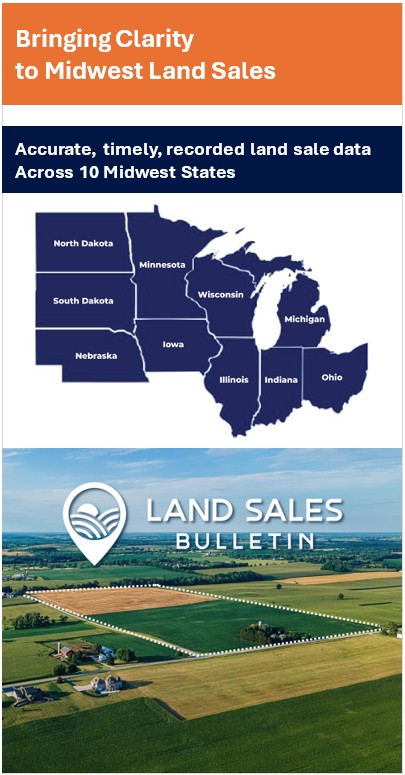
Documented Land Sales — We publish recorded land sales of 20 acres or more across 10 Midwest states providing ‘boots on the ground’ finalized, documented rural land sale transactions
-
Clear Market Insight — Farmers, landowners, realtors, lenders, investors and appraisers rely on our documented transactions to understand real market conditions.
-
Nearly 30% of all U.S. farmland lies within our 10 Midwest States— Our records provide a clear picture of real market activity across the region that drives American agriculture.
| | | APRIL TRENDING MIDWEST LAND NEWS | |
2026 Illinois Farmland Price Expectations: Navigating a Stable Yet Softening Market | |
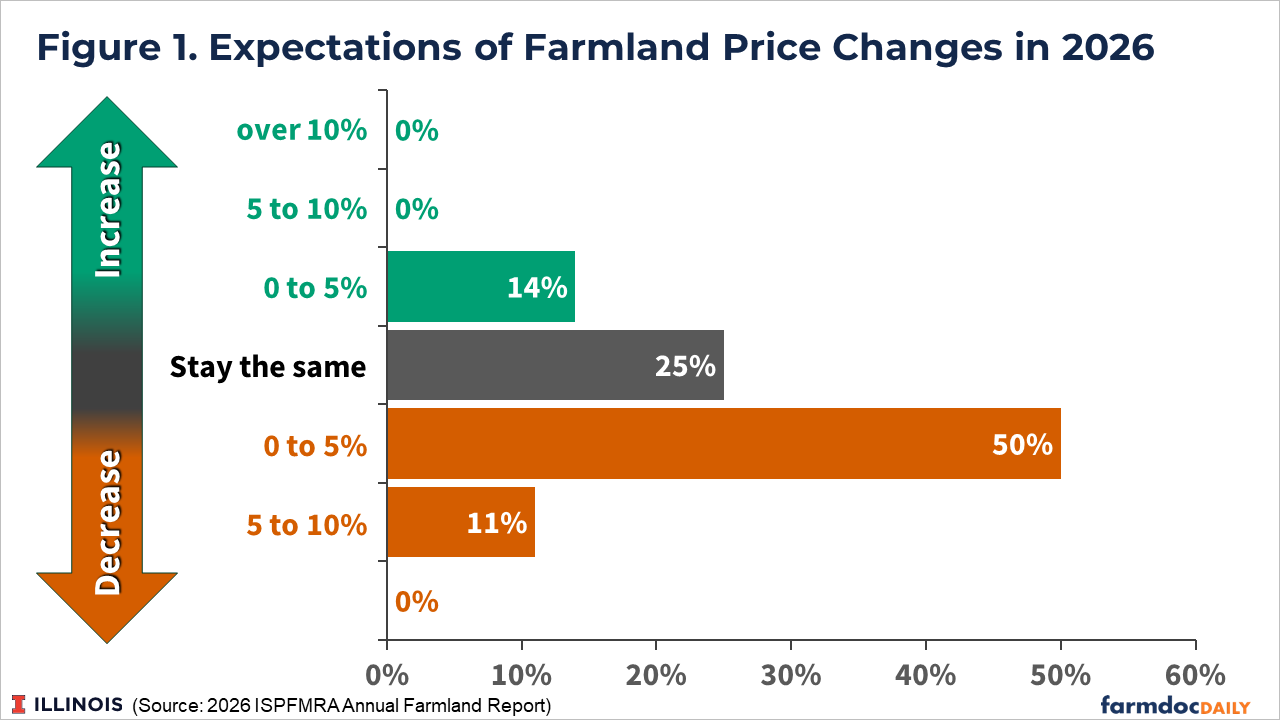
llinois farmland values are entering a period of stabilization after several years of rapid appreciation. According to the latest ISPFMRA survey, most market participants expect modest softening in 2026, driven by tighter crop margins, elevated input costs, and a high‑interest‑rate environment. While 61% of respondents anticipate slight price declines, long‑term confidence remains strong, with 77% expecting higher values within five years. Transaction volumes are also cooling, and private treaty sales are regaining ground as buyers seek flexibility in a shifting market.
As one of Land Sales Bulletin’s reporting states, Illinois continues to demonstrate the importance of timely, accurate, and completed land sale data in understanding market sentiment and tracking regional trends across the Midwest. Read More from farmdoc daily -
Download the full report: https://landsalesbulletin.com/wp-content/uploads/2026/04/fdd040726.pdf
| | | |
Strong March for Iowa Farmland: $78M in Sales Across 10,600 Acres | |
Iowa farmland auctions brought in more than $78 million in March, with over 10,600 acres changing hands across the state. Sales in counties such as Louisa, Sioux, and Ringgold reflected strong demand for high‑quality cropland and well‑maintained pasture, even as broader market conditions remain steady and increasingly selective.
Economists note that Iowa’s land values continue to be supported by limited supply, consistent buyer interest, and stronger livestock margins, while crop producers face tighter profitability. These dynamics mirror trends across Land Sales Bulletin’s Midwest reporting region, which includes Iowa among its 10 states. Read More from Successful Farming
Land Sales Bulletin provides verified, county‑level sales data to help buyers, sellers, and industry professionals track real‑time market movement across the Midwest.
| | | | |
Nebraska Farmland Values Show Mixed Movement in 2026
Nebraska remains a key state within Land Sales Bulletin’s 10‑state Midwest reporting region, and the latest preliminary data from the 2026 University of Nebraska Farm Real Estate Market Survey reflects a market adjusting to tighter margins and shifting sector strength.
Statewide farmland values dipped 1% to $3,905 per acre, marking the second consecutive year of decline as crop producers face narrower margins and softer receipts. In contrast, grazing and hay land values rose 4% to 7%, supported by strong cattle prices and historically low cow herd numbers.
Regional differences remain notable:
- East District continues to lead at $9,315/acre (down 1%).
- North Region saw the strongest gains, up 4%.
- Southeast District posted the largest decline at –3%.
Cash rents followed similar patterns, with cropland rents slipping 1% to 9% depending on land type, while pasture rents strengthened.
As one of Land Sales Bulletin’s core Midwest reporting states, Nebraska’s evolving land values, rental trends, and sector‑specific pressures continue to shape the broader regional story. The final UNL report, expected in June, will add detail on land grades, transaction characteristics, and auction trends.
Read More from Farm Progress
| | |
North Dakota Farmland Market Shows Strength Through Discipline
A major North Dakota land auction—spanning 4,398 acres across four counties, brought in $21.82 million, landing nearly even with its two‑year‑old appraisal. The results highlight what we’re seeing across the region: buyers remain active, but they’re more selective than in past peak years. Some tracts soared above 120% of appraisal values, while others settled lower, reflecting a market that rewards high‑quality soils, strong access, and proven productivity.
As one of Land Sales Bulletin’s Midwest reporting states, North Dakota continues to demonstrate that while the market isn’t at the highs of 2022, it remains far from collapsing. Demand is steady, capital is active, and buyers are selective, reflecting a more mature, disciplined phase of the land cycle.
Read More from Farm Progress
| |
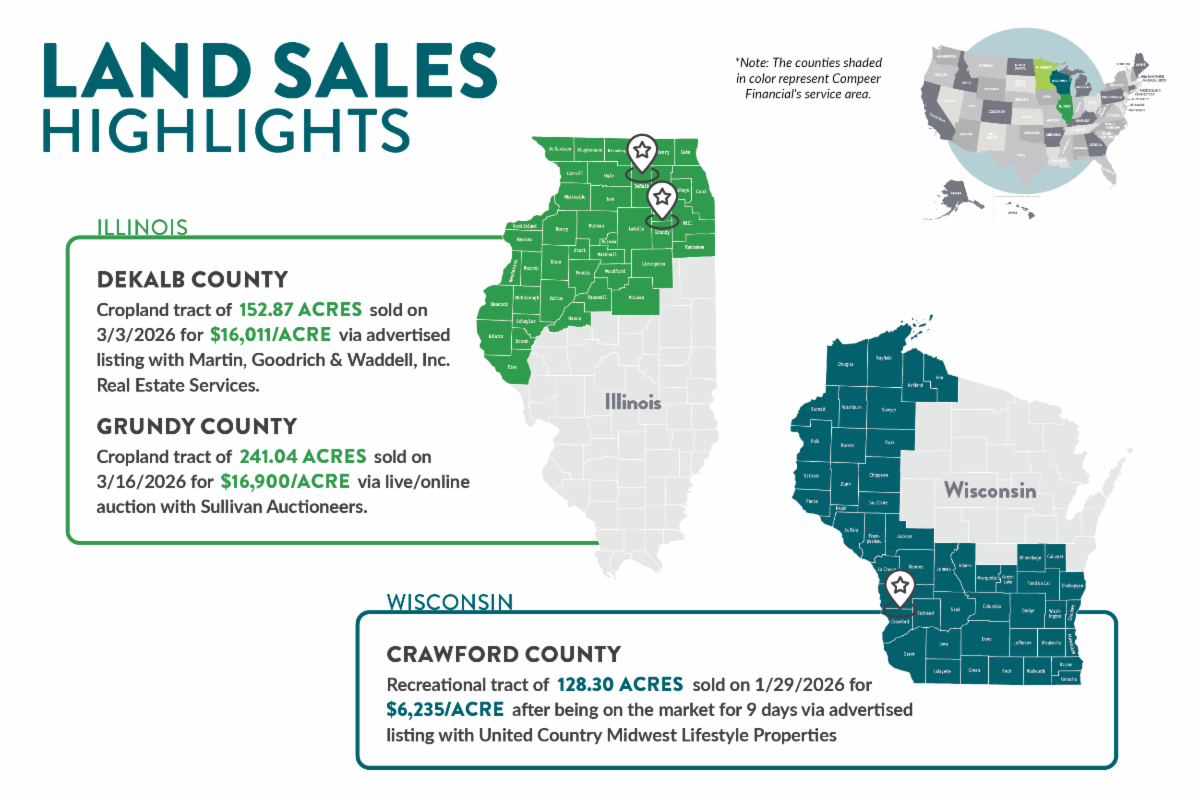
Compeer Financial - Land Sales Highlights April 2026
Three farmland sales from our Midwest reporting states of Illinois and Wisconsin are featured in Compeer Financial's latest Land Sales Highlights.
Find details to each featured sale in their links below.
| | |
Upper Midwest Farmland Values
Farmland values across the Upper Midwest continue to be defined by one theme: stability. Despite tighter margins and higher production costs, producers in our Midwest reporting states of Nebraska, Iowa, and South Dakota remain supported by strong balance sheets and historically limited land supply.
The article highlights meaningful differences across the region. Iowa is seeing lower auction volume and modest softening in returns. Nebraska remains steady, with high‑quality tracts still drawing strong interest. South Dakota stands out as the exception, posting increased sales activity and double‑digit gains in pastureland values over the past year.
Local buyers continue to dominate the market, and financing is becoming a more common strategic tool. With supply still constrained and fundamentals holding firm, the Midwest land market remains balanced and resilient — a story where stability itself is the headline.
Read More from Farm Progress
| |
Farmland values across the Midwest remain steady
Farmland values across the Midwest continue to hold steady—even inching upward in places—despite softer commodity prices and persistently high input costs. Recent insights from the Chicago Fed and the Iowa Realtors Land Institute show modest value increases across key crop districts, with tillable acres remaining especially resilient.
Industry experts point to several forces supporting today’s land market: limited supply, strong farmer demand, reinvestment through 1031 exchanges, and ongoing pressure from residential, commercial, and data‑center development. Farmland also remains a favored hedge against inflation, keeping buyers active even in a neutral interest‑rate environment.
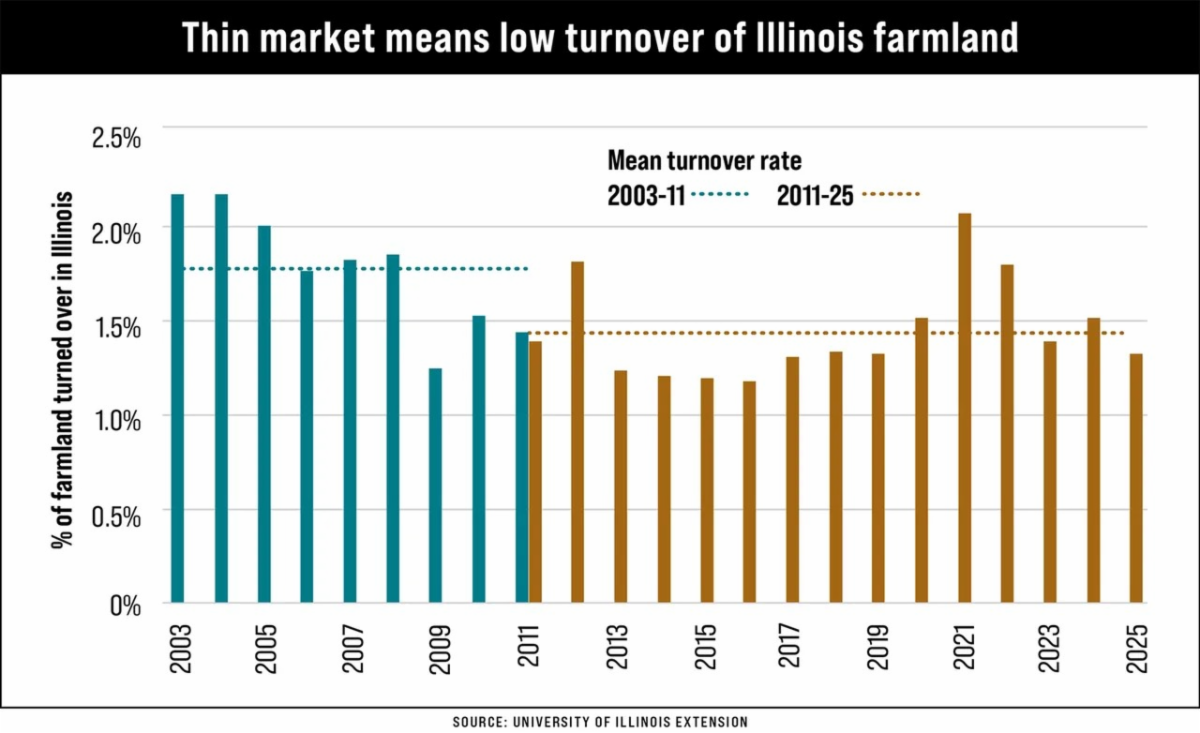
At Land Sales Bulletin, we see these same dynamics across our 10‑state Midwest reporting region: Illinois, Indiana, Iowa, Michigan, Minnesota, Nebraska, North Dakota, Ohio, South Dakota, and Wisconsin. With only 1.5% to 2% of farmland changing hands annually in many states, competition for quality acres remains strong, and farmers continue to make up the majority of buyers.
A steady market doesn’t mean a quiet one—just a competitive one shaped by long‑term value and tight supply. Read More from Farm Progress
| | MAKE SURE TO FOLLOW US ON OUR SOCIALS | | Stay up-to-date as we share recent developments in agricultural land news. You'll find further industry insights, a showcase of notable stories from our Midwest states, and shared key updates from our industry partners— all easily accessible on our social platforms | | |
www.landsalesbulletin.com |608.329.4210 | sales@landsalesbulletin.com |
| | | |