North Carolina Piloting an Innovative Program to Increase Reporting of Elder Financial Exploitation
|
|
|
One of the biggest challenges that regulators face in combating the growing problem of elder financial exploitation is lack of reporting. A new federal grant has created a secure, unified reporting platform that could open up the lines of communication between the financial industry, securities regulators and county Adult Protective Services (APS) offices to bring more suspected cases of elder financial abuse to light.
North Carolina is one of a small handful of states that’s been chosen to pilot this voluntary reporting platform. Development of the platform was funded by a U.S. Department of Justice grant to enhance collaboration between financial firms and enforcement agencies, including the NC Secretary of State’s Securities Division. The platform went live this month. NC Secretary of State Elaine F. Marshall announced the platform on Nov. 18th at a Scam Jam Anti-Fraud Workshop in Charlotte.
“We know that seniors are a frequent target for investment scam artists, but studies have indicated that for every documented case of elder financial exploitation, more than 40 other instances are never reported,” said Marshall.
“There’s a range of reasons for that under-reporting, from cognitive decline and social isolation to embarrassment when a senior realizes they’ve been conned,” said Marshall. “This reporting platform has the potential to be revolutionary in terms of opening and speeding up lines of communication between the financial industry and regulators in order to better protect seniors.”
The platform is designed to automatically route reports from broker/dealer firms to the Secretary of State’s Office and/or Adult Protective Services for appropriate review and processing. The platform will allow representatives of each agency to communicate about and/or coordinate on cases as appropriate.
The Secretary of State’s Securities Division is responsible for administering and enforcing North Carolina’s securities laws. NCSOS’s Securities Division is one of just a handful of state securities regulators around the nation that handles both administrative regulation and criminal enforcement.
Investment fraud should be reported to the NC Secretary of State’s Securities Division by calling the NC Investors Hotline at 1-800-688-4507. Investors are encouraged to call the Hotline before investing their money to find out if a broker, adviser, and investment offering is registered with the State. The Division also has a wealth of free educational resources for investors on its website at
https://www.sosnc.gov/divisions/securities/for_investors.
|
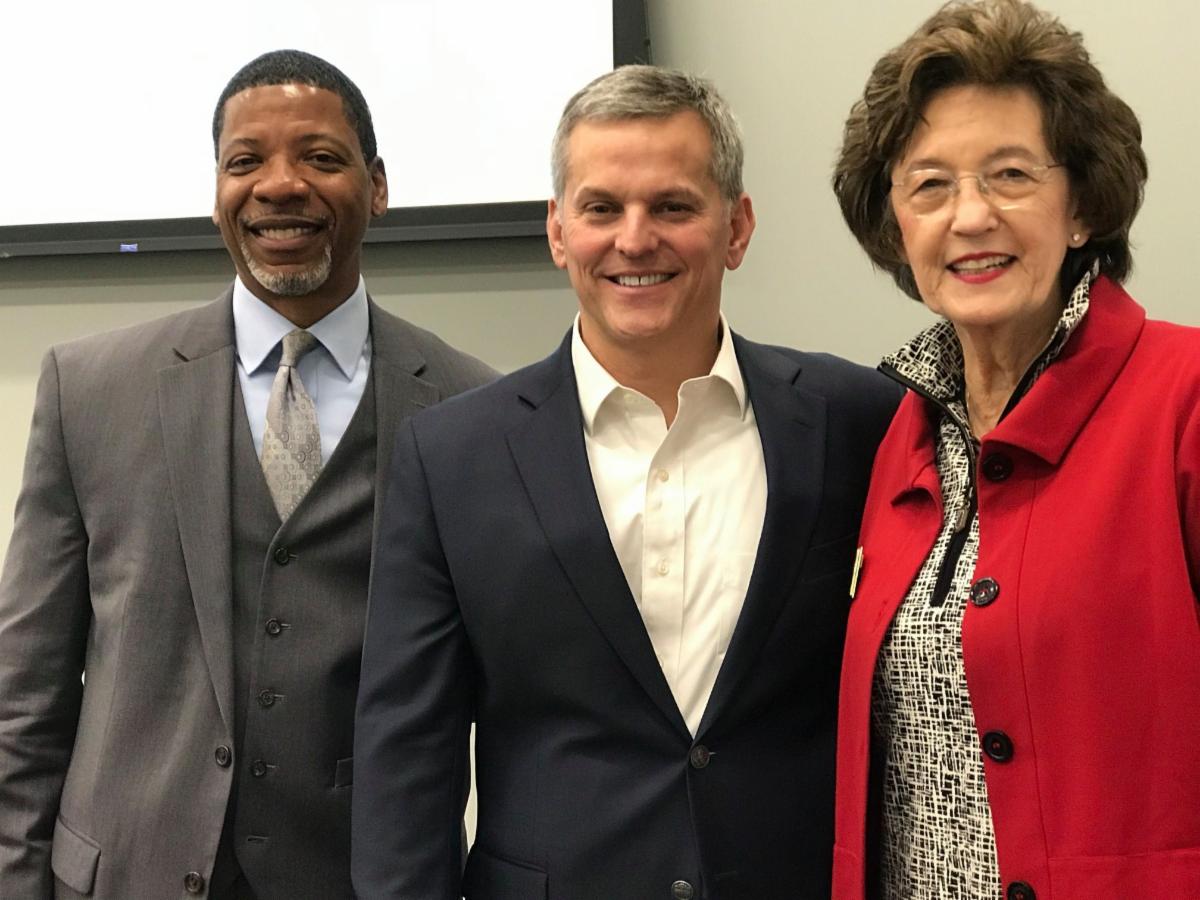
Secretary of State Elaine Marshall with Attorney General Josh Stein and
Mecklenburg County Adult Services Division Director Gregory Tanner at the Nov. 18th Scam Jam Anti-Fraud event in Charlotte.
|
Secretary Marshall speaking to attendees at the Nov. 18th Scam Jam in Charlotte.
|
|
|
Wake Forest Investment Adviser Indicted on Securities Fraud and other Federal Charges in Ponzi Scheme
|
Wake Forest I
nvestment Adviser Anthony Wayne March was indicted in federal court in late November following
an investigation by the NC Secretary of State’s Securities Division and the IRS Criminal Investigation Division into an $8.1 million alleged Ponzi scheme.
United States Attorney Robert J. Higdon, Jr.
announced on Nov. 21 that
March had been indicted and charged with one count of Securities Fraud; three counts of Wire Fraud; one count of Bankruptcy Fraud; one count of Obstruction of Bankruptcy Case; three counts of False Oaths; and four counts of Money Laundering.
From 2012 to 2015, at least 22 victims – most of them retirees – are believed to have been lured to invest more than $8.1 million
in charitable gift annuities and other products offered by Asset Trader, a nonprofit corporation that March operated.
A charitable gift annuity is essentially a planned giving
contract between a donor and a
charity
that allows donors who make a large gift to the charity through money, securities or other assets to get a partial tax deduction as well as fixed monthly payments from the charity for life.
When investing in charitable annuities, it’s vital to check the legitimacy of the charitable organization in question and to be sure that the nonprofit in question is aware of the contract.
And as
always, please call the North Carolina Investor Hotline at 1-800-688-4507 to check the registration of not only the
person offering the investment, but the investment opportunity itself.
|
|
One Call Could Save Your Life Savings!
Is that individual offering you an investment opportunity licensed to sell securities in North Carolina? Is the investment opportunity itself registered? Know before you sign!
While registration in and of itself is no guarantee against fraud, not being registered is a very big red warning flag.
We urge you to take five minutes to call our NC Investor Hotline at 1-800-688-4507 to see if the person you have been dealing with – perhaps even for years – is properly registered and/or has a disciplinary history. You can also check to see if the actual investment itself is properly registered.
Pick up the phone and call us. You owe it to yourself and your family to check. And please also consider sharing the information in this newsletter with
YOUR
contacts or your social networks. Doing so will help keep your friends and loved ones safe, too. More information can be found at
https://www.sosnc.gov/divisions/securities/for_investors
.
|
|
The NC Secretary of State’s Securities Division has launched a Cybersecurity Outreach Initiative for investment adviser, or IA, firms. The initiative is designed to
help North Carolina’s registered investment advisers become more cybersecure by thinking more critically about their cyber policies and procedures. The growing trend of cyberattacks is putting investment advisers, their business records and clients' funds at risk.
State-registered investment advisers are fiduciaries with a legal obligation to keep their clients’ personal and financial data safe and secure, and to maintain policies and procedures – including cybersecurity policies -- that are meaningful and specific to their businesses. The Secretary of State’s Office now offers
assistance to any IA who wishes to voluntarily participate in the initiative to think more critically about their cyber policies and procedures and then to craft more meaningful and relevant policies and procedures that are specific to their businesses.
Our cybersecurity consultative services are completely free and voluntary for any North Carolina-registered investment adviser. The initiative is being run through our Investor Protection and Education Services Program and is not coordinated with the audit unit, so information gathered through this consultative initiative isn't shared with the audit unit.
Participation in every stage of this initiative can significantly reduce the chances that an investment adviser will experience related compliance issues in the future.
This initiative is based on the Framework for Improving Critical Infrastructure Cybersecurity developed by the National Institute of Standards and Technology (NIST). The NIST Cybersecurity Framework identifies five core functions: Identify, Protect, Detect, Respond, and Recover.
North Carolina registered IAs interested in participating in this initiative should email us your firm’s current cybersecurity policies and procedures at
cybersecurity@sosnc.gov
. If they are too large to send to us via email, please send a message and we will send instructions for uploading the file to our secure FTP site. IAs wishing to find out more can visit our website at
https://www.sosnc.gov/divisions/securities/cyber_security.
|
|
New FINRA Foundation Research: Two-thirds of U.S. Investors Fail Investing Quiz and Face Confusion about Investment Account Fees
Number of Women With Non-Retirement Investments Remains Stagnant, While Ownership Among Men, Millennials and African-Americans Increases
Knowledge of key investing concepts among investors is low, with two-thirds of U.S. adults who own taxable investment accounts failing to correctly answer more than half of the questions contained on a 10-question quiz of investor knowledge, according to new research released today by the FINRA Investor Education Foundation (FINRA Foundation).
Broker-Dealer E&O Insurance Could Provide Relief for Investors with Unpaid Arbitration Awards
In a report released on Dec. 11th, the North American Securities Administrators Association (NASAA) encouraged broker-dealers to use errors and omissions (E&O) insurance as a resource to help meet their potential obligations to pay arbitration awards to their customers.
Arbitration is the most frequently used method to resolve securities disputes between investors and broker-dealer firms. Almost every broker-dealer includes in its customer agreements an arbitration provision that requires public investors to submit all disputes that they may have with the firm or its representatives to mandatory arbitration rather than through the courts. Unfortunately, many customers that prevail through the arbitration process are not being paid their award by the broker-dealers or representatives.
New Research: Financial Well-Being of U.S. Military Veterans Improving, Surpassing Non-Veterans
Veterans who are female, younger, married, divorced or separated, or who have children are faring worse than their veteran peers
The financial well-being of U.S. military veterans has improved in recent years, outpacing the gains of non-veterans, according to new
research
by the FINRA Investor Education Foundation. Veterans, overall, reported having less difficulty covering their expenses and bills, had a lower likelihood of experiencing an income drop and were more likely to have an emergency fund, according to the survey of more than 3,000 veterans and more than 20,000 non-veterans.
Even as FINRA Foundation research shows that many Americans struggle to make ends meet, veterans are expressing higher financial well-being, lower levels of financial anxiety and a higher likelihood of having a will, the new survey shows. Veterans were also 33 percent more likely to participate in the gig economy and were 12 percent more likely to use financial technology for planning. Further, veterans were more likely to have a retirement plan, in addition to an employer plan.
SEC Proposes Amendments to Modernize Shareholder Proposal Rule
The Securities and Exchange Commission voted on November 5th to propose amendments modernizing the rule that governs the process for shareholder proposals to be included in a company’s proxy statement.
“Today’s proposed amendments follow from the staff’s extensive experience with shareholder proposals and recognize the significant changes that have taken place in our markets in the decades since these regulatory requirements were last revised, including, in particular, the types and use of communications, the types and frequency of shareholder-company engagement and the substantial shift to investing through mutual funds and ETFs, rather than directly by Main Street investors, ” said Chairman Jay Clayton. “The proposed amendments would facilitate constructive engagement by long-term shareholders in a manner that would benefit all shareholders and our public capital markets. I would like to again thank Commissioner Roisman for his leadership on our efforts to improve the proxy process.”
Look Beyond Bond Ratings
A new Informed Investor advisory offers information to help investors better understand bond ratings and bond rating companies. Bonds are part of many investors' portfolios, held either as individual securities or through funds (such as mutual funds). A key consideration for bond investments is the rating given to a bond by a nationally recognized bond rating company. Investors consider these ratings in evaluating possible investments, but it's important to look beyond the mere rating when considering an investment in a specific bond or bond fund portfolio.
Following the 2008 financial crisis, companies that provide bond ratings were criticized for a rating process that failed to adequately assess the risk of certain investments as part of the rating process. As a result, some high-risk bonds were given inflated ratings to appear more creditworthy and appealing to investors. While corrective steps were taken following the financial crisis, there are concerns that inflated ratings continue. For this reason and others, investors should look beyond the rating when considering an investment in one or more bond or bond funds.
|
|
- On December 10, 2019, the U.S. Attorney’s Office for the District of New Jersey announced the arrest of three men in connection with a cryptocurrency mining scheme that defrauded investors of $722 million. North Carolina Securities Division conducted an investigation into a fraudulent cryptocurrency mining scheme known as the BitClub Network. As a result of the multi-jurisdictional complexity of this scheme, the Division's investigation was coordinated with the United States Attorney's Office in New Jersey as well as the Internal Revenue Service Criminal Investigation Division (IRS-CI). According to the indictment, from April 2014 through December 2019, the defendants operated BitClub Network, a fraudulent scheme that solicited money from investors in exchange for shares of purported cryptocurrency mining pools and rewarded investors for recruiting new investors. For more information, please see the U.S. Attorney’s press release. On May 30, 2018, the Securities Division issued an investor alert regarding BitClub Network and its activities. Click here to read the alert.
- On November 21, 2019, United States Attorney Robert J. Higdon, Jr. announced that a federal grand jury had returned an Indictment charging ANTHONY WAYNE MARCH, 48, of Wake Forest, North Carolina, with one count of Securities Fraud; three counts of Wire Fraud; one count of Bankruptcy Fraud; one count of Obstruction of Bankruptcy Case; three counts of False Oaths; and four counts of Money Laundering. The indictment follows an investigation by the NC Secretary of State’s Securities Division and the IRS Criminal Investigation Division. For more information, click here.
|
|
|
|
NC Department of the Secretary of State
Securities Division
Investor Protection & Education Services
|
|
|
|
|
|
|
|