Thinking About Investing in the Latest Hot Stock? Understand the Significant Risks of Short-Term Trading Based on Social Media
The SEC’s Office of Investor Education and Advocacy issued this alert to warn investors of the significant risks of short-term investing based on social media, especially in volatile markets, and provides tips for long-term investing.
Retail investors may seek to profit from volatile markets by buying individual stock, including stock in heavily-promoted companies with smaller market capitalizations. Some of these stocks may be discussed in social media, news aggregators, investment research websites, online investment newsletters, ratings websites, message boards, chat rooms, and discussion forums. It can be tempting to jump on the bandwagon and follow whatever the crowd seems to be doing. Sometimes, however, following the crowd may lead to significant investment losses.
Retail investors should understand that all investments have risk, and that short-term investing in a volatile market carries significant risk of loss.
Short-term trading, including trading aided by the use of margin or options, can lead to significant and unanticipated losses for retail investors. A Library of Congress report identified several investing behaviors that can undermine investment performance, including behaviors that involve short-term investing. Investors should keep in mind these behaviors when considering investing in a volatile market, including:
-
Investing in Bubbles or Manias. Financial “manias” or a “bubble” is the rapid rise in the price of an investment, reflecting a high degree of collective enthusiasm or exuberance regarding the investment’s prospects. This rapid rise is usually followed by a contraction in the investment’s price. The contraction, or “panic” occurs when there is wide-scale selling of the investment that causes a sharp decline in the investment’s price.
-
Momentum Investing. Another investing strategy that can pose high risks for retail investors is “momentum investing.” An investor using a momentum investing strategy seeks to capitalize on the continuance of existing trends in the market. A momentum investor believes that large increases in the price of an investment will be followed by additional gains and vice versa for declining values. If that belief turns out to be incorrect, it can lead to significant losses.
-
Noise Trading. A third related strategy is “noise trading.” Noise trading occurs when an investor makes a decision to buy or sell an investment without the use of fundamental data (that is, economic, financial, and other qualitative or quantitative data that can affect the value of the investment). Noise traders generally have poor timing, follow trends, and overreact to good and bad news in the market.
Be careful investing with margin, options, or short sales.
All investing has risks. If you invest using margin, options, or short sales these risks may be magnified. Margin trading (using borrowed money to buy securities) can be very risky and is not appropriate for every investor. Before you invest using margin consider that:
- You can lose more money than you have invested;
-
You may have to deposit additional cash or securities in your account on short notice to cover market losses (a “margin call”); and
-
Your brokerage firm can increase its margin requirements at any time and is not required to provide you with advance notice.
Options (contracts to buy or sell a stock for a specified price on or before a certain date) like other securities carry no guarantees. Investors should be aware that it is possible to lose all of your initial investment, and sometimes more. Option holders (buyers of option contracts) risk the entire amount of the premium paid to purchase the option. If a holder’s option expires “out-of-the-money” the entire premium will be lost. Option writers (sellers of option contracts) may carry an even higher level of risk since certain types of options contracts can expose writers to unlimited potential losses. For additional information on options trading and its risks, read our investor bulletin “An Introduction to Options.”
Short sales involve the sale of a stock you do not own (or borrow for delivery). Short sellers believe the price of a stock will fall. If the price falls, short sellers buy the stock back at the lower price and make a profit. However, if the price of the stock rises, short sellers will incur a loss when they have to buy the stock back at a higher price. Short sales can expose an investor to the possibility of unlimited losses, since a stock can theoretically keep rising indefinitely. For additional information on short sales, read our investor bulletin “An Introduction to Short Sales.”
Market and broker-dealer protections for volatile stocks
The national securities exchanges and FINRA have rules designed to address market volatility in stocks listed on a national securities exchange. The “Limit up-Limit Down” rules are designed to prevent trades in these stocks from occurring outside a specified price band. This price band is set at a percentage level above and below the average price of the stock over the immediately preceding five-minute trading period. If a stock’s price moves outside these price bands for more than 15 seconds, trading in the stock will be paused for five minutes. For additional information on the “Limit Up-Limit Down” rules, read our investor bulletin: “Measures to Address Market Volatility.”
Also, broker-dealers may reserve the ability to reject or limit customer transactions. This may be done for legal, compliance, or risk management reasons, and is typically discussed in the customer account agreement. In certain circumstances, broker-dealers may determine not to accept orders where a transaction presents certain associated compliance or legal risks.
Be aware of the potential for market manipulation on online platforms.
Fraudsters can use online platforms (including social news aggregators, investment research websites, online investment newsletters, ratings websites, message boards, chat rooms, and discussion forums) to spread false or misleading information. Fraudsters may try to manipulate a company’s stock price (either positively or negatively) and to profit at investors’ expense.
For example, in a pump and dump scheme, fraudsters pump up a company’s stock price by making false and misleading statements to create a buying frenzy, and then sell shares at the pumped up price. In other instances, fraudsters start negative rumors urging investors to sell their shares so that the stock price plummets and then the fraudsters take advantage of buying shares at the artificially low price.
We urge investors to consider these long-term investing tips:
-
Know your time horizon for investing. Often, information you read online about specific stocks can be short-term in nature. It focuses on events that may have an immediate impact on investments. Focus on long-term goals, and consider the benefits of diversification and asset allocation.
-
Create and follow a financial plan. Real-time discussion platforms and buy/sell indicators driven by social sentiment may lead you to make emotionally-driven or impulsive investment decisions, which can be a risky way to approach investing. Do not let short-term emotions about investments disrupt your long-term financial objectives. If you are considering short-term investments, think about how much of your overall portfolio you should allocate to these types of investments.
-
Be careful when investing based on information received on social media. While online platforms may provide useful investment information, use extreme caution when making investment decisions based solely on information found on social media platforms.
-
Never feel pressured to invest right away. Before investing your money, research the company thoroughly. Make sure you understand its business and carefully review publicly disclosed company information. Take your time researching and making any investment decision.
|
|
Does the whole GameStop run-up have you confused? Not sure what a "short squeeze" is? The folks at NPR's Planet Money podcast do a good job explaining it in terms we can all understand. And, frankly, it's a little "nutty"! Check out their podcast to find out what we mean.
|
|
|
Notice of Upcoming Courses
Free Continuing Legal Education (CLE) Courses
Presented by
The North Carolina Department of Secretary of State.
Please register on our website by clicking on the link provided below.
|
|
Social Isolation and the Risk of Investment Fraud
FINRA, the North American Securities Administrators Association (NASAA), and the staff of the SEC’s Office of Investor Education and Advocacy have joined to issue this alert in order to raise awareness that increased social isolation during the COVID-19 pandemic can have a devastating impact on senior investors.
Social isolation, whether voluntary or involuntary, has long been a leading factor contributing to the financial exploitation of older investors. The unprecedented quarantines to protect against the spread of the novel coronavirus have made many seniors more vulnerable to financial exploitation.
While financial abuse can happen at any time, perpetrators often strike during times in a senior’s life when they may be more vulnerable, such as during a health crisis or after the death of a loved one. Scammers often gather personal details from obituaries and social media posts and use this information to target their victims. Some also may attempt to exploit trust within seniors’ social and support groups to become more involved in their lives.
Social Isolation and Fraud
Social isolation and diminishing cognitive capacity can combine to affect the judgment and decision-making capacity of senior investors, rendering them more vulnerable to financial abuse. With many seniors in isolation for their own safety, friends and family are unable to physically check in and are not able to notice the sometimes small but important changes in behavior that could indicate a person is susceptible to fraud or worse, is being victimized.
Research has found that people are more likely to be victimized if they are isolated and do not have anyone to discuss an investment proposal with. As a result, those who engaged scammers and lost money are less likely to be married and more likely to be widowed or divorced. Sadly, fraud victimization seems to go hand in hand with social isolation—whether involuntary or voluntary. Common scams can range from Ponzi schemes to identity theft.
When seniors and others are socially isolated, they increasingly turn to the internet for social interaction and more frequently depend on the internet as a social outlet and are increasingly relying on online services for shopping, banking, and the initiation of electronic payments that may have otherwise been paid in person. Research has found that people who are contacted by scammers through social media or through a pop-up message on a website are more likely to engage with the scammer and lose more money than those who were targeted by phone or email. Loneliness also leads some to look for companionship online. As a result, online romance scams have become increasingly pervasive because the scammers can easily use the anonymity of the internet to mask their deceptive intentions.
How to Protect Yourself from Investment Fraud
- Ask for input from others. Scammers try to isolate their victims. Do not be afraid to contact a friend, or a company or organization you trust for advice.
- Do additional research before sending any money. One easy action: do an internet search to see if the website or pitch has been flagged as fraudulent or potentially fraudulent by news organizations or members of the public. Make sure you understand the investment, the risk attached, and the company’s history. And remember, if the investment sounds too good to be true, it probably is!
- Focus on your financial health and literacy. Individuals under financial strain and those with lower levels of financial literacy may be more susceptible to scammers.
- Knowledge is power. Knowing about scams and scammer tactics can be your best defense in successfully reducing the impact of scams. Keep up with the latest frauds by subscribing to consumer newsletters and seeking out information on current scams. Fraudsters rely on the fact that many people simply do not bother to investigate before they invest. Savvy investors take the time to do their own independent research and talk to friends and family first before investing.
- Never be afraid to complain. If you suspect fraud or a questionable practice and the explanations that you receive are not satisfactory, do not let embarrassment or concern that you will be judged incapable of handling your own affairs prevent you from filing a complaint with the SEC, FINRA, or your state securities regulator.
Common Warning Signs of Senior Exploitation
Senior financial exploitation can be difficult to identify or recognize. Below are warning signs to watch for among the seniors in your lives:
- Family members or those who insinuate themselves into a senior's life to act like “family” to extract money for loans or expenses.
- A new and overly protective friend or caregiver.
- Surrendering passwords to financial accounts or control of finances to a new friend or partner.
- Fear or sudden change in feelings about somebody.
- A lack of knowledge about financial status or new reluctance to discuss financial matters.
- Sudden or unexplained changes in spending habits, a will, trust, or beneficiary designations.
- Unexplained checks made out to cash, unexplained loans, or unexplained disappearance of assets (cash, valuables, securities, etc.). Also watch for suspicious signatures on the senior’s checks or other documents.
Red Flags of Fraud
-
Unregistered and Unlicensed Sellers. Always check whether the person offering to sell you an investment is registered and licensed, even if you know him or her personally. Unregistered and unlicensed persons commit many of the frauds that target older investors. Researching the background of the individuals and firms selling you investments, including their registration/license status and disciplinary history, is easy and free. You can verify the status of investment professionals and find out whether they have a history of customer harm by contacting the North Carolina Department of the Secretary of State Securities Division (toll-free 800-688-4507 or secdiv@sosnc.gov) or use tools available for free from the SEC and FINRA.
-
You can also call the SEC’s Office of Investor Education and Advocacy directly to help research the person and firm selling you the investment: (800) 732-0330 (open 9:00 a.m. to 5:30 p.m. EST Monday through Friday). FINRA’s Securities Helpline for Seniors® can also be leveraged to get assistance from FINRA or raise concerns about issues with brokerage accounts and investments. Call 844-57-HELPS (844-574-3577) toll free, Monday through Friday, 9 a.m. – 5 p.m. EST.
-
Promises of High Returns with Little or No Risk. The promise of a high rate of return, with little or no risk, is a classic warning sign of investment fraud. Every investment carries some degree of risk, and the potential for greater returns usually comes with greater risk. Avoid putting money into “can’t miss” investment opportunities or those promising “guaranteed returns.” Remember – if it sounds too good to be true, it probably is.
- Pressure to Buy Quickly. No reputable investment professional should push you to make an immediate decision about an investment or tell you that you must “act now.” If someone pressures you to decide on an investment without giving you time to do your research, walk away.
- Red Flags in the Financial Professional’s Background. Even if an investment professional is in good standing with his or her regulators, you should be aware of potential red flags in the professional’s background. SEC, FINRA, and NC Secretary of State records can be used to identify red flags for potential problems, including: (1) employment at firms that have been expelled from the securities industry; (2) personal bankruptcy; (3) termination; (4) being subject to internal review by an employer; (5) a high number of customer complaints; (6) failed industry qualification examinations; (7) federal tax liens; and (8) repeatedly moving firms.
How to Help the Seniors in Your Life
Social distancing does not mean social isolation. Social isolation increases vulnerability to financial exploitation and fraud. That is why it is important to keep seniors socially and mentally engaged while physically keeping them protected from the virus.
- Contact. While in-person visits may not be possible yet, be sure to keep in touch with older family members, friends, and neighbors. Call or leave a note on their front door. If they have the technology, send them a text or email, or connect through video conferencing. Contact is key to letting your loved ones know you are thinking of them and that they are not alone.
- Inform. Let your older family members know that fraudsters and scammers have found ways to exploit the pandemic. Make them aware of the red flags of fraud and common scams, which remain consistent over time. Send them updates on current scams targeting older people.
- Act. Individuals with suspicions of possible senior investment fraud or financial exploitation should contact their state securities regulators, local Adult Protective Services agencies, FINRA or the SEC. Financial and investment professionals in North Carolina also are encouraged to contact the Secretary of State's office to request a presentation on how to spot and report suspected senior financial exploitation.
|
|
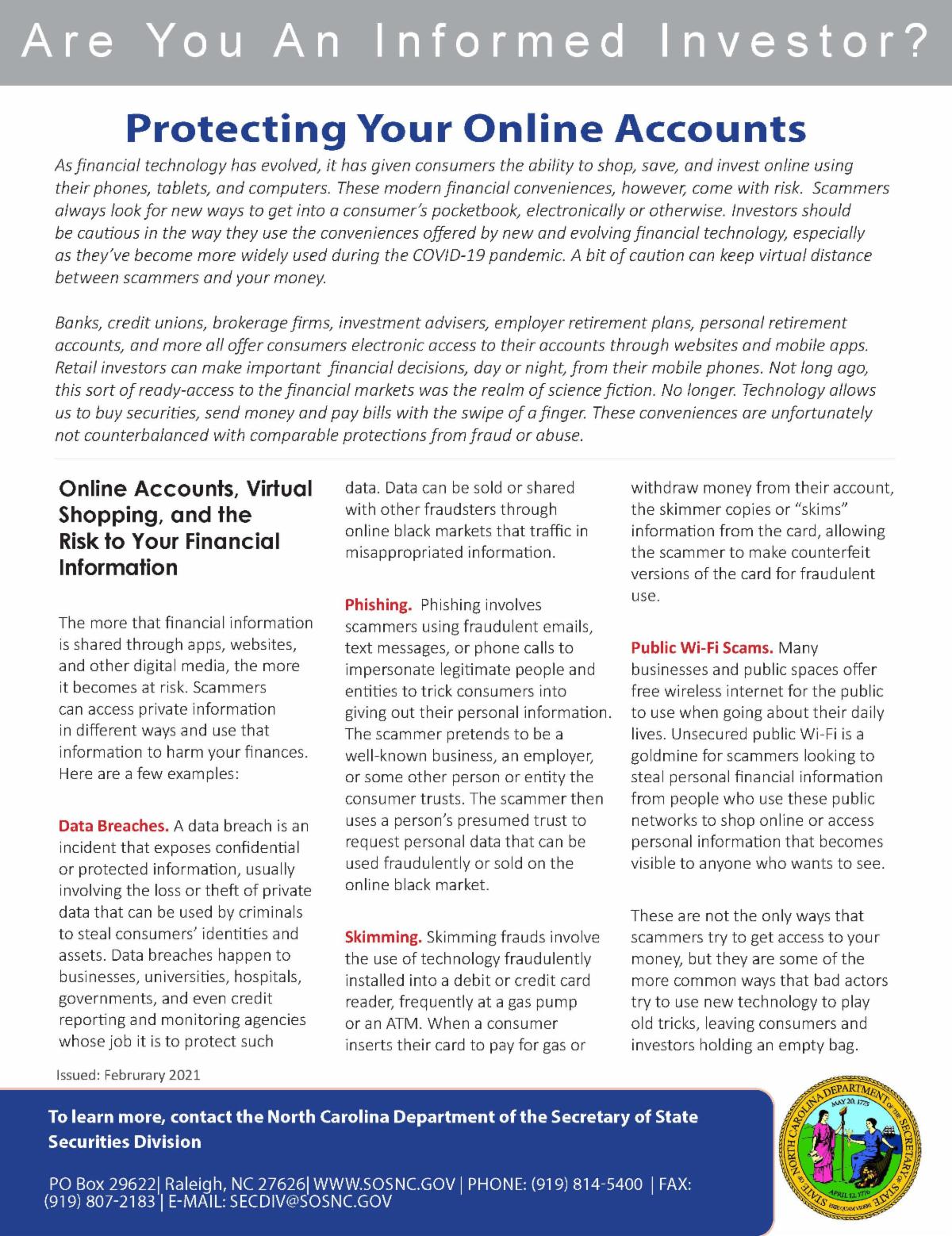
Protecting Your Online Accounts
As financial technology has evolved, it has given consumers the ability to shop, save, and invest online using their phones, tablets, and computers. These modern financial conveniences, however, come with risk. Scammers always look for new ways to get into a consumer’s pocketbook, electronically or otherwise. Investors should be cautious in the way they use the conveniences offered by new and evolving financial technology, especially as they’ve become more widely used during the COVID-19 pandemic. A bit of caution can keep virtual distance between scammers and your money.
Banks, credit unions, brokerage firms, investment advisers, employer retirement plans, personal retirement accounts, and more all offer consumers electronic access to their accounts through websites and mobile apps. Retail investors can make important financial decisions, day or night, from their mobile phones. Not long ago, this sort of ready-access to the financial markets was the realm of science fiction. No longer. Technology allows us to buy securities, send money and pay bills with the swipe of a finger. These conveniences are unfortunately not counterbalanced with comparable protections from fraud or abuse.
Please read the Informed Investor Alert at sosnc.gov to learn more about how your online activities can leave your financial data at risk and how to protect yourself.
|
|
One Call Could Save Your Life Savings!
Is that individual offering you an investment opportunity licensed to sell securities in North Carolina? Is the investment opportunity itself registered? Know before you sign!
While registration in and of itself is no guarantee against fraud, not being registered is a very big red warning flag.
We urge you to take five minutes to call our NC Investor Hotline at 1-800-688-4507 to see if the person you have been dealing with – perhaps even for years – is properly registered and/or has a disciplinary history. You can also check to see if the actual investment itself is properly registered.
Pick up the phone and call us. You owe it to yourself and your family to check. And please also consider sharing the information in this newsletter with YOUR contacts or your social networks. Doing so will help keep your friends and loved ones safe, too. More information can be found at https://www.sosnc.gov/divisions/securities/for_investors.
|
|
Join NC Secretary of State Elaine Marshall and NC Attorney General Josh Stein on March 1 on Facebook Live for an informative free teletown hall. They'll be talking about how to spot and stop tax season scams and scams revolving around COVID vaccine, and they'll be taking your questions.
|
|
2021 Report on FINRA's Examination and Risk Monitoring Program
FINRA released its 2021 Report on its Risk Monitoring and Examination Activities in February to inform member firms’ compliance programs by providing annual insights from FINRA’s Examinations and Risk Monitoring programs. The Report combines and replaces two previously published annual reports, the Report on Examination Findings and Observations and the Risk Monitoring and Examination Program Priorities Letter.
“FINRA continues to identify new ways to provide member firms with information they can use to assess and strengthen their compliance, supervisory and risk management programs,” said Bari Havlik, Executive Vice President, Member Supervision. “This report is designed to give member firms a single, authoritative source that provides insights derived both from the last year’s examinations and risk assessments, and from where we have identified emerging issues for the coming year.”
The Report addresses 18 regulatory areas, including cybersecurity. The following is an excerpt from the Report focusing on Cybersecurity and Technology Governance. You can review the report in its entirety at finra.org.
Regulatory Obligations
The SEC’s Regulation S-P Rule 30 requires firms to have written policies and procedures that are reasonably designed to safeguard customer records and information. FINRA Rule 4370 (Business Continuity Plans and Emergency Contact Information) also applies to denials of service and other interruptions to members’ operations. In addition to firms’ compliance with SEC regulations, FINRA reminds firms that cybersecurity remains one of the principal operational risks facing broker-dealers, and expects firms to develop reasonably designed cybersecurity programs and controls that are consistent with their risk profile, business model and scale of operations.
Technology-related problems, such as problems in firms’ change- and problem-management practices, can expose firms to operational failures that may compromise firms’ ability to comply with a range of rules and regulations, including FINRA Rules 4370 (Business Continuity Plans and Emergency Contact Information), 3110 (Supervision) and 4511 (General Requirements), as well as Securities Exchange Act of 1934 (Exchange Act) Rules 17a-3 and 17a-4.
Related Considerations
- What kind of governance structure has your firm developed to identify and respond to cybersecurity risks?
- What is the scope of your firm’s Data Loss Prevention program, including encryption controls?
- How does your firm address branch-specific cybersecurity risks?
- What kind of training does your firm conduct on cybersecurity, including phishing?
- What process does your firm have to evaluate your firm’s vendors’ cybersecurity controls?
- Has your firm implemented multi-factor authentication (MFA) or other relevant access management controls?
- What controls does your firm implement to mitigate system capacity performance and integrity issues that may undermine its ability to conduct business and operations, monitor risk or report key information?
- How does your firm document system change requests and approvals?
- What type of testing does your firm perform prior to changes being moved into a production environment and post-implementation?
- What are your firm’s procedures for tracking information technology problems and their remediation? Does your firm categorize problems based on their business impact?
|
|
New Research: Global Pandemic Brings Surge of New and Experienced Retail Investors Into the Stock Market
In a year when a pandemic gripped the world, beginning and experienced retail investors flocked to the stock market using taxable, non-retirement investment accounts, according to new research by the FINRA Investor Education Foundation (FINRA Foundation) and NORC at the University of Chicago.
The study, Investing 2020: New Accounts and the People Who Opened Them, found that market dips that made stocks cheaper to buy and the ability to invest with small amounts were among the top reasons younger and inexperienced investors reported entering the stock market. For respondents who opened new accounts in 2020, investing for retirement was the most frequently cited reason for opening the account, despite the study’s focus on taxable investing.
Researchers further found that the majority of new investors—meaning those who opened a non-retirement investment account for the first time during 2020—were under the age of 45 and had lower incomes than investors who already owned taxable investment accounts prior to 2020. New investors were also more likely to be racially or ethnically diverse.
“The spike in new investors demonstrates that people, given access and opportunity, will take steps to participate in the equity markets, potentially benefiting from the historically higher long-term returns these markets offer,” said FINRA Foundation President Gerri Walsh. “On the one hand, this research offers the investment industry, investor advocates and policymakers critical insights about pathways to financial inclusion for all Americans and presents a roadmap to help inexperienced investors, women and people of color close the wealth gap. On the other, low levels of investment knowledge among all types of investors in the sample—new and experienced—underscore the importance of educating investors about risk and reward, costs and fees, tax consequences of investing and other key concepts.”
“In early 2020, we began seeing media narratives about an influx of investors into the market. This research moves past the anecdotes and helps to separate fact from fiction, highlighting what is actually prompting investors to open a new account,” said Mark Lush, manager and behavioral scientist in the Behavioral and Economic Analysis and Decision-Making (BEAD) team at NORC. “The reality is that investors who opened their first taxable investment account during 2020 were more racially/ethnically diverse when compared to investors already in the market. Our study also found that many of these new investors were prompted to open their account because of the ability to invest with a small amount of money. Taken together, we may be witnessing a shift towards more equitable investment participation.”
Researchers surveyed nearly 1,300 households in 2020. Respondents were grouped into one of three categories: New Investors who opened one or more non-retirement investment account(s) during 2020, and did not own a taxable investment account at any time before 2020 (38 percent); Experienced Entrants who opened a taxable investment account during 2020, and also owned an existing taxable investment account opened before 2020 (19 percent); and Holdover Account Owners who maintained a taxable investment account that was opened before 2020 but did not open a new account during 2020 (43 percent).
Across investor categories, a number of differences emerged. Key findings from the report include:
- The largest portion of African American investors (17 percent) were New Investors, and the largest share of Hispanic/Latino investors were concentrated in both the New Investors (15 percent) and Experienced Entrants (17 percent) groups.
- New Investors held smaller balances in their taxable accounts when compared to other investors. Also, 23 percent of female investors reported balances under $500, compared to 15 percent of male investors.
- Across all categories, a large number of investors reported not knowing whether their investment account charged commissions on trades or whether their account allowed purchasing on margin.
- While all investors reported relying on a variety of information sources when making financial decisions, Holdover Account Owners more frequently relied upon financial professionals, while Experienced Entrants more frequently conducted their own personal research, and New Investors more frequently relied on the advice of friends and family.
Investment knowledge was low for all groups, though particularly low for New Investors. On average, New Investors could only answer 1.4 out of 5 investment knowledge questions correctly. FINRA offers an array of resources, including mini-modules on Smart Investing, to help investors build essential investment knowledge and skills.
Differences also emerged among new investors by age and race/ethnicity when survey respondents were asked what prompted them to open a new account in 2020. And across all categories of investors, there were stark contrasts surrounding investment goals, risk taking, trading behaviors and investment decision-making.
|
|
Kelly L. Gibson Named Acting Deputy Director of Division of Enforcement
The Securities and Exchange Commission has announced that Kelly L. Gibson, currently the Director of the Philadelphia Regional Office, has been named the Acting Deputy Director of the Division of Enforcement.
"Kelly is a proven leader and a talented lawyer," said SEC Acting Chair Allison Herren Lee. "As Associate Regional Director and then as Head of the Philadelphia office, she has built an impressive record of success on behalf of investors and the agency. She is a perfect fit to help lead the division."
"I am so pleased that Kelly has agreed to take on this role working with all the talented individuals in the division, as we build on our successes in the critical work of protecting investors and market integrity,” said Melissa Hodgman, Acting Director of the SEC’s Division of Enforcement. “As a tireless advocate and an inspirational leader with a strong sense of judgment, fairness, and mission, she is a great addition to our team."
|
|
-
On November 9, 2020, the Securities Division of the North Carolina Department of the Secretary of State issued a Temporary Cease and Desist Order to respondents, Claybourne Glenn Bass and Claybourne Glen Bass, LLC. The order found the respondents were transacting business in the State of North Carolina in violation of the North Carolina Securities Act. The Temporary Order to Cease and Desist ordered each respondent to immediately cease and desist from violating the anti-fraud provisions of the Securities Act; entering into investment contracts with the public; offering for sale, soliciting offers to purchase, or selling, any security and otherwise holding itself out to be or engaging in the business of securities dealer or salesman. The Temporary Order to Cease and Desist gives respondents 30 days in which to request a hearing. If no such request is made during that time, the Temporary Order to Cease and Desist shall become final. For more information, click here.
-
On September 8, a federal grand jury returned a superseding indictment charging Joshua Matthew Houchins, 36, of Sanford, NC, with fraud, money laundering, obstruction of justice and firearms offenses. The charges were announced today in federal court. The Federal Bureau of Investigation and the North Carolina Secretary of State are investigating the case. The Wake County Sheriff’s Office, Apex Police Department, and Sanford Police Department, also provided assistance. Assistant U.S. Attorney William M. Gilmore is prosecuting the case. An indictment is merely an accusation. The defendant is presumed innocent until proven guilty. For more information, please see this press release.
-
On August 13, Mark Colin Ramsey, 50, of Graham, N.C., was sentenced to 65 months in prison for operating a $1.1 million investment scheme. U.S. District Judge Martin Reidinger also ordered Ramsey to serve three years of supervised release and to pay restitution in the amount of $1,098,333.92. North Carolina Secretary of State Elaine F. Marshall joins U.S. Attorney Andrew Murray in making this announcement. According to filed court documents and statements made in court, from April 2008 to September 2013, Ramsey defrauded more than 20 victims out of nearly $1.1 million through a fraudulent investment scheme. In making the announcement, U.S Attorney Murray thanked the Securities Division of the North Carolina Department of the Secretary of State for their investigation of this case. For more information, please see this press release.
-
On August 3, 2020, Anthony Wayne March, of Wake Forest, NC, pleaded guilty to wire fraud for his role in an $8.1 million Ponzi scheme (see press release). According to court documents, March, 49 years old, operated the non-profit 501(c)(3) entity Asset Trader, located in Rolesville, NC, between 2012 to 2015. March represented that Asset Trader offered educational services to professionals and taxpayers in the area of exit planning. Asset Trader’s stated educational mission allowed it to obtain classification as a 28 U.S.C. § 501(c)(3) tax-exempt non-profit organization. Asset Trader used its §501(c)(3) tax-exempt status to solicit tax-deductible donations in exchange for charitable gift annuities (“CGAs”) and to recruit referral sources to obtain assets from potential donors. Through Asset Trader, March and his co-conspirators engaged in and executed what is commonly known as a “Ponzi” scheme to defraud investors by inducing them to invest with Asset Trader. The Internal Revenue Service Criminal Investigation Division (IRS-CI), and the North Carolina Secretary of State, Securities Division conducted the investigation in this matter. March's sentencing in US District Court for the Eastern District of North Carolina is currently scheduled for December 8, 2020.
-
On June 11, 2020, Joseph Maurice Deberry, a/k/a Joseph Maurice Dewberry, 56, of Charlotte, appeared before U.S. Magistrate Judge David S. Cayer on June 11, 2020, and pleaded guilty to wire fraud, for orchestrating an investment scheme that defrauded victims of hundreds of thousands of dollars. According to admissions Deberry made in plea documents and the June 11th plea hearing, from 2016 through June 2019, Deberry fraudulently obtained hundreds of thousands of dollars from more than a dozen investors. As part of the scheme, Deberry induced victims to invest in entities with which he was affiliated, such as Pinnacle Investment Properties, LLC and Place Capital Group LLC, among others. Deberry typically represented to investors that their money would be used to further projects related to the construction of student housing at certain colleges in the Carolinas and other ventures. As Deberry admitted in court and in related filings, rather than use the victims’ money as he had represented, Deberry used a significant portion of their funds to pay for personal expenses like rent, entertainment and travel. Further, Deberry actively concealed from his victims the fact that he was under a Cease and Desist Order from the North Carolina Secretary of State's Securities Division prohibiting him from offering for sale, soliciting offers to purchase, or selling any securities in North Carolina. Deberry concealed this information from victims by, among other things, telling them that his name was Maurice Dewberry. Deberry pleaded guilty to wire fraud. The charge carries a maximum prison sentence of 20 years and a $250,000 fine. A sentencing date for Deberry has not been set. For more information, see this press release.
-
On April 16, 2020, the North Carolina Department of the Secretary of State, Securities Division entered into a Final Consent Order ("Order") with Ferry Capital Management, LLC ("FCM") and Paul Edward Ferry. The Order found that Respondents transacted business in North Carolina as an investment adviser and an investment adviser representative without being registered, in violation of the North Carolina Investment Advisers Act ("Act"). Pursuant to the Order, FCM and Ferry agreed to immediately cease and desist from violating any provisions of the Act and any related administrative rules; keep FCM's Form ADV updated; hire a third-party compliance auditor; attend the Securities Division's Investment Adviser Best Practices Workshop; and pay both a civil penalty and the cost of investigation. For more information, click here.
|
|
|
|
NC Department of the Secretary of State
Securities Division
Investor Protection & Education Services
|
|
|
|
|
|
|
|