Advocate for Seniors Jane Jones Honored
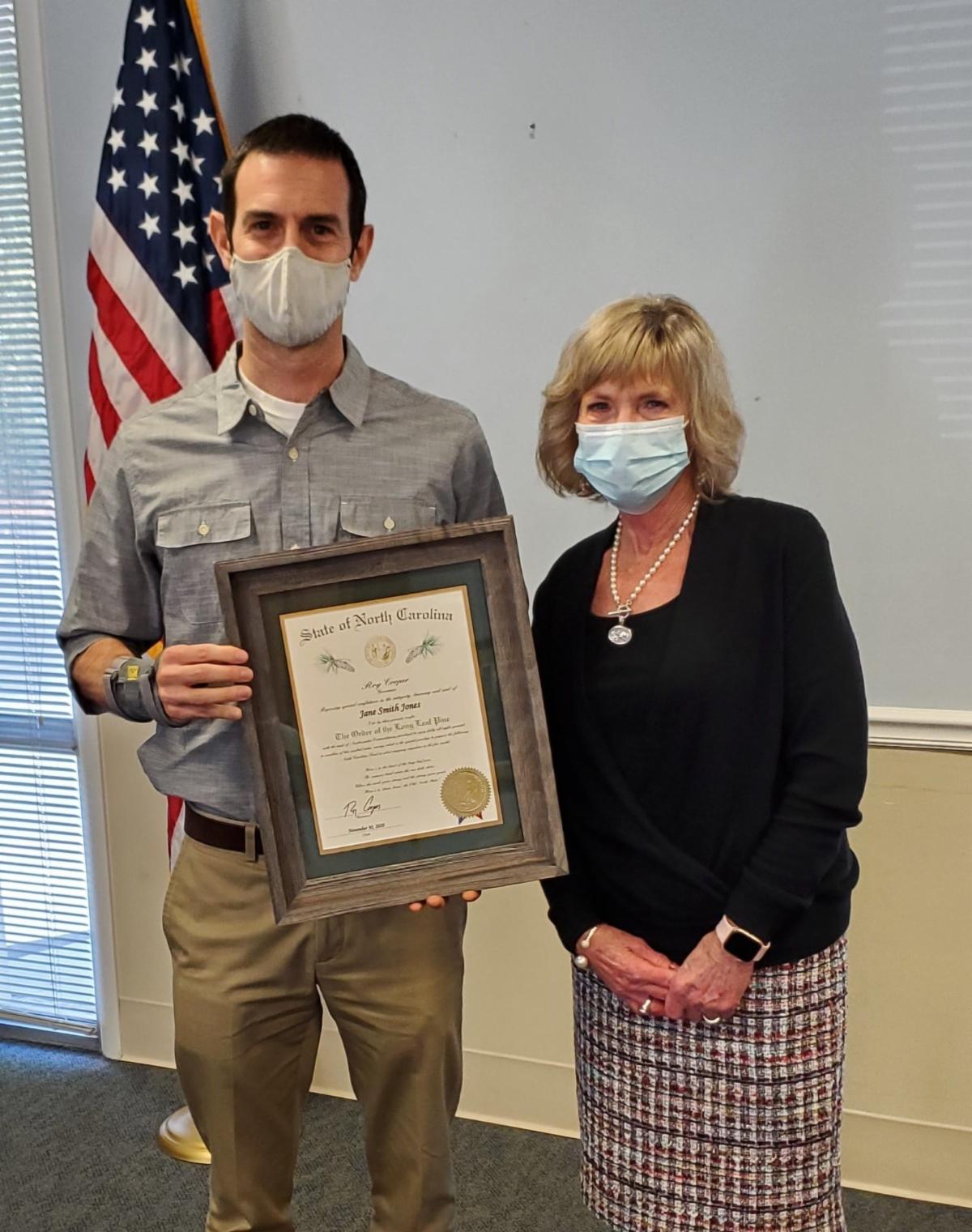
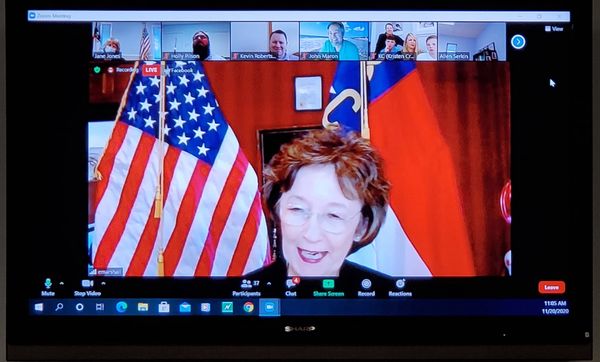
Secretary Marshall presented the Order of the Long Leaf Pine to Cape Fear Council of Governments Area Agency on Aging Director Jane Jones on November 20 for her exemplary service and exceptional accomplishments. The award was presented in a "virtual" retirement ceremony capping Jones' 30-plus year career of service to seniors in North Carolina.
|
|
Cape Fear COG Executive Director Allen Serkin Presented Jane Jones with the Order of the Long Leaf Pine on Behalf of Gov. Cooper and Sec. Marshall. |
|
Sec. Marshall was there in spirit - and on screen! - honoring Jane Jones for her years of dedication as an advocate for the region's seniors as she "virtually" presented Jones with the Order of the Long Leaf Pine. |
|
As Director of the Cape Fear Council of Governments Area Agency on Aging, Jones has spent years administering state, federal and local programs to assist seniors across Brunswick, Columbus, New Hanover and Pender counties.
Jones also coordinated numerous events, including programs raising awareness about elder abuse and financial exploitation.
(Left to Right) Jane Jones, Audie
Lowrimore and Sec. Marshall at a
2016 Anti-Fraud event in Wilmington.
Secretary Marshall participated in many of those programs, helping educate the public about the dangers of investment scam artists targeting older Americans, as well as raising awareness about the dangers of counterfeit prescription medicine, and the importance of advance health care directives.
|
|
NASAA Members Adopt Model Rule on Continuing Education by Investment Adviser Representatives
The North American Securities Administrators Association (NASAA) announced on November 30th that its membership has voted to adopt a model rule to set parameters by which NASAA members could implement continuing education programs for investment adviser representatives in their jurisdictions. The model rule has a products and practices component and an ethics component and is intended to be compatible with other continuing education programs.
“This model rule represents the culmination of years of work by state securities regulators and industry to develop a relevant and responsive continuing education program,” said Lisa A. Hopkins, NASAA President and West Virginia Senior Deputy Securities Commissioner. “This successful collaboration will help promote heightened regulatory compliance while also helping investment adviser representatives better serve their clients by remaining knowledgeable of current regulatory requirements and best practices.”
Investment adviser representatives (IARs) play an important role in the financial lives of millions of Americans by providing advice on important financial decisions such as retirement planning. However, unlike other financial service professions, IARs are not subject to a continuing education requirement to maintain their licenses with state regulators. The model rule will help NASAA members close this gap by requiring IARs to take 12 hours of continuing education annually.
The model rule is the result of several years of work by the NASAA Investment Adviser Representative Continuing Education Committee, chaired by Linda Cena, Examination and Licensing Manager for the Michigan Corporations, Securities & Commercial Licensing Bureau. The committee conducted substantial outreach efforts and considered comments from regulators and the securities industry in developing the model rule.
The model rule will be available for NASAA members to consider adopting in their own jurisdictions. A copy of the model rule is available on NASAA’s website, here.
Editor's Note: While there is no current requirement that IA Representatives registered in North Carolina get continuing education training, the NC Secretary of State's Securities Division has been offering voluntary "best practices" workshops since 2010 and plans to continue offering these workshops for the foreseeable future. Last fall, we began offering Certificates of Completion to those attendees who are members of an association that requires continuing education in order to maintain a particular designation.
|
|
Fractional Share Investing – Buying a Slice Instead of the Whole Share
The SEC’s Office of Investor Education and Advocacy issued this Investor Bulletin in November to help educate investors about investing in fractional shares.
What are Fractional Shares?
A fractional share is when you own less than one full share of a stock or other security.
Why Invest in Fractional Shares?
Fractional shares are a way to invest when you do not have enough money to purchase a full share of a particular stock. For example, if XYZ stock trades at $1000 per share, but you only have $100 to invest, fractional share investing would allow you to purchase a fraction of the XYZ stock ($1000/$100), or .1 shares.
How does Fractional Share Investing Work?
Generally, you can place orders to buy or sell fractional shares in either dollar amounts or share amounts. For example, if XYZ Stock trades for $1000, you could place an order for a fractional share such as .5 shares or for a dollar amount such as $500. The way you buy and sell fractional shares differs between brokerage firms that provide this service to their customers. Below, some of the issues are highlighted that may impact how fractional share investing works at your brokerage firm.
Important Items to Consider Before Investing in Fractional Shares
Availability
Not every brokerage firm offers fractional share investing. Even if your brokerage firm offers this service, it may not offer this service to all its customers. Contact your brokerage firm to find out if they offer fractional share investing, and if they do, if it’s available to all its customers.
Types of Securities to Trade
Brokerage firms may limit the types of securities you can buy and sell using fractional shares. Some brokerage firms only allow fractional share investing in stocks, while others allow it in stocks and exchange-traded funds (ETFs). Brokerage firms may also limit the types of stocks and ETFs available for fractional share investing. For example, some firms only allow fractional share investing in S&P 500 stocks. If your brokerage firm offers fractional share investing, ask them to provide you with a list of stocks or other securities you can buy or sell with fractional shares.
Trade Execution
Some brokerage firms allow you to buy or sell fractional shares in real-time just like full shares. However, some brokerage firms aggregate orders to handle their customer’s buying and selling of fractional shares. Aggregating orders means rather than filling each fractional share order in real-time, the brokerage firm collects these orders throughout the day and then executes one or more large orders to fulfill them. The process your brokerage firm uses to handle buying and selling of fractional shares may impact the price you pay or receive for a fractional share order. Make sure you ask your brokerage firm for specific details on how it handles each order to buy and sell fractional shares.
Order Types and Trading Limitations
Brokerage firms generally offer several ways to buy or sell (order types) securities. However, some firms do not allow the use of certain order types to buy or sell fractional shares. For example, some firms only allow market orders for fractional share investing. In addition to order type limitations, some brokerage firms also have trading limitations related to fractional shares such as:
· Requiring minimum size or dollar amounts for fractional share orders
· Limiting the trading platforms where you can place fractional share orders (e.g., only through the brokerage firm’s mobile app)
Dividends and Other Corporate Actions
When you own fractional shares you will still receive dividends and participate in other corporate actions such as stock splits or reverse stock splits. Generally, you will participate in these corporate actions based on the percentage of a whole share that you own. For example, if you own .75 shares of XYZ stock, and XYZ distributes a dividend of $10.00 per share, you would receive $7.50. Make sure you contact your brokerage firm for specific details on how they handle dividends and other corporate actions for fractional shares.
Voting Rights: You may not have voting rights if you own fractional shares. Your ability to exercise proxy voting will depend on how your brokerage firm’s fractional share investing program works. Some brokerage firms allow it, with special procedures, and some firms do not allow it at all. Ask your brokerage firm whether you will have any voting rights associated with fractional share purchases.
Fees
Some brokerage firms may charge fees for fractional share transactions. Ask your brokerage firm if any additional fees apply when you buy or sell fractional shares.
Liquidity
Liquidity refers to the ability to quickly and easily sell a stock or other security. If a stock in which you purchase fractional shares becomes illiquid, the underlying fractional shares will be illiquid as well. Some brokerage firms have indicated that they do not guarantee the liquidity of fractional shares, even if fully shares of the stock are liquid. This means you may have difficulty selling fractional shares in certain circumstances and could potentially lose money on the investment. Ask your brokerage firm and read your brokerage firm’s account agreement to see if you need to consider liquidity when selling fractional shares.
Nontransferable
You generally cannot transfer fractional shares to another brokerage firm. If you decide to transfer your brokerage account to a different brokerage firm you may have to sell any fractional shares in your account.
|
|
One Call Could Save Your Life Savings!
Is that individual offering you an investment opportunity licensed to sell securities in North Carolina? Is the investment opportunity itself registered? Know before you sign!
While registration in and of itself is no guarantee against fraud, not being registered is a very big red warning flag.
We urge you to take five minutes to call our NC Investor Hotline at 1-800-688-4507 to see if the person you have been dealing with – perhaps even for years – is properly registered and/or has a disciplinary history. You can also check to see if the actual investment itself is properly registered.
Pick up the phone and call us. You owe it to yourself and your family to check. And please also consider sharing the information in this newsletter with YOUR contacts or your social networks. Doing so will help keep your friends and loved ones safe, too. More information can be found at https://www.sosnc.gov/divisions/securities/for_investors.
|
|
Beware of Misleading Mailings to NC Businesses
The NC Secretary of State’s Office is aware of some misleading mailings going to businesses soliciting them to use a private company for filings with the NC Secretary of State’s Business Registration Division. Please be aware that you can file your annual reports and other required paperwork with our Business Registration Division without paying a private company an additional fee.
At least three companies – NC Certificate Service, Annual Report Complaint (A.R.C.), and C.P.F.S. – are sending out mailings soliciting businesses to retain their services for annual report filings and other corporate compliance. There is no need to obtain the services of a third-party vendor to obtain a Certificate of Existence or file an annual report. Report these misleading mailings directly to the Attorney General’s Consumer Complaint Division at https://ncdoj.gov/protecting-consumers/.
Key indicators of a misleading mailing is the company’s statement that they are:
- Not a government agency;
- Does not officially represent the State or any government entity;
- Has not been approved or endorsed by any government agency;
- A third-party service provider; or
- A private entity.
- The solicitation may also indicate that you are not obligated to use the solicitation and may provide or mention the NC Secretary of State’s web site address.
Additional information about these and other misleading mailings can be found on the NC Secretary of State Business Registration Division webpage.
|
|
FINRA Alerts Firms to Phishing Email Using Invest-FINRA.org Domain Name
The domain of “invest-finra.org” is not connected to FINRA and firms should delete all emails originating from this domain name.
FINRA has requested that the Internet domain registrar suspend services for "invest-finra.org".
FINRA reminds firms to verify the legitimacy of any suspicious email prior to responding to it, opening any attachments or clicking on any embedded links.
Questions regarding this Notice should be directed to:
-
Dave Kelley, Director, Member Supervision Specialist Programs, at (816) 802-4729 or by email; or
-
Greg Markovich, Senior Principal Risk Specialist, Member Supervision Specialist Programs, at (312) 899 4604 or by email.
|
|
PODCAST
AI Virtual Conference: Industry Views on the State of Artificial Intelligence
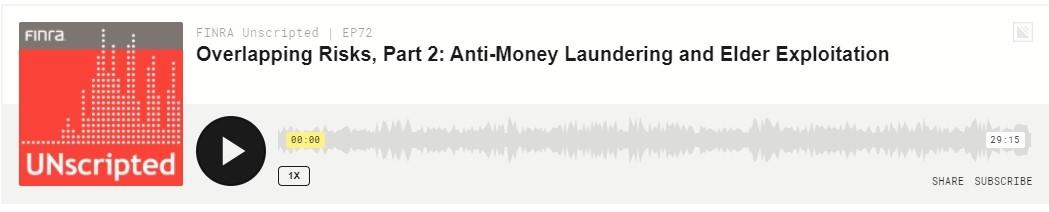
In November, FINRA hosted the virtual AI Conference to bring together regulators and leaders across the financial services industry to discuss the use of artificial intelligence and related opportunities and challenges.
In this episode of FINRA's "UNscripted podcast, you can listen in to the first of the conference’s sessions, “Industry Views on the Current and Future State of Artificial Intelligence,” with Imperative Execution CEO Roman Ginis, SIFMA Managing Director and Associate General Counsel Melissa MacGregor and Head of Fidelity Labs Mona Vernon, moderated by Haime Workie from FINRA Office of Financial Innovation, as they talk about the role of AI in the securities industry.
(Click on the image below to listen to the podcast.)
|
|
Resources mentioned in this episode:
|
|
SEC Adopts Amendments to Modernize and Enhance Management’s Discussion and Analysis and other Financial Disclosures
The Securities and Exchange Commission announced on Nov. 19th that it has voted to adopt amendments that will modernize, simplify and enhance certain financial disclosure requirements in Regulation S-K. The amendments are intended to enhance the focus of financial disclosures on material information for the benefit of investors, while simplifying compliance efforts for registrants.
"These rules will improve the quality and accessibility of the disclosure that companies provide their investors, including, importantly giving investors greater insight into the information management uses to monitor and manage the business," said SEC Chairman Jay Clayton. "The improved approach to these disclosures reflects the broad diversity of issuers in our public markets and will allow investors to make better capital allocation decisions, while reducing compliance burdens and costs and maintaining strong investor protection."
The amendments reflect the Commission's long-standing commitment to a principles-based, registrant-specific approach to disclosure. This approach, as applied to Management's Discussion and Analysis, should yield material information relevant to an assessment of the financial condition and results of operations of the registrant, and allow investors to view the registrant from management's perspective. The amendments are also intended to improve disclosure by enhancing its readability, discouraging repetition and eliminating information that is not material.
|
|
SEC Adopts Rules to Facilitate Electronic Submission of Documents to the Agency
The Securities and Exchange Commission on Nov. 17th voted to adopt rules and rule amendments that will provide additional flexibility in connection with documents filed with the Commission by permitting the use of electronic signatures in authentication documents, and facilitate electronic service and filing in the Commission's administrative proceedings. These new rules and amendments are part of a series of initiatives designed to modernize and strengthen the agency's operations.
In the first action, the Commission adopted rule amendments to permit the use of electronic signatures when executing authentication documents in connection with many documents filed with the Commission. Rule 302(b) of Regulation S-T currently requires that each signatory to an electronic filing manually sign a signature page or other document ("authentication document") before or at the time of the electronic filing to authenticate the signature that appears in typed form within the electronic filing.
The amendments permit a signatory to an electronic filing who follows certain procedures to sign an authentication document through an electronic signature that meets certain requirements specified in the EDGAR Filer Manual. In addition, the Commission amended certain rules and forms under the Securities Act, Exchange Act, and Investment Company Act to allow the use of electronic signatures in authentication documents in connection with certain other filings when these filings contain typed, rather than manual, signatures. These amendments recognize the widespread use of electronic signatures and technological developments in the authentication and security of electronic signatures, as well as the continuing need to support remote workforces, and follow a rulemaking petition joined by nearly 100 public companies. The rule amendments will be effective upon publication of the adopting release in the Federal Register.
In the second action, the Commission adopted rule amendments to require electronic filing and service of documents in administrative proceedings. These rule amendments also require redaction of sensitive personal information from many of these documents before filing with the Commission. These amendments will become effective 30 days after publication of the adopting release in the Federal Register. However, compliance will not be required until April 12, 2021, and there will be an initial 90-day phase-in period following the compliance date.
|
|
-
On November 9, 2020, the Securities Division of the North Carolina Department of the Secretary of State issued a Temporary Cease and Desist Order to respondents, Claybourne Glenn Bass and Claybourne Glen Bass, LLC. The order found the respondents were transacting business in the State of North Carolina in violation of the North Carolina Securities Act. The Temporary Order to Cease and Desist ordered each respondent to immediately cease and desist from violating the anti-fraud provisions of the Securities Act; entering into investment contracts with the public; offering for sale, soliciting offers to purchase, or selling, any security and otherwise holding itself out to be or engaging in the business of securities dealer or salesman. The Temporary Order to Cease and Desist gives respondents 30 days in which to request a hearing. If no such request is made during that time, the Temporary Order to Cease and Desist shall become final. For more information, click here.
-
On September 8, a federal grand jury returned a superseding indictment charging Joshua Matthew Houchins, 36, of Sanford, NC, with fraud, money laundering, obstruction of justice and firearms offenses. The charges were announced today in federal court. The Federal Bureau of Investigation and the North Carolina Secretary of State are investigating the case. The Wake County Sheriff’s Office, Apex Police Department, and Sanford Police Department, also provided assistance. Assistant U.S. Attorney William M. Gilmore is prosecuting the case. An indictment is merely an accusation. The defendant is presumed innocent until proven guilty. For more information, please see this press release.
-
On August 13, Mark Colin Ramsey, 50, of Graham, N.C., was sentenced to 65 months in prison for operating a $1.1 million investment scheme. U.S. District Judge Martin Reidinger also ordered Ramsey to serve three years of supervised release and to pay restitution in the amount of $1,098,333.92. North Carolina Secretary of State Elaine F. Marshall joins U.S. Attorney Andrew Murray in making this announcement. According to filed court documents and statements made in court, from April 2008 to September 2013, Ramsey defrauded more than 20 victims out of nearly $1.1 million through a fraudulent investment scheme. In making the announcement, U.S Attorney Murray thanked the Securities Division of the North Carolina Department of the Secretary of State for their investigation of this case. For more information, please see this press release.
-
On August 3, 2020, Anthony Wayne March, of Wake Forest, NC, pleaded guilty to wire fraud for his role in an $8.1 million Ponzi scheme (see press release). According to court documents, March, 49 years old, operated the non-profit 501(c)(3) entity Asset Trader, located in Rolesville, NC, between 2012 to 2015. March represented that Asset Trader offered educational services to professionals and taxpayers in the area of exit planning. Asset Trader’s stated educational mission allowed it to obtain classification as a 28 U.S.C. § 501(c)(3) tax-exempt non-profit organization. Asset Trader used its §501(c)(3) tax-exempt status to solicit tax-deductible donations in exchange for charitable gift annuities (“CGAs”) and to recruit referral sources to obtain assets from potential donors. Through Asset Trader, March and his co-conspirators engaged in and executed what is commonly known as a “Ponzi” scheme to defraud investors by inducing them to invest with Asset Trader. The Internal Revenue Service Criminal Investigation Division (IRS-CI), and the North Carolina Secretary of State, Securities Division conducted the investigation in this matter. March's sentencing in US District Court for the Eastern District of North Carolina is currently scheduled for December 8, 2020.
-
On June 11, 2020, Joseph Maurice Deberry, a/k/a Joseph Maurice Dewberry, 56, of Charlotte, appeared before U.S. Magistrate Judge David S. Cayer on June 11, 2020, and pleaded guilty to wire fraud, for orchestrating an investment scheme that defrauded victims of hundreds of thousands of dollars. According to admissions Deberry made in plea documents and the June 11th plea hearing, from 2016 through June 2019, Deberry fraudulently obtained hundreds of thousands of dollars from more than a dozen investors. As part of the scheme, Deberry induced victims to invest in entities with which he was affiliated, such as Pinnacle Investment Properties, LLC and Place Capital Group LLC, among others. Deberry typically represented to investors that their money would be used to further projects related to the construction of student housing at certain colleges in the Carolinas and other ventures. As Deberry admitted in court and in related filings, rather than use the victims’ money as he had represented, Deberry used a significant portion of their funds to pay for personal expenses like rent, entertainment and travel. Further, Deberry actively concealed from his victims the fact that he was under a Cease and Desist Order from the North Carolina Secretary of State's Securities Division prohibiting him from offering for sale, soliciting offers to purchase, or selling any securities in North Carolina. Deberry concealed this information from victims by, among other things, telling them that his name was Maurice Dewberry. Deberry pleaded guilty to wire fraud. The charge carries a maximum prison sentence of 20 years and a $250,000 fine. A sentencing date for Deberry has not been set. For more information, see this press release.
-
On April 16, 2020, the North Carolina Department of the Secretary of State, Securities Division entered into a Final Consent Order ("Order") with Ferry Capital Management, LLC ("FCM") and Paul Edward Ferry. The Order found that Respondents transacted business in North Carolina as an investment adviser and an investment adviser representative without being registered, in violation of the North Carolina Investment Advisers Act ("Act"). Pursuant to the Order, FCM and Ferry agreed to immediately cease and desist from violating any provisions of the Act and any related administrative rules; keep FCM's Form ADV updated; hire a third-party compliance auditor; attend the Securities Division's Investment Adviser Best Practices Workshop; and pay both a civil penalty and the cost of investigation. For more information, click here.
|
|
|
|
NC Department of the Secretary of State
Securities Division
Investor Protection & Education Services
|
|
|
|
|
|
|
|