Secretary Marshall Reappointed to Two Key Committees for the National Association of Secretaries of State
The National Association of Secretaries of State (NASS) recently reappointed NC Secretary of State Elaine Marshall as Co-Chair of the NASS Securities Committee and as the organization's representative to the Uniform Law Commission (ULC) Advisory Committee.
“I’m honored to be reappointed to continue the crucial work of these committees,” said Secretary Marshall. “As North Carolina’s top securities regulator it’s my mission to protect our state’s investing public, so I appreciate the NASS Securities Committee’s work to facilitate the dialogue about state securities regulation. The work of the Uniform Law Commission strengthens our federal system by providing a consistent legal framework that allows for a level of uniformity in statutes across the states while respecting the diverse needs of each state.”
“Each Secretary of State appointed brings their own unique talents, perspective and leadership experience. I’m thankful to them for agreeing to serve in these vital posts and I appreciate their contributions to the association,” said Kyle Ardoin, NASS President and Louisiana Secretary of State.
The Uniform Law Commission provides states with model legislation designed to bring clarity to critical areas of state statutory law.
The Securities Committee reviews the actions of the North American Securities Administrators Association (NASAA) and other stakeholder organizations, Congress, and relevant federal agencies with an interest in state securities regulation.
NCSOS’s Securities Division enforces and administers North Carolina’s securities laws, which are designed to protect the investing public.
Founded in 1904, NASS is the oldest nonpartisan professional organization of public officials in the United States.
|
|
New Manual Gives Prosecutors in North Carolina a New Tool in Combating Elder Abuse |
|
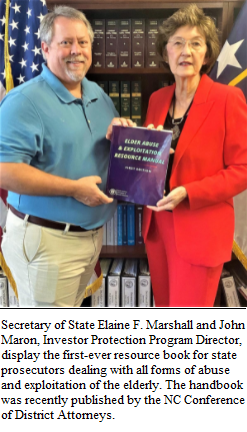
The North Carolina Secretary of State's Office was honored to be asked to participate in the NC Conference of District Attorneys project to produce the first-in-the-nation handbook to aid prosecutors in protecting North Carolina’s seniors from the growing threat of elder abuse and financial exploitation.
This manual references all of the statutes giving the Secretary of State’s Office jurisdiction to fight financial abuse and exploitation, including the statutes enforced by our Securities Division to protect the state’s investing public.
The North American Securities Administrators Association (NASAA) gave permission to include a section of their enforcement manual in the chapter of this handbook on "Initiating, Planning and Developing an Investigation."
This handbook, which was a collaborative effort between prosecutors, federal, state and local law enforcement, county social services, Legal Aid of North Carolina and the UNC School of Government, promises to serve as a national model for prosecutors, and demonstrates that North Carolina is a leader in the fight against elder fraud, abuse and exploitation.
If you believe you’ve been the victim of an investment scam, you can file a complaint on the Securities Division section of www.sosnc.gov. Call the Secretary of State's NC Investor Hotline at 1-800-688-4507 before signing over your money in any investment opportunity to make sure the individual promoting the investment is registered to sell securities in North Carolina and that the investment opportunity itself is registered. If you know of an elderly or disabled person who may be the victim of fraud, abuse or exploitation, contact your county’s Department of Social Services and make a report to their Adult Protective Services staff.
|
|
FINRA, NASAA & SEC OIEA Urge Investors to Establish a
Trusted Contact to Increase Investor Protection
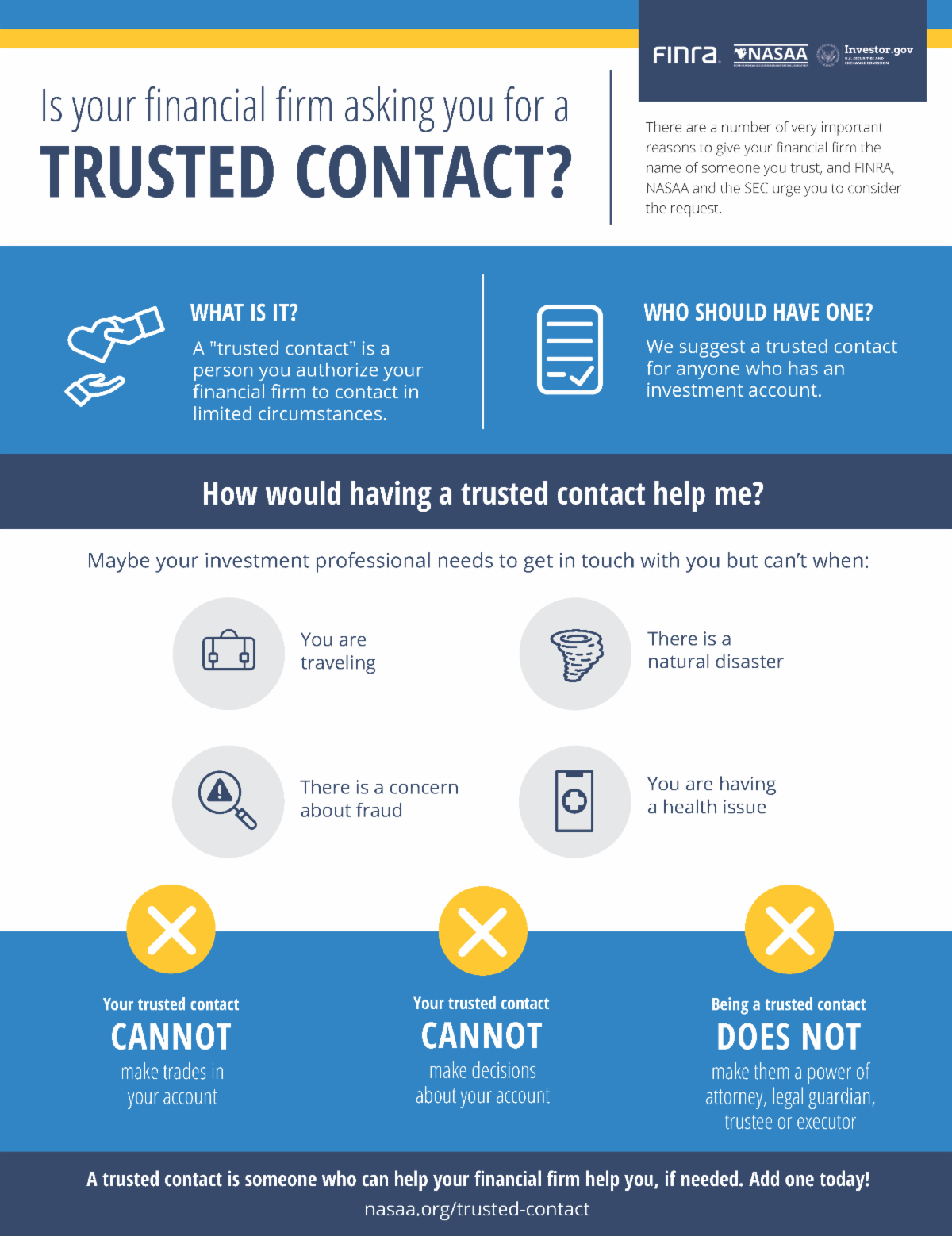
In a combined effort to provide additional protection for investors, the Financial Industry Regulatory Authority (FINRA) and the North American Securities Administrators Association (NASAA) (of which the NC Department of the Secretary of State is a member) have announced a new campaign urging investors to provide their financial firms with a trusted contact (see infographic above). The U.S. Securities and Exchange Commission’s Office of Investor Education and Advocacy (SEC OIEA) is also collaborating on this initiative.
A trusted contact is an individual authorized by an investor to be contacted by their financial firm in limited circumstances. These circumstances would include concerns about activity in the investor’s account or if the firm has been unable to reach the investor after numerous attempts. A trusted contact may be a family member, attorney, accountant or another reliable third party; investors may establish more than one trusted contact and may add or change a trusted contact at any time.
|
|
One Call Could Save Your Life Savings!
Is that individual offering you an investment opportunity licensed to sell securities in North Carolina? Is the investment opportunity itself registered? Know before you sign!
While registration in and of itself is no guarantee against fraud, not being registered is a very big red warning flag.
We urge you to take five minutes to call our NC Investor Hotline at 1-800-688-4507 to see if the person you have been dealing with – perhaps even for years – is properly registered and/or has a disciplinary history. You can also check to see if the actual investment itself is properly registered.
Pick up the phone and call us. You owe it to yourself and your family to check. And please also consider sharing the information in this newsletter with YOUR contacts or your social networks. Doing so will help keep your friends and loved ones safe, too. More information can be found at https://www.sosnc.gov/divisions/securities/for_investors.
|
|
Financial & Investment Education
Age sixty-five. Whether it’s far off or right around the corner, building a secure retirement is a concern for every American. After a global pandemic and volatile stock market, many are left confused and anxious about their personal finances.
To continue the multi-year effort, PBS Books is producing a new series of monthly financial and investor education events – arming viewers with trusted information on what to do about their personal investments amid a changing retirement landscape.
Through livestreaming, each virtual event will feature qualified experts from across the country, who can provide information and insight on different financial topics. Viewers will have an opportunity to submit comments and get answers in real time. Each event takes place the fourth Friday of each month at 1 p.m. ET on Facebook Live.
What began as a national Public Television documentary, produced by Detroit Public Television in 2016, ‘When I’m 65’ is now a national movement with robust online resources, toolkits, videos, and local engagement events to help all generations of Americans navigate retirement planning.
|
|
October is Cybersecurity Awareness Month
This Year's Theme: “Do Your Part. #BeCyberSmart.”
Now in its 18th year, Cybersecurity Awareness Month—previously known as National Cybersecurity Awareness Month—continues to raise awareness about the importance of cybersecurity across our Nation, ensuring that all Americans have the resources they need to be safer and more secure online.
Held every October, Cybersecurity Awareness Month is a collaborative effort between government and industry to ensure all Americans have the resources they need to be safer and more secure online. The Cybersecurity and Infrastructure Security Agency (CISA), the federal lead for Cybersecurity Awareness Month, co-leads Cybersecurity Awareness Month with the National Cyber Security Alliance (NCSA).
RESOURCES
Below are useful resources to enhance and promote cybersecurity awareness both during October and throughout the year.
-
The STOP. THINK. CONNECT.™ Campaign is a national public awareness campaign offering free resources to help increase the understanding of cyber threats and empowering the American public to be safer and more secure online.
-
The National Cyber Security Alliance (NCSA) builds strong public and private partnerships to create and implement broad-reaching education and awareness efforts to empower users at home, work, and school with the information they need to keep themselves, their organizations, their systems and their sensitive information safe and secure online and encourage a culture of cybersecurity.
-
CISA’s Reduce the Risk of Ransomware Campaign aims to raise awareness and combat the ongoing and evolving threat of ransomware. The campaign offers recorded webinars, guides, cyber alerts, and tip sheets for both technical and non-technical people to learn how to prevent, respond to, and recover from ransomware attacks.
-
The Be Cyber Smart Campaign, a national effort by the U.S. Department of Homeland Security, is designed to inspire the younger generation of Americans to take responsibility for their own cyber safety. Learn about cybersecurity basics, common scams, and how to report cybersecurity incidents by visiting the campaign online.
-
CISA’s Cyber Essentials is a guide for leaders of small businesses as well as leaders of small and local government agencies to develop an actionable understanding of where to start implementing organizational cybersecurity practices. For a deeper look and greater insight, check out the Cyber Essentials Toolkits, a set of modules designed to break down the CISA Cyber Essentials into bite-sized actions for IT and C-suite leadership to work toward full implementation of each Cyber Essential.
-
CISA’s Telework Guidance and Resource site is a one stop shop for CISA resources to assist organizations and teleworkers be secure when working remotely.
-
And for state-registered investment advisers, the North American Securities Administrators Association (NASAA) has developed a Cybersecurity Checklist just for you.
|
|
Calling All K-12 Students!
The Multi-State Information Sharing & Analysis Center (MS-ISAC) is holding a national poster contest to promote cybersecurity and staying safe online.
Public, private, and home schooled students in grades K-12 are invited to participate for a chance to have their artwork displayed on the 2022 MS-ISAC Posters and the Kids Safe Online Activity Book!
Entries should feature original artwork illustrating the safe use of the Internet and/or mobile devices.
Winners from each grade group (K-5, 6-8, 9-12) will be selected. A total of 13 winners will have their artwork displayed in our Kids Safe Online Activity Book, which will be distributed throughout the country and used in campaigns to raise awareness among
children of all ages about Internet and computer safety. The top four submissions will also be made into posters promoting cybersecurity practices.
The MS-ISAC will notify the school contact person named on the Poster Entry Form or the state contact if their student is a winner!
|
|
FINRA Adopts Rules to Address Firms With a Significant History of Misconduct
FINRA has adopted new rules to address firms with a significant history of misconduct. New Rule 4111 (Restricted Firm Obligations) requires member firms that are identified as “Restricted Firms” to deposit cash or qualified securities in a segregated, restricted account; adhere to specified conditions or restrictions; or comply with a combination of such obligations. New Rule 9561 (Procedures for Regulating Activities Under Rule 4111) and amendments to Rule 9559 (Hearing Procedures for Expedited Proceedings Under the Rule 9550 Series) establish a new expedited proceeding to implement Rule 4111.
The new rules and rule amendments become effective on January 1, 2022. For more details, please click here.
|
|
Digital Asset and “Crypto” Investment Scams
The SEC’s Office of Investor Education and Advocacy (OIEA) and Division of Enforcement’s Retail Strategy Task Force (RSTF) remind investors to watch out for investment schemes involving digital assets and “Crypto.”
Fraudsters continue to exploit the rising popularity of digital assets to lure retail investors into scams, often leading to devastating losses. “Digital assets” include crypto-currencies, coins, and tokens such as those offered in so called initial coin offerings (ICOs). Investors may be less skeptical of investment opportunities that involve something new or “cutting-edge,” or may get caught up in the fear of missing out (FOMO). For example, some investors may have FOMO, given the rise in price of some digital assets in recent years, that they will miss an opportunity to become very wealthy. If you are considering a digital asset-related investment, take the time to understand how the investment works and to evaluate its risks. Look for warning signs that it may be a scam.
|
|
The SEC brought charges in a $2 billion Bitcoin-related investment scam. In SEC v. BitConnect, the SEC took enforcement action against the perpetrators of one of the largest Bitcoin-related Ponzi-like schemes. According to the SEC, the defendants collected approximately 325,000 Bitcoin, worth approximately $2 billion at the time, from retail investors worldwide through a platform that encouraged investors to lend their Bitcoin to BitConnect. The founder of the platform allegedly lured investors with false promises of profits to be generated by a purported proprietary Bitcoin trading “bot” and secretly paid a network of promoters around the world for their efforts to promote the lending platform through “testimonial”-style YouTube videos and other social media in multiple countries. The SEC also alleges that investors were rewarded for recruiting new victims through a pyramid scheme-like referral program. The SEC’s complaint notes that the platform’s website represented: “Investing on BitConnect platform, as you will find, is a safe way to earn a high rate of return on your investment without having to undergo a significant amount of risk.” The platform allegedly paid investor withdrawals out of incoming investor funds and did not trade investors’ Bitcoin consistent with its representations, leading the platform to collapse and investors to lose massive amounts of money.
|
|
When considering an investment opportunity, be cautious if you spot any of these red flags of fraud:
- “Guaranteed” high investment returns. Promises of high investment returns with little or no risk are a classic warning sign of fraud. Fraudsters may post fabricated historical returns on their websites showing high investment returns.
-
Unlicensed/unregistered sellers. Unlicensed, unregistered sellers commit much of the securities fraud targeting retail investors in the U.S. Check out the background (including license and registration status) of anyone offering you an investment in securities using the search tool on Investor.gov.
- Skyrocketing account values. Depictions of investment accounts rapidly increasing in value and providing large returns are often fake. This is a tactic fraudsters use to entice investors with the prospect of great wealth.
- Sounds too good to be true. If an investment “opportunity” sounds too good to be true, it probably is. Remember that the potential for high investment returns usually involves high risk.
-
Fake Testimonials. Also, never rely solely on testimonials in making an investment decision. Fraudsters sometimes pay people – for example, actors to pose as ordinary people turned millionaires, social media influencers, and celebrities – to tout an investment on social media or in a video.
Before you hand over your money, verify that the individuals and firms offering an investment in securities are licensed/registered using the search tool on Investor.gov. Carefully review all materials about any investment opportunity and ask questions. Learn more about investments involving digital assets, including so-called ICOs, on Investor.gov, where you can find tips on investing wisely and avoiding fraud.
Additional Resources
|
|
New Research Examines Why Some Consumers are More Vulnerable to Financial Scams
Investigators found that the attitudes and beliefs shaping the ways study participants looked at the world—known as “mental frames”—may have influenced the way they reacted to scams. Specifically, researchers propose that mental frames governing compliance, opportunity, intelligence, and order may have affected the way that interviewees interpreted what scammers told them. Individuals were more likely to lose money if they believed that:
- Authority should not be challenged.
- Financial opportunities are a zero-sum game with clear winners and losers.
- The world is organized in a way that rewards good people.
- Asking too many questions can make a person seem ignorant.
“This research gives us new ways to understand who is at risk for losing money to financial scams and opens novel possibilities for protecting people against different forms of fraud,” said FINRA Foundation President Gerri Walsh. “We hope these insights into the role that beliefs and attitudes play in fraud victimization will stimulate additional research and the development of effective strategies to reduce consumer losses.”
Study participants were identified from a pool of people who filed reports with BBB Scam Tracker℠, an online fraud reporting tool offered by the Better Business Bureau. Researchers from Metro Tribal, LLC, an ethnographic-based social insight firm, conducted in-depth interviews that yielded key insights.
The researchers spoke with 17 people who were targeted by scammers. In recorded interviews, some participants explained how scammers reached out with promises of easy money or lucrative investments. Others described receiving phone calls from fraudsters posing as IRS agents and demanding payment of back taxes.
Researchers also interviewed two young men who worked from an overseas call center to defraud hundreds of people using the IRS scam. Details of their activities and tactics, described in their own words, are included in the report.
|
|
-
On July 29, 2021, the North Carolina Department of the Secretary of State, Securities Division entered into a Final Consent Order ("Order") with Tannin Capital, LLC. The Order states that Tannin Capital was ineligible for an exemption from state registration as an investment adviser from October 2019 through on or about April 2020. Pursuant to the Order, Tannin Capital agreed to immediately cease and desist from violating any provision of the North Carolina Investment Advisers Act and any related administrative rules, to pay a civil penalty and reimbursement of the costs of investigation. The North Carolina Department of the Secretary of State thanks the U.S. Securities and Exchange Commission, Atlanta Regional Office for their assistance in this matter. For more information on this Order, click here.
-
On May 21, 2021, the North Carolina Department of the Secretary of State, Securities Division entered into a Final Consent Order (“Order”) with Roy Neil Carlson. The Order states that Carlson violated North Carolina law during the last two years by transacting business in North Carolina as an investment adviser representative without a valid registration pursuant to the North Carolina Investment Advisers Act. Pursuant to the Order, Carlson agreed to immediately cease and desist from violating any provisions of the North Carolina Investment Advisers Act and any related administrative rules, to pay a civil penalty, and cost of investigation. For more information, click here.
-
On April 5, 2021, Anthony Wayne March, 49, of Wake Forest, NC, was sentenced to 135 months imprisonment for wire fraud and ordered to pay $6,040,965.00 in restitution. (See the full story above.) The Internal Revenue Service Criminal Investigation Division (IRS-CI), and the North Carolina Secretary of State, Securities Division conducted the investigation in this matter. The Office of the U.S. Bankruptcy Administrator for the Eastern District of North Carolina provided substantial assistance. Assistant United States Attorney Ethan Ontjes, Special Assistant United States Attorney Brian Behr, and Special Assistant United States Attorney Kevin Harrington represent the United States.
-
On March 26, 2021, the Securities Division of the North Carolina Department of the Secretary of State issued a Temporary Cease and Desist Order to Respondents, Roy Neil Carlson and Carlson Financial Services, LLC. The order found Respondents were transacting business in the State of North Carolina in violation of the North Carolina Investment Advisers Act. The Temporary Order to Cease and Desist ordered each Respondent and any person, employee, officer, director, entity or independent contractor under the direction or control of Respondents, to immediately cease and desist from violating the anti-fraud provisions of the Investment Advisers Act, soliciting or providing investment advice to any prospective or current advisory clients, making or causing to be made any misleading filing to the Administrator and otherwise holding itself out to be or engaged in the business of an investment adviser or investment adviser representative. The Temporary Order to Cease and Desist gives Respondents 30 days in which to request a hearing. If no such request is made during that time, the Temporary Order to Cease and Desist shall become final. For more information, click here.
-
On March 15, 2021, Charles Gilbert Murphy, a serial fraudster from Apex, NC, was sent back to federal prison to serve 75 months for an investment scam involving impersonation of a mayor, professor, and a government agency. The investigation was conducted by the Federal Bureau of Investigation, the Internal Revenue Service Criminal Investigation, and the North Carolina Secretary of State's Securities Division. For more information, see this press release.
-
On January 7, 2021, the Temporary Cease and Desist Order entered on November 9, 2020 (below) against Claybourne Glenn Bass and Claybourne Glenn Bass, LLC (the "Bass Respondents") became final, permanently barring the Bass Respondents from among other things, soliciting for purchase, offering or selling securities in North Carolina until such time as they become fully compliant with North Carolina's securities laws. For more information, click here.
-
On November 9, 2020, the Securities Division of the North Carolina Department of the Secretary of State issued a Temporary Cease and Desist Order to respondents, Claybourne Glenn Bass and Claybourne Glen Bass, LLC. The order found the respondents were transacting business in the State of North Carolina in violation of the North Carolina Securities Act. The Temporary Order to Cease and Desist ordered each respondent to immediately cease and desist from violating the anti-fraud provisions of the Securities Act; entering into investment contracts with the public; offering for sale, soliciting offers to purchase, or selling, any security and otherwise holding itself out to be or engaging in the business of securities dealer or salesman. The Temporary Order to Cease and Desist gives respondents 30 days in which to request a hearing. If no such request is made during that time, the Temporary Order to Cease and Desist shall become final. For more information, click here.
-
On September 8, 2020, a federal grand jury returned a superseding indictment charging Joshua Matthew Houchins, 36, of Sanford, NC, with fraud, money laundering, obstruction of justice and firearms offenses. The charges were announced today in federal court. The Federal Bureau of Investigation and the North Carolina Secretary of State are investigating the case. The Wake County Sheriff’s Office, Apex Police Department, and Sanford Police Department, also provided assistance. Assistant U.S. Attorney William M. Gilmore is prosecuting the case. An indictment is merely an accusation. The defendant is presumed innocent until proven guilty. For more information, please see this press release.
-
On August 13, 2020, Mark Colin Ramsey, 50, of Graham, N.C., was sentenced to 65 months in prison for operating a $1.1 million investment scheme. U.S. District Judge Martin Reidinger also ordered Ramsey to serve three years of supervised release and to pay restitution in the amount of $1,098,333.92. North Carolina Secretary of State Elaine F. Marshall joins U.S. Attorney Andrew Murray in making this announcement. According to filed court documents and statements made in court, from April 2008 to September 2013, Ramsey defrauded more than 20 victims out of nearly $1.1 million through a fraudulent investment scheme. In making the announcement, U.S Attorney Murray thanked the Securities Division of the North Carolina Department of the Secretary of State for their investigation of this case. For more information, please see this press release.
|
|
|
|
NC Department of the Secretary of State
Securities Division
Investor Protection & Education Services
|
|
|
|
|
|
|
|