|
| |
IN THIS ISSUE
Policy Corner
News Feed
Training & Events
Resources
Job Announcements
| | |
Policy Corner
Improving Access to ADHD Care
| | |
October’s National Attention-Deficit/Hyperactivity (ADHD) Awareness Month offers an opportunity to examine how state policies shape access to care for children and families. National data indicate that 7.1 million children aged 3 to 17 had a current ADHD diagnosis in 2024. The Health Resources and Services Administration (HRSA) reports that the prevalence of diagnosed ADHD among children has increased over time while treatment prevalence has declined. These trends underscore the importance of examining barriers to appropriate care.
The Centers for Disease Control and Prevention’s state-level ADHD data, drawn from HRSA’s National Survey on Children’s Health, provide estimates of diagnosis and treatment, including medication and behavioral treatment. These data offer a starting point for examining treatment patterns and identifying questions for further state-level analysis.
Two resources released in September 2026 by Temple University’s Center for Public Health Law Research bring the policy landscape into focus. A telehealth policy brief examines how reimbursement rules and provider licensing requirements can facilitate or constrain care. Telehealth may reduce transportation and scheduling burdens and expand access in communities with workforce shortages. Evidence shows that certain treatment modalities improve outcomes for children and their parents as compared to being on waitlists. Realizing the benefits of evidence-informed telehealth treatments requires policies that support access and maintain quality and safety.
A Medicaid managed care dataset examines medication coverage policies, including prior authorization, age restrictions, and behavioral therapy prerequisites. These requirements impact whether coverage decisions align with children’s clinical needs as well as the availability of recommended services.
Together, these resources provide a foundation for policy makers and system leaders to begin to assess whether their state’s telehealth and medication coverage requirements support timely, coordinated care—and where administrative processes or limited service availability create challenges for families trying to access care.
Resources
Authored by Avery Irons, JD, Senior Policy Analyst, Innovations Institute, UConn School of Social Work
| |
New Unwrapping Wrap Short 10/14
In the next Care Coordination Field Guide: Skills on the Go short, discover practical strategies for meaningfully engaging formal and natural supports in care coordination. Podcast hosts Covi and Conan discuss how personalized meeting invitations, clear expectations, and thoughtful preparation can move participation beyond simply showing up to actively contributing to the care planning process. Tune in Wednesday, October 14, by bookmarking our website and following us on Spotify.
| | | | |
Elevate Your Crisis Skills
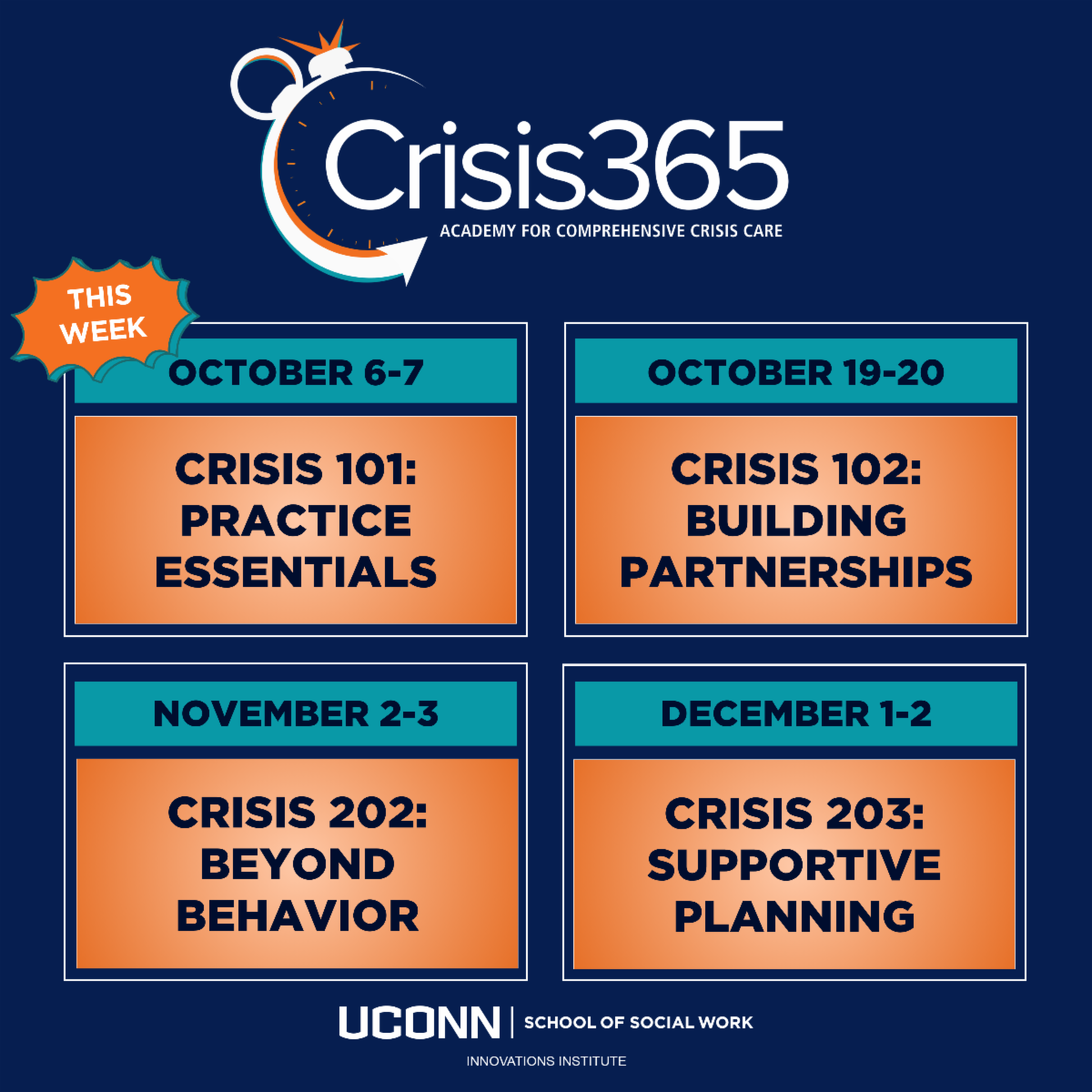
Ready to elevate your crisis response skills? Don’t miss your final opportunity of the year to start the Crisis 365 curriculum! Registration will soon close for the October 6-7 Crisis Academy 101 Practice Essentials, the required prerequisite for all advanced sessions. Don't miss this chance to become eligible for future trainings!
Secure your spot today to master core crisis care principles before classes start next week!
| |
988 "Press 3" Restored
The 988 "Press 3" LGBTQ+ Youth Voice and Chat/Text subnetworks resumed services on Wednesday, September 30, as directed by Congress. Contacts that cannot be answered within the LGBTQ+ Youth Voice subnetwork will route first to the local 988 network and, if needed, to National Backup. Chat/Text contacts that cannot be answered within the subnetwork will also route to the local network, except where local services operate through a State Centralized Platform; those contacts will route directly to National Backup.
| | | | | |
Tuesday, October 13
1:30 – 2:30 PM ET
Join Innovations' Parent, Infant, and Early Childhood (PIEC) team for the October Pyramid Practice Lunch & Learn to learn more about strategies to support children with moments of praise and opportunities to focus on and grow positive behavior interactions.
| | |
New National Indicator for Understanding Young Children's Development
Tuesday, October 6
3:00 – 4:00 PM ET
The Healthy and Ready to Learn (HRTL) measure offers a look at young children's development in the US across multiple domains. Researchers will share what the HRTL data reveal about contexts and conditions that shape how 3-year-olds develop, as well as their data dashboard and state fact sheets.
| | | | | |
Bridging Silos: How State Agencies Are Connecting Chronic Absence & Homelessness Work
Tuesday, October 6
3:00 PM ET
Students experiencing homelessness have among the highest chronic absence rates of any student group. Join experts and state officials as they discuss how attendance and homelessness interact, and how the chronic absence data already collected by states can function as an early warning signal to support students and prevent absenteeism.
| | |
Helping Young People Feel Connected
Wednesday, October 7
12:00 – 1:00 PM ET
In recognition of World Mental Health Day on October 10, the Morgan Stanley Alliance for Children’s Mental Health is holding an intergenerational panel exploring what connection means to young people and why it matters; how connection relates to loneliness, anxiety, depression, and well-being; and how parents and caregivers can support meaningful connections in young people's everyday lives.
| | | | | |
HRSA Grand Rounds: Screening & Treatment of Pediatric Depression & Anxiety
Wednesday, October 7
2:00 – 3:00 PM ET
Learn practical approaches to identifying and treating depression and anxiety in children and adolescents, including discussion of non-pharmacologic interventions. Panelists will cover appropriate prescribing and tapering of medications, as well as how Health Resources and Services Administration (HRSA) programs can support children, families, and the workforce.
| | | | |
How the New 1915(c) HCBS Waiver Authority Can Enhance Access & Outcomes
Wednesday, October 14
1:30 – 3:00 PM ET
This webinar will provide states with an overview of the new 1915(c)(11) Home and Community-Based Services (HCBS) waiver, including information about how it can improve access, outcomes, and cost-effectiveness. Presenters will share scenarios demonstrating potential for states to use the 1915(c)(11) waivers, along with covering program integrity considerations.
| | |
Strengthening Crisis Response for Infants, Young Children & Their Caregivers
Thursday, October 15
2:00 – 3:30 PM ET
This webinar will introduce key considerations for addressing behavioral health crises among infants, young children, youth, and their families within a coordinated crisis care continuum. The session will explore how to adapt crisis systems to meet the developmental needs of young children and youth, including the role of caregivers, early childhood and education systems, and family-centered approaches.
| | | | | |
Housing 101: State Housing Policies to Support Babies & Toddlers
Tuesday, October 20
11:00 AM – 5:00 PM ET
Join Thrive From the Start to learn how state housing policies and approaches can support prenatal-to-three children and their families. Attendees will gain a clearer understanding of the state housing policy landscape, learn about concrete examples of promising approaches, and leave with actionable ideas for advancing change in their own states and communities.
| |
Suicide Prevention in K-12 Schools
Schools are a critical setting for youth suicide prevention—but identifying risk is only part of the response. This open-access article explores comprehensive approaches to prevention, assessment, and intervention in K-12 settings. The authors highlight the need to expand supports for students experiencing suicidal thoughts and behaviors and strengthen partnerships among schools, researchers, and community mental health providers, particularly in rural and under-resourced communities.
| | | | |
New Youth Risk Behavior Survey Data
The Centers for Disease Control and Prevention released new data from the Youth Risk Behavior Surveillance System, a national public health survey monitoring health-risk and health-protective behavior among high school students. The findings offer a snapshot of the health and well-being of US high school students in 2025 and changes in the past two and ten years. Explore the finding on mental health and suicide and download the full report.
| |
New Child Poverty Data
New Census Bureau data show nearly 1 in 7 US children are in poverty, according to the 2025 Supplemental Poverty Measure (SPM) which provides a more complete picture of families' economic circumstances by accounting for taxes, public assistance, necessary expenses, and cost of living. It also shows the impact of public supports. Explore the latest poverty data in this Annie E Casey Foundation analysis.
| | | |
Do you have a job opportunity you would like to share with the field?
Be sure to indicate any applicant deadlines.
| | | | |