|
Dear Friends,
First of all, to our friends, family members, alumni and students in Israel and across the Middle East - I hope that you and yours are safe, and that the current war ends soon and brings a return to life without sirens, bomb shelters and fear. The Israelis I know are resilient and understand that life is like this sometimes, but it shouldn’t be, and I hope for peace to return very soon. More on this in a moment.
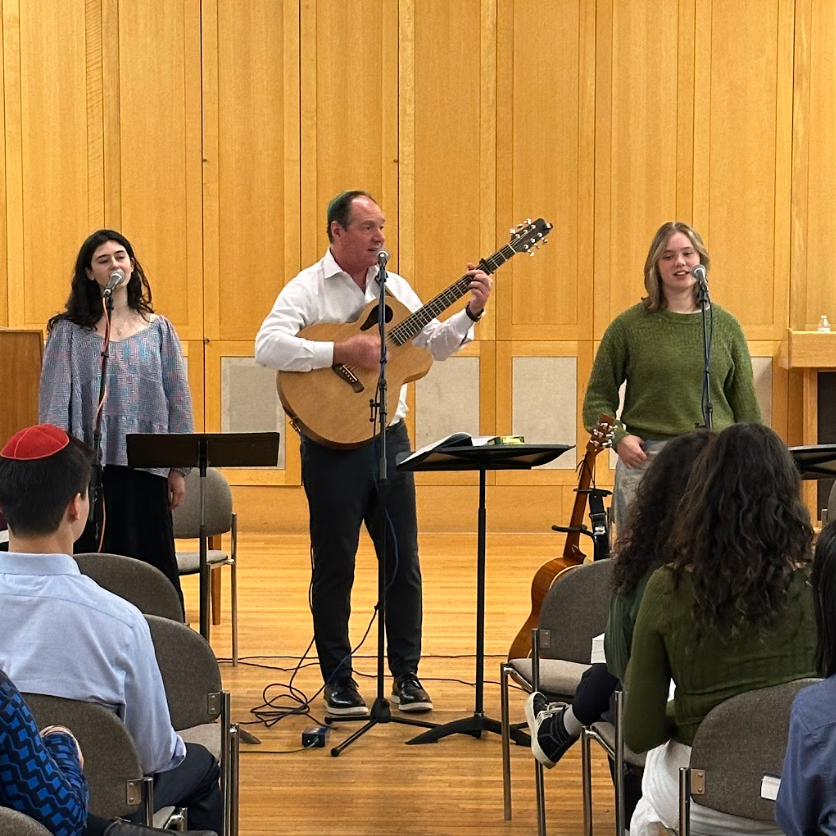
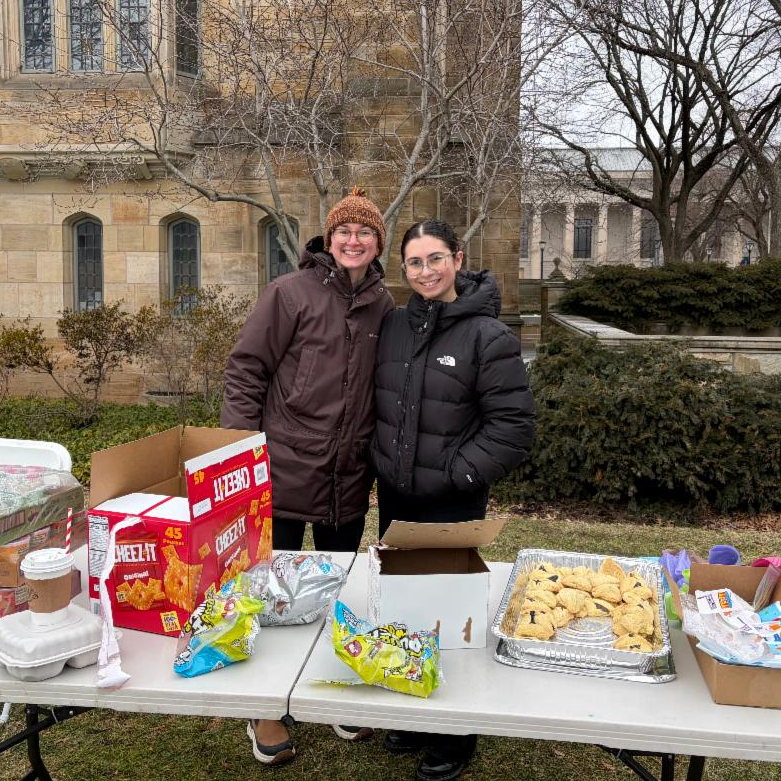
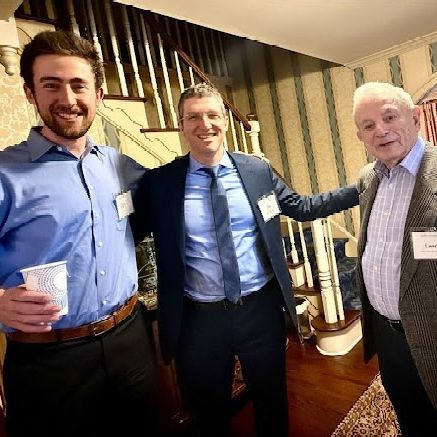
Believe it or not, this was the first time in many years that Purim has not fallen during Spring Break! Below are some Purim celebration highlights. We’ve had lots of other special occasions, too, including a weekend visit from renowned Reform music writer and singer Dan Nichols, an event on “Antisemitism and the Law” with Avi Helfand and our own Lauren Steinberg, and a Jewish text study on immigration. Take a look below for pictures and a recap!
For this month’s reflection, I want to speak personally about the moment in which we find ourselves as a global Jewish people. To be clear, most of what follows is not specific to Yale’s Jewish community, and my remarks do not suppose any substantial level of potential control or responsibility by Slifka or Yale or any other organization or individual. I feel compelled in this moment, however, to give voice to what I’m struggling with as a Jew that perhaps you may be encountering as well.
Something feels different to me about this iteration of the war in the Middle East, and it’s not the politics. For three weeks now, Israelis have been running to and from bomb shelters, Iranians have been seeing and hearing explosions around them, southern Lebanon is a battleground, news comes throughout the day of strategic successes and setbacks, and we’re getting different interpretations of each development that lead to contradictory predictions of what will happen next.
We have been through this before in shorter-duration with different circumstances. But I still can’t escape the feeling that something is different. The alignments are convoluted, with multiple actors and many different axes upon which decisions could be made - were it not for the unpredictable impact of whim. Not only do I not know what is going to happen next, I don’t know how to think about it, either.
Perhaps we had gotten used to a world that operated in a logical way. We used to have access to lots of information that we could count on to help us figure out how to think, speak, and act. We have even more information now, but it’s pointing in lots of different directions, causing confusion, suspicion, and feelings of being lost – and that’s if we do this right by reading lots of different sources and perspectives. If we do this wrong and only read views that align with our own, we are led down a garden path filled with deception, blindness, and false self-assuredness.
I feel this on campus, too. The campus climate at Yale has been mostly calm and constructive for Jews along the axes we’ve gotten used to discussing since October 7. People ask me why, and I don’t think anyone knows for sure. There are factors one can point to, but even taken together, they don’t fully explain why campus life feels so uncertainly “normal.”
Still, the increasing frequency of violent antisemitic acts taking place around the world and the country gives diaspora Jews a much-diluted version of what Israelis are experiencing acutely: attacks are coming regularly, we install bomb shelters, bollards and security cameras and fences to protect us, use them when needed, and then live our lives as normally as we can in between. Despite the fact that for the majority of Jewish history, Jews have needed to behave more like this than not, in 2026, this dynamic is not, and should never be considered “normal.” The cognitive dissidence is jarring – are things ok, or are they not ok? I don’t know.
On Purim morning, we read from Exodus 17:8-16 in which the Israelites were attacked by their archenemies – Amalek. In this episode of the conflict, Moses goes up to the top of the mountain to direct the fighting. When he raises his hands to the sky, the Israelites gain the advantage. When Moses’ hands tire and sag, Amalek takes control. So what did the Israelites do? Aharon and Hur joined Moses on the top of the mountain, and stood there holding up his hands, leading to what turns out to be a temporary victory for the Israelites, prompting the Torah to quote God saying, “I will blot out the memory of Amalek from under Heaven.” Unfittingly, the passage ends by saying that God will be at war against Amalek “midor dor” - from generation to generation.
As a human being, Moses could not have accomplished the defeat of Amalek on his own – it would not have been physically possible - gravity would always pull his arms to the ground eventually. Joined by his teammates, however, Moses was able to perform his role as leader and inspirer-in-chief. One could stop here and make this a lesson about how collaborative leadership is the best way to win.
Then again, what does this episode really show about Moses? I doubt he spent much time doing bicep curls to increase his stamina. How long he could defy gravity alone would be determined in equal part his own human strength and God’s infusion of divine strength. In the end, the Israelites don’t resort to prayer that God fill Moses’s hands with helium – their leaders take action to literally hold up his arms, and he accepts the help. One could stop here and make this a lesson about how important it is for human beings to use the wisdom, partners, and skills we’ve been given to act, to accept assistance, and not wait for God to provide.
So the Israelites prevailed over Amalek this round. So how does the story end? In one of the most confusing commands ever, the famous Deuteronomy text about Amalek (25:19) exhorts the Israelites “timche et zecher Amalek mitahat hashamayim– lo tishkach” – “erase the memory of Amalek under Heaven – don’t forget!” Never mind the fact that Exodus says God will be the one to fight Amalek and in Deuteronomy God shifts this responsibility to the people - the very instruction itself is contradictory! First, access your memory of Amalek, then erase it – and don’t ever forget it! What is going on here?
This text is read each year on the Shabbat before Purim as the special maftir reading for Shabbat Zachor – the Shabbat of memory – which is the second in a series of four special Shabbatot leading up to Passover – the Festival of our Redemption from Egypt. The liturgical prominence of this story makes me want to look the Torah in the eye and say, “Which is it, Torah? Should we remember, or forget? You can’t have it both ways!” The truth, however, is that we can, and we do alternate between forgetting and remembering, and this is the path that leads to the Redemption and Freedom we celebrate on Passover, just a month after we read the Amalek text.
Here is how I understand this conundrum in my own life:
In order to understand where we are, we need to understand where we’ve been. What better place to learn about the history of humankind than Yale! As the people of the book, Jews have long been students of history under the assumption that if we do so we’ll be better able to navigate the future. That’s the "remember" part.
But in 2026, everything seems murkier and less logical. Long-standing global precedents are falling, assumptions about the way the world works – or would work if only we dismantled something or built something new – are proving false or at least non-linear. Actions are not being met with equal and opposite reactions – sometimes much weaker, sometimes much stronger – some of short duration and some with staying power. That’s the "forget" part – what we knew isn’t working anymore, and we need to be able to move forward to something new and unfamiliar.
Our tradition exhorts us to both remember and to forget on the way to freedom and redemption. Purim is the holiday where everything is upside down. The Jewish Queen Esther is able to manipulate the whole Persian empire, and Haman and his sons are hanged on the very gallows they had built for Mordechai and the Jews. Very little in this story makes sense in our concept of history, so the Megillah gives us five mitzvot (commandments) to help us make sense of it. First, read the story (twice, traditionally) so that we remember it (that’s #s 1&2), take from what is ours to give gifts to the poor (that’s #3) and to our friends (that’s #4) to enable them to join us in having a celebratory feast (#5!) so we properly celebrate and include others in celebrating the fact that the uncertainty that worked out for our people – this time. And four weeks later, we sit at the Passover Seder where we recall the story of our redemption from Egypt… without ever retelling the moments of the exodus itself. Go figure!
I don’t know what will happen next, but I guarantee you I will be both surprised and not surprised at the same time. Back on campus, April is always a difficult month and I suspect this one will be too, – unless it’s not! Slifka is both part of Yale and not – we operate in many highly integrated ways, but as a separate organization, our funding, energy, and vitality are only our own. As Yale Jews who care, we must be vigilant and uncompromising in doing what it takes to protect and sustain Yale’s Jewish community.
In a world in which it often feels like our lives are not in our control, that our influence cannot reliably spread beyond our home, family, or neighborhood, we must remember that mitzva goreret mitzva – each good deed generates another one. The Yale Jewish community is part of our own Jewish family, and we are called upon as Jews to help build, advocate for, engage, and provide the support that helps us live out our commitments in ways that form our legacy. We must be our own link in the chain of remembrance and forgetting that leads to our ultimate redemption: a world in which our future is guaranteed to be better than our present.
Thanks, as always for reading.
|