Volume 5 | Issue 12 | December 2025

Cosmology of Light Newsletter


Hello Friends,


This year has been about taking conceptual ideas, and grounding them.


On the publishing side, I completed the third series of Cosmology of Light, bringing the project to three series and 22 volumes. I also published a Springer book, Pioneering New Avenues in Quantum Technology, which lays out a different approach to quantum computation rooted in the Quaternary Interpretation of Quantum Dynamics (QIQD) that was inspired by my work in Cosmology of Light.


But grounding a concept into practical technology is always the harder step. From that practical perspective, three developments stood out for me this year, each one bringing QIQD closer to a realizable quantum computer:


  1. A hands-on quantum simulation on D-Wave QPUs.
  2. Programming a Pulsed Electromagnetic Field (PEMF) device to hold a QIQD-engineered frequency “cocktail”.
  3. Building a QIQD Dialogic Computer using AI as a law-governed sandbox for structural quantum design.


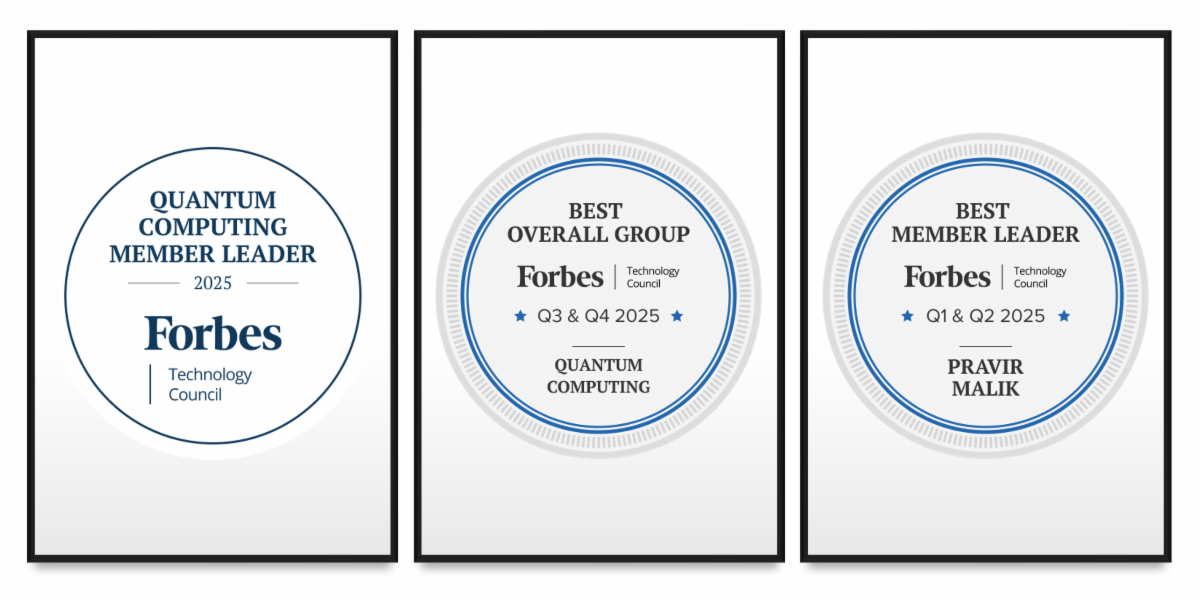
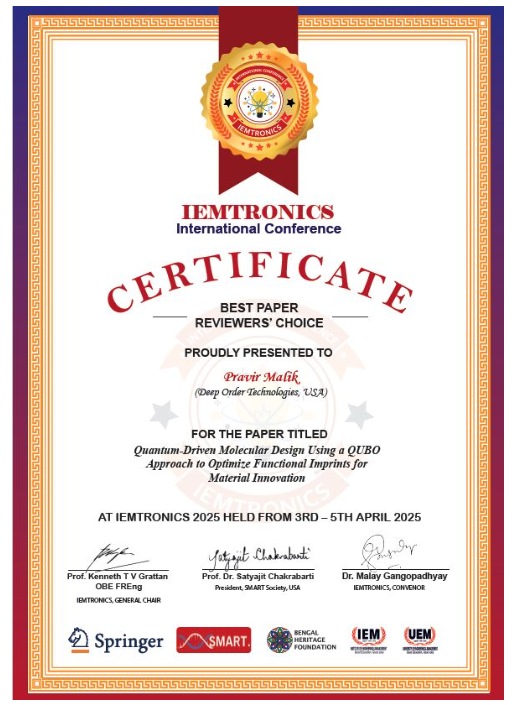
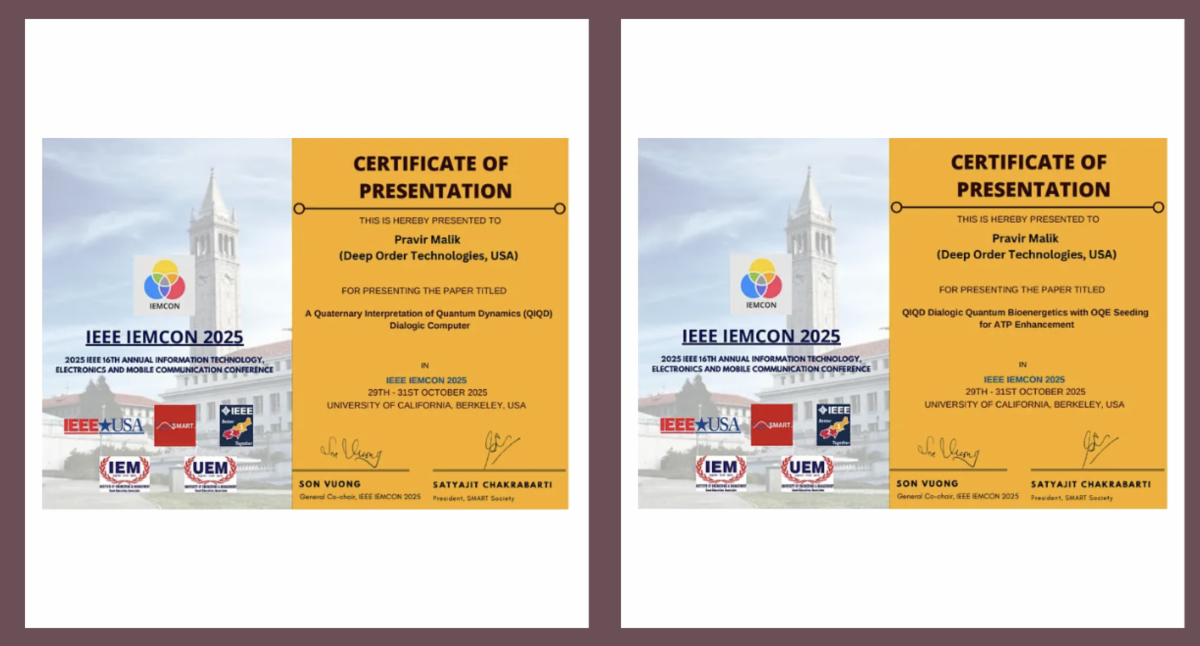
Along the way, I was honored to receive two recognitions from Forbes Technology Council for leading the global quantum computing community, a Best Presenter award at the IEMTRONICS, Springer-backed conference at Imperial College London, and I ended the year with two QIQD Dialogic Computer presentations at IEEE IEMCON at UC Berkeley.


Warmly,

Pravir

Simulation of a Synthetic Molecule Using D-Wave's QPUs

Inspired by D-Wave’s optimization potential (and a Forbes session where I hosted its CEO and CDO), I dove into Python, QUBO modeling, and the practical realities of running on a quantum annealer. The goal was ambitious: to design a synthetic molecule that combines chemically incompatible elements for transformative applications—indestructible composites, room-temperature superconductors, and other “impossible” material frontiers—using QIQD’s notion of energetic imprints.


I presented early results as Quantum-Driven Molecular Design Using a QUBO Approach to Optimize Functional Imprints for Material Innovation (to be published by Springer Nature). Conceptually, I see this as a first step toward using platforms such as photonics to develop “qibits” that encode an atom’s fourfold meaning—so quantum computing becomes a medium for capturing matter’s essence, not just its probabilities.


Programming a PEMF Device with a QIQD-Engineered Blend of Frequencies

A second grounding path focused on optimizing cellular function.


In my work on Pulsed Electromagnetic Fields (PEMF), I’ve been exploring what it would mean to build a device based on a fourfold, symmetrical model of light: one that can create a cascading mechanical influence across atoms → molecules → molecular plans → cells using QIQD, and thereby support positive biological responses.


In this framework, the device’s signal is designed to activate four functional aspects - Presence, Power, Knowledge, Harmony - at the heart of QIQD.


This year, that concept became tangible through programming an existing PEMF device (the BUBBLE by Centropix) to hold a proprietary blend of QIQD-engineered frequencies, turning the theory into something you can actually run, test, and refine.


While the Springer book I referenced earlier articulates the detailed logic connecting quaternary patterns across different levels of granularity, so that in effect the right cocktail of frequencies can influence the implicit quaternary fractal counterpart at the level of cells, a separate paper discussing the design of such a general PEMF device has already been published in January this year, also by Springer: An Ideal Pulsed Electromagnetic Field Device Based on a Multidimensional Model of Light.


Creation of a QIQD Dialogic Computer

The final strand is where all of this becomes especially tangible, and where AI enters as a catalyst rather than a bystander.


On October 30, 2025, at IEEE IEMCON at UC Berkeley, I presented two papers on QIQD Dialogic Computation. These experiments use large language models to embody a QIQD-style computer as if it already existed, while enforcing the laws, types, and constraints that define the architecture.


  • Paper 1: introduced a law-governed system that uses four-property seeds (K, Pr, Po, H) and typed entanglement to run structure-first algorithms, including a room-temperature superconductor experiment that improved coherence while preserving assurance metrics.
  • Paper 2: applied the same framework to cellular energy, exploring how organized quantum energy at subtle electromagnetic strata can lawfully influence ATP-related dynamics under normoxic and hypoxic conditions.


These dialogic experiments are demonstrate how AI can be used as an active simulation layer for structural quantum design. By “wrapping” the blueprinted QIQD hardware, logic, and mathematics inside a law-enforcing conversational engine, we can begin rehearsing tomorrow’s quantum architectures today, testing structural hypotheses, quantifying coherence, and exploring applications across materials, cryptography, and bioenergetics before the full hardware stack arrives.


quantuSelected Links

  1. Cosmology of Light & Related Books
  2. ORCID Page
  3. Index to Cosmology of Light Links
  4. QIQuantum Page
  5. Previous Newsletters
  6. PravirMalik.com