Visual 1st Perspectives


January 31, 2024

From photo apps to photo print products – when & how partnering makes sense


At some point any photo or video product developer runs into the question whether their company can – or should – develop an entire offering themselves or whether it makes more sense to partner with a company that could deliver part of their solution at higher quality, faster turnaround, or lower costs.


For the photo print industry two factors make this question extra critical, as there are always in-house production capacity challenges lurking:


  • In the end, printing photo products involves manufacturing and delivering a physical product, which by its nature is much less scalable than digital products, such as software or cloud storage. 


  • The photo printing industry is particularly seasonal – in Q4 photo print service providers (PSPs) often need to scramble to produce their consumer orders on time; school photography printers are swamped in the fall and spring; and printers catering to cruise lines and theme parks have their peak during the summer holidays.


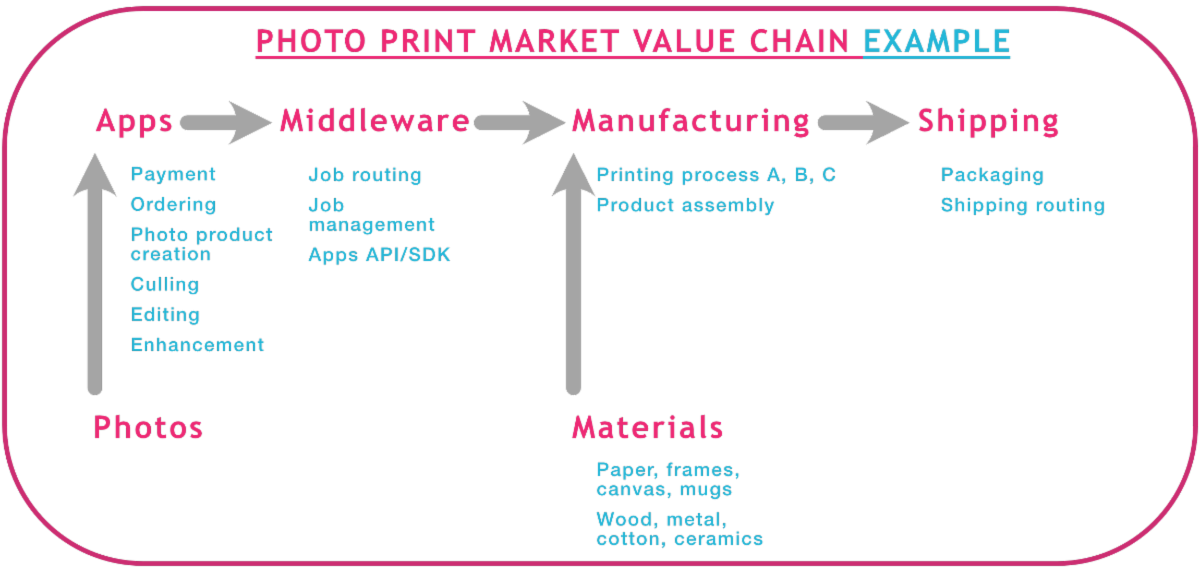
Photo print manufacturing requires a combination of physical and digital products for multiple stages of its value chain.


The manufacturing of photo products most often requires engaging with suppliers of various physical materials, such as paper, canvas, frames or mugs, who often, in turn, engage with suppliers of raw source materials, such as wood, metal, cotton/polyester, or ceramics. Photo product manufacturing also requires engaging with packaging and shipping providers to optimize delivery time, sustainability, and to minimize costs.


On the software side of things, photo print product manufacturing also requires specialized middleware, for instance to manage orders, to route print jobs internally or to partners, or to integrate with best-of-breed customer-facing applications, ranging from photo enhancement apps to order payment apps.


Announcing:


Visual 1st 2024 &

Visual 1st Spotlights

Visual 1st: Oct. 16 - 17, San Francisco

Save the date or buy your $100-off Super Early Bird discount ticket now!


Visual 1st Spotlights:

Buy your $19 Early Bird tickets now!


Feb 28, 8:00 - 9:30 am Pacific Time

Fostering cross-sector photo print partnerships: 

When doing it all yourself doesn’t make sense


Apr 10, 8:00 - 9:30 am Pacific Time

Re-establishing trust in visuals: 

Untangling the potential solutions


Jun 12, 8:00 - 9:30 am Pacific Time

Visuals for ecommerce: 

The new frontier for innovation


Spotlight session descriptions

Partnerships that enable a vendor to offer a more complete product could be made with upstream, downstream, or peer vendors in the photo printing value chain:


  • Downstream partnering example: a B2C photo enhancement app might want to better monetize its users by also offering the ability to create and purchase print products of their photos. Rather than developing the print product creation, ordering, upselling, payment solutions, and integration with PSPs themselves, they might want to partner with a middleware provider that offers these solutions. 


  • Upstream partnering example: a PSP that offers B2C print products might decide that rather than developing the upstream software needed to attract end-users themselves, they’d better leverage the software from a middleware vendor, who, in turn, might have decided that high-quality photo culling, photo editing and automatic photo enhancements are crucial for providing a compelling complete product, and hence have integrated best-of-breed apps from partners in these respective areas.


  • Peer partnering examples: a PSP that is about to max out its capacity might outsource some jobs to other PSPs. A middleware company that encounters additional requirements from its customer might not be in a position to develop the necessary software or integration themselves, and opts to integrate with a peer middleware vendor instead. 


In short: As a result of the photo print industry’s scalability constraints, seasonal production requirements and the combination of physical and digital requirements inherent to print production, no single vendor can do everything all in-house. In fact, the photo print market sees a higher number and a greater variety of partnerships – including coopetition (collaborating peers who are also competitors) – than any other part of the photography ecosystem!


For an in-depth live discussion on the pros, cons, and how-to’s of photo print partnerships, join our Spotlight on February 28!

Fostering Cross-Sector Photo Print Partnerships: 

When doing it all yourself doesn’t make sense


February 28, 8:00 – 9:30 am Pacific Time (5:00 – 6:30 pm CET). Live-streamed discussions.

$19 Early Bird Tickets ends February 14.


Even more so than anywhere else in the photo & video ecosystem, the photo print production & commerce segment relies on cross-sector partnerships. But how do you select the right partner when you need print output fulfillment, middleware SaaS solutions, white label apps, a print network platform, kiosks, retail commerce, or print consumables? 


In this Spotlight we’ll hear from a variety of industry players what they’ve learned from partnering to gain access to solutions they couldn’t – or chose not to – develop themselves. What works, what doesn’t? How to start a partnership and what’s the right time to consider adding or switching partners? What are the pros and cons of having multiple partners with similar offerings?


Speakers:


And a few more things...


HP & Apple. What do they have in common? Security first! Or was it $s? 


Let’s start with HP. How about this for a headline? “HP CEO evokes James Bond-style hack via ink cartridges.” At stake: HP’s Dynamic Security system, which stops HP printers from functioning if an ink cartridge without an HP chip or HP electronic circuitry (i.e. third-party cartridges) is installed. HP has issued firmware updates that block printers with such ink cartridges from printing. Needless to say, lawsuits galore.


But HP CEO Enrique Lores has now explained HP’s rationale: "We have seen that you can embed viruses in the cartridges. Through the cartridge, [the virus can] go to the printer, [and then] from the printer, go to the network." Wow!


And then Apple, traditionally also on the barricades to keep us secure – by only allowing us to download apps and various in-app purchases from its own App Store. But the EU has a different perspective on Apple’s App Store monopoly: its Digital Markets Act (“DMA”) forces Apple in Europe to allow the use of alternative app stores and “sideloading” (i.e., downloading apps directly from a website). 


Will Apple lose tons of money this way? Is hard to tell, as Apple just announced a complex set of policies for European app distribution that include lower Apple App Store commission on one hand, but on the other a fee for developers to pay €0.50 (Core Technology Fee) for each first annual install per year over a 1M threshold, regardless of their distribution channel.


How about this for a headline? “When Apple takes the European Commission for fools: An initial overview of Apple’s new terms and conditions for iOS app distribution in the EU”?

Or check out "Reading the fine print of Apple’s DMA rules: 25 things app developers need to know."


Nightshade. Poisoning AI models. We’ve covered Glaze before, a tool developed by computer scientists at the University of Chicago, which subtly alters an image at the pixel level so AI models see something totally different than what’s actually there.


The team is now leaving subtlety behind with Nightshade, a new free software tool allowing artists to “poison” AI models seeking to train on their works. An AI model that ended up training on many images altered or “shaded” with Nightshade would likely erroneously categorize objects going forward for all users of that model, even in images that had not been shaded with Nightshade. 


Who wants this? Nightshade received 250K downloads in its first 5 days: “Beyond anything we imagined,” according to the developers.


Kin.art. Preventing AI models. Another tech tool to fight AI models through one’s artwork. Kin.art does not go as far as trying to poison the AI models: it simply aims at preventing these models to learn from a user’s artwork. Kin.art’s training-defeating tool uses image segmentation (i.e., concealing parts of artwork) and tag randomization (swapping an art piece’s image metatags) to interfere with the model training process.


While the tool is free, artists have to upload their artwork to Kin.art’s portfolio platform in order to use it. 


Artisse AI. Raising $. Artisse AI, the app known for its more photorealistic AI generation of images trained on user-submitted photos, raises $6.7M in seed funding. 


Artisse transforms your selfies into high-quality images, allowing you to personalize them in a myriad of scenarios, outfits, hairstyles, and more. Artisse’s model takes into consideration factors like race, facial structures, skin color, lighting, camera type, camera angle, the way the body is shot, the scenery, and more. The catch: it takes 30-40 minutes to train its model on the original photo.


Google Lumiere. Text-to-video generator. Google announced a promising AI video generator in a research paper, accompanied by several text-to-animal created video clips. Lumiere is slated to perform text-to-video generation (turning a written prompt into a video), convert still images into videos, generate videos in specific styles using a reference image, apply consistent video editing using text-based prompts, create cinemagraphs by animating specific regions of an image, and offer video inpainting capabilities. 


Output is up to 5 second 1024×1024 videos – still a long way to go until AI-generated video from scratch will see mass adoption, but with Meta, Runway, Stable Diffusion, and Google all setting their teeth in the complexities of AI video generation, higher res and longer videos featuring more than just animals are on the horizon.


Topaz Labs. Upscaled upscaling. Topaz announces Gigapixel 7, the latest version of its desktop image enhancement application, best known for its image upscaling capabilities. The new version offers a range of improvements, including a fresh UI and, not surprisingly, upgrades to the AI engine, allowing better compatibility and faster processing.


Best,


Hans Hartman


Archive & Subscribe | Share your news with us | Connect on LinkedIn