|
Jewish Artists:
Aaron Henry Gorson
Jewish Encyclopedia:
Senior Companionship
Resources:
Storagram
Small Towns Project:
Butler County
Calendar:
Sept. 14: Fine Fellowship Lecture
Community Calendar:
Sept. 12-14: Churchill MCM Tour
Sept. 14: Mark Thompson (JGS)
Community:
URA photographs
SHHS archives
JCBA "Road-Trip"
Research Tools:
Newspapers, Cemeteries,
Memorial Plaques, Books,
Population Figures, Synagogues, Newsletter Archive,
Shul Records America,
Timeline
| | | |
Jewish Artists:
A. H. Gorson
| | |
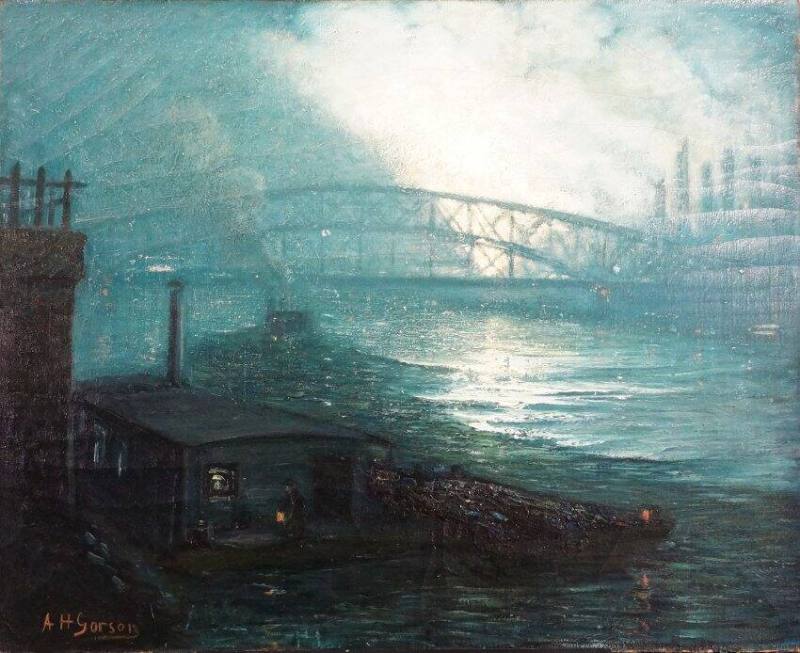
Dark impressionistic oil painting. River flows through center of painting. In lower left foreground are two boats are moored to river bank. Centered and spanning the Monongahela River is a steel beamed bridge. On far bank of river appears seven smokestacks and hints of mills. Coming from the smokestakes and behind bridge is bright furnace light and smoke. Light illuminates river in foreground and casts bridge's shadow. Painted in dark blues, greens and blacks. Mill lights in yellow, white and tans.
“Steel Mills” (1912), Aaron Henry Gorson
Gift of Carl Borntraeger, 1952
| | |
Aaron Henry Gorson died in New York City in November 1934, “leaving behind a studio full of nocturnes and crepuscules,” as one critic put it. A few months later, Kaufmann’s Department Store hosted the A. H. Gorson Memorial Exhibition on its 11th floor. It had 22 canvases, mostly Pittsburgh scenes.
Gorson had immigrated to Philadelphia from his native Lithuania as a teenager in the late 1880s and moved to Pittsburgh around the turn of the century. In part through the patronage of Dr. J. Leonard Levy at Rodef Shalom Congregation, Gorson became the first Jewish artist to receive recognition in Pittsburgh. He became best known locally for his paintings of industrial and river scenes, and his work was popular among the management class of the industrial community of Pittsburgh. “He was not the first to catch the steel mill spirit, but in his time he was the best, and this despite a monochrome palette, a one-ness of viewpoint,” as a critic using the pen name “H. G.” wrote in a review of the memorial exhibit. “His canvasses were touched with élan, there was the drama (and occasionally the over-accentuated theater) of the blast furnaces, and so Gorson started what might be called ‘the Pittsburgh school.”
Gorson left for New York in the early 1920s seeking a more expansive market, but he maintained contacts. Even today, his works have a market locally.
| | As part of our yearlong initiative to highlight Jewish artists in Pittsburgh, we’ve created a new entry for “Artists” on the Jewish Encyclopedia of Western Pennsylvania. The entry includes links to profiles of 23 local Jewish artists, including the artists profiled in this newsletter so far this year, as well as several artists who have collections at the Rauh Jewish Archives. We will continue to update and expand this entry in the weeks and months to come. | | All year, the Rauh Jewish Archives is highlighting stories of Jewish artists in Western Pennsylvania before World War II. If you would like to donate a material from this time period, or any historic materials documenting Jewish life in this region, contact the archive or call 412-454-6406. | | |
Jewish Encyclopedia:
Senior Compansionship
| | |
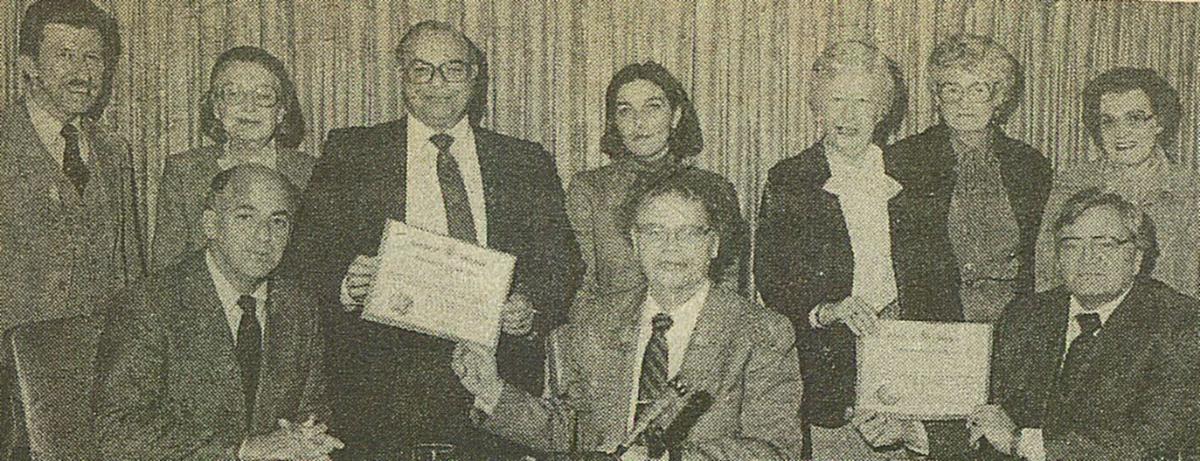
Black and white photograph of Allegheny County Commissioners establishing the Senior Companionship Program with representatives from Jewish Family & Children’s Service, the Bickur Cholim Society, and the Bickur Cholim Nursing and Convalescent Home.
Jewish Chronicle (Feb. 3, 1983)
Pittsburgh Jewish Newspaper Project
| | After more than a decade leading the Bickur Cholim Convalescent and Nursing Home, Ronald Kottler became executive director of Jewish Family & Children’s Service in early 1982. In early 1983, JFCS-Pittsburgh, the Bickur Cholim Society, the Bickur Cholim Nursing and Convalescent Home, and the Allegheny County Area Agency on Aging jointly launched a “Senior Companionship Program” in Squirrel Hill, Greenfield, and Point Breeze. The program was based out of the National Council of Jewish Women-Pittsburgh Section’s Anathan House. It arranged visits for home-bound elderly. A similar home-visitation program already operated in other parts of Allegheny County, but the initiative in the 14th ward was the first structured as a private-public partnership. | | |
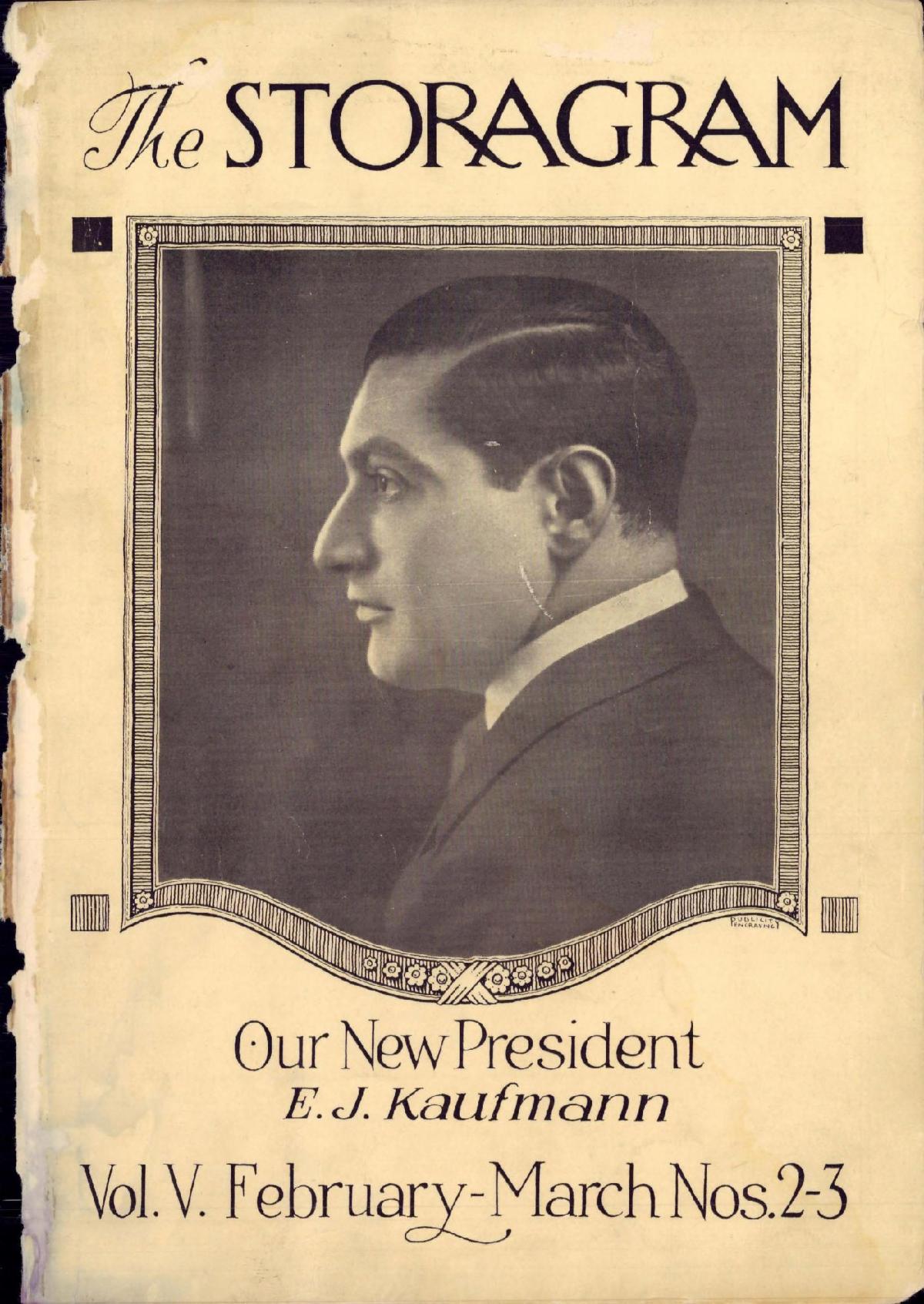
Cover of The Storagram celebrating the appointment of Edgar J. Kaufmann to presidency.
The Storagram (Feb-Mar, 1924)
Kaufmann’s Department Store Records [MSS 371]
Rauh Jewish Archives
| | The Storagram was the employee newsletter of Kaufmann’s Department Store. For decades, it provided an inside look at the people, operations, and culture of the beloved department store. The Detre Library & Archives has created a new online repository with 61 back issues of the Storagram from the 1920s. | | |
Small Towns Project:
Butler
| | |
Color photograph of the former Congregation B’nai Abraham synagogue at 123 Fifth Ave. in Butler, Pa. Photo credit: Rabbi Dovid Krautwirth.
Rabbi Dovid Krautwirth Digital Photographs [2023.0071]
| | |
Does your family have connections to Butler County?
The Rauh Jewish Archives is seeking materials documenting the historic Jewish experience in the county, including Butler, Chicora, Clearfield Township, Evans City, Harmony, Petrolia, Slippery Rock, Zelienople, and other towns.
The RJA recently received a grant from the Jewish Federation of Greater Pittsburgh to collect historic documentation of Jewish life in Butler County. In addition to bolstering the activities of the archives, these materials will specifically be used in an ongoing effort to improve awareness and understanding about Jewish people throughout rural Western Pennsylvania.
Although the Jewish population of Butler County never surpassed 750 people, this small community made significant contributions to the fields of religion, industry, agriculture, the arts, and of course recreation through Emma Farm Camp and other summer camps. If you have information about Butler County to share for this initiative, please contact the archive or call 412-454-6406.
| | |
September 14:
“Offerings of Grief, Offerings of Rage:
Revisiting Tree of Life Synagogue and George Floyd Square”
| | |
In the inaugural Fine Fellowship Lecutre, Dr. Laura Levitt will compare and contrast the tribute gifts brought to the site of the Pittsburgh synagogue shotting and the George Floyd Global Memorial in Minneapolis.
Dr. Levitt is the inaugural recipient of the Fine Fellowship, created by the University of Pittsburgh Jewish Studies Program in collaboration with the Rauh Jewish Archives at the Heinz History Center. In her research, she has studied materials related to the Oct. 27, 2018 synagogue shooting. The bulk of these materials are held in the Rauh Jewish Archives with additional materials are held at the University of Pittsburgh.
This FREE program is organized by the University of Pittsburgh Jewish Studies Program, the Rauh Jewish Archives at the Heinz History Center, and the 10.27 Healing Partnership with support from Tree of Life Congregation, New Light Congregation, Congregation Dor Hadash, and the Tree of Life. The Fine Fellowship is supported by the Fine Foundation.
Laura Levitt is Professor of Religion, Jewish Studies, and Gender at Temple University and the author The Objects that Remain (2020), American Jewish Loss after the Holocaust (2007), and Jews and Feminism: The Ambivalent Search for Home (1997).
| | |
September 14:
“The Best Uses of AI for Genealogy”
with Mark Thompson at the Jewish Genealogy Society
| | |
Artificial Intelligence has brought powerful new tools to family history research. AI can efficiently summarize documents, reliably extract information from large texts, and accelerate your research. These tools offer fascinating possibilities for enhancing and simplifying your family history.
Intended for those new to AI, this session explores promising applications of AI in family history. It also highlights areas where caution is critical and traditional research methods remain essential.
Join Mark for an accessible overview of AI's potential and discover what these emerging capabilities could mean for your family history research.
Mark Thompson is a professional genealogist and public speaker specializing in the application of artificial intelligence to genealogy. As co-host of the Family History AI Show podcast alongside Steve Little, Mark helps genealogists bridge the gap between high technology and their family histor research.
Mark serves as President of the Victoria Genealogical Society and chairs their DNA Special Interest Group. Mark is a frequent presenter on technology-centric genealogy topics including AI, Genetic Genealogy, and Family Archiving. When not exploring family histories, he enjoys nature photography i his home province of British Columbia, Canada
| | |
September 12-14:
Churchill Mid-Century Modern Home Tour
| | |
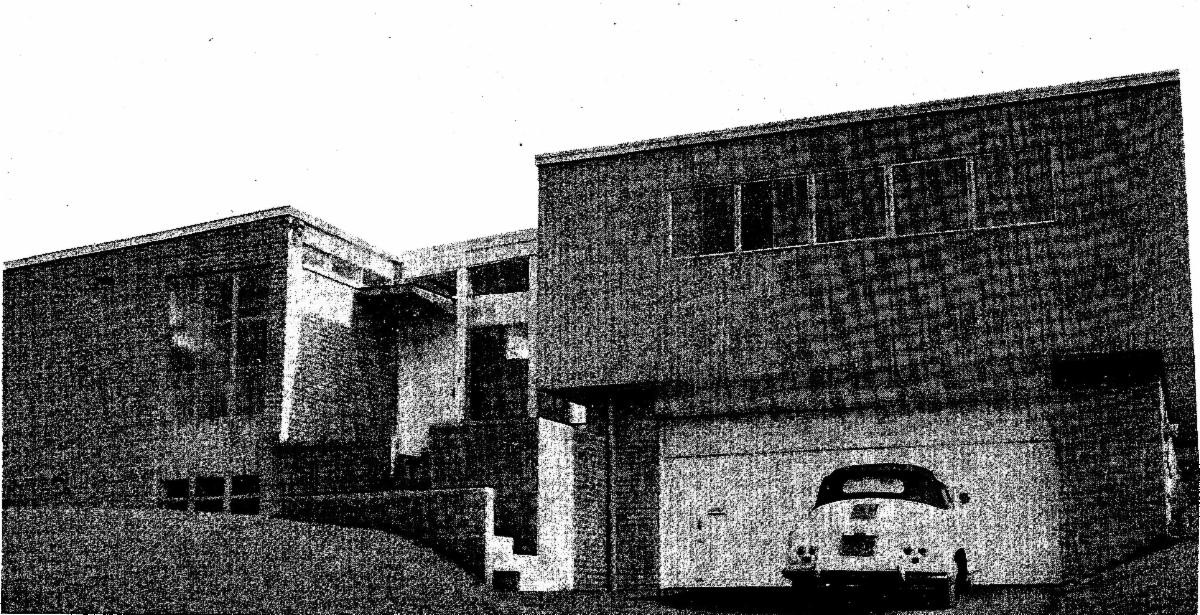
Black and white photograph of the Gatz residence on Marbury Rd.
Charette (April 1957)
CMU Digital Libraries
| | |
Churchill is home to a large collection of mid-century modern homes, including many commissioned by Jewish patrons in the 1950s, 1960s, and early 1970s.
The first ever Churchill Midcentury Modern Home Tour is taking place September 12-14, 2025. It includes a soiree, home tours, and related talks. The tour is organized by the Churchill Midcentury Modern Home Tour Planning Committee in collaboration with Churchill Borough, the Recreation Board of Churchill, and Pittsburgh Modern Committee of Preservation Pittsburgh.
| | Urban Redevelopment Authority Archives | | The City of Pittsburgh Archives has launched a new digital archive containing thousands of photographs and documents spanning more than two centuries. Of particular interest to local Jewish history is a collection of more than 2,000 photographs of properties in the lower Hill District taken by the Urban Redevelopment Authority in the late 1950s prior to demolitions in the area. | | Squirrel Hill Historical Society Archives | | Squirrel Hill Historical Society has added a collection of 60 historic images of Squirrel Hill to the Historic Pittsburgh website. The collection contains selected images from three organizations: the Squirrel Hill Historical Society, Squirrel Hill Urban Coalition, and Mary S. Brown Memorial-Ames United Methodist Church. The photographs document many aspects of life in Squirrel Hill, including many beloved businesses from the 1990s that no longer exist. | |
From the Jewish Cemetery & Burial Association
"Road Trip: The Jewish Cemeteries of Western Pennsylvania"
| | |
The Jewish Cemetery and Burial Association of Greater Pittsburgh has released a new documentary showcasing Jewish cemeteries in Western Pennsylvania.
“Road Trip: The Jewish Cemeteries of Western Pennsylvania” is a one-hour tour of the many cemetery properties overseen by the JCBA, as well as an overview of the organization’s ongoing work to care for these sacred burial grounds. The video is a wonderful opportunity to celebrate these special Jewish cultural sites in our region. The video includes many historic photographs and documents from the collections of the Rauh Jewish Archives.
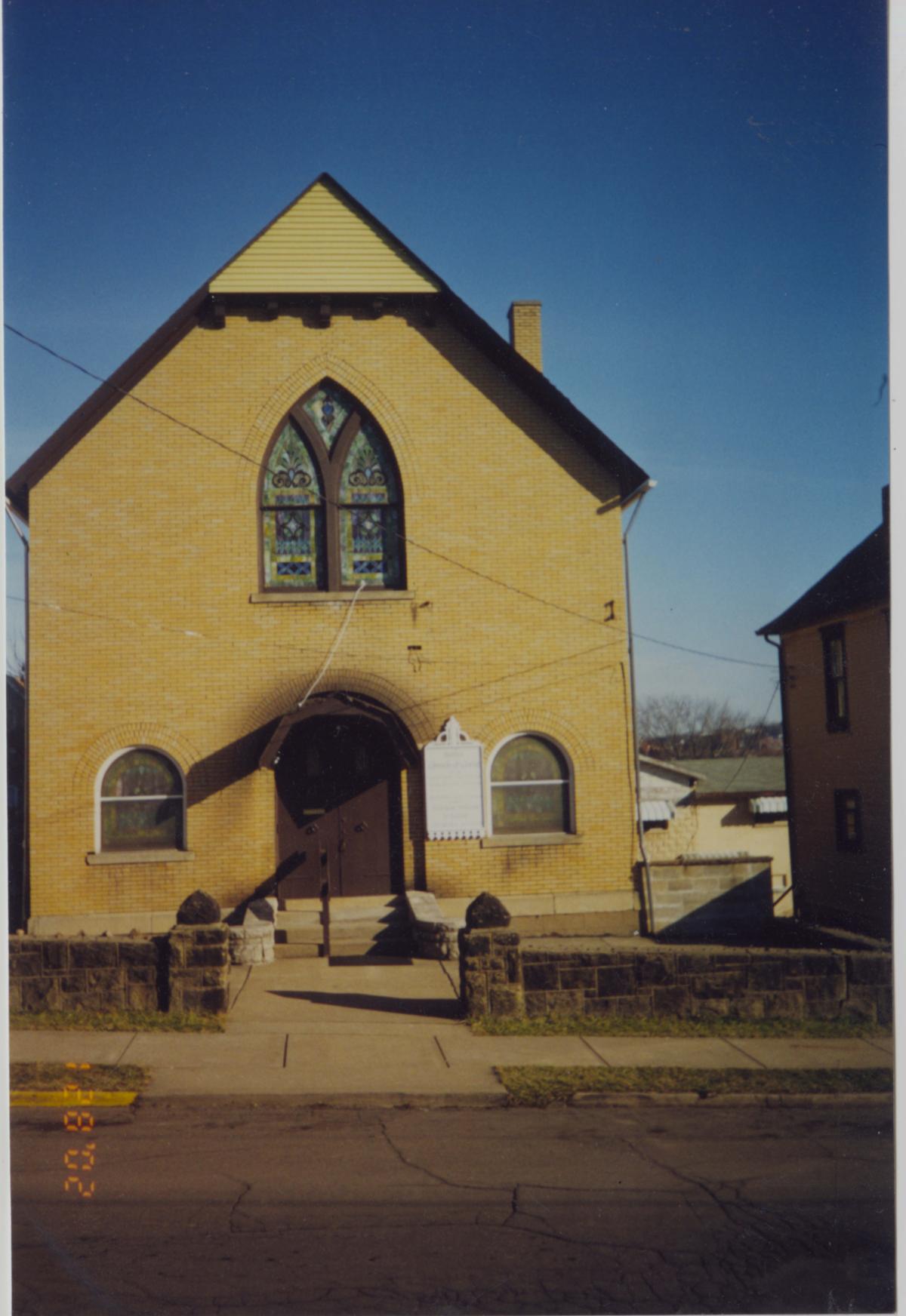
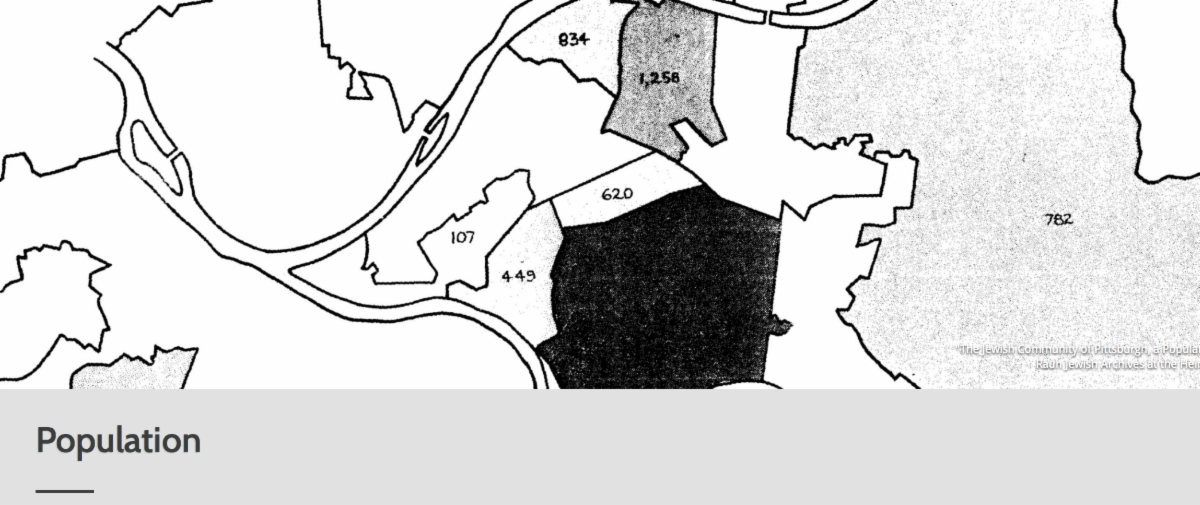
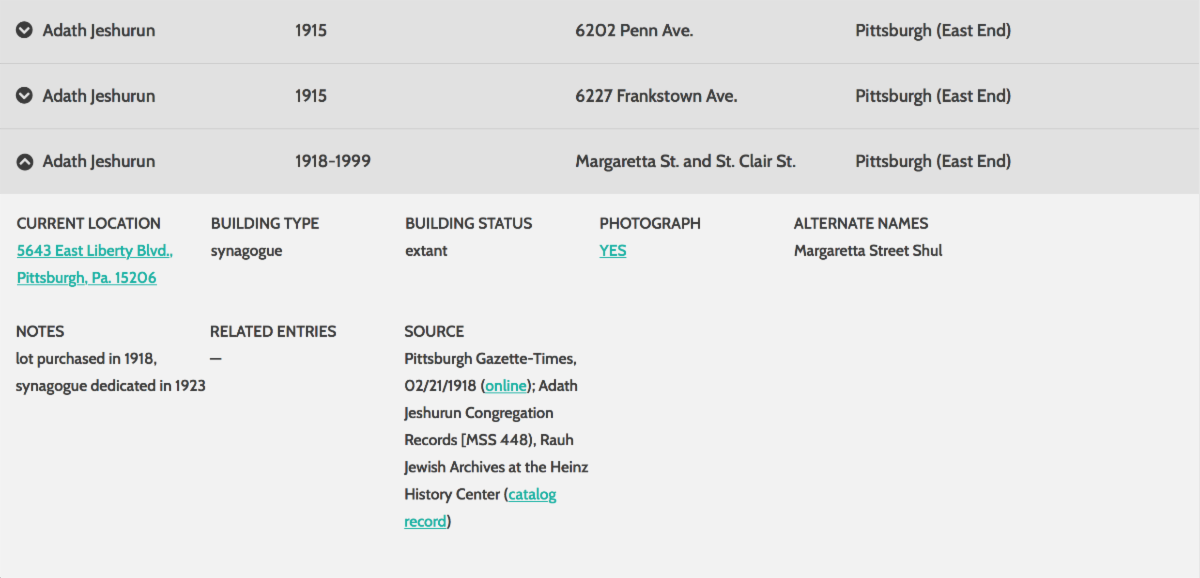
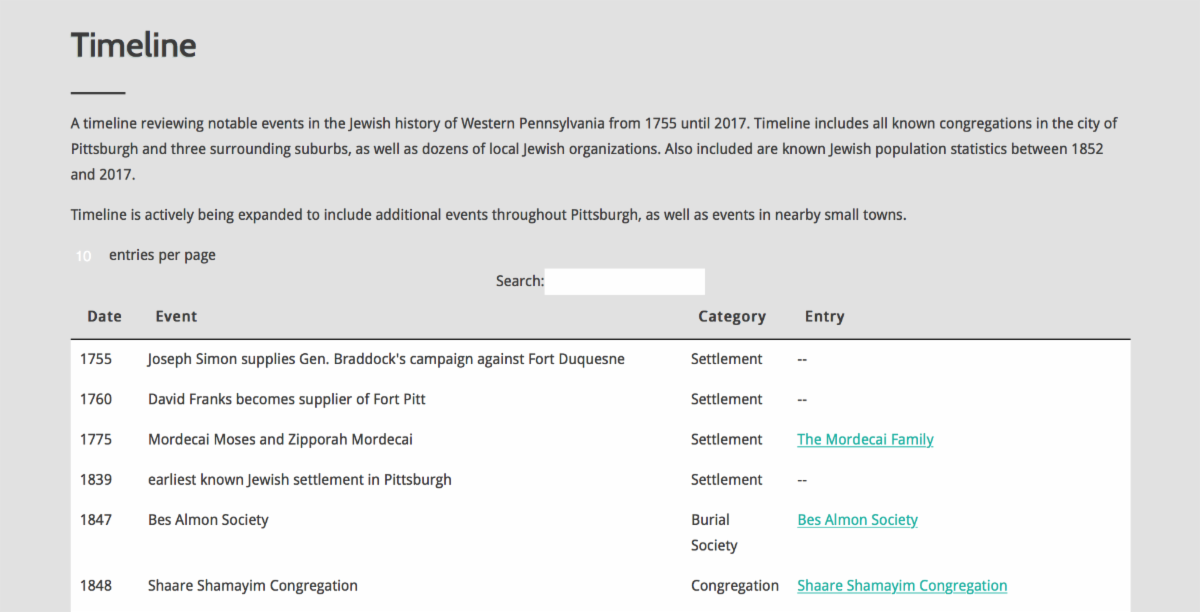
| | Pittsburgh Jewish Newspaper Project | | The Pittsburgh Jewish Newspaper Project contains digitized, searchable copies of four local English-language Jewish newspapers between 1895 and 2010. It is a valuable tool for researching almost any topic about Jewish history in Western Pennsylvania. For a primer on using the website, watch our video. | | | Western Pennsylvania Jewish Cemetery Project | | | | The Rauh Jewish Archives launched the Western Pennsylvania Jewish Cemetery Project in 1998 to preserve burial records from Jewish cemeteries across the region. Over a period of fifteen years, the information was compiled into a searchable, online database containing approximately 50,000 burial records from 78 Jewish cemeteries throughout the region. | | Western Pennsylvania Yahrzeit Plaques Project | | The Rauh Jewish Archives launched the Western Pennsylvania Yahrzeit Plaques Project in 2020. The goal was to create a comprehensive collection of burial records from memorial boards at synagogues across the region. Volunteers are currently transcribing these boards and records are being added monthly to our online database. The database currently contains more than 2,700 listings. | | | Rauh Jewish Archives Bibliography | | | | University of Pittsburgh librarian and Rauh Jewish Archives volunteer Laurie Cohen created this comprehensive bibliography of the Rauh Jewish Archives library holdings from 1988 through 2018. It lists nearly 350 volumes arranged by type and then by subject. This a great tool to use early in your research process, as you’re surveying available resources on a given subject. | | Jewish Population Estimates | | Looking to figure out how many Jews lived in a certain part of Western Pennsylvania at a certain moment in time? This bibliography includes more than 30 estimates of the Jewish population of Pittsburgh and small-towns throughout the region, conducted between 1852 and 2017. | | | | | A database of buildings throughout Western Pennsylvania known to have hosted Jewish worship services. Includes links to photographs and citations with original source material. Database currently includes 90 locations from 2 institutions | | Rauh Jewish Archives Newsletter | | The Rauh Jewish Archives has been publishing a weekly newsletter since 2020. The newsletter contains a variety of articles about local Jewish history, including much original research not found anywhere else. You can find and read every issue—more than 150!— in our new index. | | | | | Online finding aid from JewishGen listing congregational archival collections held at publicly accessible repositories across the United States. Includes 63 listings from the Rauh Jewish Archives, as well as other repositories with Western Pennsylvania congregational records. | | Timeline of local Jewish history between 1755 and 2017, including the founding dates for 85 organizations, 66 congregations, and 30 schools in Pittsburgh and its surrounding suburbs. The timeline also includes 23 local Jewish population estimates made between the mid-19th and early 21st centuries. | | |
[IMAGE: Marian Schreiber and employees at the Schreiber Trucking Company, c.1943—from Schreiber Family Papers and Photographs, MSS 846.]
If you like this newsletter, why not forward it to a friend? We want to share the story of Western Pennsylvania Jewish history with as many people as possible.
If you've received this newsletter from a friend or neighbor, and you want to read more, just click on the link below to start receiving future editions.
| | The Rauh Jewish Archives was founded on November 1, 1988 to collect and preserve the documentary history of Jewish life in Western Pennsylvania and to make it available to the world through research assistance, programing, exhibits, publications, and partnerships. | | | | |