Inaugural class of Institute for Energy Law (IEL) Legends includes LSU Law Professor Emertius Patrick Martin and alumnus Rick Plaeger (’77) | | |
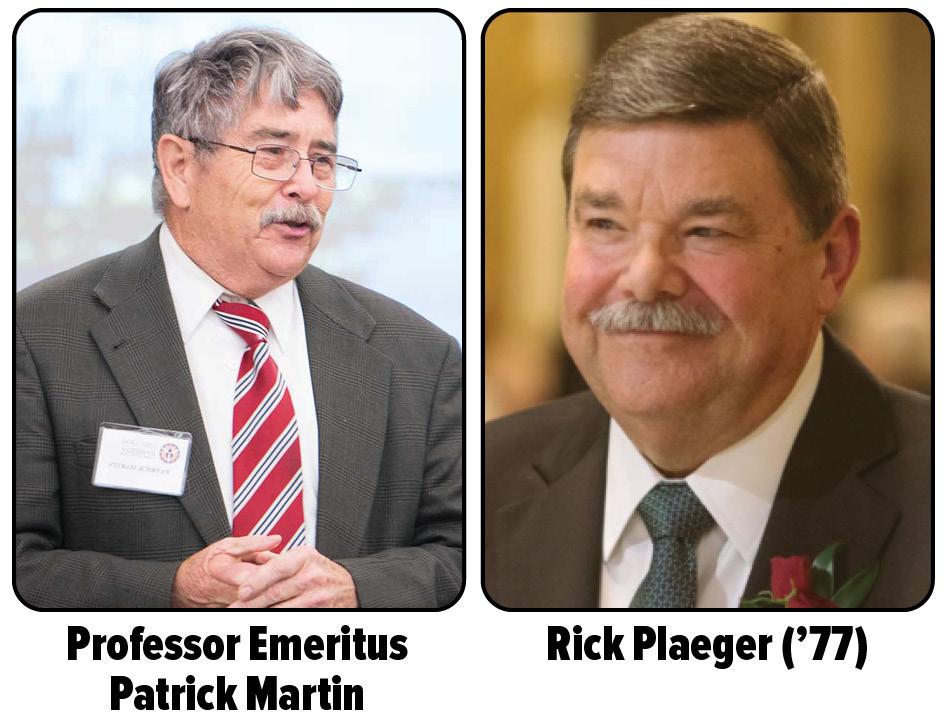
LSU Law Professor Emeritus Patrick Martin and Class of 1977 alumnus Rick Plaeger are among just eight energy law professionals from across the country to be inducted into the inaugural class of Institute for Energy Law (IEL) Legends.
Recognized as one of the nation’s leading authorities on mineral law, Martin joined the LSU Law faculty in 1977 and taught primarily in the areas of mineral law, contracts, and jurisprudence until his retirement in 2011. He also served as director of the Louisiana Mineral Law Institute, and published many casebooks, treatises, and articles on issues relating to energy law and regulation.
“Professor Patrick Martin is one of the most influential scholars in modern oil and gas law and a central figure in the history of the IEL and its predecessor organizations,” the IEL said, noting he has been deeply involved in the organization for decades and has served in a wide range of leadership roles, including as Chair of the Advisory Board from 1998 to 2001. “His term as Chair set up some of the most significant changes for IEL in the early 2000s, including moving the annual conference from its fifty plus year home in Dallas.”
Plaeger's career included more than 30 years as a senior executive at three publicly traded Fortune 500 oil and gas companies in the Houston area prior to his retirement about 10 years ago. He also previously served as a federal court law clerk and a partner in a New Orleans-based commercial law firm.
“Frederick J. ‘Rick’ Plaeger II is a distinguished energy executive and attorney whose leadership helped shape modern evolution of the IEL during a critical period of growth and expansion,” the IEL said, adding that his term as Chair of the Advisory Board from 2005 to 2008 coincided with the launch of a new era of strategic planning that significantly expanded membership. “Under his leadership, IEL introduced innovative programming in power and alternative energy, and developed new programming for oilfield service professionals, young professionals, and international energy attorneys.”
Martin and Plaeger were inducted as IEL Legends during a special event at the 77th Annual Energy Law Conference in Houston on Friday, Feb. 27. Others selected for inclusion in the inaugural class of IEL Legends include Janice Hartrick, Sheila Slocum Hollis, Professor Bruce Kramer, Hon. Joseph Morris (deceased), Laura Robertson, and Robert G. Storey (deceased).
Founded in 1959, the IEL is a division of The Center for American and International Law (CAIL), a Dallas-based nonprofit launched in 1947 that is dedicated to advancing justice and promoting the rule of law trough professional development opportunities. Read more.
| | LSU Law 3L Hannah Roppolo wins national Association of International Energy Negotiators Student Writing Competition | | |
Heading into her final year of studies at LSU Law, Hannah Roppolo knew she needed to complete a major paper on an energy law topic in order to earn an optional Graduate Certificate in Energy Law and Policy in addition to her J.D. Looking for some guidance, she consulted with one of her favorite professors, Keith Hall, who serves as director of both the John P. Laborde Energy Law Center and LSU Mineral Law Institute at LSU Law.
“I’ve taken all of his classes,” said Roppolo, a Baton Rouge native. “We talked about some potential topics that are current and relevant to me. The job that I’ll be starting after I graduate in the spring is one that deals with international transactions, so the topic I ended up choosing made a lot of sense for me.”
Entitled “Equal Credits, Unequal Recognition: The Emerging Policy Mismatch Between U.S.,” the 16-page paper explores the differences in U.S. and European carbon capture tax laws as well as how they could limit the real-world value of U.S. carbon capture incentives for companies operating globally, particularly those exporting to the EU. It took her four months to complete.
“This was a very complicated topic that required me to sift through a lot of European regulations, which I had no previous experience with. A lot of what I read felt so over my head,” said Roppolo. “So, my mindset going into the paper was just to get it finished, get my credit, and graduate.”
But Hall saw greater potential for Roppolo’s paper than merely course credit. He encouraged her to submit it to the Association of International Energy Negotiations Student Writing Competition.
“Hannah’s paper was well written and it included some really good analysis of the legal issues,” Hall said.
On Jan. 8, AIEN representatives informed Roppolo that she had won the Student Writing Competition, noting her paper “stood out among numerous submissions from universities and schools around the world.” As the winner, Roppolo was awarded registration and accommodation for the 10th Annual International Energy Summit (IES), which will be held June 2-4 in New Orleans as well as a one-year AIEN student membership. Read more.
| | ‘Journal of Energy Law and Resources’ presents annual symposium at LSU Law | | |
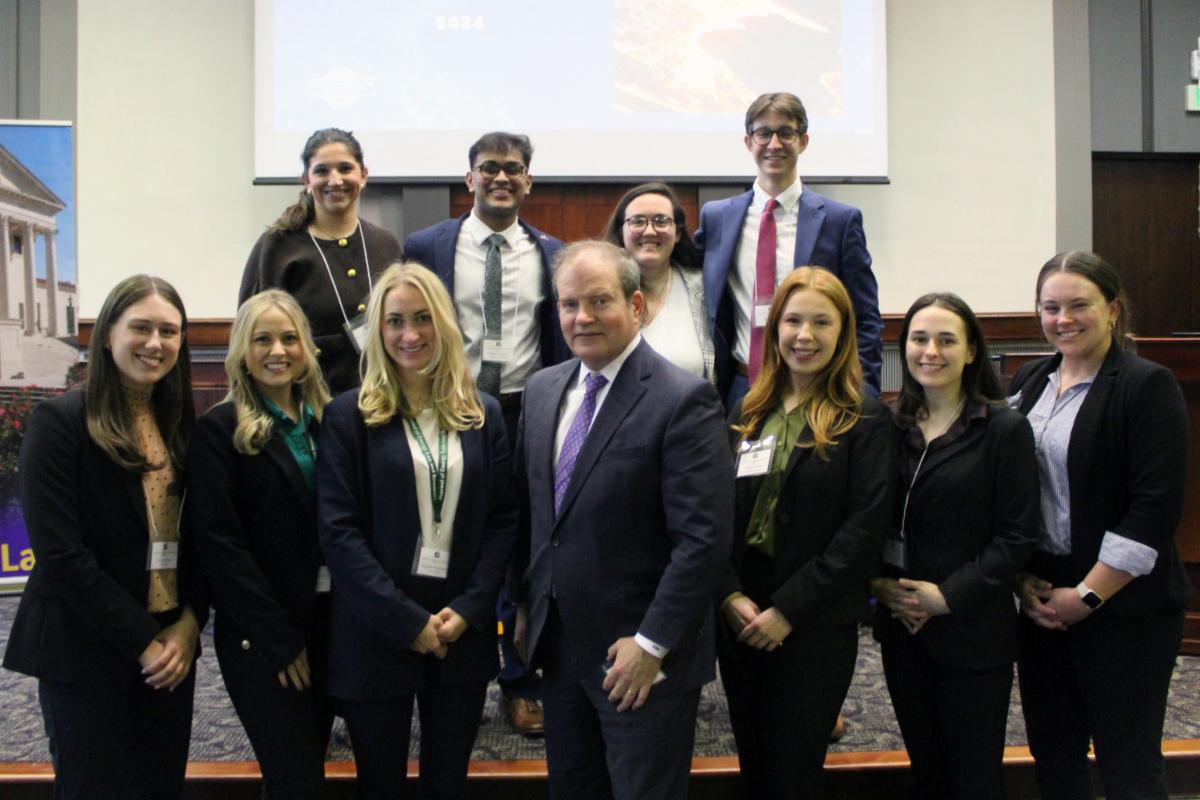
Approximately 75 people attended the Journal of Energy Law and Resources’ annual symposium on Friday, Jan. 30 in the McKernan Auditorium at the LSU Paul M. Hebert Law Center.
Entitled “The Evolving Energy Landscape From Policy to Practice: Navigating Legal, Policy, and Regulatory Shifts in the Energy Sector,” the symposium included presentations and panel discussions on topics such as geothermal energy; modernizing energy and natural resources law; title uncertainty in Louisiana; Texas law and the future of produced water; and more.
Among the presenters were LSU Law Professors Keith Hall and Nick Bryner as well as LSU Law alumni Charles G. Blaize Jr. (’98), Maureen Harbourt (’83), and Thomas Smart (’82).
| | ‘LSU Journal of Energy Law and Resources’ announces Vol. XV editorial board | | |
Fourteen Junior Associates of the student-edited Journal of Energy Law and Resources (JELR) have been selected for the Volume XV editorial board, including:
-
William Farrar — Editor-in-Chief
-
Karime Puga — Senior Managing Editor
-
Meghan Romano — Notes and Comments Editor
-
Anne Nelson and Rhyan Stelljes — Senior Articles Editors
-
Lauren Robichaux — Development Editor
-
John Trapp and Caroline Barrow — Production Editors
-
Caitlyn DeCorte — Online Articles Editor
-
Isabelle Fitzmorris, Cameron “Eli” Pattat, Kelly Campbell, Taylor Myers, and Ethan McCorquodale — Senior Editors
JELR was founded in November 2011 and published its first issue the following year. Committed to developing and promoting scholarship on a diverse variety of topics related to energy, environmental, and natural resource law, the journal’s membership consists of second- and third-year students at LSU Law. Students are invited to join based on academic performance as welll as writing and editing abilities, which are tested through an annual write-on competition. Selected students receive invitations during the summer between their first and second years of law school. Read more.
| | LSU Law alumni, faculty, and students participate in Energy Law Conference | | |
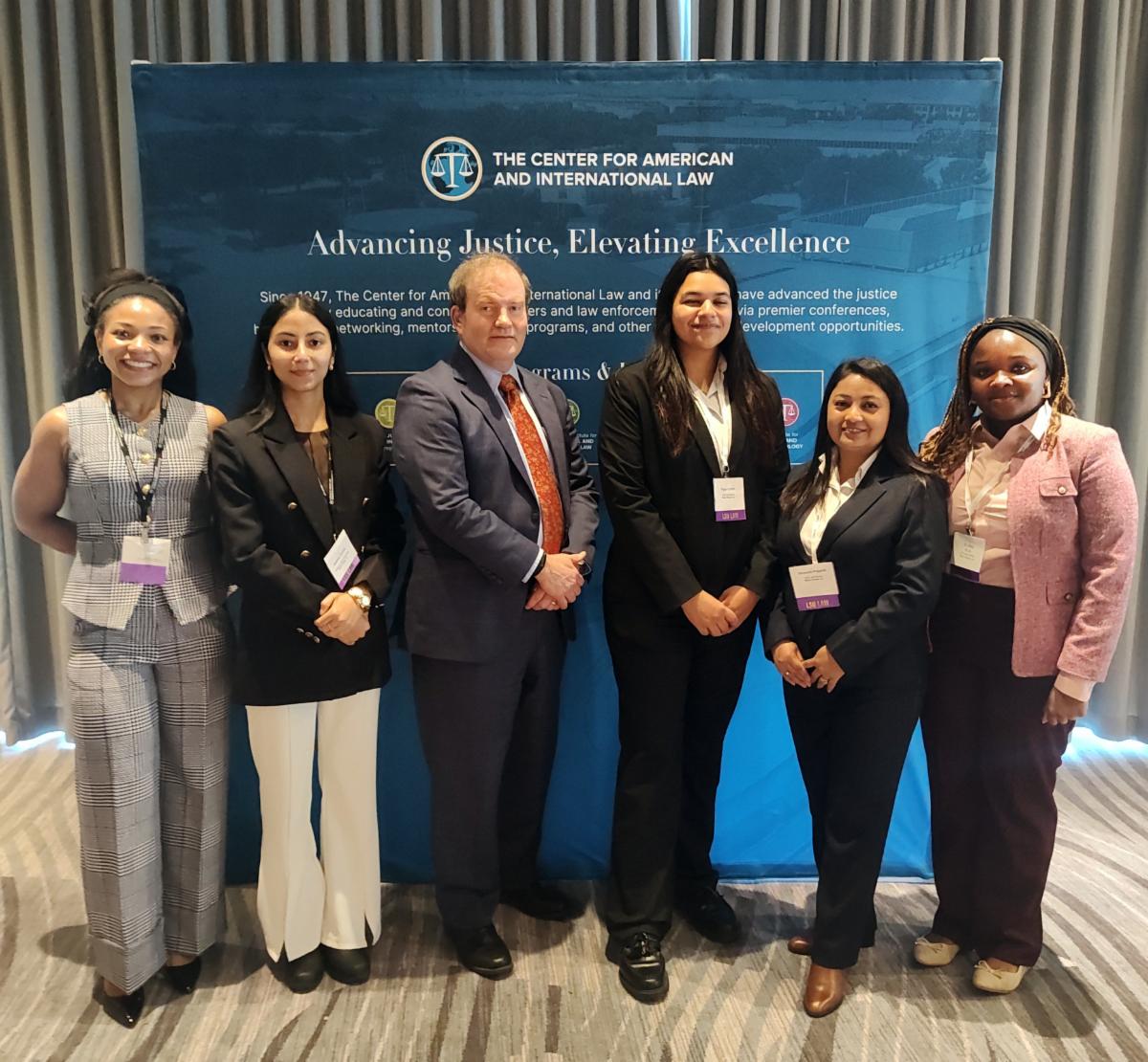
LSU Law was well represented at the world’s longest running conference on energy law—the Institute for Energy Law’s 77th Annual Energy Law Conference—which was held in Houston on Feb. 26-27.
LSU Law alumnus Louie Layrisson (’08), a partner at Baker Botts in Houston, served as a co-chair of the conference. Alumna Brooksie Bonvillian Boutet (’14), a principal at Shipley Snell Montgomery in Houston, co-presented on “Recent Developments in Energy Case Law.”
LSU Law Professor Keith Hall attended the conference with five LSU Law students who are pursuing their optional graduate certificate in energy law and policy.
During the conference, LSU Law alumnus J.T. Nesser IV ('99) was appointed to serve as IEL Senior Vice Chair, while alumnus Ryan Boutet ('15) was appointed to serve as Renewables Practice Committee Vice Chair and Hall was re-appointed to the Executive Committee as Editor-in-Chair of the IEL Oil & Gas E-Report.
| | Tanner Johnson returns to alma mater to speak with energy law students as a guest of the John P. Laborde Energy Law Center | | |
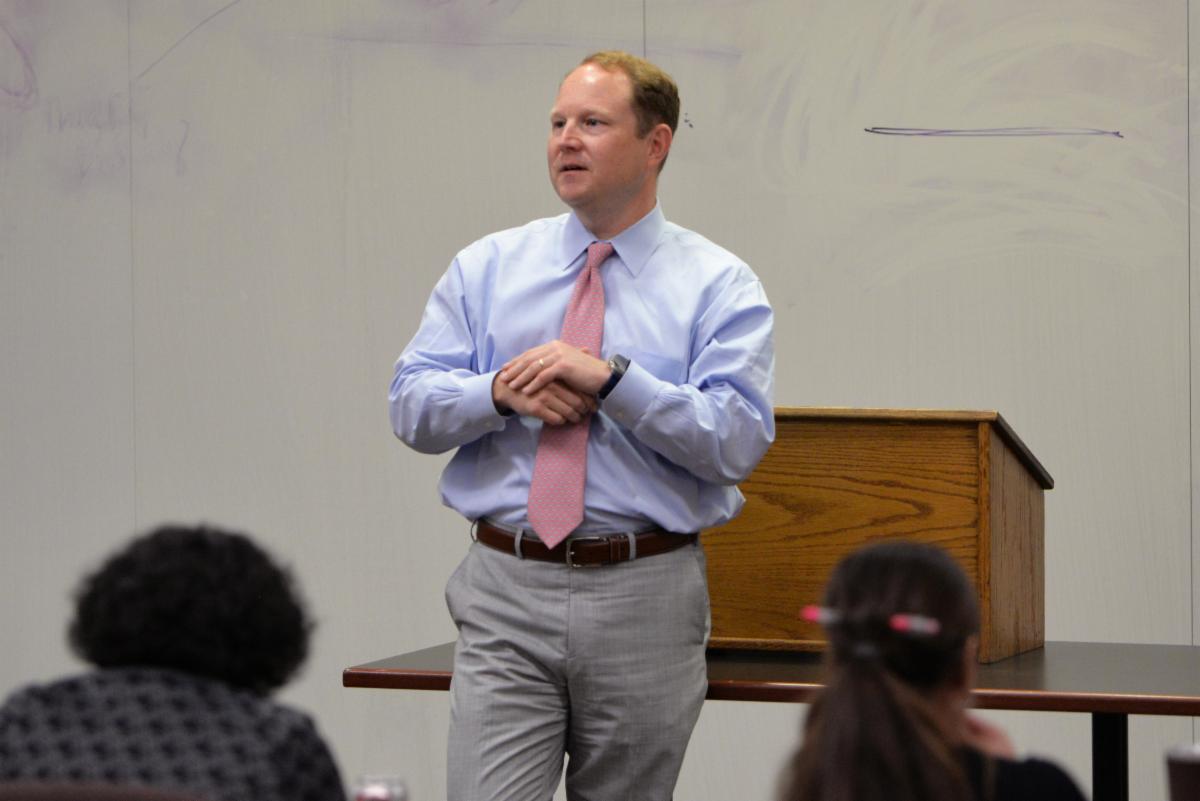
Tanner Johnson, a member of the LSU Law Class of 2001 and partner at Van Ness Feldman, returned to LSU Law on Tuesday, March 10 to speak with law students who are pursuing a Graduate Certificate in Energy Law program as well as those active in the Energy Law Society.
During his hour-long, lunchtime visit, Johnson discussed his career in public policy, including serving in the Congressional offices of former U.S. Rep. Donald J. Cazayoux and former U.S. Senator Mary L. Landrieu.
He also previously served as policy director for America's Wetland Foundation, director of donor services for the Baton Rouge Area Foundation, and director of the Gulf Environmental Benefit Fund for the National Fish and Wildlife Foundation. Johnson joined Van Ness Feldman five years ago. During his visit, he also talked about how the rigorous environment at LSU Law prepared him to “think on his feet” as he entered the world of energy policy and answered questions from students.
| | 73rd Annual Mineral Law Institute to be held at LSU Law on March 19-20 | | |
The longest-running annual mineral law conference in the country returns to LSU Law on Thursday and Friday, March 19-20.
The Mineral Law Institute (MLI) annually brings hundreds of lawyers, landmen, and industry executives to LSU Law from several states, with most attendees coming from Texas and Louisiana.
With a wide range of topics presented over two full days, attendees can earn upwards of 12.5 hours of continuing legal education credit.
Get complete details and register to attend.
The MLI promotes an understanding of Louisiana mineral law and facilitates its development through scholarly and educational activities. It was created in 1953 as an annual continuing legal education conference, long before CLE was mandatory in Louisiana.
The Mineral Law Institute Council, composed of leading members of the oil and gas legal community of Louisiana and of other producing states, supports the work of the institute, especially in the planning of the annual conference. MLI provides resources to scholars and the profession through publication of the proceedings of the conference and a digest of cases.
| | | | |