Fundraising Talks
News and updates from the USM Office of
Advancement Research

Upcoming Events


CASE Webinar - Charitable Giving and New Tax Law

When: December 5, 2025, 1:00 PM – 3:00 PM


CASE Insights on Generative AI in Advancement

When: December 8, 2025, 1 PM


The Neurogiving Conversation: Turning Brain Science into Better Asks

When: December 11, 2025, 12 PM


AASP Webinar: John's Annual IRS & State Regulations Update 

When: January 14, 2026, 2 PM 

Tell Me More...

Looking for funding opportunities? We've identified a few funds that might be useful to you. Visit the links below to learn more about the requirements and deadlines for these opportunities. 


William T. Grant Foundation – Research Grants on Reducing Inequality 
Deadline: January 7, 2026


Spencer Foundation – Small Research Grans on Education 
Deadline: December 15, 2025 


Vanguard Charitable - The Philanthropic Impact Fund Deadline: December 8, 2025 (LOI)


Camille and Henry Dreyfus Foundation – Teacher-Scholar Awards 
Deadline: February 3, 2026


Contact Us


Sapna Varghese

Director of Advancement Research

301.445.2709


Lois Baker

Prospect Researcher


Bethany Jones

Office Clerk

301.445.1950

Letter from the Director

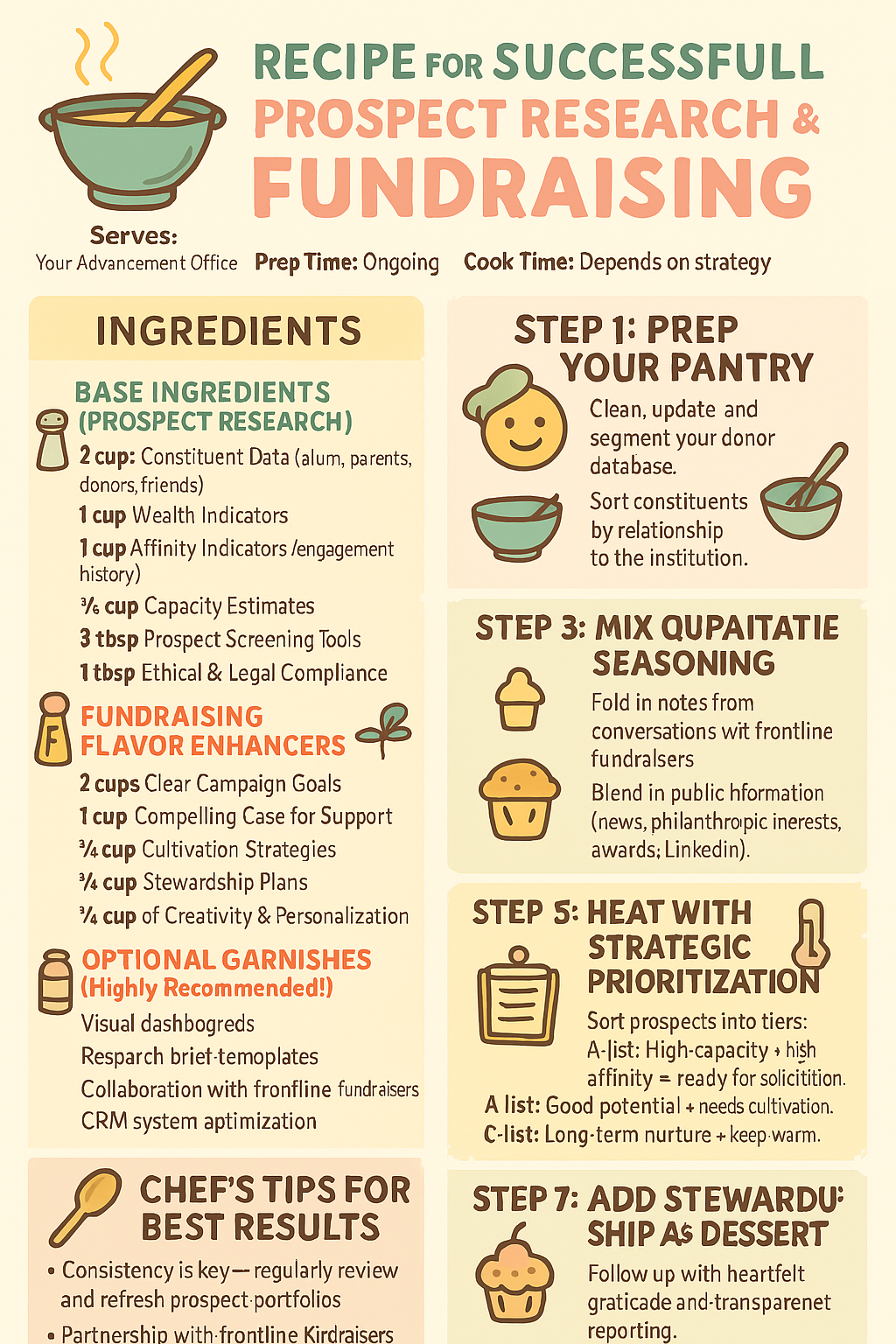
Welcome to the December edition of Fundraising Talks! Season’s greetings to all! As we enter the final weeks of 2025, nonprofits can build on the momentum of Giving Tuesday to carry that energy through the end of the year. Expressing gratitude to donors and sharing stories that highlight the impact of their generosity can inspire even more giving. This year’s Giving Tuesday results are impressive: $4 billion was donated in the U.S. by approximately 38.1 million participants. These numbers demonstrate the power of generous people coming together to create meaningful change. In 2025, we’ve heard a lot about the growing role of artificial intelligence across advancement teams. As we head into the festive season, I’d like to share a fun “recipe” created using ChatGPT, “Successful Prospect Research and Fundraising," along with a visual infographic designed by Microsoft Copilot. Enjoy!

Recipe for Successful Prospect Research & Fundraising

Serves: Your Advancement Office

Prep Time: Ongoing

Cook Time: Depends on strategy

Difficulty: Strategic and Rewarding


🧾 Ingredients

Base Ingredients (Prospect Research)

  • 2 cups Constituent Data (alumni, parents, donors, friends)
  • 1 cup Wealth Indicators
  • 1 cup Affinity Indicators (engagement history)
  • ½ cup Capacity Estimates
  • 3 tbsp Prospect Screening Tools
  • 1 tbsp Ethical & Legal Compliance
  • Fundraising Flavor Enhancers
  • 2 cups Clear Campaign Goals
  • 1 cup Compelling Case for Support
  • 1 cup Cultivation Strategies
  • ¾ cup Stewardship Plans
  • ½ cup Impact Stories
  • A dash of Creativity & Personalization
    

Optional Garnishes (Highly Recommended!)

  • Visual dashboards
  • Research brief templates
  • Collaboration with frontline fundraisers
  • CRM system optimization


🧑‍🍳 Instructions

Step 1: Prep Your Pantry (Data Organization)

Clean, update, and segment your donor database.

Sort constituents by relationship to the institution (alumni, parents, community, corporations).


Make sure you have access to reliable research tools (LexisNexis, iWave, donor surveys, wealth screenings, etc.).


Step 2: Mix Capacity + Affinity

Combine wealth indicators (real estate, business ownership, giving history, stock holdings)

with affinity indicators (event attendance, volunteerism, giving patterns, board connections).


Stir gently until a clear prospect profile begins to form.


Step 3: Add Qualitative Seasoning

Fold in notes from conversations with frontline fundraisers.

Add feedback from program staff or leadership.


Blend in public information (news, philanthropic interests, awards, LinkedIn).


This enhances flavor and ensures each prospect feels personalized—not generic.


Step 4: Heat with Strategic Prioritization

Sort prospects into tiers:

A-list: High capacity + high affinity → ready for solicitation.

B-list: Good potential → needs cultivation.

C-list: Long-term nurture → keep warm.


Let your frontline fundraisers “taste-test” the list and give final approval.


Step 5: Prepare the Fundraising Strategy

For each high-potential prospect, craft a menu of:

Cultivation ideas (meetings, tours, impact updates).

Ask amounts aligned with capacity.


Shared interests aligned with institutional priorities.

Build customized outreach plans — the flavor profile matters!


Step 6: Serve the Ask

Present a clear, compelling case for support.

Plate with precision — timing, relationship, and communication style matter.


Offer a suggested gift amount confidently and respectfully.


Step 7: Add Stewardship as Dessert

Follow up with heartfelt gratitude and transparent reporting.


Show the donor the impact of their gift.


Offer additional opportunities for engagement & continued connection.


This step is essential — it turns one-time donors into lifelong supporters.


🍽️ Chef’s Tips for Best Results

  • Consistency is key — regularly review and refresh prospect portfolios.
  • Partnership with frontline fundraisers makes the whole recipe stronger.
  • Storytelling warms the dish — people give to people, causes, and emotion.
  • Ethics > everything — accuracy and privacy matter.


If you have ideas for additional content, please let us know. As we look ahead to 2026, we remain grateful for the opportunity to provide research that serves as the foundation for fundraising, such as supporting donor identification, cultivation and solicitation strategies, and effective stewardship.


While S&P reports lower expectations for U.S. nonprofit higher education in 2026 due to changes in federal policy, enrollment declines, rising operating expenses, and frequent closures and consolidations, we are hopeful that advancement professionals will meet these challenges with resilience and innovative strategies.


Warmest wishes for a wonderful holiday season! As always, please feel free to reach out with questions, comments, or requests for assistance with fundraising research.


Best regards,


Sapna and the USM Advancement Research Team


How Donor-Advised Funds Shape Giving in Economic Downturns

Donor-advised funds (DAFs) now represent nearly one in four charitable dollars in the U.S., making them a defining force in philanthropy. A new CCS and Lilly School Fundraising report, Do Donor-Advised Funds Respond to Nonprofit Financial Distress?, reveals that while DAFs are resilient during economic downturns, their impact depends on visibility and not just volatility. During the pandemic, DAF grants to human services grew 20 percent faster than overall giving, but in the 2022 slowdown, support was more selective and favored nonprofits that clearly communicated financial need. Ultimately, perceived vulnerability drives donor action. Nonprofits that pair financial transparency with demonstrated impact can activate these pre-committed resources quickly. Looking ahead, strategies like assessing financial margins, embracing transparency, and converting crisis donors into long-term partners will help organizations thrive. Click here to read the full article.

Four Nonprofit Fundraising Innovations to Deepen Donor Relationships

At NonProfit POWER in Baltimore, attendees looked into how technology and creativity are reshaping fundraising. Key takeaways are that AI is emerging as a powerful tool to boost efficiency and insights, but experts stress that success depends on keeping a human touch and aligning teams around clear goals. Additionally, peer-to-peer fundraising continues to excel as a strategy for diversifying revenue and building community, with events like City of Hope’s Walk for Hope raising millions while creating mission-driven experiences. Speakers also emphasized emotional connection over clicks. Trust and simplicity are key to donor retention, and technology should amplify humanity, not replace it. Despite digital growth, direct mail remains a strong channel, especially when paired with compelling storytelling and personalization. Overall, NonProfitPRO's takeaway is that combining innovation with authentic engagement is the formula for sustainable fundraising success.

The Generosity Continues: Next Steps After GivingTuesday

GivingTuesday may be over, but nonprofits can sustain impact by prioritizing gratitude. Send personalized thank-you notes, share heartfelt messages, and highlight the difference each gift makes, advises the GivingTuesday blog. Transparency is key: showcase results with visuals, videos, and stories to keep donors connected and inspired. Continue engagement through follow-up events, exclusive updates, and reminders about year-end giving deadlines. Storytelling remains a powerful tool, as always. Focus on authentic, mission-driven narratives that spark emotion and action. Finally, reflect with your team, celebrate wins, and start planning for next year to turn GivingTuesday into a springboard for lasting generosity.

With Trump’s tax bill set to dent giving by the wealthy, can middle-class donors make up the difference?

New tax laws are expected to reduce charitable giving by wealthy donors in 2026, with economists projecting a $4.1 to $6.1 billion annual decline as top earners lose key deductions and see their tax benefit drop from 37 percent to 35 percent. While the bill introduces a new incentive for non-itemizers (allowing up to $1,000 in deductible cash donations) experts doubt smaller gifts will offset the shortfall from high-net-worth donors. The changes come amid a “K-shaped” economy, where overall giving has grown to $392 billion, but fewer Americans are donating as wealthier households dominate philanthropy. Analysts warn that economic uncertainty and rising costs could further strain everyday donors, even as policymakers hope to broaden participation. For now, advisors recommend accelerating donations before year-end and leveraging tools like DAFs or appreciated stock gifts to maximize tax benefits. As of now, it is unclear if these reforms will democratize giving or deepen the gap between major donors and everyone else.

AI Agents Took Over Giving Tuesday. Here’s What Comes Next

In the early hours of GivingTuesday, a nonprofit operations center braced for donations surging, inquiries flooding in, and staff scrambling to keep pace. But this year was different. An AI agent had worked through the night, answering questions, drafting records, and clearing bottlenecks before anyone arrived. As a result, the team stepped into a calm, controlled environment. This glimpse into the future shows how AI agents are quietly transforming GivingTuesday and redefining the way nonprofits work. Nonprofits are under pressure as donor expectations for rapid response and mobile engagement surge, especially during GivingTuesday’s $3.1 billion spike. AI agents are emerging as critical infrastructure, automating routine tasks like donor inquiries, volunteer matching, and reporting, which frees hundreds of staff hours for mission-focused work. Organizations like Blue Star Families and Pledge 1% report major efficiency gains, and are using platforms such as Salesforce to enable personalized donor support at scale. However, when adopting AI agents in nonprofit organizations, boards must address governance, data literacy, and ethical safeguards to ensure transparency and trust. Click here to read more.

Inconvenient Truths about Single Family Offices

Single family offices (SFOs) play a pivotal role in overseeing ultra-high-net-worth families’ assets, governance, and legacy planning. While they’re often linked to billion-dollar fortunes, recent research reveals disparities. In the U.S., the average SFO manages about $767 million in assets, yet the median is $476 million, and nearly 40 percent were launched by families worth $500 million or less. Operating costs and staffing levels differ significantly as well: median expenses hover around $1.4 million, and most offices employ five or fewer people. Many SFOs outsource critical functions such as investment management, legal, and accounting, which blurs the line between traditional and hybrid models. For prospect researchers, the presence of an SFO signals considerable wealth (typically $30 million+ in investable assets) and often a liquidity event, though size and structure require deeper context. As wealth management grows more complex, these offices will continue adapting by balancing in-house expertise with outsourcing to meet governance, investment, and philanthropic goals.