Also, with Victor Motti (Executive Director of the World Futures Studies Federation and Advisory Board Member of the CFC), I co-authored and published a new online book A Dialogue on Science Fiction: How to Achieve Planetary Wisdom through Future Consciousness. Available to read at Alternative Planetary Futures Institute.
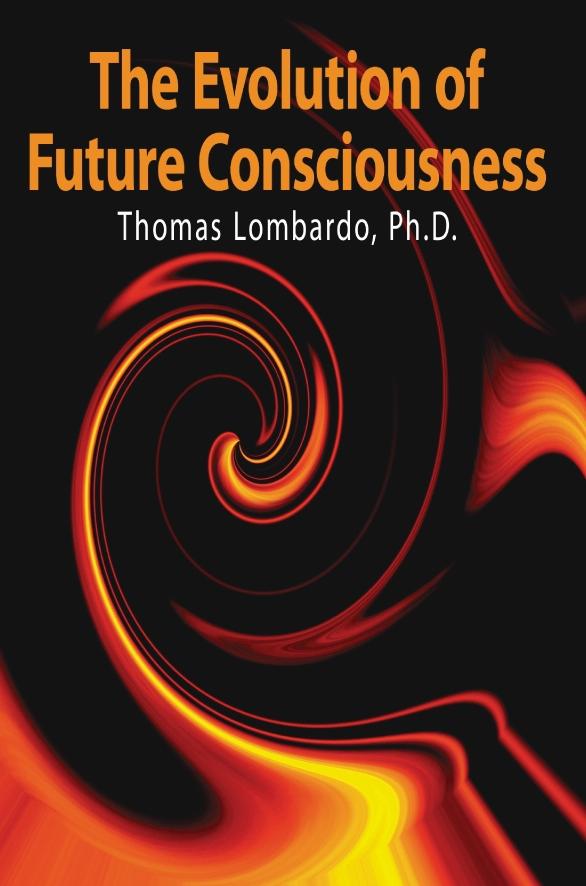
I also published three new articles in the WFSF magazine Human Futures: “Science Fiction During the Pandemic,” “Teaching Science Fiction as a Lens on the Future,” and “The Future Evolution of Consciousness.” All are available to read at theHuman Futures website.
Additionally, I published an essay “Imagination” in Mark Riva’s online Imagine magazine.
As preparatory steps toward a planned new book, I began a new series of online essays on “The Purposeful Evolution of Consciousness” (three published so far) in the CFC newsletter Future Consciousness Insights.
In 2021, I continued my Webinar Series (begun in 2020) on the “The Evolution of Science Fiction,” hosting and making available online eight new two-hour videos. All told, there are now 15 videos in this series that are available for viewing and more talks are scheduled for this coming year. As a central site for accessing and viewing all these webinar videos, Tery Spataro and the CFC created a new Video School.
In another video pulling together the topics of future consciousness and science fiction, I gave the opening guest lecture to futures studies students at Prince Mohammad Bin Fahd Center for Futuristic Studies on “Science Fiction and the Evolution of Future Consciousness”.
With my wife, Jeanne, I attended the WFSFglobal conference in Berlin, Germany in October, and participated in three events: A panel discussion on “Science Fiction and Futures Studies;” a dual-talk and dialogue with Linda Groff on “The Purposeful Evolution of Consciousness,” and an introductory presentation on my multi-volume history of science fiction series. An expanded version of my “The Purposeful Evolution of Consciousness” talk was subsequently presented as a webinar video and is available for viewing on YouTube.
I wish to thank all the many people who contributed in numerous ways to these events and accomplishments, including Tery Spataro, Victor Motti, Jeanne Lombardo, Erik Øverland, Debbie Aliya, Tim Mack, Leslie Combs, Claire Nelson, Alan Ross, Linda Groff, Mark Riva, Greg Moffitt, Rick Trowbridge, Hank Kune, Xerxes Voshmgir, Pouyan Bizeh, Kacper Nosarzewski, and Karlheinz Steinmüller.
Ongoing New Webinar in Science Fiction Series: The New Culture and the New Wave
Part one of my new webinar "The New Culture and the New Wave," which examines the evolution of science fiction from 1965 to the late 1970s, was offered on January 8th.
Part two of the webinar will be presented on January 29 at 12 pm EST. Registration details are below.
Here's an introduction to the content of the two part webinar:
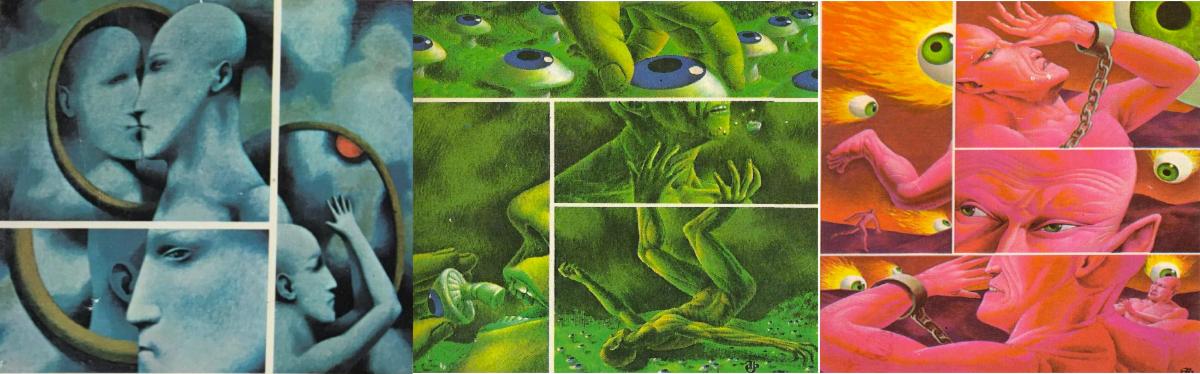
Although science fiction often attempts to anticipate the future, in the late 1960s science fiction reflected changes and new trends in human society at least as much as it foresaw them. The emerging pop counter-culture of the 1960s, which challenged traditional social norms and values, had a strong impact on science fiction, provoking a “New Wave” of revolutionary, even rebellious writers, avant-garde literary styles, and controversial narrative themes.
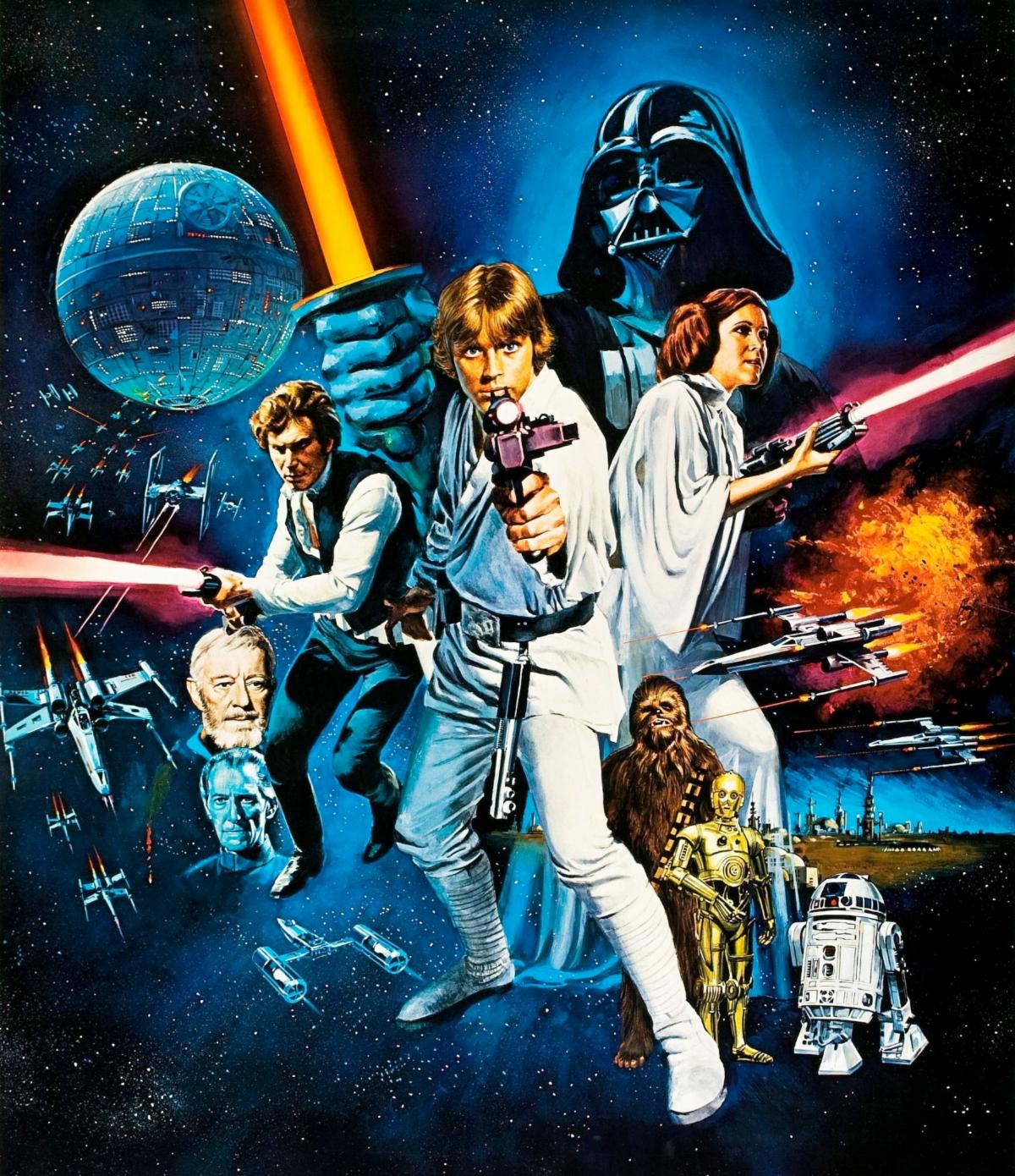
Science fiction became increasingly concerned with “inner space,” rather than outer space, and sexuality, gender, religion, spirituality, drugs, ethics, society, and psychology—all big concerns of the 60s culture—increasingly became the focus of New Wave science fiction. The Western ideal of unending materialistic-technological progress, attacked by the 60s culture, was severely critiqued by J. G. Ballard, a key figure of the New Wave, in his mesmeric tales of the catastrophic (such as The Crystal World and The Drowned World), and by John Brunner in his “Quartet of Dreadful Warnings,” notably in his Hugo winning Stand on Zanzibar. In his time-traveling retelling of the Crucifixion, Behold the Man, Michael Moorcock dove into the blasphemous. Harlan Ellison edited the ground-breaking Dangerous Visions and rewrote the story of the Garden of Eden in "The Deathbird;" he won the Hugo for his totally unnerving “I Have No Mouth and I Must Scream.” Philip Jose Farmer resurrected the dead—every last member of our species in To Your Scattered Bodies Go—and led the deep and at times perverse dive into science fiction sex in The Lovers, Flesh, and Strange Relations. The lyrical Roger Zelazny explored the mythic and the mystical in tales such as Lord of Light, and Robert Silverberg, one of the most popular and prolific writers of the era, went totally psychedelic and erotic in Son of Man, his novel of the far-future evolution of humanity. Joe Haldeman wrote the Vietnam-inspired, great anti-war, pot-infused Hugo-Nebula winning novel The Forever War, and in the movies Kubrick assaulted the senses, boggled the mind, and gleefully dove into hell—all done with great cinematic pizazz and aesthetics—in Dr. Strangelove, 2001, and A Clockwork Orange.
But perhaps the most significant development in the New Wave was the dramatic and powerful rise of women authors and feminist themes, beginning with Ursula Le Guin and her award winning The Left Hand of Darkness and The Dispossessed, and soon followed by Joanna Russ (The Female Man), the wondrous mystery man/woman James Tiptree, Jr. (“Love is the Plan, the Plan is Death”), and numerous other women writers and tales.
In the New Wave the mind-space of science fiction evolved.
Science Fiction: The Evolutionary Mythology of the Future
New Books:
Volumes Two and Three
An evolutionary and transformative journey through the history of science fiction, from ancient to contemporary times, exploring the innermost passions and dreams of the human spirit, the most expansive cosmic creations of thought and imagination, and the farthest reaches of the universe and beyond.
“Lombardo is just simply brilliant... you will feel overwhelmed.”
DR. ERIK ØVERLAND, President of the World Futures Studies Federation
* * *
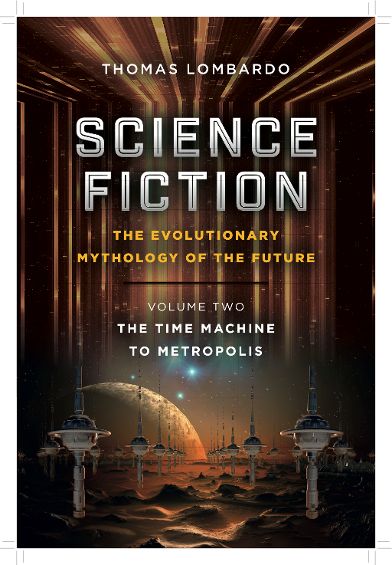
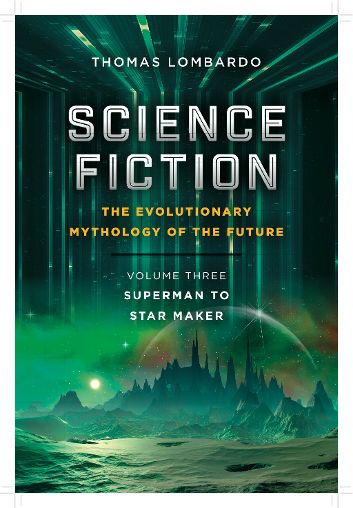
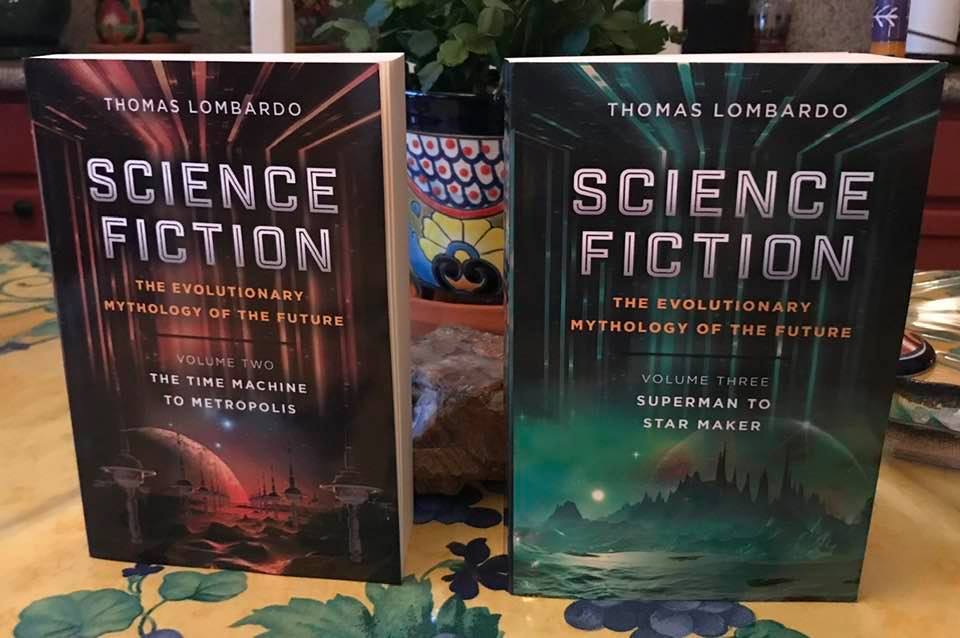
I am happy to announce the publication of two new volumes in my Science Fiction: The Evolutionary Mythology of the Future series:
Volume Two “The Time Machine to Metropolis”
Volume Three “Superman to Star Maker”
Both new volumes are available for purchase on Amazon, Barnes & Noble, and the Publisher’s website.
Continuing his in-depth evolutionary history of science fiction Tom Lombardo examines science fiction literature, art, cinema, and comics, and the impact of culture, philosophy, science, technology, and futures studies on the development of science fiction. These two new volumes also describe the reciprocal influence of science fiction on human society and the evolution of future consciousness.
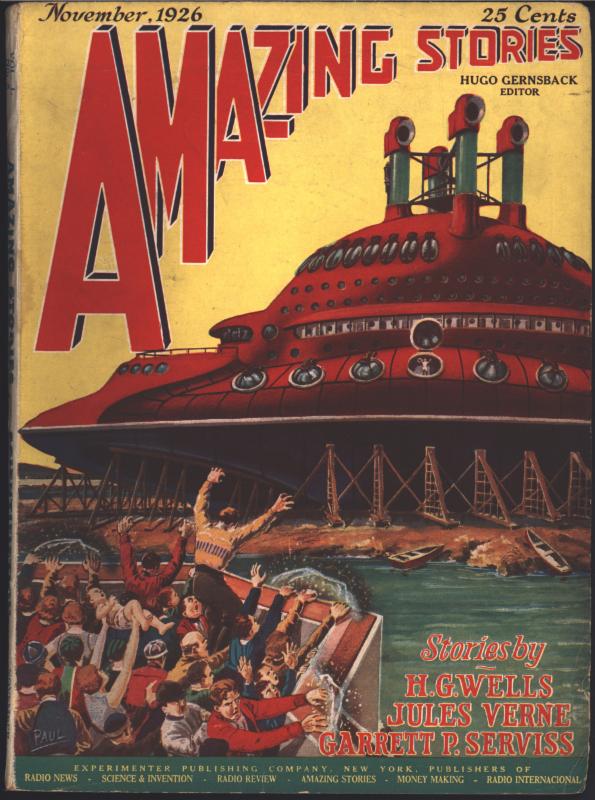
Volume Two covers the years 1895 to 1930, and includes an extensive discussion of H. G. Wells and his numerous science fiction novels and futurist publications. Also covered in-depth are Thea von Harbou and Fritz Lang’s classic silent movie Metropolis. Other key figures discussed in Volume Two include Méliès, Zamyatin, Gernsback, Burroughs, Merritt, Huxley, and Hodgson.
Volume Three primarily focuses on the 1930s, covering the phenomenon of Superman and key authors such as Čapek, Hamilton, “Doc” Smith, Campbell, Lovecraft, C. A. Smith, and Williamson. Volume Three concludes with an extensive philosophical examination of Olaf Stapledon’s Last and First Men and Star Maker.
Some of the key themes and topics addressed in the two volumes include: Dystopian and utopian visions of the future; the meaning of progress and the meaning of life; the future evolution of the human conscious mind and the possible emergence of psychic powers and collective forms of intelligence; the ethics and philosophy of space operas and super-heroes; technology, robots, and human society; technological intelligence; alien mentality and alien civilizations; time travel, time loops, and time wars; global war, catastrophes, and world-wide disasters; science and religion; fear and horror, and hope and wonder in science fiction; and the significance of the theory of evolution in the development of science fiction.
"It is unmistakably the best webinar presentation, consecutively viewed or singly viewed, that I have ever spent as a participant or a viewer. Ever!" Cedar Sarilo Leverett, MFA, Society of Consciousness Studies
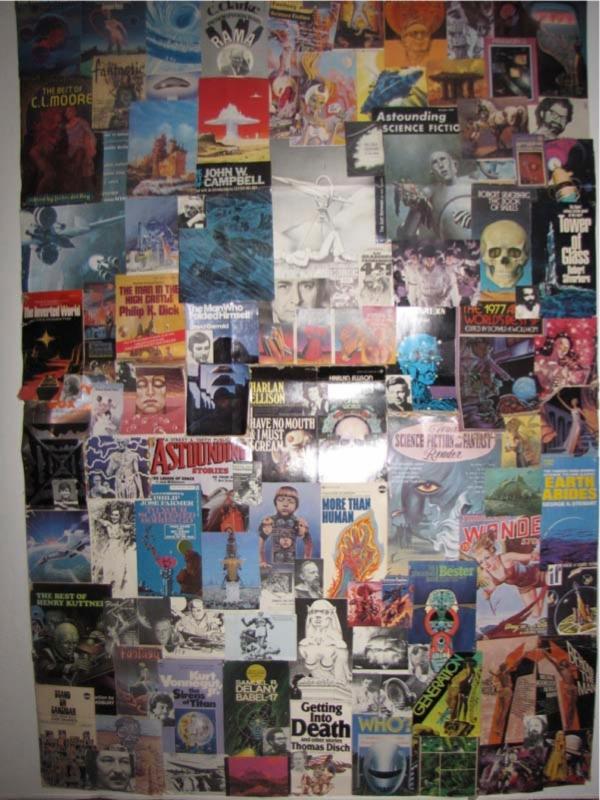
Combining colorful slide presentations and in-depth analysis, in these webinars, based on my book series Science Fiction: The Evolutionary Mythology of the Future, I examine the evolutionary history of science fiction from ancient to contemporary times. I delve into the mythological origins and dimensions of science fiction; fantasy versus science fiction; the rise of the modern scientific world view; utopias and dystopias through the ages; the Enlightenment, Romanticism, and Gothic horror; the impact of evolutionary theory on science fiction; Wells, Stapledon, and the integration of futures studies and science fiction; robots, techno-intelligence, and aliens; time travel and alternate realities; fantastical adventures, space exploration, and Space Operas; the Golden Age, the Silver Age, the New Wave, Feminist Science Fiction, Cyberpunk, Steampunk, and the "New Weird;" social, psychological, and religious science fiction; and numerous other key themes and dimensions of science fiction. Covering science fiction literature, art, cinema, and comics, I discuss in depth the appeal, value, and influence of science fiction on the modern world and the impact of intellectual and cultural trends on the evolution of science fiction.
To support our ongoing educational and publication efforts please DONATEto the Center for Future Consciousness.