A few days ago I emailed to colleagues and friends the following short statement:
“As you probably are doing as well, I am watching coverage of the horrendous and immensely depressing events occurring in our world. I am not saying simply the events in Ukraine, since although it is at the center of this cyclone of moral catastrophe, what is happening in this one country reflects the mentality of our current human planetary reality—the state of our “modern” civilization. And the evil and carnage being inflicted on this brave country is having a deep impact on the world as a whole. The ugliness, depravity, and tragic destructiveness permeates outward, invading and infecting all of our conscious minds. Although there is a pervasive and intense global counter-reaction to the stupidity and evil of the attack on Ukraine, at some point in our evolution perhaps we will collectively realize that “enough is enough,” and we will create a way to stop such horrible realities from gestating and occurring within human society.”
One of the recipients of the email, Victor Motti—President and CEO ofAlternative Planetary Futures Institute (ApFi)—asked me to expand my short statement into a blog post for the ApFi website. (I am a member of the Scientific Council for the ApFi.) Writing an expanded post makes perfect sense, since I emphasize in this statement that the Russian invasion and attack on Ukraine is not simply a regional catastrophe but rather a planetary problem requiring a planetary solution. (See ApFi Blog Post.)
It is the collective reality of humanity—the nations, cultures, organizations, businesses, and general population—that has afforded and allowed this horrendous event to materialize and occur. Of course, there is a cluster of individuals in Russia, led by one individual, who is fundamentally responsible for the Ukraine invasion, but we have fed (through trade and economic transactions), tolerated, and watched this monster grow, as we busied and occupied ourselves with other concerns.
The effects of this war—the psychological, social, and economic-physical impact—is worldwide. It has become an emotional trauma experienced across the globe, and the multi-faceted stress and upheaval will in all probability intensify and worsen in both the short- and long-term future. The disaster is rippling out across humanity, infecting the entire earth.
I have asked myself—and people I know have mirrored and reinforced this perplexity and frustration—why the world as a whole (for example, the United Nations) seems impotent at stopping this disaster. People in Ukraine keep getting killed every day, and towns keep getting decimated, and yet the best we seem able to do in response is to talk, debate, condemn, and impose sanctions. Of course, we are sending immense humanitarian aid to help the millions of refugees, and we are supplying the Ukrainians with weapons and military resources, but the bully is still bloodying women and children in front of the eyes of the world, and tragically and shamefully we cannot muster the planetary force, courage, and wherewithal to stop the bully from continuing his assault. A friend of mine pointed out that such disasters—of humanity’s inhumanity against itself—occur across the globe and have occurred throughout human history. This fact, though, only makes the current disaster so much worse; it is not an anomaly, but a repeated occurrence. It is a destructive and horrendous pattern of behavior that keeps happening.
When I reread my original statement, I realized that it was highly emotionally charged. We can, through various media and information sources, access the relevant up-to-date facts pertaining to this event; we can listen to or read various analyses and probabilistic projections and scenarios about where the whole thing could be heading; and we can ponder the reasons and causes behind the invasion and think about what it all means, but these are all cognitive approaches to the invasion. Of course it is important to understand, but what is really striking about this event and its local and planetary impact is the intense emotional response to it. This event is generating an incredible amount of human stress, hatred, fear, terror, anxiety, despair, depression, love and compassion, anger, and even visceral nausea. A big part of the meaning of this event is embodied in our emotional response, and a big part of what will move events in the future will be human emotions. The remarkable planetary outcry around the event is shaking the world. One cannot understand this event or understand where it will lead without taking into account the emotional dimension of this reality.
Another point of emphasis in my original short statement has to do with ethics. I described the invasion as an evil action. Although our national and global consciousness, and its numerous and varied expressions in our media, is permeated with multiple and often conflicting perspectives on reality and what is morally right and wrong, it seems that the invasion is unequivocally an evil act. Although we might hesitate to use the world “evil” to describe either human individuals or their actions, I believe that such an attitude is naive.
We have witnessed evil throughout human history. We need to acknowledge that this invasion and those who support it are embodiments of evil. We could say that the war is a political war, one of democracy versus authoritarianism, but responsible self-determination versus forceful subjugation of individuals, as political philosophies and practices, is fundamentally an ethical issue. Of course, the Russian government and media present an alternative narrative of what is occurring in Ukraine and the reasons and causes behind it, attempting to justify their actions. But it clearly appears that this alternative interpretation is grounded in numerous falsehoods. It is an ethical and political position built on lies. As such, is not ethical, for truth is foundational to any credible ethics. It is clear that the war in Ukraine is a struggle for good on a planetary scale against the threat of evil on a planetary scale.
Part of a planetary ethics should be a rejection of the forceful and violent subjugation of individuals or nations, as well as a universally practiced conscientious support of what is true. But a planetary ethics needs to embody other important values as part of a holistic vision of human well-being. Of special note, individual and collective human well-being must transcend a purely economic/materialistic vision of the good life. In this regard, watching the news on major TV networks, I have been repeatedly struck by the regular intrusion of commercials that are shallow and self-indulgent marketing ploys endeavoring to identify the “good life” as one found in the endless consumption of the advertiser’s products. The world might be falling apart, but luxury cars, techno-enhanced office chairs, cruises, cheeseburgers, deodorants, and drugs galore still get hammered into our consciousness—a perpetual trivial sea of pleasures and distractions. Especially at this point in time such bread and circuses seems totally oblivious to what deeply matters in life; it all seems ridiculous if not obscene. A good deal of our ethical failings at a global level is a consequence of prioritizing money, profit, and riches and the power it brings over a life of psychological and social well being for all of humanity. It is imperative that we establish a positive and effective ethical system for humanity at a planetary level which takes precedence in human affairs. The Russian invasion indicates that such a planetary ethical consciousness has not yet emerged worldwide
When is enough going to be enough?
Thomas Lombardo
Director of the Center for Future Consciousness
Board Member and Fellow of the WFSF
Board Member of the ApFi Scientific Council
New Webinar in Science Fiction Series:
How Science Fiction Conquered the World - the 1980s
Announcing a new two-part webinar in my "Evolution of Science Fiction" series:
Dates and times: April 16th and April 30th (Saturdays) - 10 am to 12 noon - Arizona Time
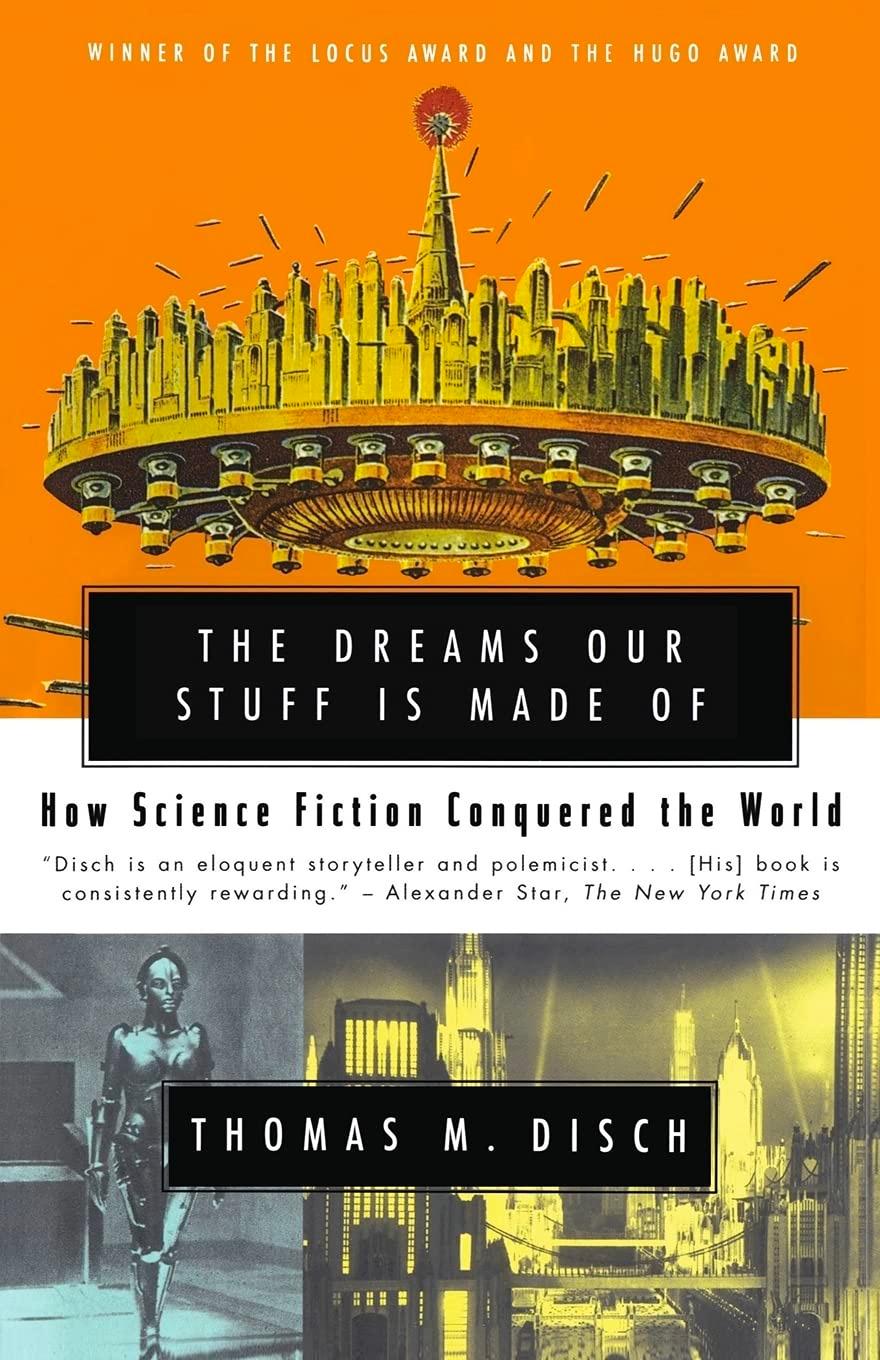
Beginning in the late 1970s and continuing through the 1980s, “Science Fiction Conquered the World.” This quote, taken from Thomas Disch’s book The Dreams Our Stuff is Made Of, dramatically summarizes how science fiction came to dominate pop culture during this period. This rise in influence was notably triggered through the movies. With the appearance of blockbuster, visually spectacular movies, such as Star Wars, Close Encounters, Superman, and E.T., science fiction films catapulted to the top of the list of the biggest money-making cinematic productions of all time, and continue to hold the lion’s share of top positions in revenue and number of views up to the present time.
Further, ignited by the success of science fiction movies, a great wave of commercialization and science fiction consumerism arose, with record-breaking sales in toys, gadgets, costumes, action figures, art, collectibles, and assorted paraphernalia. Science fiction became super-big business, integral to the fantasy and play of children and many adults.
In the 1980s there were more new science fiction movies produced than ever before, including such classics as Alien, Brazil, Bladerunner, Tron, and Akira; there were many new science fiction TV shows and Star Trek was resurrected with a “new generation;” there was a continued increase in conventions (including the hugely attended Trekkie conventions), and there were new science fiction awards established. Science fiction art and graphics diversified and flourished, penetrating into mainstream culture. We decorated the world with science fiction.
Within science fiction literature, a number of epochal and expansive book series appeared, including David Brin’s bio-tech Uplift novels, such as Startide Rising and The Uplift War; Orson Scott Card’s inspiring tales of Ender Wiggin, including Ender’s Game and Speaker for the Dead; John Varley’s wildly bizarre Gaean Trilogy of an insane planetary-size intelligence; C. J. Cherryh’s massive Union-Alliance saga; the immensely popular, highly comical The Hitchhiker’s Guide to the Galaxy novels by Douglas Adams; and Gene Wolfe’s colossal, deeply imaginative and intricate work of the far distant future The Book of the New Sun.
Aside from C. J. Cherryh and her Hugo winning novels Downbelow Station and Cyteen—within her Union-Alliance saga—other notable women science fiction writers and their award winning novels in this period include Vonda McIntryre’s Dreamsnake, Joan Vinge’s The Snow Queen, and Margaret Atwood’s The Handmaid’s Tale.
Yet science fiction and popular culture perhaps most powerfully interacted, creating a new hi-tech, future-focused social landscape, with the emergence and spreading influence of cyberpunk in the mid to late 1980s. Informed and inspired by rapid contemporary developments in a multitude of “cutting edge” technologies—especially computers, robots, virtual reality, biotechnology, psychopharmacology, the Internet, and web communication—the cyberpunk movement in science fiction, transcending outer space, jumped into cyberspace and would have a powerful, multi-faceted impact on global consciousness.
Through such books as William Gibson’s Neuromancer, Bruce Sterling’s Islands in the Net and Mirrorshades, Rudy Rucker’s Mondo 2000 and The Ware Tetralogy, and Neal Stephenson’s Snow Crash, cyberpunk literature and mentality both reflected social and technological trends in contemporary culture, and powerfully intensified and directed those trends, helping to turn the modern world into a science fiction reality.
Science Fiction: The Evolutionary Mythology of the Future
New Books:
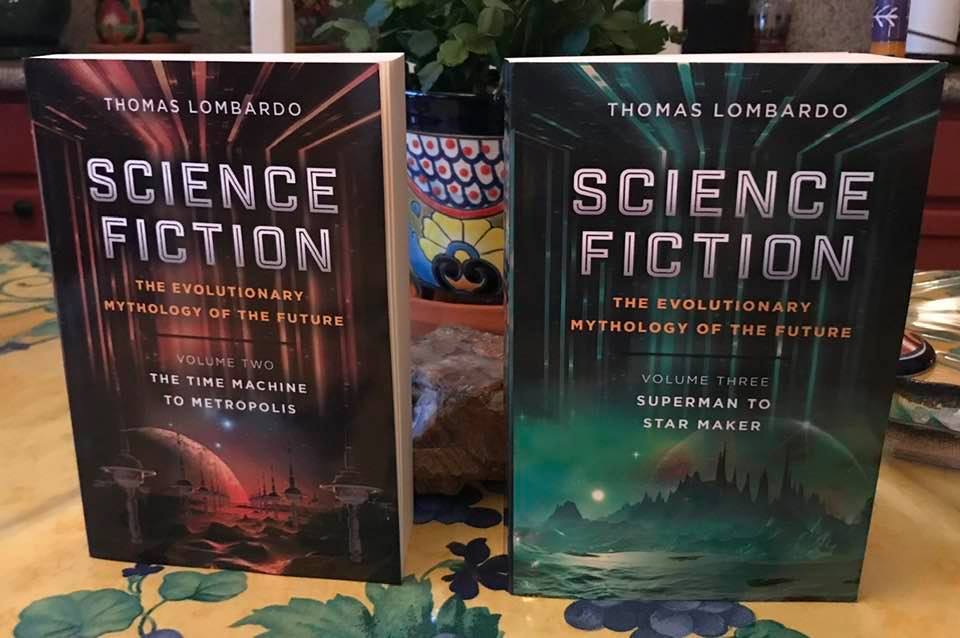
Volumes Two and Three
An evolutionary and transformative journey through the history of science fiction, from ancient to contemporary times, exploring the innermost passions and dreams of the human spirit, the most expansive cosmic creations of thought and imagination, and the farthest reaches of the universe and beyond.
“Lombardo is just simply brilliant... you will feel overwhelmed.”
DR. ERIK ØVERLAND, President of the World Futures Studies Federation
* * *
I am happy to announce the publication of two new volumes in my Science Fiction: The Evolutionary Mythology of the Future series:
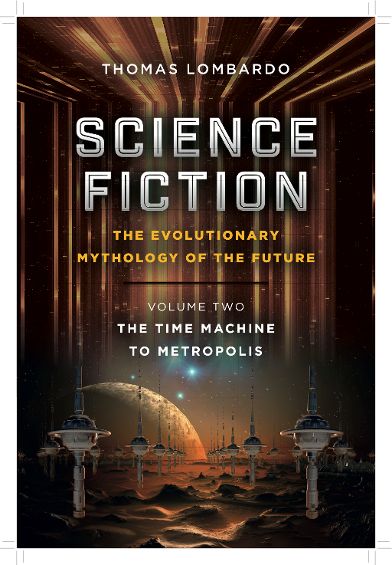
Volume Two “The Time Machine to Metropolis”
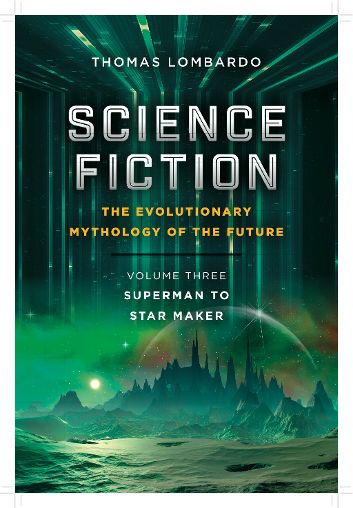
Volume Three “Superman to Star Maker”
Both new volumes are available for purchase on Amazon, Barnes & Noble, and the Publisher’s website.
Continuing his in-depth evolutionary history of science fiction Tom Lombardo examines science fiction literature, art, cinema, and comics, and the impact of culture, philosophy, science, technology, and futures studies on the development of science fiction. These two new volumes also describe the reciprocal influence of science fiction on human society and the evolution of future consciousness.
Volume Two covers the years 1895 to 1930, and includes an extensive discussion of H. G. Wells and his numerous science fiction novels and futurist publications. Also covered in-depth are Thea von Harbou and Fritz Lang’s classic silent movie Metropolis. Other key figures discussed in Volume Two include Méliès, Zamyatin, Gernsback, Burroughs, Merritt, Huxley, and Hodgson.
Volume Three primarily focuses on the 1930s, covering the phenomenon of Superman and key authors such as Čapek, Hamilton, “Doc” Smith, Campbell, Lovecraft, C. A. Smith, and Williamson. Volume Three concludes with an extensive philosophical examination of Olaf Stapledon’s Last and First Men and Star Maker.
Some of the key themes and topics addressed in the two volumes include: Dystopian and utopian visions of the future; the meaning of progress and the meaning of life; the future evolution of the human conscious mind and the possible emergence of psychic powers and collective forms of intelligence; the ethics and philosophy of space operas and super-heroes; technology, robots, and human society; technological intelligence; alien mentality and alien civilizations; time travel, time loops, and time wars; global war, catastrophes, and world-wide disasters; science and religion; fear and horror, and hope and wonder in science fiction; and the significance of the theory of evolution in the development of science fiction.
"It is unmistakably the best webinar presentation, consecutively viewed or singly viewed, that I have ever spent as a participant or a viewer. Ever!" Cedar Sarilo Leverett, MFA, Society of Consciousness Studies
Combining colorful slide presentations and in-depth analysis, in these webinars, based on my book series Science Fiction: The Evolutionary Mythology of the Future, I examine the evolutionary history of science fiction from ancient to contemporary times. I delve into the mythological origins and dimensions of science fiction; fantasy versus science fiction; the rise of the modern scientific world view; utopias and dystopias through the ages; the Enlightenment, Romanticism, and Gothic horror; the impact of evolutionary theory on science fiction; Wells, Stapledon, and the integration of futures studies and science fiction; robots, techno-intelligence, and aliens; time travel and alternate realities; fantastical adventures, space exploration, and Space Operas; the Golden Age, the Silver Age, the New Wave, Feminist Science Fiction, Cyberpunk, Steampunk, and the "New Weird;" social, psychological, and religious science fiction; and numerous other key themes and dimensions of science fiction. Covering science fiction literature, art, cinema, and comics, I discuss in depth the appeal, value, and influence of science fiction on the modern world and the impact of intellectual and cultural trends on the evolution of science fiction.
To support our ongoing educational and publication efforts please DONATEto the Center for Future Consciousness.