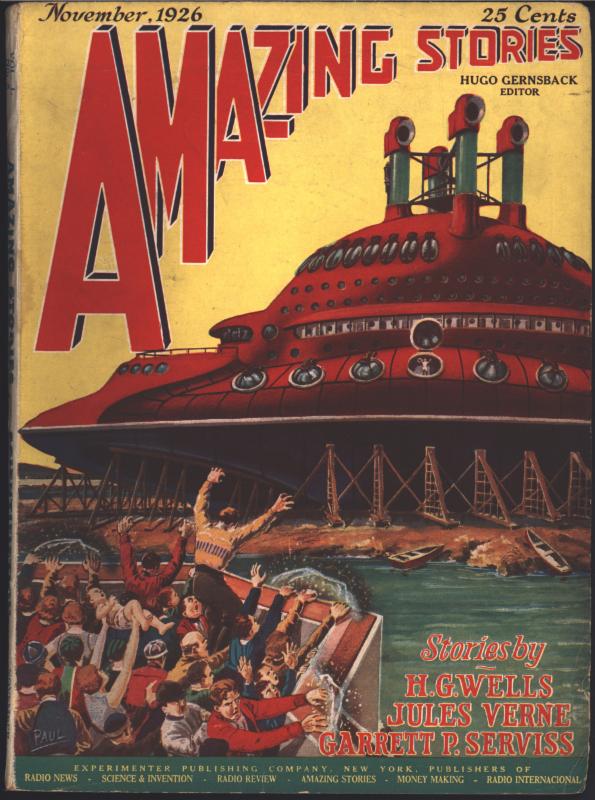
After taking a summer break, this fall the evolution of science fiction webinar series will continue, beginning with "The 1990s: The Farthest Reaches of Space, Time, and Mind." The webinars on the 1990s will be offered on October 15 and November 5 at 10 am to 12 noon Arizona time.
Here's a introductory description of both parts one and two:
In the 1990s science fiction literature expands outward into the farthest reaches of space, time, and mind. The depth and breadth of science fiction novels ascends to new levels in world-building, universe-building, and cosmic speculation. In a trend that began in the 1980s, novels get bigger, more intellectually intricate and mind-stretching.
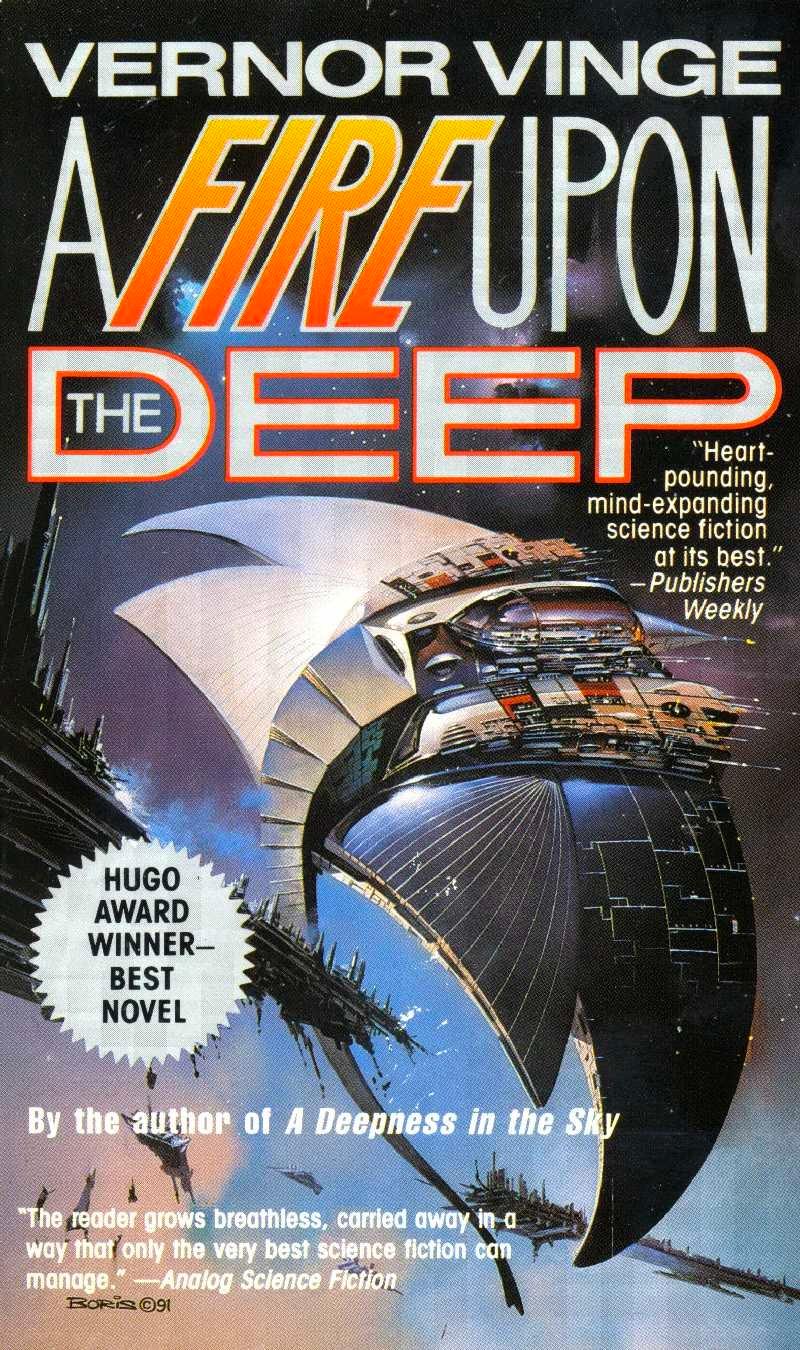
Setting new literary and imaginary standards along these lines, Dan Simmons’ Hyperion Cantos—modeled on Chaucer’s Canterbury Tales—delves into the “future of everything” a thousand years from now; we encounter the “Second Coming,” human immortality, and resurrection through time travel. Vernor Vinge, who first popularized the concept of the “technological singularity,” won Hugo awards for his grand space adventures in the Milky Way and his fantastical aliens in A Fire Upon the Deep and A Deepness in the Sky. In Blood Music, Eon, Queen of Angels, and Darwin’s Radio Greg Bear dives into the foundations of consciousness, madness, and the evolutionary transcendence of contemporary humanity. Kim Stanley Robinson, in his Mars Trilogy (Red Mars, Green Mars, Blue Mars), writes the best books ever on the settlement of Mars, comprehensive, highly realistic utopian visions of the terra-forming of another world. With amazing literary flair, Michael Bishop, in a great American novel on baseball, retells the story of Frankenstein in his Brittle Innings. Greg Egan—a powerhouse scientific-mathematical intellect—creates virtual minds, virtual universes, and virtual gods in his evolutionary epochs Permutation City, Diaspora, and Schild's Ladder. And perhaps at the zenith of contemporary speculation and scientific extrapolation, Stephen Baxter tells and retells the story of the universe from beginning to end multiple times in his Xeelee Saga, the Manifold Trilogy, Evolution, and The Time Ships.
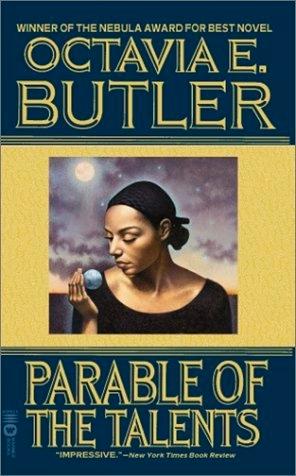
There were also numerous thought-provoking and highly engaging women authors, creating many famous novels of the time, such as Octavia Butler and her tales of cultural disaster, struggle, and pain, Parable of the Sower and Parable of the Talents; five-time Hugo winner Lois McMaster Bujold and her multi-volume space-opera the Vorkosigan Saga; Sheri Tepper and her novel Grass, a “masterwork” of ecological mystery and authoritarian religion; and Nancy Kress and her biotechnological evolutionary novel Beggars in Spain.
Also during this period, Steampunk—a multi-faceted, rambunctious, and inventive new literary and cultural movement—emerged and began to rewrite history, redesign reality, and redirect the future.
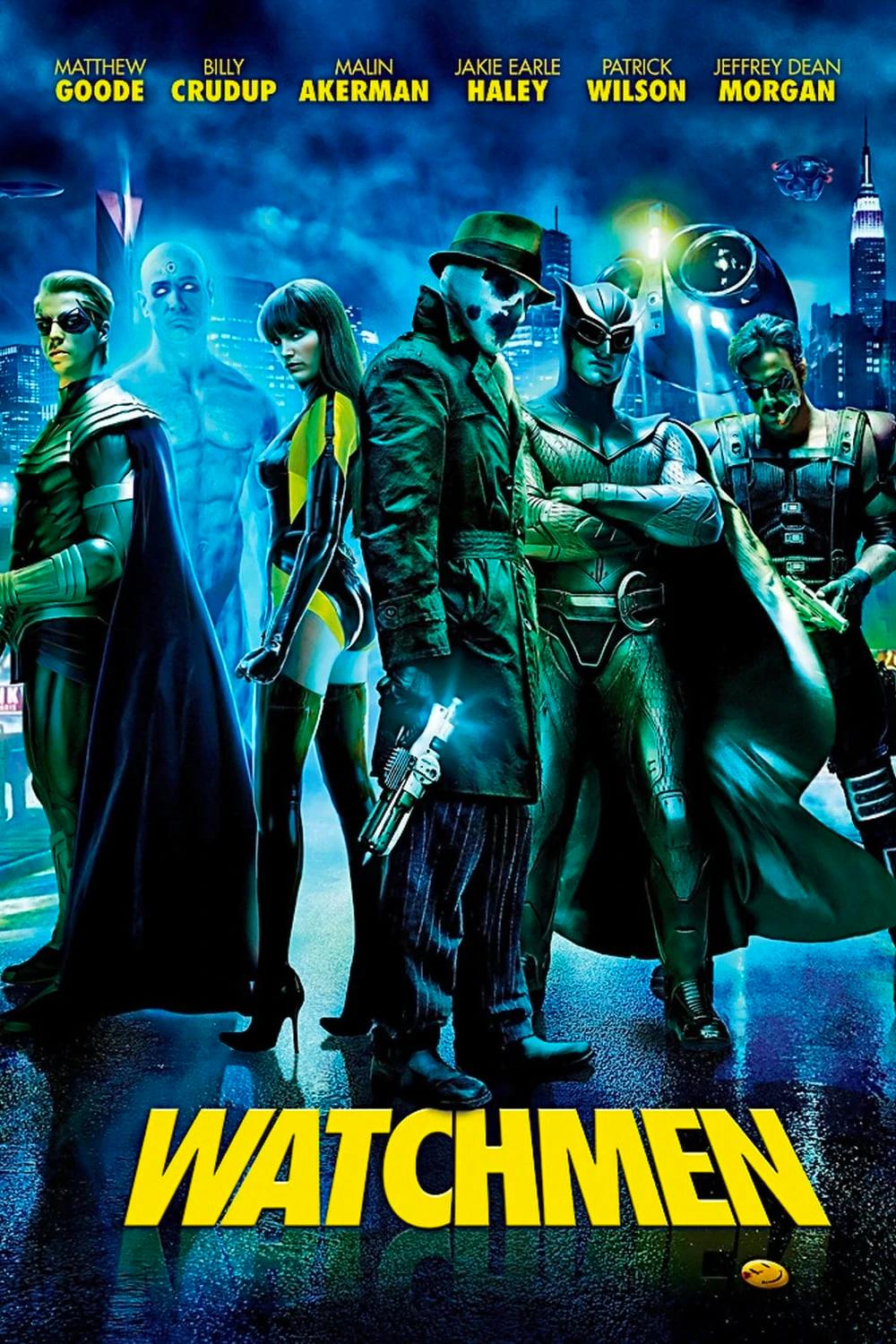
Science fiction in the 1990s continued to dominate the cinema, with such notable films as The Matrix, Jurassic Park, Independence Day, The Fifth Element, Contact, Twelve Monkeys, and Terminator: Judgment Day. Programmed entirely with science fiction movies and series, the Sci-Fi Channel appeared in the 1990s, leading the way to a much more pervasive presence of science fiction on TV. Finally, building on the great success of Akira, Sandman, and the phenomenal Watchmen—one of the great novels of the twentieth century—science fiction graphic novels exploded in popularity.
Without question, science fiction significantly evolved in the 1990s.
The Future Ages of Collective Awakening
The Alternative Planetary Futures Institute recently conducted an integrative survey of members of its Scientific Council--of which I am a member--and other global futurists regarding current trends and future possibilities of our planetary level human civilization. Victor Motti--Director of the APFI and Board Member of Center for Future Consciousness--created a fascinating and information-rich slide show presentation based on the views collected in this survey.
"Weak and strong signals, from diverse and independent sources, point to an imminent global consciousness, suggesting spirit, mind, and ethical revolutions. On the horizon, we observe a new rush hour of the prophets, ideologies, and cults calling for first values and first principles. In 2100 the planetary consciousness will push machine-humanity towards increasing freedom. In 3000, at the dawn of the cosmic age, the myth of the sacred rock will be re-defined around the entire planet Earth."
New Book
Essays on the Future of Psychology and Consciousness
Thomas Lombardo
Announcing the publication of my new book Essays on the Future of Psychology and Consciousness.
The book is available in paperback and can be purchased at Amazon:
Spanning over twenty years of inquiry, teaching, and writing in futures studies, psychology, philosophy, and science fiction these essays comprehensively address a critically important issue regarding the future of humanity. How may human psychology and human consciousness transform and evolve in the future? Of special significance, what are the preferable and desirable directions for our psychological and conscious evolution? The broad array of topics covered in these essays include: Psychological growth versus stagnation; coping with rapid and accelerative social and technological change; developing a globally-expansive and fluid sense of self-identity; Western and Eastern views of the human self and human society; the primacy and mystery of consciousness; the technological augmentation of the human mind; men and women and masculine and feminist mindsets; education for the mind of the future; the evolution of the science of psychology; pop psychology and the ongoing transformation of mental health and mental illness; technological immersion, virtual reality, and wise cyborgs; emotion, thinking, imagination, creativity, and human virtues with an eye on the future; ethics, evil, and disasters in the future; creating wisdom narratives for the future; the wise society; the centrality of consciousness of the future in the future evolution of consciousness; science fiction visions of the future of the human mind; and ecological and cosmic consciousness.
Advance Praise for Essays on the Future of Psychology and Consciousness:
“The interesting thing about Tom Lombardo is his ability to combine a futurist perspective with knowledge and wisdom from different professions. This collection of outstanding essays address nothing less than the future of human psychology. Overwhelmed by the richness of perspectives and insights combined with a futures approach, you feel honored and grateful at the same time. Just simply a brilliant collection of essays by one of the world leading futurists!”
Dr. Erik F. Øverland, President, World Futures Studies Federation
“Essays on the Future of Psychology and Consciousness, together with the other contributions in Tom Lombardo’s wide-ranging oeuvre, stands head and shoulders above most writings by more conventional professional futurists. It is well worthwhile.”
Oliver Markley, Ph.D., Professor Emeritus and former Chair, Graduate Program in Studies of the Future, University of Houston- Clear Lake
“Since the pandemic, the issue of mental health has erupted in businesses, schools, and the healthcare system. At the same time, digitalization, the transformation of work and family, social networks, and the Alien Gen all point to profound changes in the human mind. This new and brilliant book by Professor Lombardo, therefore, arrives at the right time to structure this reflection and it should meet a very large audience, well beyond the thinkers of the future, his usual aficionados.”
Fabienne Goux-Baudiment, CEO of proGective, Research Centre for Futures Studies, Former President of the World Futures Studies Federation
“A superbly written encyclopedia of futures studies approached from the lens of psychology, which opens your mind to the fascinating mystery of consciousness and the epic story of cosmic evolution.”
Victor V. Motti, President and CEO, Alternative Planetary Futures Institute (APFI), Washington DC, and Executive Director of the World Futures Studies Federation
Update: The Evolution of Science Fiction Webinar Series
"It is unmistakably the best webinar presentation, consecutively viewed or singly viewed, that I have ever spent as a participant or a viewer. Ever!" Cedar Sarilo Leverett, MFA, Society of Consciousness Studies
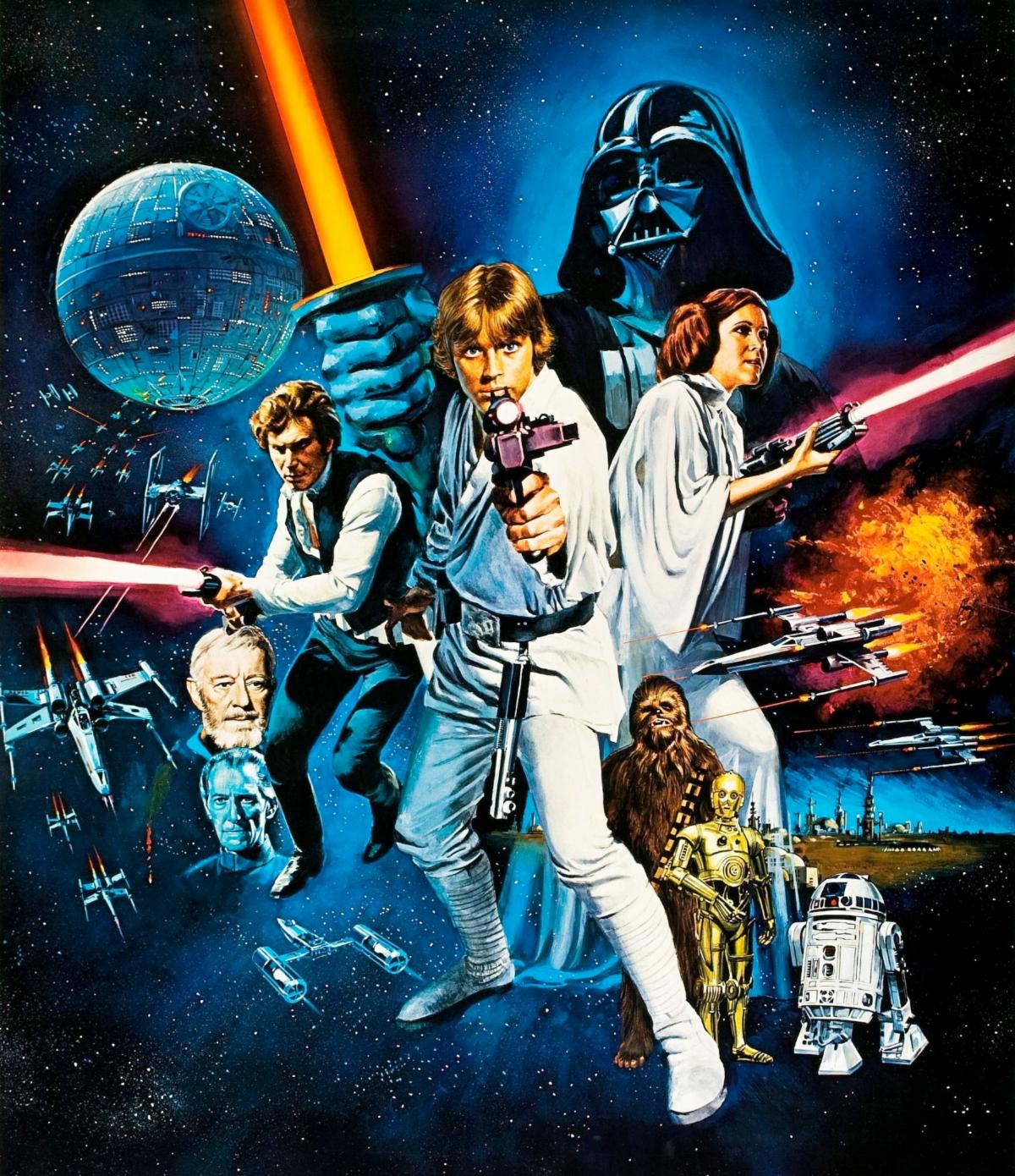
Having completing in May, 2022 the three-part webinar on "The 1980s: From Star Wars through Cyberpunk - How Science Fiction Conquered the World," the entire Evolution of Science Fiction Webinar series produced thus far from ancient myth and fantasy up through the 1980s, and concluding with Neal Stephenson's Snow Crash and The Diamond Age, is now available for viewing--as roughly 20 individual video presentations--on the Center for Future Consciousness Video School website.
For those unfamiliar with the Evolution of Science Fiction webinars, here's an introduction to the entire series:
"Combining colorful slide presentations and in-depth analysis, in these webinars, based on my book series Science Fiction: The Evolutionary Mythology of the Future, I examine the evolutionary history of science fiction from ancient to contemporary times. I delve into the mythological origins and dimensions of science fiction; fantasy versus science fiction; the rise of the modern scientific world view; utopias and dystopias through the ages; the Enlightenment, Romanticism, and Gothic horror; the impact of evolutionary theory on science fiction; Wells, Stapledon, and the integration of futures studies and science fiction; robots, techno-intelligence, and aliens; time travel and alternate realities; fantastical adventures, space exploration, and the emergence of Space Operas; the Golden Age, the Silver Age, the New Wave, Feminist Science Fiction, Cyberpunk, Steampunk, and the "New Weird;" social, psychological, and religious science fiction; and numerous other key themes and dimensions of science fiction. Covering science fiction literature, art, cinema, and comics, I discuss in depth the appeal, value, and influence of science fiction on the modern world and the impact of intellectual and cultural trends on the evolution of science fiction."
Science Fiction: The Evolutionary Mythology of the Future
New Books:
Volumes Two and Three
An evolutionary and transformative journey through the history of science fiction, from ancient to contemporary times, exploring the innermost passions and dreams of the human spirit, the most expansive cosmic creations of thought and imagination, and the farthest reaches of the universe and beyond.
“Lombardo is just simply brilliant... you will feel overwhelmed.”
DR. ERIK ØVERLAND, President of the World Futures Studies Federation
* * *
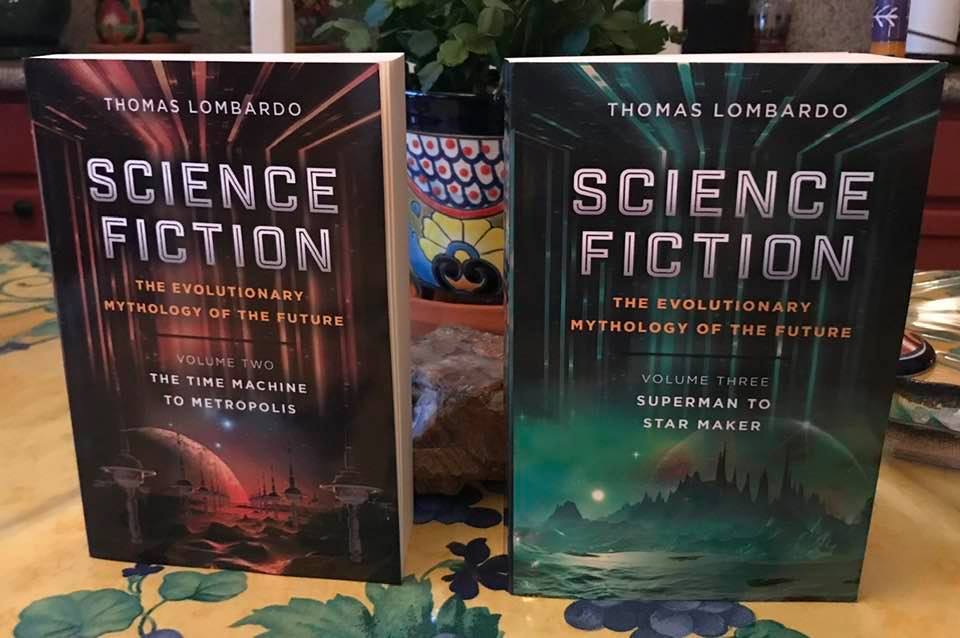
I am happy to announce the publication of two new volumes in my Science Fiction: The Evolutionary Mythology of the Future series:
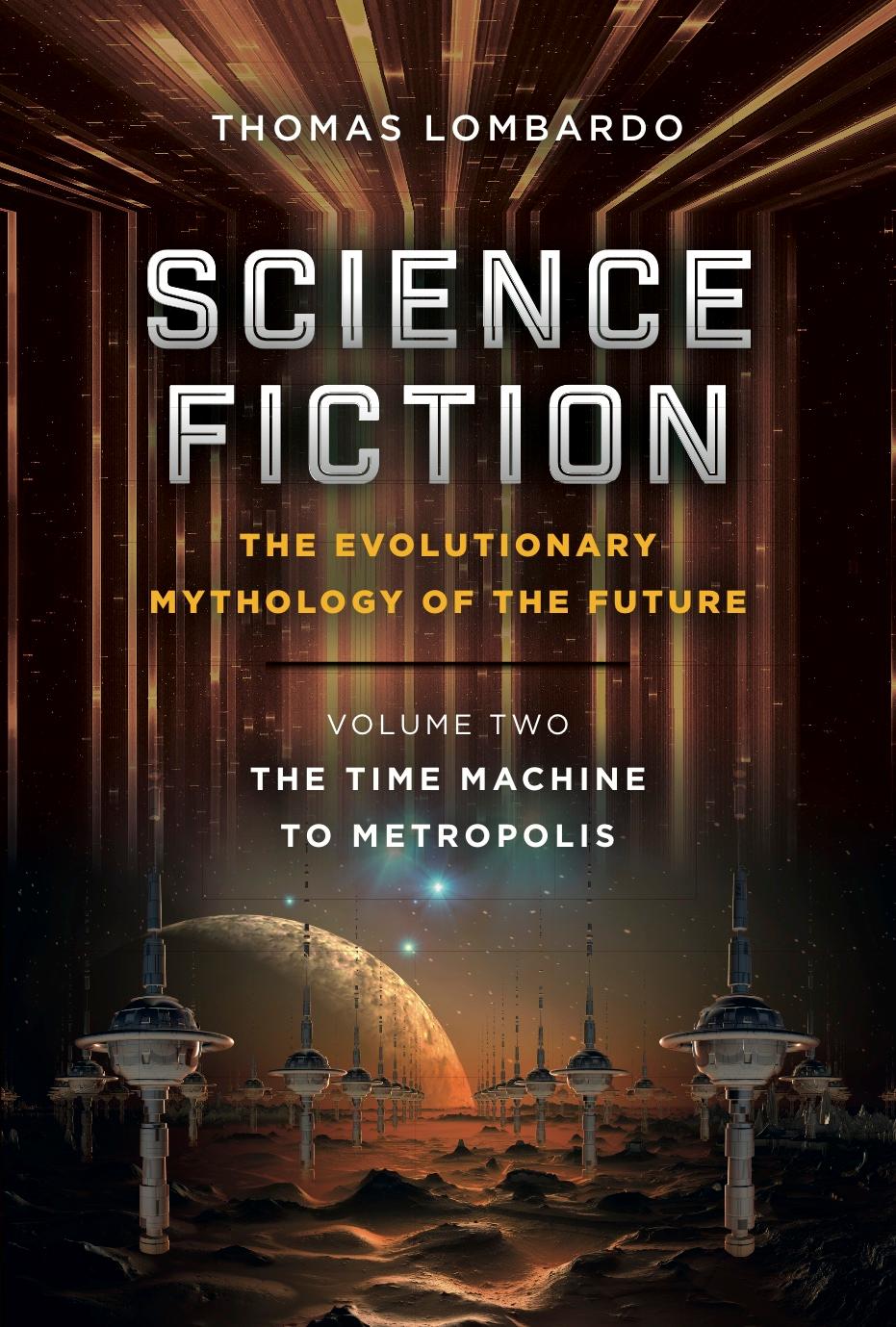
Volume Two “The Time Machine to Metropolis”
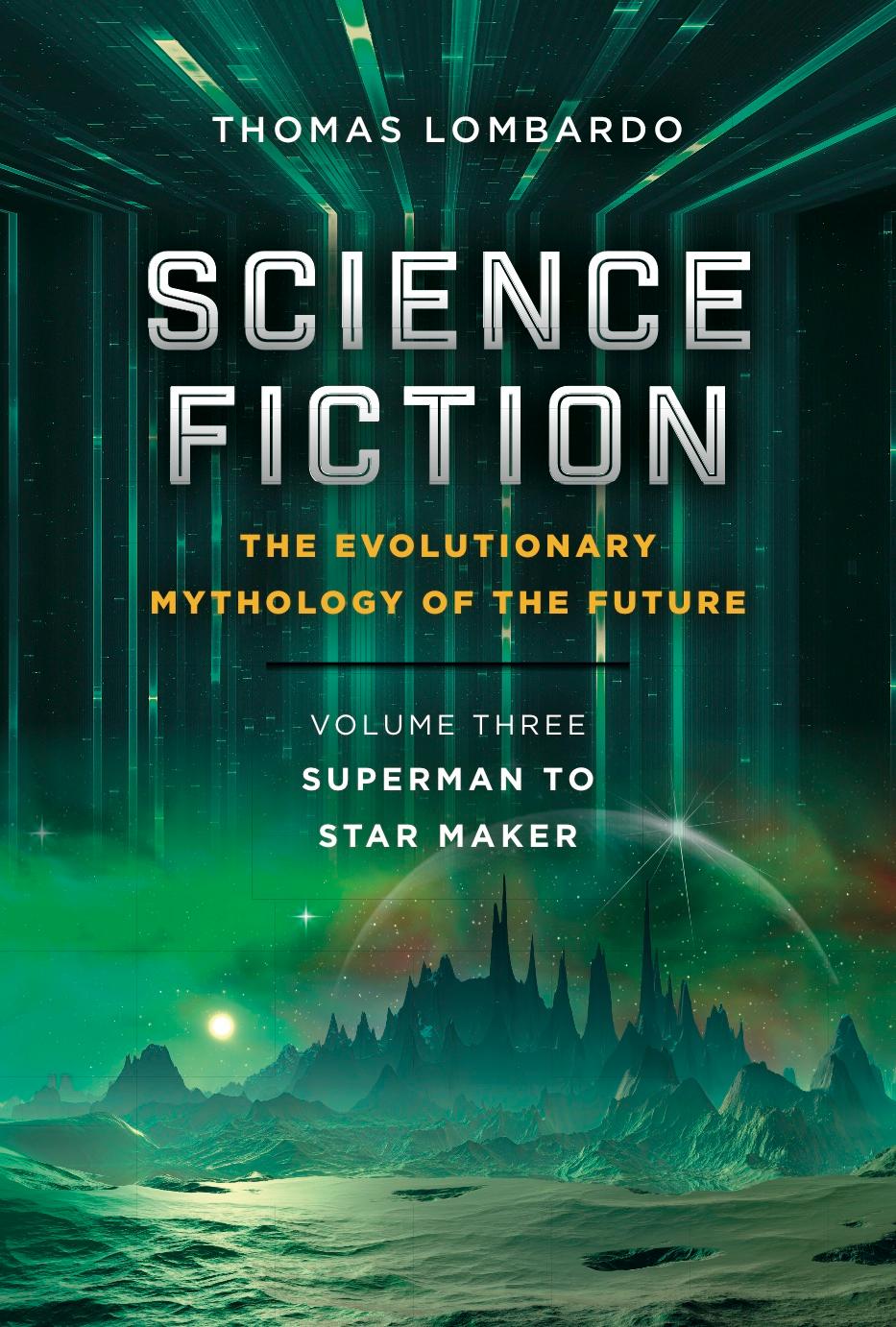
Volume Three “Superman to Star Maker”
Both new volumes are available for purchase on Amazon, Barnes & Noble, and the Publisher’s website.
Continuing his in-depth evolutionary history of science fiction Tom Lombardo examines science fiction literature, art, cinema, and comics, and the impact of culture, philosophy, science, technology, and futures studies on the development of science fiction. These two new volumes also describe the reciprocal influence of science fiction on human society and the evolution of future consciousness.
Volume Two covers the years 1895 to 1930, and includes an extensive discussion of H. G. Wells and his numerous science fiction novels and futurist publications. Also covered in-depth are Thea von Harbou and Fritz Lang’s classic silent movie Metropolis. Other key figures discussed in Volume Two include Méliès, Zamyatin, Gernsback, Burroughs, Merritt, Huxley, and Hodgson.
Volume Three primarily focuses on the 1930s, covering the phenomenon of Superman and key authors such as Čapek, Hamilton, “Doc” Smith, Campbell, Lovecraft, C. A. Smith, and Williamson. Volume Three concludes with an extensive philosophical examination of Olaf Stapledon’s Last and First Men and Star Maker.
Some of the key themes and topics addressed in the two volumes include: Dystopian and utopian visions of the future; the meaning of progress and the meaning of life; the future evolution of the human conscious mind and the possible emergence of psychic powers and collective forms of intelligence; the ethics and philosophy of space operas and super-heroes; technology, robots, and human society; technological intelligence; alien mentality and alien civilizations; time travel, time loops, and time wars; global war, catastrophes, and world-wide disasters; science and religion; fear and horror, and hope and wonder in science fiction; and the significance of the theory of evolution in the development of science fiction.
To support our ongoing educational and publication efforts please DONATEto the Center for Future Consciousness.